
Entry
Reader's guide
Entries A-Z
Subject index
Person/Situation (Environment) Assessment
Introduction
This entry gives an overview of the importance of person/situation interaction for the psychological assessment of either persons or situations, and provides guidelines for the assessment of person/situation interaction.
Any individual's specific behaviour such as a stress reaction varies across situations and can be graphically represented as an intraindividual situation profile of that behaviour. A behaviour shows a person/situation interaction if different individuals vary differently across situations in that behaviour (graphically: their situation profiles are not parallel). In such a case, the interindividual differences within situations are not consistent across situations; hence the behaviour correlates lower than 1 between the situations.
Figure 1 illustrates three typical cases: (a) no person/situation interaction between situations 1, 2 (note that the curves of the two individuals differ, however, in the level of the behaviour); (b) ordinal person/situation interaction between situations 2, 3 due to a ceiling effect (the interindividual rank-order is constant across situations but the sizes of the interindividual differences vary); (c) disordinal person/situation interaction between situations 3, 4 (the interindividual rank-order varies across situations; graphically, the profiles cross).
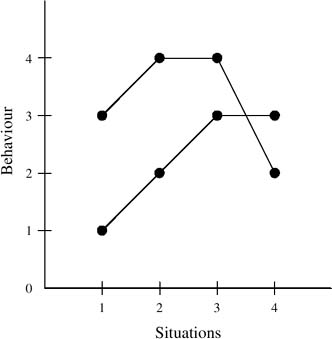
Figure 1. Three typical cases of (no) person/situation interaction. The two curves refer to two individuals (see text).
Importance of Person/Situation Interactions
The importance of person/situation interaction for the assessment of personality traits was first recognized during the consistency debate in the 1970s and 1980s (Mischel, 1968; Kenrick & Funder, 1988). Single behaviours were found to show low cross-situational consistencies, which questioned the assumption of broad personality traits that would allow the prediction of behaviour in heterogeneous situations. However, these studies confounded person/situation interaction and measurement error, and hence overestimated the amount of systematic person/situation interaction. Empirical studies that have controlled measurement error by aggregating trait-relevant behaviour over time or across similar situations have found that the size of person/situation interaction varies greatly between different traits, from virtually zero interaction for subjective well-being to maximum interaction (equivalent to zero cross-situational consistency) for sociability in work versus recreational situations (Diener & Larsen, 1984). Thus, attempts to obtain general estimates of the percentage of variance attributable to persons, situations, and person/situation interaction (e.g. Endler & Hunt, 1966) are in vain.
Furthermore, it has been increasingly recognized that the size of person/situation interaction strongly depends also on the sampling of trait-relevant situations. Whereas it is relatively easy to obtain person samples that are representative of populations such as national age groups or applicants for particular jobs, it is still an unresolved issue how a representative situation sample should be obtained for a behaviour or a personality trait (Ten Berge & De Raad, 1999). The amount of person/situation interaction found will very likely depend on the heterogeneity of the situations in the situation sample. In addition, the extremity of the situations will also influence the amount of person/situation interaction because ceiling and floor effects induce ordinal interactions (see Figure 1).
Finally, person/situation interactions depend on whether an ecologically valid or an experimental design is chosen. In the first case, the frequency of persons in situations is controlled by the persons themselves such as in beeper studies that obtain at random times during the day reports of the current situation as well as experience or behaviour in the situation. In contrast, in experimental designs all persons are assigned to the same situations by the experimenter one by one, and are observed in them or are asked how they would react to them. The size of person/situation interaction tends to be smaller in ecologically valid designs to the extent that persons have opportunities to choose or to avoid certain situations.
...
- 1. Theory and Methodology
- Ambulatory Assessment
- Assessment Process
- Assessor's Bias
- Automated Test Assembly Systems
- Classical and Modern Item Analysis
- Classical Test Theory
- Classification (General, including Diagnosis)
- Criterion-Referenced Testing: Methods and Procedures
- Cross-Cultural Assessment
- Decision (including Decision Theory)
- Diagnosis of Mental and Behavioural Disorders
- Diagnostic Testing in Educational Settings
- Dynamic Assessment (Learning Potential Testing, Testing the Limits)
- Ethics
- Evaluability Assessment
- Evaluation: Programme Evaluation (General)
- Explanation
- Factor Analysis: Confirmatory
- Factor Analysis: Exploratory
- Formats for Assessment
- Generalizability Theory
- History of Psychological Assessment
- Intelligence Assessment through Cohort and Time
- Item Banking
- Item Bias
- Item Response Theory: Models and Features
- Latent Class Analysis
- Multidimensional Item Response Theory
- Multidimensional Scaling Methods
- Multimodal Assessment (including Triangulation)
- Multitrait-Multimethod Matrices
- Needs Assessment
- Norm-Referenced Testing: Methods and Procedures
- Objectivity
- Outcome Assessment/Treatment Assessment
- Person/Situation (Environment) Assessment
- Personality Assessment through Longitudinal Designs
- Prediction (General)
- Prediction: Clinical vs. Statistical
- Qualitative Methods
- Reliability
- Report (General)
- Reporting Test Results in Education
- Self-Presentation Measurement
- Self-Report Distortions (including Faking, Lying, Malingering, Social Desirability)
- Test Adaptation/Translation Methods
- Test User Competence/Responsible Test Use
- Theoretical Perspective: Cognitive
- Theoretical Perspective: Cognitive-Behavioural
- Theoretical Perspective: Constructivism
- Theoretical Perspective: Psychoanalytic
- Theoretical Perspective: Psychological Behaviourism
- Theoretical Perspective: Psychometrics
- Theoretical Perspective: Systemic
- Trait-State Models
- Utility
- Validity (General)
- Validity: Construct
- Validity: Content
- Validity: Criterion-Related
- 2. Methods, Tests and Equipment
- Adaptive and Tailored Testing
- Analogue Methods
- Autobiography
- Behavioural Assessment Techniques
- Brain Activity Measurement
- Case Formulation
- Coaching Candidates to Score Higher on Tests
- Computer-Based Testing
- Equipment for Assessing Basic Processes
- Field Survey: Protocols Development
- Goal Attainment Scaling (GAS)
- Idiographic Methods
- Interview (General)
- Interview in Behavioural and Health Settings
- Interview in Child and Family Settings
- Interview in Work and Organizational Settings
- Neuropsychological Test Batteries
- Observational Methods (General)
- Observational Techniques in Clinical Settings
- Observational Techniques in Work and Organizational Settings
- Projective Techniques
- Psychoeducational Test Batteries
- Psychophysiological Equipment and Measurements
- Self-Observation (Self-Monitoring)
- Self-Report Questionnaires
- Self-Reports (General)
- Self-Reports in Behavioural Clinical Settings
- Self-Reports in Work and Organizational Settings
- Socio-Demographic Conditions
- Sociometric Methods
- Standard for Educational and Psychological Testing
- Subjective Methods
- Test Accommodations for Disabilities
- Test Anxiety
- Test Designs: Developments
- Test Directions and Scoring
- Testing through the Internet
- Unobtrusive Measures
- 3. Personality
- Anxiety Assessment
- Attachment
- Attitudes
- Attribution Styles
- Big Five Model Assessment
- Burnout Assessment
- Cognitive Styles
- Coping Styles
- Emotions
- Empowerment
- Interest
- Leadership Personality
- Locus of Control
- Motivation
- Optimism
- Person/Situation (Environment) Assessment
- Personal Constructs
- Personality Assessment (General)
- Personality Assessment through Longitudinal Designs
- Prosocial Behaviour
- Self-Control
- Self-Efficacy
- Self-Presentation Measurement
- Self, The (General)
- Sensation Seeking
- Social Competence (including Social Skills, Assertion)
- Temperament
- Time Orientation
- Trait-State Models
- Values
- Weil-Being (including Life Satisfaction)
- 4. Intelligence
- Attention
- Cognitive Ability: g Factor
- Cognitive Ability: Multiple Cognitive Abilities
- Cognitive Decline/Impairment
- Cognitive Plasticity
- Cognitive Processes: Current Status
- Cognitive Processes: Historical Perspective
- Cognitive/Mental Abilities in Work and Organizational Settings
- Creativity
- Dynamic Assessment (Learning Potential Testing, Testing the Limits)
- Emotional Intelligence
- Equipment for Assessing Basic Processes
- Fluid and Crystallized Intelligence
- Intelligence Assessment (General)
- Intelligence Assessment through Cohort and Time
- Language (General)
- Learning Disabilities
- Memory (General)
- Mental Retardation
- Practical Intelligence: Conceptual Aspects
- Practical Intelligence: Its Measurement
- Problem Solving
- Triarchic Intelligence Components
- Wisdom
- 5. Clinical and Health
- Anger, Hostility and Aggression Assessment
- Antisocial Disorders Assessment
- Anxiety Assessment
- Anxiety Disorders Assessment
- Applied Behavioural Analysis
- Applied Fields: Clinical
- Applied Fields: Gerontology
- Applied Fields: Health
- Caregiver Burden
- Child and Adolescent Assessment in Clinical Settings
- Clinical Judgement
- Coping Styles
- Counselling, Assessment in
- Couple Assessment in Clinical Settings
- Dangerous/Violence Potential Behaviour
- Dementia
- Diagnosis of Mental and Behavioural Disorders
- Dynamic Assessment (Learning Potential Testing, Testing the Limits)
- Eating Disorders
- Health
- Identity Disorders
- Interview in Behavioural and Health Settings
- Irrational Beliefs
- Learning Disabilities
- Mental Retardation
- Mood Disorders
- Observational Techniques in Clinical Settings
- Outcome Assessment/Treatment Assessment
- Palliative Care
- Prediction: Clinical vs. Statistical
- Psychoneuroimmunology
- Quality of Life
- Self-Observation (Self-Monitoring)
- Self-Reports in Behavioural Clinical Settings
- Social Competence (including Social Skills, Assertion)
- Stress
- Substance Abuse
- Test Anxiety
- Thinking Disorders Assessment
- Type A: A Proposed Psychosocial Risk Factor for Cardiovascular Diseases
- Type C: A Proposed Psychosocial Risk Factor for Cancer
- 6. Educational and Child Assessment
- Achievement Testing
- Applied Fields: Education
- Child Custody
- Children with Disabilities
- Coaching Candidates to Score Higher on Tests
- Cognitive Psychology and Assessment Practices
- Communicative Language Abilities
- Development (General)
- Development: Intelligence/Cognitive
- Development: Language
- Development: Psychomotor
- Development: Socio-Emotional
- Diagnostic Testing in Educational Settings
- Dynamic Assessment (Learning Potential Testing, Testing the Limits)
- Evaluation in Higher Education
- Giftedness
- Instructional Strategies
- Interview in Child and Family Settings
- Item Banking
- Learning Strategies
- Performance
- Performance Standards: Constructed Response Item Formats
- Performance Standards: Selected Response Item Formats
- Planning
- Planning Classroom Tests
- Pre-School Children
- Psychoeducational Test Batteries
- Reporting Test Results in Education
- Standard for Educational and Psychological Testing
- Test Accommodations for Disabilities
- Test Directions and Scoring
- Testing in the Second Language in Minorities
- 7. Work and Organizations
- Achievement Motivation
- Applied Fields: Forensic
- Applied Fields: Organizations
- Applied Fields: Work and Industry
- Career and Personnel Development
- Centres (Assessment Centres)
- Cognitive/Mental Abilities in Work and Organizational Settings
- Empowerment
- Interview in Work and Organizational Settings
- Job Characteristics
- Job Stress
- Leadership in Organizational Settings
- Leadership Personality
- Motor Skills in Work Settings
- Observational Techniques in Work and Organizational Settings
- Organizational Culture
- Performance
- Personnel Selection, Assessment in
- Physical Abilities in Work Settings
- Risk and Prevention in Work and Organizational Settings
- Self-Reports in Work and Organizational Settings
- Total Quality Management
- 8. Neurophysiopsychological Assessment
- Applied Fields: Neuropsychology
- Applied Fields: Psychophysiology
- Brain Activity Measurement
- Dementia
- Equipment for Assessing Basic Processes
- Executive Functions Disorders
- Memory Disorders
- Neuropsychological Test Batteries
- Outcome Evaluation in Neuropsychological Rehabilitation
- Psychoneuroimmunology
- Psychophysiological Equipment and Measurements
- Visuo-Perceptual Impairments
- Voluntary Movement
- 9. Environmental Assessment
- Behavioural Settings and Behaviour Mapping
- Cognitive Maps
- Couple Assessment in Clinical Settings
- Environmental Attitudes and Values
- Family
- Landscapes and Natural Environments
- Life Events
- Organizational Structure, Assessment of
- Perceived Environmental Quality
- Person/Situation (Environment) Assessment
- Post-Occupancy Evaluation for the Built Environment
- Residential and Treatment Facilities
- Social Climate
- Social Networks
- Social Resources
- Stressors: Physical
- Stressors: Social
- Loading...
Get a 30 day FREE TRIAL
-
 Watch videos from a variety of sources bringing classroom topics to life
 -
Read modern, diverse business cases
-
Explore hundreds of books and reference titles

Read next

More like this
Sage Recommends
We found other relevant content for you on other Sage platforms.
Have you created a personal profile? Login or create a profile so that you can save clips, playlists and searches