
Entry
Reader's guide
Entries A-Z
Subject index
Multidimensional Item Response Theory
Item response theory (IRT) models are stochastic models for responses of persons to items, where the influences of items and persons on the responses are modelled by disjunctive sets of parameters. In the framework of educational and psychological measurement, the person parameter can usually be labelled ability or proficiency; in the sequel, the term ability will be used. The definition of separate parameters for persons and items supports a comprehensive framework for many important issues in educational and psychological measurement, such as test scoring, validity, local reliability, test equating, calibration of item banks using incomplete designs, differential item functioning, optimal test construction and computerized adaptive testing (see, for instance, Lord, 1980, or Hambleton & Swaminathan, 1985).
In many instances, it suffices to assume that ability is unidimensional. However, in other instances, it may be a priori clear that multiple abilities are involved in producing the manifest responses, or the dimensionality of the ability structure might not be clear at all. In such cases, multidimensional IRT (MIRT) models can serve confirmatory and explorative purposes, respectively. As this terminology suggests, many MIRT models are closely related to factor analytic models; in fact, Takane and de Leeuw (1987) have identified a class of MIRT models that is equivalent to a factor analysis model for categorical data. This class of models will be treated first. Then attention will be given to a second class of MIRT models, defined by the existence of minimal sufficient statistics and closely related to loglinear models for the analysis of discrete data. This entry will be concluded with some remarks about the choice between the two models.
In the first class of models, MIRT models for dichotomously scored items were first presented by McDonald (1967) and Lord and Novick (1968). These authors use a normal ogive to describe the probability of a correct response. The idea of this approach is that the dichotomous response of person i to item j is determined by an unobservable continuous random variable. This random variable has a standard normal distribution and the probability of a correct response is equal to the probability mass below some cut-off point ηij. That is, the robability of a correct response is given by
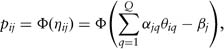
where Φ(.) is the cumulative standard normal distribution, θiq, q = 1, …, Q, are the Q ability parameters (or factor scores) of person i, βj is the difficulty of item j, and αjq, q = 1, …, Q, are Q factor loadings expressing the relative importance of the Q ability dimensions for giving a correct response to item j. Further, it is assumed that the ability parameters θiq, q = 1, …, Q, have a Q-variate normal distribution with a mean-vector μ with the elements μq, q = l, …, Q, and a covariance matrix σ. So it is assumed that Q ability dimensions play a role in test response behaviour, the relative importance of these ability dimensions in the responses to specific items is modelled by item-specific loadings αjq, and the relation between the ability dimensions in some populations of respondents is modelled by the correlation between the ability dimensions.
...
- 1. Theory and Methodology
- Ambulatory Assessment
- Assessment Process
- Assessor's Bias
- Automated Test Assembly Systems
- Classical and Modern Item Analysis
- Classical Test Theory
- Classification (General, including Diagnosis)
- Criterion-Referenced Testing: Methods and Procedures
- Cross-Cultural Assessment
- Decision (including Decision Theory)
- Diagnosis of Mental and Behavioural Disorders
- Diagnostic Testing in Educational Settings
- Dynamic Assessment (Learning Potential Testing, Testing the Limits)
- Ethics
- Evaluability Assessment
- Evaluation: Programme Evaluation (General)
- Explanation
- Factor Analysis: Confirmatory
- Factor Analysis: Exploratory
- Formats for Assessment
- Generalizability Theory
- History of Psychological Assessment
- Intelligence Assessment through Cohort and Time
- Item Banking
- Item Bias
- Item Response Theory: Models and Features
- Latent Class Analysis
- Multidimensional Item Response Theory
- Multidimensional Scaling Methods
- Multimodal Assessment (including Triangulation)
- Multitrait-Multimethod Matrices
- Needs Assessment
- Norm-Referenced Testing: Methods and Procedures
- Objectivity
- Outcome Assessment/Treatment Assessment
- Person/Situation (Environment) Assessment
- Personality Assessment through Longitudinal Designs
- Prediction (General)
- Prediction: Clinical vs. Statistical
- Qualitative Methods
- Reliability
- Report (General)
- Reporting Test Results in Education
- Self-Presentation Measurement
- Self-Report Distortions (including Faking, Lying, Malingering, Social Desirability)
- Test Adaptation/Translation Methods
- Test User Competence/Responsible Test Use
- Theoretical Perspective: Cognitive
- Theoretical Perspective: Cognitive-Behavioural
- Theoretical Perspective: Constructivism
- Theoretical Perspective: Psychoanalytic
- Theoretical Perspective: Psychological Behaviourism
- Theoretical Perspective: Psychometrics
- Theoretical Perspective: Systemic
- Trait-State Models
- Utility
- Validity (General)
- Validity: Construct
- Validity: Content
- Validity: Criterion-Related
- 2. Methods, Tests and Equipment
- Adaptive and Tailored Testing
- Analogue Methods
- Autobiography
- Behavioural Assessment Techniques
- Brain Activity Measurement
- Case Formulation
- Coaching Candidates to Score Higher on Tests
- Computer-Based Testing
- Equipment for Assessing Basic Processes
- Field Survey: Protocols Development
- Goal Attainment Scaling (GAS)
- Idiographic Methods
- Interview (General)
- Interview in Behavioural and Health Settings
- Interview in Child and Family Settings
- Interview in Work and Organizational Settings
- Neuropsychological Test Batteries
- Observational Methods (General)
- Observational Techniques in Clinical Settings
- Observational Techniques in Work and Organizational Settings
- Projective Techniques
- Psychoeducational Test Batteries
- Psychophysiological Equipment and Measurements
- Self-Observation (Self-Monitoring)
- Self-Report Questionnaires
- Self-Reports (General)
- Self-Reports in Behavioural Clinical Settings
- Self-Reports in Work and Organizational Settings
- Socio-Demographic Conditions
- Sociometric Methods
- Standard for Educational and Psychological Testing
- Subjective Methods
- Test Accommodations for Disabilities
- Test Anxiety
- Test Designs: Developments
- Test Directions and Scoring
- Testing through the Internet
- Unobtrusive Measures
- 3. Personality
- Anxiety Assessment
- Attachment
- Attitudes
- Attribution Styles
- Big Five Model Assessment
- Burnout Assessment
- Cognitive Styles
- Coping Styles
- Emotions
- Empowerment
- Interest
- Leadership Personality
- Locus of Control
- Motivation
- Optimism
- Person/Situation (Environment) Assessment
- Personal Constructs
- Personality Assessment (General)
- Personality Assessment through Longitudinal Designs
- Prosocial Behaviour
- Self-Control
- Self-Efficacy
- Self-Presentation Measurement
- Self, The (General)
- Sensation Seeking
- Social Competence (including Social Skills, Assertion)
- Temperament
- Time Orientation
- Trait-State Models
- Values
- Weil-Being (including Life Satisfaction)
- 4. Intelligence
- Attention
- Cognitive Ability: g Factor
- Cognitive Ability: Multiple Cognitive Abilities
- Cognitive Decline/Impairment
- Cognitive Plasticity
- Cognitive Processes: Current Status
- Cognitive Processes: Historical Perspective
- Cognitive/Mental Abilities in Work and Organizational Settings
- Creativity
- Dynamic Assessment (Learning Potential Testing, Testing the Limits)
- Emotional Intelligence
- Equipment for Assessing Basic Processes
- Fluid and Crystallized Intelligence
- Intelligence Assessment (General)
- Intelligence Assessment through Cohort and Time
- Language (General)
- Learning Disabilities
- Memory (General)
- Mental Retardation
- Practical Intelligence: Conceptual Aspects
- Practical Intelligence: Its Measurement
- Problem Solving
- Triarchic Intelligence Components
- Wisdom
- 5. Clinical and Health
- Anger, Hostility and Aggression Assessment
- Antisocial Disorders Assessment
- Anxiety Assessment
- Anxiety Disorders Assessment
- Applied Behavioural Analysis
- Applied Fields: Clinical
- Applied Fields: Gerontology
- Applied Fields: Health
- Caregiver Burden
- Child and Adolescent Assessment in Clinical Settings
- Clinical Judgement
- Coping Styles
- Counselling, Assessment in
- Couple Assessment in Clinical Settings
- Dangerous/Violence Potential Behaviour
- Dementia
- Diagnosis of Mental and Behavioural Disorders
- Dynamic Assessment (Learning Potential Testing, Testing the Limits)
- Eating Disorders
- Health
- Identity Disorders
- Interview in Behavioural and Health Settings
- Irrational Beliefs
- Learning Disabilities
- Mental Retardation
- Mood Disorders
- Observational Techniques in Clinical Settings
- Outcome Assessment/Treatment Assessment
- Palliative Care
- Prediction: Clinical vs. Statistical
- Psychoneuroimmunology
- Quality of Life
- Self-Observation (Self-Monitoring)
- Self-Reports in Behavioural Clinical Settings
- Social Competence (including Social Skills, Assertion)
- Stress
- Substance Abuse
- Test Anxiety
- Thinking Disorders Assessment
- Type A: A Proposed Psychosocial Risk Factor for Cardiovascular Diseases
- Type C: A Proposed Psychosocial Risk Factor for Cancer
- 6. Educational and Child Assessment
- Achievement Testing
- Applied Fields: Education
- Child Custody
- Children with Disabilities
- Coaching Candidates to Score Higher on Tests
- Cognitive Psychology and Assessment Practices
- Communicative Language Abilities
- Development (General)
- Development: Intelligence/Cognitive
- Development: Language
- Development: Psychomotor
- Development: Socio-Emotional
- Diagnostic Testing in Educational Settings
- Dynamic Assessment (Learning Potential Testing, Testing the Limits)
- Evaluation in Higher Education
- Giftedness
- Instructional Strategies
- Interview in Child and Family Settings
- Item Banking
- Learning Strategies
- Performance
- Performance Standards: Constructed Response Item Formats
- Performance Standards: Selected Response Item Formats
- Planning
- Planning Classroom Tests
- Pre-School Children
- Psychoeducational Test Batteries
- Reporting Test Results in Education
- Standard for Educational and Psychological Testing
- Test Accommodations for Disabilities
- Test Directions and Scoring
- Testing in the Second Language in Minorities
- 7. Work and Organizations
- Achievement Motivation
- Applied Fields: Forensic
- Applied Fields: Organizations
- Applied Fields: Work and Industry
- Career and Personnel Development
- Centres (Assessment Centres)
- Cognitive/Mental Abilities in Work and Organizational Settings
- Empowerment
- Interview in Work and Organizational Settings
- Job Characteristics
- Job Stress
- Leadership in Organizational Settings
- Leadership Personality
- Motor Skills in Work Settings
- Observational Techniques in Work and Organizational Settings
- Organizational Culture
- Performance
- Personnel Selection, Assessment in
- Physical Abilities in Work Settings
- Risk and Prevention in Work and Organizational Settings
- Self-Reports in Work and Organizational Settings
- Total Quality Management
- 8. Neurophysiopsychological Assessment
- Applied Fields: Neuropsychology
- Applied Fields: Psychophysiology
- Brain Activity Measurement
- Dementia
- Equipment for Assessing Basic Processes
- Executive Functions Disorders
- Memory Disorders
- Neuropsychological Test Batteries
- Outcome Evaluation in Neuropsychological Rehabilitation
- Psychoneuroimmunology
- Psychophysiological Equipment and Measurements
- Visuo-Perceptual Impairments
- Voluntary Movement
- 9. Environmental Assessment
- Behavioural Settings and Behaviour Mapping
- Cognitive Maps
- Couple Assessment in Clinical Settings
- Environmental Attitudes and Values
- Family
- Landscapes and Natural Environments
- Life Events
- Organizational Structure, Assessment of
- Perceived Environmental Quality
- Person/Situation (Environment) Assessment
- Post-Occupancy Evaluation for the Built Environment
- Residential and Treatment Facilities
- Social Climate
- Social Networks
- Social Resources
- Stressors: Physical
- Stressors: Social
- Loading...
Get a 30 day FREE TRIAL
-
 Watch videos from a variety of sources bringing classroom topics to life
 -
Read modern, diverse business cases
-
Explore hundreds of books and reference titles

Read next

More like this
Sage Recommends
We found other relevant content for you on other Sage platforms.
Have you created a personal profile? Login or create a profile so that you can save clips, playlists and searches