
Entry
Reader's guide
Entries A-Z
Subject index
Social Dilemmas
Social dilemmas are situations in which private interests are at odds with collective interests. Such situations arise because people frequently attach more weight to their short-term selfish interests than to the longterm interests of the group, organization, or society to which they belong. Many of the most challenging issues people face, from the interpersonal to the intergroup, are at their core social dilemmas.
Consider these examples. As individuals, we are each better off when we make use of public services such as schools, hospitals, and recreational grounds without contributing to their maintenance. However, if we each acted according to our narrow self-interest, then these resources would not be provided, and everyone would be worse off. Similarly, in the long run, everyone would benefit from a cleaner environment, yet how many people are prepared to voluntarily reduce their carbon footprint by saving more energy or driving or flying less frequently?
Definitions and Metaphors
Social dilemmas are formally defined by two properties: (1) each person has an individual rational strategy that yields the best outcome in all circumstances (the noncooperative choice); (2) if all individuals pursue this strategy, it results in a deficient collective outcomeeveryone would be better off by cooperating. Researchers frequently use experimental games to study social dilemmas in the laboratory. An experimental game is a situation in which participants choose between cooperative and noncooperative alternatives, yielding consequences for themselves and others in terms of their monetary outcomes.
The literature on social dilemmas has historically revolved around three metaphorical stories, the prisoner's dilemma, the public good dilemma, and the commons dilemma, and each of these stories has been modeled as an experimental game. The prisoner's dilemma game was developed by scientists in the 1950s. The cover story for the game involved two prisoners who are separately given the choice between testifying against the other (noncooperation) or keeping silent (cooperation). The outcomes are such that each of them is better off testifying against the other, but if they both pursue this strategy, they are both worse off than if they remain silent.
Table 1 Payoff Matrix for Prisoner's Dilemma
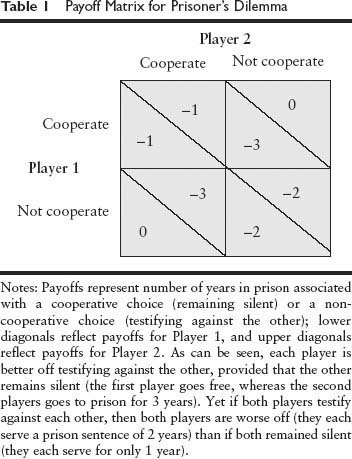
The public good dilemma has the same properties as the prisoner's dilemma game but involves more than two individuals. A public good is a resource from which all may benefit regardless of whether they contributed to the good. For instance, people can enjoy the city parks regardless of whether they contributed to their upkeep through local taxes. Public goods are nonexcludable: Once these goods are provided, nobody can be excluded from using them. As a result, there is a temptation to enjoy the good without making a contribution. Those who do so are called free riders, and although it is rational to free ride, if all do so, then the public good is not provided, and all are worse off. Researchers study primarily two public good dilemma games in the laboratory. Participants get a monetary endowment to play these games and decide how much to invest in a private fund versus a group fund. It is individually rational to invest in the private fund, yet all would be better off investing in the group fund because this yields a bonus. In the continuous game, the more that people invest in the group fund, the larger their share of the bonus. In the step-level game, people get a share of the bonus if the total group investments exceed a critical (step) level.
...
- Cognitions and Feelings
- Affect Control Theory
- Ageism
- Ambivalent Sexism
- Anti-Semitism
- Attachment Theory
- Attitudes Toward Women Scale
- Attribution Biases
- Aversive Racism
- Brainstorming
- Categorization
- Children: Stereotypes and Prejudice
- Cognitive Consistency
- Collective Guilt
- Collective Induction
- Collective Self
- Collectivism/Individualism
- Common Knowledge Effect
- Conservatism
- Conspiracy Theories
- Cross-Categorization
- Culture
- Culture of Honor
- Decategorization
- Dehumanization/Infrahumanization
- Deindividuation
- Depersonalization
- Distributive Justice
- Dogmatism
- Entitativity
- Essentialism
- Ethnocentrism
- False Consensus Effect
- Group Cohesiveness
- Group Emotions
- Group Learning
- Group Memory
- Group Mind
- Group Polarization
- Group Position Theory
- Group Potency
- Group Problem Solving and Decision Making
- Groupthink
- Hidden Profile Task
- Homophobia
- Identity Control Theory
- Ideology
- Illusion of Group Effectivity
- Illusory Correlation
- Implicit Association Test (IAT)
- Implicit Prejudice
- Informational Influence
- Intergroup Anxiety
- Intergroup Emotions Theory
- Intergroup Empathy
- Islamophobia
- Justice
- Language and Intergroup Relations
- Leader Categorization Theory
- Linguistic Category Model (LCM)
- Linguistic Intergroup Bias (LIB)
- Modern Forms of Prejudice
- Modern Racism
- Modern Sexism
- Multiple Identities
- Need for Closure
- Outgroup Homogeneity Effect
- Perceived Group Variability
- Pluralistic Ignorance
- Prejudice
- Procedural Justice
- Protestant Work Ethic
- Racial Ambivalence Theory
- Racism
- Relational Cohesion Theory
- Rumor
- Self-Categorization Theory
- Self-Esteem
- Self-Fulfilling Prophecy
- Self-Stereotyping
- Sexism
- Shared Mental Models
- Social Comparison Theory
- Social Decision Schemes
- Social Dominance Theory
- Social Representations
- Socially Shared Cognition
- Sociometer Model
- Stereotype Threat
- Stereotyping
- Subtyping
- Symbolic Racism
- System Justification Theory
- Team Reflexivity
- Transactive Memory Systems
- Ultimate Attribution Error
- Weightism
- Xenophobia
- Conflict and Cooperation within Groups
- Anticonformity
- Asch, Solomon
- Black Sheep Effect
- Cliques
- Coalitions
- Collaboration Technology
- Commons Dilemma
- Conformity
- Cooperation and Competition
- Cooperative Learning
- Deutsch, Morton
- Deviance
- Distributive Justice
- Dominance Hierarchies
- Emergent Norm Theory
- Escalation of Commitment
- Evolutionary Psychology
- Faultlines
- Frustrationaggression Hypothesis
- Graduated Reciprocation in Tension Reduction (GRIT)
- Group Cohesiveness
- Group Emotions
- Group Problem Solving and Decision Making
- Group Structure
- Inclusion/Exclusion
- Ingroup Allocation Bias
- Interdependence Theory
- Interindividual/Intergroup Discontinuity
- Jigsaw Classroom Technique
- Justice
- Mediation
- Minimal Group Effect
- Minority Influence
- Moscovici, Serge
- Need for Power
- Negotiation and Bargaining
- Norms
- Opinion Deviance
- Power
- Power Dependence Theory
- Prisoner's Dilemma
- Procedural Justice
- Relational Cohesion Theory
- Relational Model of Authority in Groups
- Relative Deprivation
- Schisms
- Sensitivity Training Groups
- Sexual Harassment
- Sherif, Muzafer
- Social Decision Schemes
- Social Dilemmas
- Sports Teams
- Stanford Prison Experiment
- Subjective Group Dynamics
- Tajfel, Henri
- Team Negotiation
- Therapy Groups
- Trust
- Virtual/Internet Groups
- Work Teams
- Group Decision Making
- Anticonformity
- Asch, Solomon
- Brainstorming
- Cliques
- Coalitions
- Collective Induction
- Common Knowledge Effect
- Computer Simulation
- Conformity
- Delphi Technique
- Dominance Hierarchies
- Escalation of Commitment
- Graduated Reciprocation in Tension Reduction (GRIT)
- Group Cohesiveness
- Group Composition
- Group Emotions
- Group Memory
- Group Mind
- Group Motivation
- Group Performance
- Group Polarization
- Group Problem Solving and Decision Making
- Group Structure
- Group Task
- Groupthink
- Hidden Profile Task
- Idiosyncrasy Credit
- Inclusion/Exclusion
- Informational Influence
- Juries
- Leniency Contract
- Mediation
- Minority Influence
- Moscovici, Serge
- Need for Closure
- Negotiation and Bargaining
- Normative Influence
- Norms
- Obedience to Authority
- Opinion Deviance
- Power
- Power Dependence Theory
- Reference Groups
- Referent Informational Influence Theory
- Relational Cohesion Theory
- Relational Model of Authority in Groups
- Shared Mental Models
- Sherif, Muzafer
- Social Decision Schemes
- Social Networks
- Status
- Status Characteristics/Expectations States Theory
- Status Construction Theory
- Team Negotiation
- Trust
- Work Teams
- Group Performance and Problem Solving
- Boundary Spanning
- Brainstorming
- Charismatic Leadership
- Collaboration Technology
- Communication Networks
- Computermediated Communication
- Contingency Theories of Leadership
- Cooperative Learning
- Deindividuation
- Delphi Technique
- Distributive Justice
- Diversity
- Dominance Hierarchies
- Dynamical Systems Approach
- Emergent Norm Theory
- Escalation of Commitment
- Faultlines
- Free Riding
- Gender and Behavior
- Gender Roles
- Great Person Theory of Leadership
- Group Boundaries
- Group Cohesiveness
- Group Composition
- Group Development
- Group Dissolution
- Group Ecology
- Group Emotions
- Group Formation
- Group Learning
- Group Mind
- Group Motivation
- Group Potency
- Group Problem Solving and Decision Making
- Group Socialization
- Group Structure
- Group Task
- Groupthink
- Hidden Profile Task
- Identification and Commitment
- Illusion of Group Effectivity
- Inclusion/Exclusion
- Initiation Rites
- Innovation
- Interaction Process Analysis
- Interactionist Theories of Leadership
- Job Design
- Justice
- Köhler Effect
- Leader Categorization Theory
- Leader-Member Exchange (LMX) Theory
- Leadership
- Loyalty
- Mergers
- Negotiation and Bargaining
- Norms
- Obedience to Authority
- Organizations
- Pathgoal Theory of Leadership
- Personality Theories of Leadership
- Personnel Turnover
- Power
- Power Dependence Theory
- Procedural Justice
- Process Consultation
- Process Gain and Loss
- Relational Cohesion Theory
- Relational Model of Authority in Groups
- Ringelmann Effect
- Role Transitions
- Roles
- Romance of Leadership
- Self-Managing Teams
- Shared Mental Models
- Social Compensation
- Social Entrainment
- Social Exchange in Networks and Groups
- Social Facilitation
- Social Identity Model of Deindividuation Effects
- Social Identity Theory
- Social Identity Theory of Leadership
- Social Impact Theory
- Social Loafing
- Socially Shared Cognition
- Socioemotional and Task Behavior
- Sports Teams
- Status
- Status Characteristics/Expectations States Theory
- Status Construction Theory
- Stepladder Technique
- Sucker Effect
- Team Building
- Team Negotiation
- Team Performance Assessment
- Team Reflexivity
- Teams
- Transactional Leadership Theories
- Transactive Memory Systems
- Transformational Leadership Theories
- Trust
- Vertical Dyad Linkage Model
- Virtual/Internet Groups
- Work Teams
- Group Structure
- Affirmative Action
- Apartheid
- Assimilation and Acculturation
- Attachment Theory
- Boundary Spanning
- Cliques
- Coalitions
- Common-Identity/Common-Bond Groups
- Communication Networks
- Computermediated Communication
- Crowding
- Crowds
- Deviance
- Diversity
- Dominance Hierarchies
- Dynamical Systems Approach
- Emergent Norm Theory
- Faultlines
- Gender and Behavior
- Gender Roles
- Group Boundaries
- Group Cohesiveness
- Group Composition
- Group Development
- Group Dissolution
- Group Formation
- Group Position Theory
- Group Socialization
- Group Structure
- Homophily
- Inclusion/Exclusion
- Initiation Rites
- Job Design
- Legitimation
- Mergers
- Norms
- Opinion Deviance
- Organizations
- Ostracism
- Personnel Turnover
- Relational Cohesion Theory
- Role Transitions
- Roles
- Schisms
- Shared Mental Models
- Slavery
- Social Class
- Social Mobility
- Social Networks
- Social Relations Model
- Sociometric Choice
- Sports Teams
- Status
- Status Characteristics/Expectation States Theory
- Status Construction Theory
- Stepladder Technique
- SYMLOG
- System Theory
- Team Building
- Territoriality
- Tokenism
- Virtual/Internet Groups
- Work Teams
- Identity and Self
- Assimilation and Acculturation
- Black Sheep Effect
- Categorization
- Collective Guilt
- Collective Movements and Protest
- Collective Self
- Collectivism/Individualism
- Common Ingroup Identity Model
- Common-Identity/Common-Bond Groups
- Cross-Categorization
- Deindividuation
- Depersonalization
- Ethnicity
- Ethnolinguistic Vitality
- Extended Contact Effect
- Gender and Behavior
- Gender Roles
- Group Position Theory
- Identification and Commitment
- Identity Control Theory
- Ingroup Allocation Bias
- Interindividual/Intergroup Discontinuity
- Looking-Glass Self
- Loyalty
- Minimal Group Effect
- Minority Coping Strategies
- Minority Groups in Society
- Multiple Identities
- Mutual Intergroup Differentiation Model
- Nationalism and Patriotism
- Need for Belonging
- Optimal Distinctiveness
- Perceived Group Variability
- Reference Groups
- Referent Informational Influence Theory
- Self-Categorization Theory
- Self-Esteem
- Self-Stereotyping
- Social Identity Model of Deindividuation Effects
- Social Identity Theory of Leadership
- Sociometer Model
- Subjective Group Dynamics
- Symbolic Interactionism
- Tajfel, Henri
- Uncertainty-Identity Theory
- Influence and Persuasion
- Anticonformity
- Asch, Solomon
- Bystander Effect
- Charismatic Leadership
- Cognitive Consistency
- Collective Induction
- Collective Movements and Protest
- Common Knowledge Effect
- Compliance
- Conformity
- Contingency Theories of Leadership
- Culture
- Deviance
- Dominance Hierarchies
- Dynamical Systems Approach
- Emergent Norm Theory
- Fads and Fashions
- False Consensus Effect
- Festinger, Leon
- Gender and Behavior
- Great Person Theory of Leadership
- Group Cohesiveness
- Group Mind
- Group Polarization
- Group Problem Solving and Decision Making
- Groupthink
- Hidden Profile Task
- Identification and Commitment
- Idiosyncrasy Credit
- Inclusion/Exclusion
- Informational Influence
- Innovation
- Interactionist Theories of Leadership
- Leader Categorization Theory
- Leader-Member Exchange (LMX) Theory
- Leadership
- Leniency Contract
- Lewin, Kurt
- Loyalty
- Mediation
- Minority Influence
- Moscovici, Serge
- Need for Closure
- Need for Power
- Negotiation and Bargaining
- Normative Influence
- Norms
- Obedience to Authority
- Opinion Deviance
- Ostracism
- Pathgoal Theory of Leadership
- Personality Theories of Leadership
- Pluralistic Ignorance
- Power
- Reference Groups
- Referent Informational Influence Theory
- Relational Cohesion Theory
- Ringelmann Effect
- Romance of Leadership
- Rumor
- Sherif, Muzafer
- Social Compensation
- Social Decision Schemes
- Social Exchange in Networks and Groups
- Social Facilitation
- Social Identity Model of Deindividuation Effects
- Social Identity Theory
- Social Identity Theory of Leadership
- Social Impact Theory
- Social Loafing
- Status
- Status Characteristics/Expectation States Theory
- Status Construction Theory
- SYMLOG
- Team Negotiation
- Terrorism
- Therapy Groups
- Transactional Leadership Theories
- Transformational Leadership Theories
- Trust
- Vertical Dyad Linkage Model
- Intergroup Relations in Society
- Affirmative Action
- Ageism
- Allport, Gordon
- Ambivalent Sexism
- Anti-Semitism
- Apartheid
- Assimilation and Acculturation
- Attitudes Toward Women Scale
- Authoritarian Personality
- Aversive Racism
- Banality of Evil
- Black Sheep Effect
- Children: Stereotypes and Prejudice
- Civil Rights Legislation
- Civil Rights Movement
- Collective Guilt
- Collective Movements and Protest
- Common Ingroup Identity Model
- Conspiracy Theories
- Cooperative Learning
- Cults
- Desegregation
- Deviance
- Discrimination
- Distributive Justice
- Diversity
- Ethnicity
- Ethnocentrism
- Ethnolinguistic Vitality
- Eugenics
- Evolutionary Psychology
- Extended Contact Effect
- Feminism
- Frustrationaggression Hypothesis
- Gangs
- Genocide
- Graduated Reciprocation in Tension Reduction (GRIT)
- Group Emotions
- Group Position Theory
- Hate Crimes
- Holocaust
- Homophobia
- Ideology
- Immigration
- Ingroup Allocation Bias
- Institutionalized Bias
- Intergroup Anxiety
- Intergroup Contact Theory
- Intergroup Emotions Theory
- Intergroup Empathy
- Intergroup Violence
- Islamophobia
- J-Curve Hypothesis
- Jigsaw Classroom Technique
- Just World Hypothesis
- Justice
- Language and Intergroup Relations
- Linguistic Category Model (LCM)
- Linguistic Intergroup Bias (LIB)
- Mergers
- Minimal Group Effect
- Minority Coping Strategies
- Minority Groups in Society
- Modern Forms of Prejudice
- Modern Racism
- Modern Sexism
- Multiculturalism
- Mutual Intergroup Differentiation Model
- Nationalism and Patriotism
- Prejudice
- Procedural Justice
- Protestant Work Ethic
- Racial Ambivalence Theory
- Racism
- Realistic Group Conflict Theory
- Relative Deprivation
- Right Wing Authoritarianism
- Scapegoating
- Schisms
- Self-Categorization Theory
- Self-Fulfilling Prophecy
- Sexism
- Sexual Harassment
- Sherif, Muzafer
- Slavery
- Social Class
- Social Darwinism
- Social Deviance
- Social Dominance Theory
- Social Identity Theory
- Stereotype Threat
- Stigma
- Subjective Group Dynamics
- Symbolic Racism
- System Justification Theory
- Tajfel, Henri
- Territoriality
- Terror Management Theory
- Terrorism
- Tokenism
- Weightism
- Xenophobia
- Methodology
- Action Research
- Ambivalent Sexism
- Attitudes Toward Women Scale
- Authoritarian Personality
- Computer Simulation
- Experimentation
- Implicit Association Test (IAT)
- Interaction Process Analysis
- Levels of Analysis
- Modern Racism
- Modern Sexism
- Need for Closure
- Need for Power
- Research Methods and Issues
- Right Wing Authoritarianism
- Social Relations Model
- Sociometric Choice
- Survey Methods
- SYMLOG
- Organizations
- Affirmative Action
- Assimilation and Acculturation
- Boundary Spanning
- Charismatic Leadership
- Cliques
- Coalitions
- Collaboration Technology
- Collective Self
- Communication Networks
- Computermediated Communication
- Contingency Theories of Leadership
- Cooperation and Competition
- Culture
- Deviance
- Distributive Justice
- Diversity
- Dominance Hierarchies
- Dynamical Systems Approach
- Escalation of Commitment
- Faultlines
- Free Riding
- Gender and Behavior
- Gender Roles
- Great Person Theory of Leadership
- Group Boundaries
- Group Cohesiveness
- Group Composition
- Group Ecology
- Group Learning
- Group Motivation
- Group Performance
- Group Socialization
- Group Structure
- Group Task
- Homophily
- Identification and Commitment
- Ideology
- Initiation Rites
- Innovation
- Interactionist Theories of Leadership
- Job Design
- Justice
- Leader Categorization Theory
- Leader-Member Exchange (LMX) Theory
- Leadership
- Loyalty
- Mergers
- Multiple Identities
- Negotiation and Bargaining
- Norms
- Obedience to Authority
- Organizations
- Pathgoal Theory of Leadership
- Personality Theories of Leadership
- Personnel Turnover
- Power
- Power Dependence Theory
- Procedural Justice
- Process Consultation
- Process Gain and Loss
- Protestant Work Ethic
- Relational Cohesion Theory
- Relational Model of Authority in Groups
- Role Transitions
- Roles
- Romance of Leadership
- Schisms
- Self-Managing Teams
- Sexual Harassment
- Social Compensation
- Social Exchange in Networks and Groups
- Social Facilitation
- Social Impact Theory
- Social Loafing
- Social Networks
- Socially Shared Cognition
- Socioemotional and Task Behavior
- Status
- Status Characteristics/Expectation States Theory
- Status Construction Theory
- Sucker Effect
- System Theory
- Team Building
- Team Negotiation
- Team Performance Assessment
- Team Reflexivity
- Teams
- Tokenism
- Transactional Leadership Theories
- Transformational Leadership Theories
- Trust
- Vertical Dyad Linkage Model
- Virtual/Internet Groups
- Work Teams
- Theory
- Affect Control Theory
- Allport, Gordon
- Ambivalent Sexism
- Asch, Solomon
- Attachment Theory
- Authoritarian Personality
- Aversive Racism
- Charismatic Leadership
- Cognitive Consistency
- Contingency Theories of Leadership
- Deutsch, Morton
- Dynamical Systems Approach
- Emergent Norm Theory
- Eugenics
- Evolutionary Psychology
- Festinger, Leon
- Frustrationaggression Hypothesis
- Great Person Theory of Leadership
- Group Position Theory
- Identity Control Theory
- Interactionist Theories of Leadership
- Interdependence Theory
- Intergroup Contact Theory
- Intergroup Emotions Theory
- Just World Hypothesis
- Justice
- Leader Categorization Theory
- Leader-Member Exchange (LMX) Theory
- Lewin, Kurt
- Modern Forms of Prejudice
- Modern Racism
- Modern Sexism
- Moscovici, Serge
- Mutual Intergroup Differentiation Model
- Need for Belonging
- Need for Closure
- Need for Power
- Optimal Distinctiveness
- Pathgoal Theory of Leadership
- Personality Theories of Leadership
- Power Dependence Theory
- Racial Ambivalence Theory
- Realistic Group Conflict Theory
- Referent Informational Influence Theory
- Relational Cohesion Theory
- Relational Model of Authority in Groups
- Right Wing Authoritarianism
- Self-Categorization Theory
- Sherif, Muzafer
- Social Decision Schemes
- Social Dominance Theory
- Social Identity Model of Deindividuation Effects
- Social Identity Theory
- Social Identity Theory of Leadership
- Social Impact Theory
- Sociometer Model
- Status Characteristics/Expectation States Theory
- Status Construction Theory
- Subjective Group Dynamics
- Symbolic Interactionism
- System Justification Theory
- System Theory
- Tajfel, Henri
- Terror Management Theory
- Transactional Leadership Theories
- Transformational Leadership Theories
- Uncertainty-Identity Theory
- Vertical Dyad Linkage Model
- Types of Groups and Subgroups
- Children's Groups
- Cliques
- Coalitions
- Collective Movements and Protest
- Common-Identity/Common-Bond Groups
- Communication Networks
- Computermediated Communication
- Cooperative Learning
- Crowds
- Cults
- Dominance Hierarchies
- Dyads
- Ethnicity
- Families
- Gangs
- Jigsaw Classroom Technique
- Juries
- Minority Groups in Society
- Organizations
- Reference Groups
- Schisms
- Self-Managing Teams
- Sensitivity Training Groups
- Sports Teams
- Stepladder Technique
- Support Groups
- Teams
- Therapy Groups
- Tokenism
- Virtual/Internet Groups
- Work Teams
- Loading...
Get a 30 day FREE TRIAL
-
 Watch videos from a variety of sources bringing classroom topics to life
 -
Read modern, diverse business cases
-
Explore hundreds of books and reference titles

Read next

More like this
Sage Recommends
We found other relevant content for you on other Sage platforms.
Have you created a personal profile? Login or create a profile so that you can save clips, playlists and searches