
Entry
Reader's guide
Entries A-Z
Subject index
Maoism
AFTER A BLOODY split in April 1927, Chiang Kaishek of the Kuomintang, or Nationalist Party, ruling China broke with his allies in the Communist Party. He launched a series of “extermination” campaigns that gradually were destroying the communists and their Red Army. At that time, Wang Ming, the leader of the Communist Party, had been discredited when he had fled for his life to the Soviet Union in January 1931. Within China, the de facto leader of the party became Mao Zedong, who had become involved in progressive politics while still a student at the First Normal School of Hunan in 1912, the year the Chinese Republic had been proclaimed by Sun Yatsen. In October 1934, Mao and the communists set out upon their epic Long March to ultimate safety in Shanxsi.
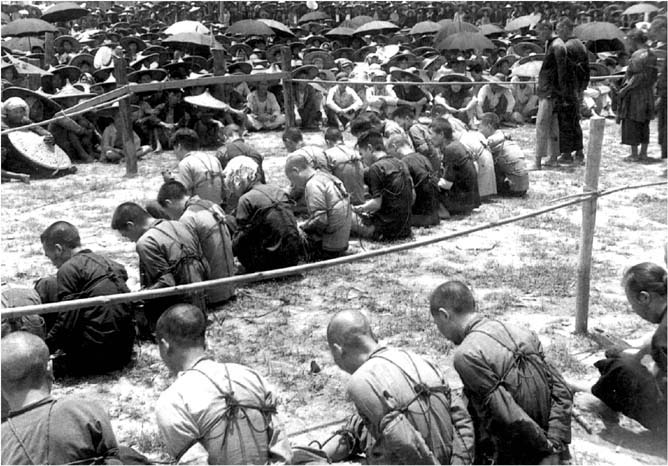
Chinese political prisoners, many of whom were labeled as spies, subversives, or traitors, are assembled for sentencing by Communist Party leaders in the early 1950s. Maoism put a high price on disloyalty to the changing nature of the revolution.
At a critical moment in the Long March in January 1935, after heavy casualties, Mao won an important meeting at Zunyi, which established him as leader of the communists in China. Finally, by the time they finally reached Shanxsi province in the north in the autumn of 1935, little more than a tenth of those who had set out were still alive. But they had reached the sanctuary of the north, remote mountains and difficult terrain where they could regroup and launch new offensives. In December 1935, the Red Army was refreshed enough to march to Yenan where, for 11 years, Mao made his military base.
It was there in the caves at Yenan that Mao formulated the ideology that could be described as Maoism—the authentic voice of Chinese Communism. The relationship with the peasantry became the cornerstone of the Maoist world view—not that China lacked a working proletariat as had revolutionary Russia. Indeed, the Chinese Revolution had begun with workers' risings in Wuchang and Hankow. Indeed, Mao viewed the working proletariat as already radicalized, and thus an important ally of the Communist Party in awakening the peasantry. A major influence in Mao's thought was the “revolutionary literature” of China's past, including his favorite, The Romance of the Three Kingdoms.
In all of these tales, revolutionary bandits rebelling against unjust emperors had survived, and sometimes triumphed, with the help of the peasants who, in 1935, were still in the vast majority of China's population. Indeed, they still are in 2004. Mao had astutely observed the alienation among the peasants that had accompanied the rampages of the armies of the warlords, like Chang Tsolin, who had surrendered Beijing to Chiang in 1928. Mao realized correctly that if he were to win out against the superior Kuomintang forces of Chiang, he had to win the loyalty of the peasant masses. Chiang, of course, remained in power largely due to extortionate tax-gathering among the peasants.
As early as March 1926, Mao had written, “poor peasants [who] possess neither adequate farm implements or funds … are among the most hard—pressed of the peasants, and very receptive to revolutionary agitation.” Furthermore, “farm laborers find themselves the most oppressed in the villages, and hold a position in the peasant movement as important as the poor peasants.” He saw potential allies already in those peasants he called the lumpen peasants—those who had lost everything and had formed gangs outside the Chinese economy. He wrote, “able to fight very bravely but apt to be destructive, they can become a revolutionary force if properly guided.”
...
- People on the Left
- Anthony, Susan B.
- Bellamy, Edward
- Bentham, Jeremy
- Breitman, George
- Browder, Earl
- Carmichael, Stokely
- Carter, James E.
- Carville, James
- Cleaver, Eldridge
- Clinton, William J.
- Coxey, Jacob
- Croly, Herbert
- Debs, Eugene V.
- Deng Xiaoping
- Douglass, Frederick
- Du Bois, W.E.B.
- Duclos, Jacques
- Dunayevskaya, Raya
- Engels, Friedrich
- Flynn, Elizabeth Gurley
- Foster, William Z.
- Freidan, Betty
- Fromm, Erich
- Ghandi, Mahatma
- Gilman, Charlotte Perkins
- Gitlow, Benjamin
- Goldman, Emma
- Gorbachev, Mikhail
- Guevara, Che
- Hall, Gus
- Hammett, Dashiell
- Harrington, Michael
- Hayden, Tom
- Haywood, William D
- Hillman, Sidney
- Hillquit, Morris
- Hobbes, Thomas
- Hollywood Ten
- Hopkins, Harry
- Hume, David
- Humphrey, Hubert H.
- Jefferson, Thomas
- Johnson, Lyndon B.
- Kefauver, Estes
- Kennedy, John F.
- King, Martin Luther, Jr.
- La Follette, Robert
- Lenin, Vladimir I.
- Lincoln, Abraham
- Lippmann, Walter
- Lloyd, Henry Demarest
- Locke, John
- Long, Huey
- Lovestone, Jay
- Malcolm X
- Marcuse, Herbert
- Marx, Karl
- Moore, Michael
- Mott, Lucretia
- Muste, Abraham J.
- Nader, Ralph
- Nearing, Scott
- O'Neil, Thomas P.
- Orwell, George
- Paul, Alice
- Randolph, A. Philip
- Reed, John
- Roosevelt, Eleanor
- Roosevelt, Franklin D.
- Rousseau, Jean-Jacques
- Sacco and Vanzetti
- Schlesinger, Arthur M., Jr.
- Stanton, Elizabeth Cady
- Steinem, Gloria
- Stevenson, Adlai E.
- Thomas, Norman M.
- Thompson, Hunter S.
- Trotsky, Leon
- Truman, Harry
- Wallace, Henry A.
- Washington, George
- Wilson, Woodrow
- Wright, Frances
- People on the Right
- Ali, Noble Drew
- Bennett, William J.
- Bilbo, Theodore G.
- Borah, William E.
- Buchanan, Patrick J.
- Buckley, William F., Jr.
- Burke, Edmund
- Bush, George H.W.
- Bush, George W.
- Churchill, Sir Winston
- Coolidge, Calvin
- Coughlin, Charles E.
- Coulter, Ann H.
- Dewey, Thomas E.
- Dos Passos, John
- Drudge, Matt
- Eisenhower, Dwight D.
- Ford, Gerald R.
- Garvey, Marcus
- Gingrich, Newt
- Goldwater, Barry
- Harding, Warren G.
- Hearst, William Randolph
- Hitler, Adolf
- Hoover, Herbert
- Hoover, J. Edgar
- Khomeini, Ruhollah
- La Guardia, Fiorello H.
- Landon, Alfred M.
- Limbaugh, Rush
- Lincoln, Abraham
- Lind, Michael
- Lindbergh, Charles A.
- Luce, Henry R.
- Mises, Ludwig von
- Nietzsche, Friedrich
- Nixon, Richard M.
- Rand, Ayn
- Reagan, Ronald
- Roosevelt, Theodore
- Shockley, William B.
- Sowell, Thomas
- Taft, Robert A.
- Taft, William H.
- Thatcher, Margaret
- Washington, Booker T.
- Will, George F.
- Willkie, Wendell
- Countries/Regions: Left Politics
- Africa
- Argentina
- Asia
- Australia
- Austria
- Brazil
- Canada
- Chile
- China
- Czech Republic
- Egypt
- France
- Greece
- India
- Indonesia
- Iran
- Ireland
- Israel
- Italy
- Japan
- Korea, North
- Korea, South
- Mexico
- Middle East
- Nigeria
- Peru
- Poland
- Russia, Post-Soviet
- Saudi Arabia
- Singapore
- South Africa
- South America
- Soviet Union
- Spain
- Sweden
- Switzerland
- Turkey
- Uganda
- Ukraine
- United Kingdom
- United States
- Countries/Regions: Right Politics
- Africa
- Argentina
- Asia
- Australia
- Austria
- Brazil
- Canada
- Chile
- China
- Czech Republic
- Egypt
- France
- Greece
- India
- Iran
- Iraq
- Ireland
- Israel
- Italy
- Japan
- Korea, South
- Mexico
- Middle East
- Nigeria
- Peru
- Poland
- Russia, Post-Soviet
- Saudi Arabia
- Singapore
- South Africa
- South America
- Soviet Union
- Spain
- Sweden
- Switzerland
- Turkey
- Uganda
- Ukraine
- United Kingdom
- United States
- Leftist “Isms”
- Abolitionism
- Anarchism
- Anarcho-Syndicalism
- Bicameralism
- Bolshevism
- Communism
- Communitarianism
- Despotism
- Environmentalism
- Fabianism
- Feminism
- Fourierism
- Liberalism
- Maoism
- Market Socialism
- Marxist Humanism
- Populism
- Postmodernism
- Québec Separatism
- Saint-Simonism
- Socialism
- Socialist Realism
- Stalin and Stalinism
- Syndicalism
- Third Worldism
- Titoism
- Zionism
- Rightist “Isms”
- Agrarianism
- Black Nationalism
- Black Separatism
- Capitalism
- Colonialism
- Conservatism
- Corporatism
- Corsican Separatism
- Darwinism
- Despotism
- Elitism
- Falangism
- Fascism
- Feudalism
- Fundamentalism
- Imperialism
- Isolationism
- Libertarianism
- McCarthyism
- Monarchism
- Nationalism
- Orientalism
- Pan-Africanism
- Patriotism
- Peronism
- Prohibitionism
- Sabbatarianism
- Totalitarianism
- Ultramontanism
- Unilateralism
- Zionism
- Leftist Political Issues
- Abolitionism
- Alienation
- Anarchism
- Anarcho-Syndicalism
- Anti-Globalization
- Bicameralism
- Campaign Finance
- Communism
- Communitarianism
- Cultural Diversity
- Democracy
- Desegregation
- Environmentalism
- Human Rights
- Ideology
- Liberalism
- Lobbying
- Market Socialism
- Media Bias, Left
- Political Economy
- Politically Correct
- Polls and Pollsters
- Social Democracy
- Socialism
- Socialist Realism
- Stalin and Stalinism
- Vietnam War
- Voting, Unrestricted
- Welfare and Poverty
- Rightist Political Issues
- Balance of Power
- Capitalism
- Censorship
- Conservatism
- Corporatism
- Darwinism
- Despotism
- Education
- Ethnic Cleansing
- Fascism
- Foreign Policy, U.S.
- Fundamentalism
- Globalization
- Healthcare
- Ideology
- Isolationism
- Laissez-Faire
- Libertarianism
- Lobbying
- Manifest Destiny
- Media Bias, Right
- Polls and Pollsters
- Realpolitik
- Segregation
- States' Rights
- Technocracy, Inc.
- Theocracy
- Totalitarianism
- Unilateralism
- Vietnam War
- Welfare and Poverty
- Xenophobia
- Leftist Laws
- Abortion/Pro-Choice
- American Civil Liberties Union
- Animal Rights
- Bill of Rights
- Censorship
- Church and State Separation
- Civil Liberties
- Civil Rights
- Constitutional Amendments
- Consumer Rights
- Death Penalty Elimination
- Desegregation
- First Amendment
- Freedom of Information
- Gun Control
- Healthcare
- Human Rights
- Immigration
- Lobbying
- New Deal
- Social Security
- Supreme Court
- Voting, Unrestricted
- Welfare and Poverty
- Rightist Laws
- Leftist Political Parties
- African National Congress
- American Civil Liberties Union
- Black Panthers
- Catholic Worker
- Christian Democracy
- Communist Party, Soviet
- Democratic Party
- Green Party
- Greenback Party
- Labour Party, UK
- Liberal Party, Australia
- Liberal Party, Canada
- Liberal Party, Hong Kong
- Liberal Party, UK
- PRI (Mexico)
- Progressive Party
- Socialist Party, U.S.
- Socialist Workers' Party, UK
- Suffragists
- Workers Party
- Workingmen's Party
- Rightist Political Parties
- Leftist Political Movements
- Abortion/Pro-Choice
- Affirmative Action
- Anarcho-Syndicalism
- Animal Rights
- Anti-Globalization
- Bolshevism
- Civil Rights
- Consumer Rights
- Death Penalty Elimination
- Democracy
- Desegregation
- Environmentalism
- Feminism
- Gay and Lesbian Movements
- Gun Control
- Human Rights
- Niagara Movement
- Palestine Liberation Organization
- Postmodernism
- Protests
- Solidarity
- Students for a Democratic Society
- Suffragists
- Zionism
- Rightist Political Movements
- Loading...
Get a 30 day FREE TRIAL
-
 Watch videos from a variety of sources bringing classroom topics to life
 -
Read modern, diverse business cases
-
Explore hundreds of books and reference titles

Read next

More like this
Sage Recommends
We found other relevant content for you on other Sage platforms.
Have you created a personal profile? Login or create a profile so that you can save clips, playlists and searches