
Entry
Reader's guide
Entries A-Z
Subject index
Manifest Destiny
IN 1845, JOHN L. O'SULLIVAN argued persuasively for the acquisition of the Oregon Territory under the right of what he termed “our Manifest Destiny.” Invoking predominant legacies of American religious providence and secular expansionism, O'Sullivan's phrase has resonated for some 150 years in the national spirit of continental expansionism and global influence. Although explicit political invocation has ebbed and waned throughout times of crisis and conflict, Manifest Destiny cannot be understood merely as a political doctrine. Rather the ideological, cultural, and social values embedded in the belief of American providence and territorial expansion comprise an important and central narrative regarding the origins, history, and purpose of America as a nation. These values, if not the doctrine itself, remain constant today, as they have throughout much of America's history.
The religious overtones of O'Sullivan's phrase are unmistakable and stand as a central theme in the American Anglo-Saxon narrative of divine providence. Drawing from colonial beliefs of America as the “New Israel” and “New Eden,” early Americans and particularly Puritans envisioned their new world as an extension of God's promise or covenant to his chosen people. As O'Sullivan himself noted, the Manifest Destiny of America lay not merely in the right to land, but rather in the entire “revelation of right” through which the “magnificent domain of time and space” becomes the domain of God's promise. Thus, the posturing of America as the “New Israel” had at its core not merely the historical break from Europe but also the theological break from the Old World and its failures and corruptions.
While many nations throughout history have had similar divine providence myths, equally important to O'Sullivan's notion of Manifest Destiny was the growing technological and industrial power of the United States in the middle of the 19th century. America's role as an emerging world power, premised upon industrial growth and the belief of America as a “stage” for the rights and liberties of man, was the secular counterpart to the religious underpinnings of Manifest Destiny. This divine imperative of Manifest Destiny was thus coupled with industrial strength and Enlightenment ideals prevalent at the time to argue for the imperative of mass land acquisition, not only from indigenous people who left the land “fallow” but also from European nations and especially Britain, which (it was argued) sought to counter the ideals of Jeffersonian democracy and the providence of American power.
In terms of continental expansion, Manifest Destiny was perhaps most visible as a political doctrine in the mid-18th century annexations of Texas, Oregon, and California. Between 1824 and 1853, approximately 1.7 million square miles of land were appropriated or conquered from Mexico alone. Under James Polk, the Oregon Territory was usurped from British control in 1846. In the ensuing war with Mexico, ending in 1848, the United States wrested control of Texas from Mexico, as well as California north of the Rio Grande. By the middle of the century, the American continent stretched from coast to coast.
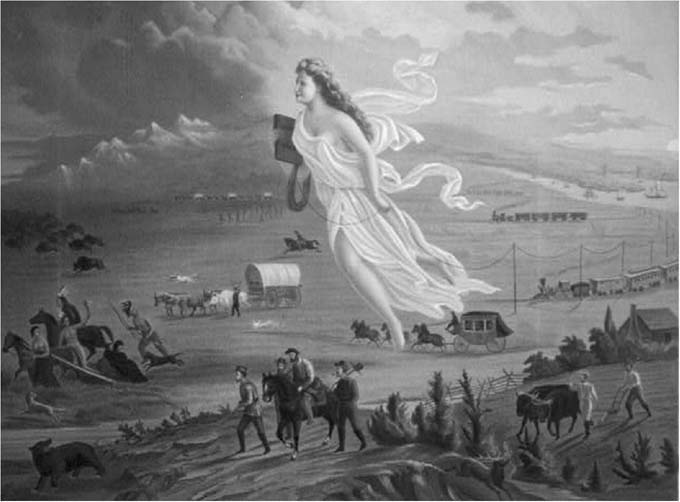
A painting titled “American Progress” or “Westward the Course of Destiny” by George A. Crofutt, 1873, features an allegorical female figure leading pioneers and railroads westward, and captures the spirit of Manifest Destiny.
...
- People on the Left
- Anthony, Susan B.
- Bellamy, Edward
- Bentham, Jeremy
- Breitman, George
- Browder, Earl
- Carmichael, Stokely
- Carter, James E.
- Carville, James
- Cleaver, Eldridge
- Clinton, William J.
- Coxey, Jacob
- Croly, Herbert
- Debs, Eugene V.
- Deng Xiaoping
- Douglass, Frederick
- Du Bois, W.E.B.
- Duclos, Jacques
- Dunayevskaya, Raya
- Engels, Friedrich
- Flynn, Elizabeth Gurley
- Foster, William Z.
- Freidan, Betty
- Fromm, Erich
- Ghandi, Mahatma
- Gilman, Charlotte Perkins
- Gitlow, Benjamin
- Goldman, Emma
- Gorbachev, Mikhail
- Guevara, Che
- Hall, Gus
- Hammett, Dashiell
- Harrington, Michael
- Hayden, Tom
- Haywood, William D
- Hillman, Sidney
- Hillquit, Morris
- Hobbes, Thomas
- Hollywood Ten
- Hopkins, Harry
- Hume, David
- Humphrey, Hubert H.
- Jefferson, Thomas
- Johnson, Lyndon B.
- Kefauver, Estes
- Kennedy, John F.
- King, Martin Luther, Jr.
- La Follette, Robert
- Lenin, Vladimir I.
- Lincoln, Abraham
- Lippmann, Walter
- Lloyd, Henry Demarest
- Locke, John
- Long, Huey
- Lovestone, Jay
- Malcolm X
- Marcuse, Herbert
- Marx, Karl
- Moore, Michael
- Mott, Lucretia
- Muste, Abraham J.
- Nader, Ralph
- Nearing, Scott
- O'Neil, Thomas P.
- Orwell, George
- Paul, Alice
- Randolph, A. Philip
- Reed, John
- Roosevelt, Eleanor
- Roosevelt, Franklin D.
- Rousseau, Jean-Jacques
- Sacco and Vanzetti
- Schlesinger, Arthur M., Jr.
- Stanton, Elizabeth Cady
- Steinem, Gloria
- Stevenson, Adlai E.
- Thomas, Norman M.
- Thompson, Hunter S.
- Trotsky, Leon
- Truman, Harry
- Wallace, Henry A.
- Washington, George
- Wilson, Woodrow
- Wright, Frances
- People on the Right
- Ali, Noble Drew
- Bennett, William J.
- Bilbo, Theodore G.
- Borah, William E.
- Buchanan, Patrick J.
- Buckley, William F., Jr.
- Burke, Edmund
- Bush, George H.W.
- Bush, George W.
- Churchill, Sir Winston
- Coolidge, Calvin
- Coughlin, Charles E.
- Coulter, Ann H.
- Dewey, Thomas E.
- Dos Passos, John
- Drudge, Matt
- Eisenhower, Dwight D.
- Ford, Gerald R.
- Garvey, Marcus
- Gingrich, Newt
- Goldwater, Barry
- Harding, Warren G.
- Hearst, William Randolph
- Hitler, Adolf
- Hoover, Herbert
- Hoover, J. Edgar
- Khomeini, Ruhollah
- La Guardia, Fiorello H.
- Landon, Alfred M.
- Limbaugh, Rush
- Lincoln, Abraham
- Lind, Michael
- Lindbergh, Charles A.
- Luce, Henry R.
- Mises, Ludwig von
- Nietzsche, Friedrich
- Nixon, Richard M.
- Rand, Ayn
- Reagan, Ronald
- Roosevelt, Theodore
- Shockley, William B.
- Sowell, Thomas
- Taft, Robert A.
- Taft, William H.
- Thatcher, Margaret
- Washington, Booker T.
- Will, George F.
- Willkie, Wendell
- Countries/Regions: Left Politics
- Africa
- Argentina
- Asia
- Australia
- Austria
- Brazil
- Canada
- Chile
- China
- Czech Republic
- Egypt
- France
- Greece
- India
- Indonesia
- Iran
- Ireland
- Israel
- Italy
- Japan
- Korea, North
- Korea, South
- Mexico
- Middle East
- Nigeria
- Peru
- Poland
- Russia, Post-Soviet
- Saudi Arabia
- Singapore
- South Africa
- South America
- Soviet Union
- Spain
- Sweden
- Switzerland
- Turkey
- Uganda
- Ukraine
- United Kingdom
- United States
- Countries/Regions: Right Politics
- Africa
- Argentina
- Asia
- Australia
- Austria
- Brazil
- Canada
- Chile
- China
- Czech Republic
- Egypt
- France
- Greece
- India
- Iran
- Iraq
- Ireland
- Israel
- Italy
- Japan
- Korea, South
- Mexico
- Middle East
- Nigeria
- Peru
- Poland
- Russia, Post-Soviet
- Saudi Arabia
- Singapore
- South Africa
- South America
- Soviet Union
- Spain
- Sweden
- Switzerland
- Turkey
- Uganda
- Ukraine
- United Kingdom
- United States
- Leftist “Isms”
- Abolitionism
- Anarchism
- Anarcho-Syndicalism
- Bicameralism
- Bolshevism
- Communism
- Communitarianism
- Despotism
- Environmentalism
- Fabianism
- Feminism
- Fourierism
- Liberalism
- Maoism
- Market Socialism
- Marxist Humanism
- Populism
- Postmodernism
- Québec Separatism
- Saint-Simonism
- Socialism
- Socialist Realism
- Stalin and Stalinism
- Syndicalism
- Third Worldism
- Titoism
- Zionism
- Rightist “Isms”
- Agrarianism
- Black Nationalism
- Black Separatism
- Capitalism
- Colonialism
- Conservatism
- Corporatism
- Corsican Separatism
- Darwinism
- Despotism
- Elitism
- Falangism
- Fascism
- Feudalism
- Fundamentalism
- Imperialism
- Isolationism
- Libertarianism
- McCarthyism
- Monarchism
- Nationalism
- Orientalism
- Pan-Africanism
- Patriotism
- Peronism
- Prohibitionism
- Sabbatarianism
- Totalitarianism
- Ultramontanism
- Unilateralism
- Zionism
- Leftist Political Issues
- Abolitionism
- Alienation
- Anarchism
- Anarcho-Syndicalism
- Anti-Globalization
- Bicameralism
- Campaign Finance
- Communism
- Communitarianism
- Cultural Diversity
- Democracy
- Desegregation
- Environmentalism
- Human Rights
- Ideology
- Liberalism
- Lobbying
- Market Socialism
- Media Bias, Left
- Political Economy
- Politically Correct
- Polls and Pollsters
- Social Democracy
- Socialism
- Socialist Realism
- Stalin and Stalinism
- Vietnam War
- Voting, Unrestricted
- Welfare and Poverty
- Rightist Political Issues
- Balance of Power
- Capitalism
- Censorship
- Conservatism
- Corporatism
- Darwinism
- Despotism
- Education
- Ethnic Cleansing
- Fascism
- Foreign Policy, U.S.
- Fundamentalism
- Globalization
- Healthcare
- Ideology
- Isolationism
- Laissez-Faire
- Libertarianism
- Lobbying
- Manifest Destiny
- Media Bias, Right
- Polls and Pollsters
- Realpolitik
- Segregation
- States' Rights
- Technocracy, Inc.
- Theocracy
- Totalitarianism
- Unilateralism
- Vietnam War
- Welfare and Poverty
- Xenophobia
- Leftist Laws
- Abortion/Pro-Choice
- American Civil Liberties Union
- Animal Rights
- Bill of Rights
- Censorship
- Church and State Separation
- Civil Liberties
- Civil Rights
- Constitutional Amendments
- Consumer Rights
- Death Penalty Elimination
- Desegregation
- First Amendment
- Freedom of Information
- Gun Control
- Healthcare
- Human Rights
- Immigration
- Lobbying
- New Deal
- Social Security
- Supreme Court
- Voting, Unrestricted
- Welfare and Poverty
- Rightist Laws
- Leftist Political Parties
- African National Congress
- American Civil Liberties Union
- Black Panthers
- Catholic Worker
- Christian Democracy
- Communist Party, Soviet
- Democratic Party
- Green Party
- Greenback Party
- Labour Party, UK
- Liberal Party, Australia
- Liberal Party, Canada
- Liberal Party, Hong Kong
- Liberal Party, UK
- PRI (Mexico)
- Progressive Party
- Socialist Party, U.S.
- Socialist Workers' Party, UK
- Suffragists
- Workers Party
- Workingmen's Party
- Rightist Political Parties
- Leftist Political Movements
- Abortion/Pro-Choice
- Affirmative Action
- Anarcho-Syndicalism
- Animal Rights
- Anti-Globalization
- Bolshevism
- Civil Rights
- Consumer Rights
- Death Penalty Elimination
- Democracy
- Desegregation
- Environmentalism
- Feminism
- Gay and Lesbian Movements
- Gun Control
- Human Rights
- Niagara Movement
- Palestine Liberation Organization
- Postmodernism
- Protests
- Solidarity
- Students for a Democratic Society
- Suffragists
- Zionism
- Rightist Political Movements
- Loading...
Get a 30 day FREE TRIAL
-
 Watch videos from a variety of sources bringing classroom topics to life
 -
Read modern, diverse business cases
-
Explore hundreds of books and reference titles

Read next

More like this
Sage Recommends
We found other relevant content for you on other Sage platforms.
Have you created a personal profile? Login or create a profile so that you can save clips, playlists and searches