
Entry
Reader's guide
Entries A-Z
Subject index
Hayden, Tom (1939–)
TOM HAYDEN HAS spent his adult life working for political, economic, and global change. Born in 1939, Hayden reached adulthood at the beginning of one of the nation's more activist periods, and he jumped right in. From his first anti-war demonstration through his years in the California state legislature and later as a retired legislator, Hayden has upheld his beliefs in democracy, specifically economic democracy.
Hayden first became interested in politics and activism in 1960 during the civil rights movement, when he joined the sit-in demonstrations against Woolworth stores. As he continued to work toward his degree in English, he also continued to explore political radicalism, eventually accepting his place in the student movements that spread across the nation in the mid-to-late 1960s. Hayden's involvement in the radical movement was more than joining the various student groups; instead, he formed two organizations of his own (VOICE, ERAP), staged demonstrations, and spearheaded many anti-war activities. Except for the anti-war demonstrations, Hayden's political activities and beliefs centered on the ideology of economic equity. He believed that the nation's problems were the result of economic oppression and the unregulated power of the federal government and large corporations. Through his Economic Research and Action Project (ERAP), Hayden organized a number of community action groups and was very active in the most successful of those groups, the Newark Community Union Project (NCUP). Under Hayden's sponsorship, NCUP managed to build a playground for the local children, helped terminate an urban renewal project, and got better garbage collection for the ghetto community.
Between 1966 and 1971, Hayden's militant anti-war stance grew until it culminated at a violent protest in Chicago, Illinois. He came to national attention in 1968 as one of the organizers of the demonstration and riot at the Democratic National Convention in Chicago, becoming a renowned leader of the national radical movement. A member of the infamous Chicago Seven, Hayden helped organize the various demonstrations, trained the youthful demonstrators in various military tactics and methods of self-defense, and recruited numerous students and others from the Students for a Democratic Society (SDS) and other student and anti-war organizations in which he was involved. The demonstrators hoped to prove to the political mainstream and the nation that the U.S. involvement in Vietnam was a conspiracy of the military-industrial complex and the federal government. After the riots, the Chicago Seven were indicted and convicted for conspiracy with the intent to incite a riot and contempt of court, charges that were overturned in 1973.
Tom Hayden speaks to students in 1969 at an anti-war demonstration on the campus of the University of California, Berkeley.
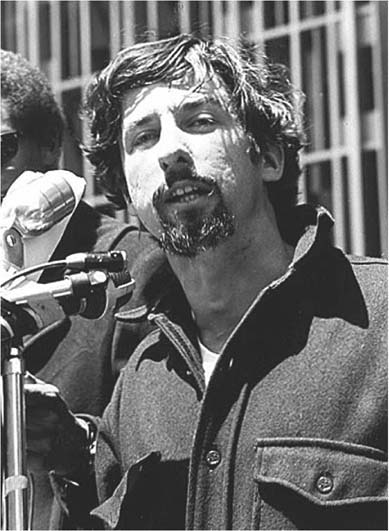
After the conviction in 1970 and throughout the early 1970s, Hayden began to move from overtly militant to more conventional methods of trying to influence the government. He continued to protest the war, but did so using traditional means such as supporting anti-war Democratic candidate George McGovern in 1972 and writing articles against the war. In 1971, he met activist-actress Jane Fonda, and together, they called for the immediate U. S. withdrawal from Southeast Asia. Once the Paris peace accords were signed ending the war, the couple continued their political involvement and solidified their commitment to their leftist politics and each other by marrying in 1973.
...
- People on the Left
- Anthony, Susan B.
- Bellamy, Edward
- Bentham, Jeremy
- Breitman, George
- Browder, Earl
- Carmichael, Stokely
- Carter, James E.
- Carville, James
- Cleaver, Eldridge
- Clinton, William J.
- Coxey, Jacob
- Croly, Herbert
- Debs, Eugene V.
- Deng Xiaoping
- Douglass, Frederick
- Du Bois, W.E.B.
- Duclos, Jacques
- Dunayevskaya, Raya
- Engels, Friedrich
- Flynn, Elizabeth Gurley
- Foster, William Z.
- Freidan, Betty
- Fromm, Erich
- Ghandi, Mahatma
- Gilman, Charlotte Perkins
- Gitlow, Benjamin
- Goldman, Emma
- Gorbachev, Mikhail
- Guevara, Che
- Hall, Gus
- Hammett, Dashiell
- Harrington, Michael
- Hayden, Tom
- Haywood, William D
- Hillman, Sidney
- Hillquit, Morris
- Hobbes, Thomas
- Hollywood Ten
- Hopkins, Harry
- Hume, David
- Humphrey, Hubert H.
- Jefferson, Thomas
- Johnson, Lyndon B.
- Kefauver, Estes
- Kennedy, John F.
- King, Martin Luther, Jr.
- La Follette, Robert
- Lenin, Vladimir I.
- Lincoln, Abraham
- Lippmann, Walter
- Lloyd, Henry Demarest
- Locke, John
- Long, Huey
- Lovestone, Jay
- Malcolm X
- Marcuse, Herbert
- Marx, Karl
- Moore, Michael
- Mott, Lucretia
- Muste, Abraham J.
- Nader, Ralph
- Nearing, Scott
- O'Neil, Thomas P.
- Orwell, George
- Paul, Alice
- Randolph, A. Philip
- Reed, John
- Roosevelt, Eleanor
- Roosevelt, Franklin D.
- Rousseau, Jean-Jacques
- Sacco and Vanzetti
- Schlesinger, Arthur M., Jr.
- Stanton, Elizabeth Cady
- Steinem, Gloria
- Stevenson, Adlai E.
- Thomas, Norman M.
- Thompson, Hunter S.
- Trotsky, Leon
- Truman, Harry
- Wallace, Henry A.
- Washington, George
- Wilson, Woodrow
- Wright, Frances
- People on the Right
- Ali, Noble Drew
- Bennett, William J.
- Bilbo, Theodore G.
- Borah, William E.
- Buchanan, Patrick J.
- Buckley, William F., Jr.
- Burke, Edmund
- Bush, George H.W.
- Bush, George W.
- Churchill, Sir Winston
- Coolidge, Calvin
- Coughlin, Charles E.
- Coulter, Ann H.
- Dewey, Thomas E.
- Dos Passos, John
- Drudge, Matt
- Eisenhower, Dwight D.
- Ford, Gerald R.
- Garvey, Marcus
- Gingrich, Newt
- Goldwater, Barry
- Harding, Warren G.
- Hearst, William Randolph
- Hitler, Adolf
- Hoover, Herbert
- Hoover, J. Edgar
- Khomeini, Ruhollah
- La Guardia, Fiorello H.
- Landon, Alfred M.
- Limbaugh, Rush
- Lincoln, Abraham
- Lind, Michael
- Lindbergh, Charles A.
- Luce, Henry R.
- Mises, Ludwig von
- Nietzsche, Friedrich
- Nixon, Richard M.
- Rand, Ayn
- Reagan, Ronald
- Roosevelt, Theodore
- Shockley, William B.
- Sowell, Thomas
- Taft, Robert A.
- Taft, William H.
- Thatcher, Margaret
- Washington, Booker T.
- Will, George F.
- Willkie, Wendell
- Countries/Regions: Left Politics
- Africa
- Argentina
- Asia
- Australia
- Austria
- Brazil
- Canada
- Chile
- China
- Czech Republic
- Egypt
- France
- Greece
- India
- Indonesia
- Iran
- Ireland
- Israel
- Italy
- Japan
- Korea, North
- Korea, South
- Mexico
- Middle East
- Nigeria
- Peru
- Poland
- Russia, Post-Soviet
- Saudi Arabia
- Singapore
- South Africa
- South America
- Soviet Union
- Spain
- Sweden
- Switzerland
- Turkey
- Uganda
- Ukraine
- United Kingdom
- United States
- Countries/Regions: Right Politics
- Africa
- Argentina
- Asia
- Australia
- Austria
- Brazil
- Canada
- Chile
- China
- Czech Republic
- Egypt
- France
- Greece
- India
- Iran
- Iraq
- Ireland
- Israel
- Italy
- Japan
- Korea, South
- Mexico
- Middle East
- Nigeria
- Peru
- Poland
- Russia, Post-Soviet
- Saudi Arabia
- Singapore
- South Africa
- South America
- Soviet Union
- Spain
- Sweden
- Switzerland
- Turkey
- Uganda
- Ukraine
- United Kingdom
- United States
- Leftist “Isms”
- Abolitionism
- Anarchism
- Anarcho-Syndicalism
- Bicameralism
- Bolshevism
- Communism
- Communitarianism
- Despotism
- Environmentalism
- Fabianism
- Feminism
- Fourierism
- Liberalism
- Maoism
- Market Socialism
- Marxist Humanism
- Populism
- Postmodernism
- Québec Separatism
- Saint-Simonism
- Socialism
- Socialist Realism
- Stalin and Stalinism
- Syndicalism
- Third Worldism
- Titoism
- Zionism
- Rightist “Isms”
- Agrarianism
- Black Nationalism
- Black Separatism
- Capitalism
- Colonialism
- Conservatism
- Corporatism
- Corsican Separatism
- Darwinism
- Despotism
- Elitism
- Falangism
- Fascism
- Feudalism
- Fundamentalism
- Imperialism
- Isolationism
- Libertarianism
- McCarthyism
- Monarchism
- Nationalism
- Orientalism
- Pan-Africanism
- Patriotism
- Peronism
- Prohibitionism
- Sabbatarianism
- Totalitarianism
- Ultramontanism
- Unilateralism
- Zionism
- Leftist Political Issues
- Abolitionism
- Alienation
- Anarchism
- Anarcho-Syndicalism
- Anti-Globalization
- Bicameralism
- Campaign Finance
- Communism
- Communitarianism
- Cultural Diversity
- Democracy
- Desegregation
- Environmentalism
- Human Rights
- Ideology
- Liberalism
- Lobbying
- Market Socialism
- Media Bias, Left
- Political Economy
- Politically Correct
- Polls and Pollsters
- Social Democracy
- Socialism
- Socialist Realism
- Stalin and Stalinism
- Vietnam War
- Voting, Unrestricted
- Welfare and Poverty
- Rightist Political Issues
- Balance of Power
- Capitalism
- Censorship
- Conservatism
- Corporatism
- Darwinism
- Despotism
- Education
- Ethnic Cleansing
- Fascism
- Foreign Policy, U.S.
- Fundamentalism
- Globalization
- Healthcare
- Ideology
- Isolationism
- Laissez-Faire
- Libertarianism
- Lobbying
- Manifest Destiny
- Media Bias, Right
- Polls and Pollsters
- Realpolitik
- Segregation
- States' Rights
- Technocracy, Inc.
- Theocracy
- Totalitarianism
- Unilateralism
- Vietnam War
- Welfare and Poverty
- Xenophobia
- Leftist Laws
- Abortion/Pro-Choice
- American Civil Liberties Union
- Animal Rights
- Bill of Rights
- Censorship
- Church and State Separation
- Civil Liberties
- Civil Rights
- Constitutional Amendments
- Consumer Rights
- Death Penalty Elimination
- Desegregation
- First Amendment
- Freedom of Information
- Gun Control
- Healthcare
- Human Rights
- Immigration
- Lobbying
- New Deal
- Social Security
- Supreme Court
- Voting, Unrestricted
- Welfare and Poverty
- Rightist Laws
- Leftist Political Parties
- African National Congress
- American Civil Liberties Union
- Black Panthers
- Catholic Worker
- Christian Democracy
- Communist Party, Soviet
- Democratic Party
- Green Party
- Greenback Party
- Labour Party, UK
- Liberal Party, Australia
- Liberal Party, Canada
- Liberal Party, Hong Kong
- Liberal Party, UK
- PRI (Mexico)
- Progressive Party
- Socialist Party, U.S.
- Socialist Workers' Party, UK
- Suffragists
- Workers Party
- Workingmen's Party
- Rightist Political Parties
- Leftist Political Movements
- Abortion/Pro-Choice
- Affirmative Action
- Anarcho-Syndicalism
- Animal Rights
- Anti-Globalization
- Bolshevism
- Civil Rights
- Consumer Rights
- Death Penalty Elimination
- Democracy
- Desegregation
- Environmentalism
- Feminism
- Gay and Lesbian Movements
- Gun Control
- Human Rights
- Niagara Movement
- Palestine Liberation Organization
- Postmodernism
- Protests
- Solidarity
- Students for a Democratic Society
- Suffragists
- Zionism
- Rightist Political Movements
- Loading...
Get a 30 day FREE TRIAL
-
 Watch videos from a variety of sources bringing classroom topics to life
 -
Read modern, diverse business cases
-
Explore hundreds of books and reference titles

Read next

More like this
Sage Recommends
We found other relevant content for you on other Sage platforms.
Have you created a personal profile? Login or create a profile so that you can save clips, playlists and searches