
Entry
Reader's guide
Entries A-Z
Subject index
White House Press Corps
The White House press corps consists of those journalists from various news media who primarily cover the presidency. In covering the president as well as other administration officials, they rely on daily briefings and news releases for information, ideally hold officials accountable, and give the White House communication entrée into the presidential news cycle by deadline.
Journalists have covered the president from the nation's beginning, along with other news from the nation's capital. As the power of the presidency grew in the 19th century, two factors led to a White House press corps. First, the number of Washington correspondents increased from four, during James Madison's administration, to several hundred by the 20th century and to almost 10,000 by the 21st century. Because of this, journalists had to specialize their coverage. Second, by the latter part of the 19th century a number of major city newspaper editors and publishers concentrated on reportage of the president so much so that a designated White House space was allotted to waiting journalists. A secretary would give daily briefings on everyday information and advance copies of speeches and arrange for conferences and interviews with the president.
With more and more direct contact with Washington correspondents and a desire to sway public opinion, the White House developed additional techniques to influence its political communication. Theodore Roosevelt held informal press meetings with his “newspaper cabinet,” as he called them, when he went over his mail or had his morning shave. For the most part, he gave the journalists background information, without attribution, and threatened to stop all briefings and press releases for erring journalists. Woodrow Wilson initiated semiweekly talks and was surprised when a hundred reporters attended. Although the meetings were useful for both the president and the correspondents, even with rules of confidentiality, Wilson found it difficult to be open with the journalists during peacetime and impossible during war; by the end of 1916, he stopped.
President Gerald Ford talks with reporters, including Helen Thomas, during a press conference at the White House, Washington, D.C.
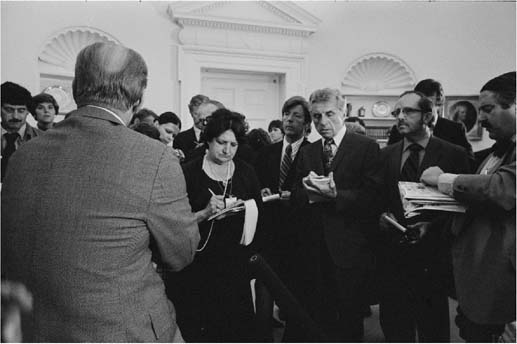
To separate from the huge Washington Correspondents' Association, a White House Correspondents Association began in 1914 as a social organization with a dozen or so members; it also acted as a screening mechanism for admission to the president's press conferences. The impetus was President Wilson's threat to cease his press meetings after several journalists published his “off-the-record” comments about a 1913 diplomatic crisis with Mexico. The association accredited members, weeded out rule violators, and negotiated with the White House over their working conditions. Membership was initially limited to those whose duty was to cover the White House (then, print journalists) and who had membership in the accredited press galleries of Congress. During the Franklin Roosevelt years, the association began annual dinners for the president. Today, all kinds of media are represented in the White House press corps.
New technologies impacted the White House press corps membership and communication. Radio correspondents were included in the 1940s, television in the 1950s, and more recently reporters for online publications. Now, the press corps relies on the White House Web site for press releases, the daily briefings, the president's schedule, and pooled reports from those journalists who travel with the president. The president's press conferences have gone from taped television during the Eisenhower years to live television beginning with John F. Kennedy to live press secretary's briefings during the Clinton era. Website updates meant that Washington correspondents can follow White House news.
...
- Abdullah II
- Adenauer, Konrad
- Agnew, Spiro
- Ailes, Roger
- Al-Asad, Hafiz
- Alfonsín, Raúl
- Allende, Salvador
- Al-Sadat, Anwar
- Arafat, Yasser
- Aznar, José María
- Bachelet Jeria, Michelle
- Ben Ali, Zine el-Abidine
- Berlusconi, Silvio
- Blair, Tony
- Blumler, Jay G.
- Bormann, Ernest
- Bouteflika, Abdelaziz
- Brandt, Willy
- Broder, David
- Buchanan, Patrick
- Bush, George H. W.
- Bush, George W.
- Bush, Laura
- Cardoso, Fernando Henrique
- Carville, James
- Castro, Fidel
- Chaffee, Steven H.
- Chávez, Hugo
- Chirac, Jacques
- Chisolm, Shirley
- Churchill, Sir Winston
- Çiller, Tansu
- Clinton, Hillary Rodham
- Clinton, William Jefferson
- Coburg-Gotha, Simeon Saxe
- Collor de Mello, Fernando
- Connally, John
- Cronkite, Walter
- Dean, Howard
- de Gaulle, Charles
- Demirel, Süleyman
- Deng Xiaoping
- Denton, Robert E., Jr.
- Dole, Elizabeth
- Dole, Robert
- Donsbach, Wolfgang
- Dukakis, Michael
- Ecevit, Bülent
- Edelman, Murray
- Eisenhower, Dwight D.
- Entman, Robert
- Erdoğan, Recep Tayyip
- Ferraro, Geraldine
- Fleischer, Ari
- Ford, Betty
- Ford, Gerald
- Fox, Vicente
- Franken, Al
- Gandhi, Indira
- Gerbner, George
- Gingrich, Newt
- Giscard d'Estaing, Valéry
- Giuliani, Rudy
- Goebbels, Joseph
- Goldwater, Barry
- González Márquez, Felipe
- Gorbachev, Mikhail
- Gore, Albert
- Graber, Doris A.
- Greeley, Horace
- Guggenheim, Charles
- Haider, Jörg
- Hallin, Daniel C.
- Hanson, Pauline
- Harris, Fred
- Hart, Gary
- Hart, Roderick P.
- Hassan II, King
- Havel, Václav
- Hearst, William Randolph
- Hitler, Adolf
- Holtz-Bacha, Christina
- Humphrey, Hubert H.
- Hussein I, King
- Jackson, Jesse
- Jamieson, Kathleen Hall
- Johnson, Lyndon B.
- Jordan, Barbara
- Kaid, Lynda Lee
- Katz, Elihu
- Kekkonen, Urho
- Kennedy, Edward (Ted)
- Kennedy, John F.
- Kennedy, Robert F.
- Kenyatta, Jomo
- Kepplinger, Hans Mathias
- Kerry, John
- Khrushchev, Nikita
- Kibaki, Mwai
- King, Martin Luther, Jr.
- Klapper, Joseph
- Kohl, Helmut
- Kraus, Sidney
- Kreisky, Bruno
- Kwaśniewski, Aleksander
- Lang, Gladys Engel
- Lang, Kurt
- Lasswell, Harold
- Lazarsfeld, Paul F.
- Lehrer, Jim
- Lenin, Vladímir I.
- Le Pen, Jean-Marie
- Lewinsky, Monica
- Limbaugh, Rush
- Lippmann, Walter
- Loukanov, Andrey
- Machiavelli, Niccolò
- Mancini, Paolo
- Mandela, Nelson
- Mandelson, Peter
- Mao Zedong
- Marx, Karl
- Matalin, Mary
- Mazzoleni, Gianpietro
- McCain, John
- McCombs, Maxwell
- McGovern, George
- McLuhan, Marshall
- McQuail, Denis
- Meir, Golda
- Menem, Carlos
- Merkel, Angela
- Mitsotakis, Konstantinos
- Mitterrand, François
- Mohammed VI
- Moi, Daniel Arap
- Morales, Evo
- Moseley Braun, Carol
- Moyers, William (Bill)
- Mubarak, Hosni
- Murrow, Edward R.
- Muskie, Edmund
- Nader, Ralph
- Napolitan, Joseph
- Nasser, Gamal Abdel
- Nimmo, Dan
- Nixon, Richard M.
- Noelle-Neumann, Elisabeth
- Nyerere, Julius
- Obama, Barack
- Onassis, Jacqueline Kennedy
- O'Reilly, Bill
- Özal, Turgut
- Palme, Olof
- Papandreou, Andreas
- Perón, Juan
- Perón, María Eva Duarte de
- Perot, Ross
- Putin, Vladimir
- Quayle, Dan
- Rabin, Yitzhak
- Rather, Dan
- Rawlings, Jerry
- Reagan, Nancy
- Reagan, Ronald
- Rice, Condoleezza
- Richards, Ann
- Rivera, Geraldo
- Rogers, Everett M.
- Roosevelt, Eleanor
- Roosevelt, Franklin D.
- Sabato, Larry
- Sanders, Keith R.
- Schramm, Wilbur
- Schröder, Gerhard
- Schroeder, Patricia
- Schulz, Winfried
- Schüssel, Wolfgang
- Schwartz, Tony
- Schwarzenegger, Arnold
- Senghor, Léopold Sédar
- Sharon, Ariel
- Simitis, Konstantinos
- Stephanopoulos, George
- Stevenson, Adlai
- Thatcher, Margaret
- Trippi, Joe
- Uzan, Cem
- Vargas, Getulio
- Vranitzky, Franz
- Wałęsa, Lech
- Wallace, George
- Watts, J. C.
- Weaver, David H.
- Wellstone, Paul
- Will, George
- Wilson, Harold
- Wolfsfeld, Gadi
- Yassine, Abdessalam
- Yeltsin, Boris
- Zhelev, Zhelyu
- Zhivkov, Todor
- All the President's Men
- American Voter, The
- Bowling Alone
- Campaigns & Elections Magazine
- Candidate, The
- Candidates and Their Images
- Citizen Kane
- Commander in Chief
- Comparing Media Systems
- Creating Reality
- Crosstalk
- Daily Show, The
- Deciding What's News
- Effects of Mass Communication, The
- Film and Politics
- Four Theories of the Press
- Great Debates, The
- Handbook of Political Communication, The
- Image, The
- Mediated Political Realities
- Nature of Prejudice, The
- News: The Politics of Illusion
- Nightline
- People's Choice, The
- Personal Influence
- Political Campaign Communication
- Political Communication
- Presentation of Self in Everyday Life, The
- Processing the News
- Psychology of Radio, The
- Responsive Chord, The
- Saturday Night Live
- Selling of the President 1968, The
- Symbolic Uses of Politics, The
- Television in Politics
- Unseeing Eye, The
- Virtuous Circle, A
- War of the Worlds, The
- West Wing, The
- Argentina Democratization Process, Role of the Media
- Brazil, Media and the Political System
- Bulgaria, Democratization
- Democratization, Role of the Media in
- Direct Action Protest, Australia
- Direct Democracy
- German Unification, Role of the Media
- Hungary, Communication and Politics
- Poland, Democratization
- Russia, Democratization and Media
- Carrie Chapman Catt Center for Women and Politics
- Center for the Study of the American Electorate
- Freedom Forum Media Studies Center
- Graduate School of Political Management
- McGovern Library and Center for Public Service and Leadership
- Pew Internet & American Life Project
- Pew Research Center for the People & the Press
- Political Commercial Archive
- Political Communication Center
- Survey Research Center
- Vanderbilt Television News Archive
- World Association for Public Opinion Research
- Electoral Systems
- European Parliamentary Elections
- E-Voting
- Grassroots Campaigning
- Iowa Caucuses
- Primaries
- Proportional Representation
- Second-Order Election
- Ticket Splitting
- Voter News Service
- Voting Behavior
- Youth Voting
- Brazil, Media and the Political System
- China, Media and Politics in
- Chinese Cultural Revolution
- Communism
- Conservative, Conservatism
- E-Government
- Electoral Systems
- Eurobarometer
- European Commission
- European Parliament
- European Parliamentary Elections
- European Union
- Federal Trade Commission
- Government Communication
- Hong Kong Handover
- Hungary, Communication and Politics
- Political Prisoners
- Press Secretary, White House
- Proportional Representation
- Public Affairs, Communication in
- State of the Union Address
- Supreme Court, Media and the
- Abortion
- Affirmative Action
- Ballot Initiatives
- Bipartisan Campaign Reform Act
- Brazil, Media and the Political System
- Buckley v. Valeo
- Campaign Finance
- Censorship, Political
- Civil Rights Movement
- Communications Act of 1934
- Council of Europe, Media Policy
- Equal Time Provision
- European Commission
- European Convention on Human Rights
- European Court of Justice
- European Union Media Policy
- Fairness Doctrine
- Federal Election Campaign Act
- Federal Trade Commission
- First Amendment
- Free Airtime
- Freedom of Information
- Libel
- McConnell v. Federal Election Commission
- Obscenity and Pornography
- Press Freedom
- Press Law of 1766, Sweden
- Red Lion Broadcasting Co. v. FCC
- Reputation in Politics
- Royal Commission on the Press
- Shield Laws
- Soft Money
- UNESCO Media Policy
- United States Information Agency
- Ad Watch
- Advocacy Advertising
- Agenda Melding
- Agenda Setting
- Al Jazeera Television
- Alternative Media in Politics
- Argentina Democratization Process, Role of the Media
- Banner Ads
- Big-Character Posters, China
- Blogs, Blogging
- Brazil, Media and the Political System
- Bush–Rather Confrontation
- Campaigns & Elections Magazine
- Candidate Films, Biographical
- Cartoons, Political
- Checkers Speech
- China, Media and Politics in
- Citizen Journalism
- CNN (Cable News Network)
- Commander in Chief
- Commentary, Political
- Congress and the Media
- C-SPAN Network
- Daily Show, The
- Daisy Girl Ad
- Debates
- DebateWatch
- Democratization, Role of the Media in
- Direct Mail
- Editorials
- E-Mail, Political Uses
- Fairness Doctrine
- Film and Politics
- Fireside Chats
- Fourth Estate, Media as
- Fox News
- Free Airtime
- Freedom Forum Media Studies Center
- German Unification, Role of the Media
- Gulf War, Media Coverage of
- Hard News
- Horserace Coverage
- Hostile Media Effect
- Hungary, Communication and Politics
- Information Technology in Politics
- Infotainment
- Iraq War, Media Coverage of
- Letters to the Editor
- Media Bias
- Media Buying in Politics
- Media Consultants
- Media Events
- Media Feeding Frenzy
- Media Logic
- Mediatization
- Metacoverage
- Muckrakers, Muckraking
- Music and Politics
- National Association of Broadcasters
- National Public Radio (NPR)
- Negative Advertising
- New Media Technologies
- New York Times, The
- News Coverage, Politics
- News Magazines
- News Management
- News Selection Process
- Newspapers, Role in Politics
- Nightline
- Party Election Broadcasts
- Party Press
- PBS (Public Broadcasting Service)
- Political Advertising, Independent
- Political Advertising, Radio
- Political Advertising
- Political Branding
- Pooled Journalism
- Posters, Political
- Press and Politics
- Press Conferences
- Press Freedom
- Press Secretary, White House
- Press Theories
- Public Affairs, Communication in
- Public Relations, Political
- Public Service Broadcasting
- Radio Addresses
- Radio Free Europe
- Radio, Politics and
- Reporters Without Borders
- Rock the Vote
- Russia, Democratization and Media
- Rwanda Genocide, Role of Media
- Saturday Night Live
- Soft News
- Sound Bite
- Spin, Political
- Stringer
- Supreme Court, Media and the
- Tabloids
- Talk Radio, Political
- Talk Shows, Television
- Tampa Incident
- TechnoDistortions
- Testimonials, Political
- Underground Media
- UNESCO Media Policy
- Video Games, Political
- Videostyle
- Voice of America
- Voter News Service
- War Coverage
- War of the Worlds, The
- Washington Post, The
- Web Campaigning
- Webstyle
- West Wing, The
- White House Press Corps
- Willie Horton Ad
- Women Candidates, Advertising
- Women Candidates, News Coverage
- World Wide Web, Political Uses
- Apathy, Voter
- Authoritarianism
- Cybernationalism
- Ideology
- Mass Political Behavior
- New Right
- Parasocial Relationships in Politics
- Party Identification
- Political Branding
- Political Correctness
- Political Culture
- Political Involvement
- Political Knowledge
- Polls
- Populism
- Psychographics in Politics
- Public Opinion
- Race in Politics
- Ticket Splitting
- Voter Behavior
- American-Style Campaigning
- Ballot Initiatives
- Campaign Finance
- Candidate-Centered Communication
- Candidate Films, Biographical
- Celebrities in Politics
- Commission on Presidential Debates
- Daisy Girl Ad
- Debates
- DebateWatch
- Free Airtime
- Grassroots Campaigning
- Hate Speech
- Iowa Caucuses
- Media Consultants
- Negative Campaigning
- Party Election Broadcasts
- Personal Campaigning
- Political Advertising
- Political Advertising, Independent
- Political Advertising, Radio
- Primaries
- Soft Money
- Testimonials, Political
- Web Campaigning
- Webstyle
- Willie Horton Ad
- Women Candidates, Advertising
- Women Candidates, News Coverage
- Checkers Speech
- Chinese Cultural Revolution
- Falklands-Malvinas War
- Gulf War, Media Coverage of
- Helsinki Process
- Heuristics in Political Decision Making
- Hill–Thomas Hearings
- Hong Kong Handover
- Inaugural Addresses, Presidential
- Iowa Caucuses
- Iraq War, Media Coverage of
- Kennedy Assassination
- Mass Nonviolent Protest, Australia
- McCarthy Hearings
- Muhammed Cartoon Events
- Pentagon Papers, The
- Political Conflict
- Political Scandal
- Protests, Political
- Revolution, Political
- Speeches, Presidential
- Spiegel Affair
- State of the Union Address
- Tampa Incident
- Terrorism and Media
- Waldheim Affair
- War Coverage
- Watergate
- Watts Riots
- AARP
- Advocacy Advertising
- Aging and Politics
- American Association of Political Consultants
- Center for the Study of the American Electorate
- Commission on Presidential Debates
- Congress and the Media
- Conservative Party, Britain
- Conventions, Political
- Council of Europe, Media Policy
- Democratic National Committee
- Democratic Party
- European Association of Political Consultants
- European Parliament
- European Parliamentary Elections
- European Union
- European Union, Media Policy
- Feminist Movement
- Freedom Forum Media Studies Center
- Glasgow Media Group
- Green Party
- Interest Groups in Politics
- Labour Party, Britain
- Latinos and Politics, Media
- Libertarian Party
- Lobbying, Lobbyist
- Minorities, Role in Politics
- NAACP (National Association for the Advancement of Colored People)
- National Association of Broadcasters
- New Right
- Party Identification
- Pew Internet & American Life Project
- Pew Research Center for the People & the Press
- Political Action Committees (PACs)
- Political Culture
- Political Parties
- Reform Party
- Religion in Politics
- Republican National Committee
- Republican Party
- Solidarity Movement
- UNESCO Media Policy
- Unions, Political Activity
- Youth Voting
- Abortion
- Aging and Politics
- Ballot Initiatives
- Civil Rights Movement
- Issue Management
- Issue Ownership
- Kids Voting USA
- Lobbying, Lobbyist
- Mass Political Behavior
- Minorities, Role in Politics
- Political Corruption
- Political Knowledge
- Segregation
- Welfare Policy
- Bush–Rather Confrontation
- Commentary, Political
- Embedded Journalists
- Hostile Media Effect
- Journalism, Political
- Metacoverage
- Muckrakers, Muckraking
- Pack Journalism
- Pooled Journalism
- Public Journalism
- Talk Radio, Political
- Talk Shows, Television
- Women Candidates, News Coverage
- Yellow Journalism
- Agenda Melding
- Agenda Setting
- Americanization
- Apologia
- Argumentation, Political
- Aristotle
- Authoritarianism
- Communism
- Conservative, Conservatism
- Constructivism
- Critical Theory
- Cultivation Theory
- Cultural Imperialism
- Cultural Studies
- Dealignment
- Deliberation
- Democracy Theories
- Demography
- Dependency Theory, Media
- Diffusion of Innovations
- Digital Divide
- Dramatistic Approaches to Political Communication
- Fantasy Theme Analysis
- Fear Appeals, Use in Politics
- Feminine Style in Communication
- Focus Groups
- Framing
- Gender and Politics
- Globalization
- Group Decision Making, Political
- Heuristics in Political Decision Making
- Hostile Media Effect
- Humor in Politics
- Image, Political
- Impression Management
- Indexing Theory
- Information Flow, Global
- Information Society
- Inoculation, Political
- Intercultural Communication, Dimensions
- Interpersonal Communication
- Kids Voting USA
- Knowledge Gap
- Language and Politics
- Limited Effects Theory
- Mass Political Behavior
- McConnell v. Federal Election Commission
- Mediatization
- Medium Theory
- Methodology
- Modernization
- Music and Politics
- News Management
- News Selection Process
- Orientation, Need for
- Participation, Political
- Personalization of Politics
- Persuasion, Political
- Pharisee Effect
- Pluralistic Ignorance
- Political Conflict
- Political Disaffection
- Political Efficacy
- Political Engagement
- Political Information Efficacy
- Political Information Processing
- Political Involvement
- Political Knowledge
- Political Leadership
- Political Marketing
- Political Scandal
- Political Socialization
- Politics, Policy, Polity
- Presidential Communication
- Press and Politics
- Press Theories
- Priming
- Professionalization
- Propaganda
- Psychographics in Politics
- Public Communication in Politics
- Public Sphere
- Pundits, Punditry
- Race in Politics
- Reputation in Politics
- Resonance Theory
- Rhetoric, Political
- Selective Processes, Exposure, Perception, Memory
- Sleeper Effect
- Social Marketing
- Social Responsibility Theory
- Speeches, Presidential
- Spiral of Silence
- Strategic Communication
- Symbolic Convergence Theory
- Systems Theory
- Third-Person Effect
- Two-Step Flow Model of Communication
- Uses and Gratifications Approach
- Verbal Style
- Videostyle
- Voter Behavior
- Carrie Chapman Catt Center for Women and Politics
- Feminine Style in Communication
- First Ladies, Political Communication of
- Gender and Politics
- Hill–Thomas Hearings
- Women Candidates, Advertising
- Women Candidates, News Coverage
- Loading...
Get a 30 day FREE TRIAL
-
 Watch videos from a variety of sources bringing classroom topics to life
 -
Read modern, diverse business cases
-
Explore hundreds of books and reference titles

Read next

More like this
Sage Recommends
We found other relevant content for you on other Sage platforms.
Have you created a personal profile? Login or create a profile so that you can save clips, playlists and searches