
Entry
Reader's guide
Entries A-Z
Subject index
Protests, Political
Political protest refers to various means of influencing the political process that typically fall outside of the more traditional means such as voting for elected officials and running for office. These actions do not always involve fringe groups or individuals and can emerge instead from within the establishment. Further, protest activities are instrumental to social movements as a way to affect change, recruit members, share messages, and reach broader publics through mass media coverage. Protest acts can take many forms, including speeches, marches, rallies, letter-writing campaigns, sit-ins, and demonstrations, among other actions. As a result of this variation, research on political protest has explored a wide range of groups, activities, issues, and causes. Scholars have particularly focused on the key role communication processes can play in the success and functioning of protest activities at many levels, including through interpersonal connections among members, the communication artifacts and rhetorical strategies used by social movements, and coverage of protest acts by news media.
Much of the scholarship on what factors predict whether individuals will engage in protest-related activity has been categorized under the “social movements” label. This literature suggests the importance of an individual's connections to other people and how those connections influence the individual's decision to participate in protest activities and join protest groups. The influence of others takes two main forms. First, social network research indicates that having network ties to protestors and protest groups are important, such that those with more social network ties to protestors are more likely to engage in protest activity than those who have few ties to protesters. Second, work by Pamela Oliver and others on critical mass indicates that individuals take into account the number of other individuals participating in a protest action or social movement when making their own decision to participate. Specifically, each individual has a threshold for the number of people that need to be involved in order to feel comfortable participating themselves. If there are not enough other people involved, the individual will not participate.
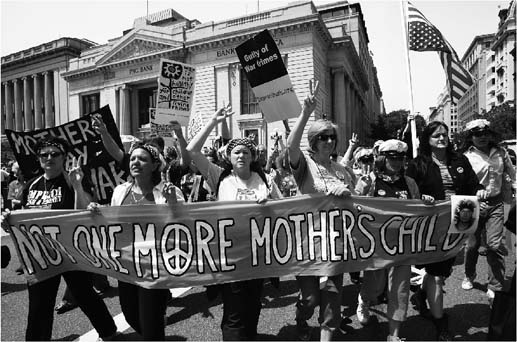
Protesters, including Cindy Sheehan (center), march down 15th Street during the "10,000 Mother of a March" rally May 14, 2007, in Washington, D.C. Hundreds of antiwar protesters marched from Lafayette Park across from the White House to the U.S. Capitol, staging a sit-in and blocking traffic on Independence Avenue for more than 30 minutes.
Apart from individual protesters, interpretations of the meaning and success of a protest event are based on the rhetorical strategies and tactics employed by a movement. The symbolic actions—speeches, marches, slogans, signs, chants, clothing, and so on—that different protest groups employ have provided a rich source for scholars studying the rhetoric of social movements, and each contributes to how a group or event is interpreted. As such, the rhetorical scholar studying social movements would only consider the protest event as one small piece of the symbolic meaning of a social movement. Considerable debate within the field has also centered on how to best characterize and study the rhetoric of social movements. Morris and Brown's collection of readings tracks the theoretical development and debates within this area of research as well as highlighting scholarly work on key political movements. Such work highlights a shift in focus toward application and testing of rhetorical theory by conducting case studies on key political movements such as the American Indian movement, the Black Power movement, and the feminist movement, among others.
...
- Abdullah II
- Adenauer, Konrad
- Agnew, Spiro
- Ailes, Roger
- Al-Asad, Hafiz
- Alfonsín, Raúl
- Allende, Salvador
- Al-Sadat, Anwar
- Arafat, Yasser
- Aznar, José María
- Bachelet Jeria, Michelle
- Ben Ali, Zine el-Abidine
- Berlusconi, Silvio
- Blair, Tony
- Blumler, Jay G.
- Bormann, Ernest
- Bouteflika, Abdelaziz
- Brandt, Willy
- Broder, David
- Buchanan, Patrick
- Bush, George H. W.
- Bush, George W.
- Bush, Laura
- Cardoso, Fernando Henrique
- Carville, James
- Castro, Fidel
- Chaffee, Steven H.
- Chávez, Hugo
- Chirac, Jacques
- Chisolm, Shirley
- Churchill, Sir Winston
- Çiller, Tansu
- Clinton, Hillary Rodham
- Clinton, William Jefferson
- Coburg-Gotha, Simeon Saxe
- Collor de Mello, Fernando
- Connally, John
- Cronkite, Walter
- Dean, Howard
- de Gaulle, Charles
- Demirel, Süleyman
- Deng Xiaoping
- Denton, Robert E., Jr.
- Dole, Elizabeth
- Dole, Robert
- Donsbach, Wolfgang
- Dukakis, Michael
- Ecevit, Bülent
- Edelman, Murray
- Eisenhower, Dwight D.
- Entman, Robert
- Erdoğan, Recep Tayyip
- Ferraro, Geraldine
- Fleischer, Ari
- Ford, Betty
- Ford, Gerald
- Fox, Vicente
- Franken, Al
- Gandhi, Indira
- Gerbner, George
- Gingrich, Newt
- Giscard d'Estaing, Valéry
- Giuliani, Rudy
- Goebbels, Joseph
- Goldwater, Barry
- González Márquez, Felipe
- Gorbachev, Mikhail
- Gore, Albert
- Graber, Doris A.
- Greeley, Horace
- Guggenheim, Charles
- Haider, Jörg
- Hallin, Daniel C.
- Hanson, Pauline
- Harris, Fred
- Hart, Gary
- Hart, Roderick P.
- Hassan II, King
- Havel, Václav
- Hearst, William Randolph
- Hitler, Adolf
- Holtz-Bacha, Christina
- Humphrey, Hubert H.
- Hussein I, King
- Jackson, Jesse
- Jamieson, Kathleen Hall
- Johnson, Lyndon B.
- Jordan, Barbara
- Kaid, Lynda Lee
- Katz, Elihu
- Kekkonen, Urho
- Kennedy, Edward (Ted)
- Kennedy, John F.
- Kennedy, Robert F.
- Kenyatta, Jomo
- Kepplinger, Hans Mathias
- Kerry, John
- Khrushchev, Nikita
- Kibaki, Mwai
- King, Martin Luther, Jr.
- Klapper, Joseph
- Kohl, Helmut
- Kraus, Sidney
- Kreisky, Bruno
- Kwaśniewski, Aleksander
- Lang, Gladys Engel
- Lang, Kurt
- Lasswell, Harold
- Lazarsfeld, Paul F.
- Lehrer, Jim
- Lenin, Vladímir I.
- Le Pen, Jean-Marie
- Lewinsky, Monica
- Limbaugh, Rush
- Lippmann, Walter
- Loukanov, Andrey
- Machiavelli, Niccolò
- Mancini, Paolo
- Mandela, Nelson
- Mandelson, Peter
- Mao Zedong
- Marx, Karl
- Matalin, Mary
- Mazzoleni, Gianpietro
- McCain, John
- McCombs, Maxwell
- McGovern, George
- McLuhan, Marshall
- McQuail, Denis
- Meir, Golda
- Menem, Carlos
- Merkel, Angela
- Mitsotakis, Konstantinos
- Mitterrand, François
- Mohammed VI
- Moi, Daniel Arap
- Morales, Evo
- Moseley Braun, Carol
- Moyers, William (Bill)
- Mubarak, Hosni
- Murrow, Edward R.
- Muskie, Edmund
- Nader, Ralph
- Napolitan, Joseph
- Nasser, Gamal Abdel
- Nimmo, Dan
- Nixon, Richard M.
- Noelle-Neumann, Elisabeth
- Nyerere, Julius
- Obama, Barack
- Onassis, Jacqueline Kennedy
- O'Reilly, Bill
- Özal, Turgut
- Palme, Olof
- Papandreou, Andreas
- Perón, Juan
- Perón, María Eva Duarte de
- Perot, Ross
- Putin, Vladimir
- Quayle, Dan
- Rabin, Yitzhak
- Rather, Dan
- Rawlings, Jerry
- Reagan, Nancy
- Reagan, Ronald
- Rice, Condoleezza
- Richards, Ann
- Rivera, Geraldo
- Rogers, Everett M.
- Roosevelt, Eleanor
- Roosevelt, Franklin D.
- Sabato, Larry
- Sanders, Keith R.
- Schramm, Wilbur
- Schröder, Gerhard
- Schroeder, Patricia
- Schulz, Winfried
- Schüssel, Wolfgang
- Schwartz, Tony
- Schwarzenegger, Arnold
- Senghor, Léopold Sédar
- Sharon, Ariel
- Simitis, Konstantinos
- Stephanopoulos, George
- Stevenson, Adlai
- Thatcher, Margaret
- Trippi, Joe
- Uzan, Cem
- Vargas, Getulio
- Vranitzky, Franz
- Wałęsa, Lech
- Wallace, George
- Watts, J. C.
- Weaver, David H.
- Wellstone, Paul
- Will, George
- Wilson, Harold
- Wolfsfeld, Gadi
- Yassine, Abdessalam
- Yeltsin, Boris
- Zhelev, Zhelyu
- Zhivkov, Todor
- All the President's Men
- American Voter, The
- Bowling Alone
- Campaigns & Elections Magazine
- Candidate, The
- Candidates and Their Images
- Citizen Kane
- Commander in Chief
- Comparing Media Systems
- Creating Reality
- Crosstalk
- Daily Show, The
- Deciding What's News
- Effects of Mass Communication, The
- Film and Politics
- Four Theories of the Press
- Great Debates, The
- Handbook of Political Communication, The
- Image, The
- Mediated Political Realities
- Nature of Prejudice, The
- News: The Politics of Illusion
- Nightline
- People's Choice, The
- Personal Influence
- Political Campaign Communication
- Political Communication
- Presentation of Self in Everyday Life, The
- Processing the News
- Psychology of Radio, The
- Responsive Chord, The
- Saturday Night Live
- Selling of the President 1968, The
- Symbolic Uses of Politics, The
- Television in Politics
- Unseeing Eye, The
- Virtuous Circle, A
- War of the Worlds, The
- West Wing, The
- Argentina Democratization Process, Role of the Media
- Brazil, Media and the Political System
- Bulgaria, Democratization
- Democratization, Role of the Media in
- Direct Action Protest, Australia
- Direct Democracy
- German Unification, Role of the Media
- Hungary, Communication and Politics
- Poland, Democratization
- Russia, Democratization and Media
- Carrie Chapman Catt Center for Women and Politics
- Center for the Study of the American Electorate
- Freedom Forum Media Studies Center
- Graduate School of Political Management
- McGovern Library and Center for Public Service and Leadership
- Pew Internet & American Life Project
- Pew Research Center for the People & the Press
- Political Commercial Archive
- Political Communication Center
- Survey Research Center
- Vanderbilt Television News Archive
- World Association for Public Opinion Research
- Electoral Systems
- European Parliamentary Elections
- E-Voting
- Grassroots Campaigning
- Iowa Caucuses
- Primaries
- Proportional Representation
- Second-Order Election
- Ticket Splitting
- Voter News Service
- Voting Behavior
- Youth Voting
- Brazil, Media and the Political System
- China, Media and Politics in
- Chinese Cultural Revolution
- Communism
- Conservative, Conservatism
- E-Government
- Electoral Systems
- Eurobarometer
- European Commission
- European Parliament
- European Parliamentary Elections
- European Union
- Federal Trade Commission
- Government Communication
- Hong Kong Handover
- Hungary, Communication and Politics
- Political Prisoners
- Press Secretary, White House
- Proportional Representation
- Public Affairs, Communication in
- State of the Union Address
- Supreme Court, Media and the
- Abortion
- Affirmative Action
- Ballot Initiatives
- Bipartisan Campaign Reform Act
- Brazil, Media and the Political System
- Buckley v. Valeo
- Campaign Finance
- Censorship, Political
- Civil Rights Movement
- Communications Act of 1934
- Council of Europe, Media Policy
- Equal Time Provision
- European Commission
- European Convention on Human Rights
- European Court of Justice
- European Union Media Policy
- Fairness Doctrine
- Federal Election Campaign Act
- Federal Trade Commission
- First Amendment
- Free Airtime
- Freedom of Information
- Libel
- McConnell v. Federal Election Commission
- Obscenity and Pornography
- Press Freedom
- Press Law of 1766, Sweden
- Red Lion Broadcasting Co. v. FCC
- Reputation in Politics
- Royal Commission on the Press
- Shield Laws
- Soft Money
- UNESCO Media Policy
- United States Information Agency
- Ad Watch
- Advocacy Advertising
- Agenda Melding
- Agenda Setting
- Al Jazeera Television
- Alternative Media in Politics
- Argentina Democratization Process, Role of the Media
- Banner Ads
- Big-Character Posters, China
- Blogs, Blogging
- Brazil, Media and the Political System
- Bush–Rather Confrontation
- Campaigns & Elections Magazine
- Candidate Films, Biographical
- Cartoons, Political
- Checkers Speech
- China, Media and Politics in
- Citizen Journalism
- CNN (Cable News Network)
- Commander in Chief
- Commentary, Political
- Congress and the Media
- C-SPAN Network
- Daily Show, The
- Daisy Girl Ad
- Debates
- DebateWatch
- Democratization, Role of the Media in
- Direct Mail
- Editorials
- E-Mail, Political Uses
- Fairness Doctrine
- Film and Politics
- Fireside Chats
- Fourth Estate, Media as
- Fox News
- Free Airtime
- Freedom Forum Media Studies Center
- German Unification, Role of the Media
- Gulf War, Media Coverage of
- Hard News
- Horserace Coverage
- Hostile Media Effect
- Hungary, Communication and Politics
- Information Technology in Politics
- Infotainment
- Iraq War, Media Coverage of
- Letters to the Editor
- Media Bias
- Media Buying in Politics
- Media Consultants
- Media Events
- Media Feeding Frenzy
- Media Logic
- Mediatization
- Metacoverage
- Muckrakers, Muckraking
- Music and Politics
- National Association of Broadcasters
- National Public Radio (NPR)
- Negative Advertising
- New Media Technologies
- New York Times, The
- News Coverage, Politics
- News Magazines
- News Management
- News Selection Process
- Newspapers, Role in Politics
- Nightline
- Party Election Broadcasts
- Party Press
- PBS (Public Broadcasting Service)
- Political Advertising, Independent
- Political Advertising, Radio
- Political Advertising
- Political Branding
- Pooled Journalism
- Posters, Political
- Press and Politics
- Press Conferences
- Press Freedom
- Press Secretary, White House
- Press Theories
- Public Affairs, Communication in
- Public Relations, Political
- Public Service Broadcasting
- Radio Addresses
- Radio Free Europe
- Radio, Politics and
- Reporters Without Borders
- Rock the Vote
- Russia, Democratization and Media
- Rwanda Genocide, Role of Media
- Saturday Night Live
- Soft News
- Sound Bite
- Spin, Political
- Stringer
- Supreme Court, Media and the
- Tabloids
- Talk Radio, Political
- Talk Shows, Television
- Tampa Incident
- TechnoDistortions
- Testimonials, Political
- Underground Media
- UNESCO Media Policy
- Video Games, Political
- Videostyle
- Voice of America
- Voter News Service
- War Coverage
- War of the Worlds, The
- Washington Post, The
- Web Campaigning
- Webstyle
- West Wing, The
- White House Press Corps
- Willie Horton Ad
- Women Candidates, Advertising
- Women Candidates, News Coverage
- World Wide Web, Political Uses
- Apathy, Voter
- Authoritarianism
- Cybernationalism
- Ideology
- Mass Political Behavior
- New Right
- Parasocial Relationships in Politics
- Party Identification
- Political Branding
- Political Correctness
- Political Culture
- Political Involvement
- Political Knowledge
- Polls
- Populism
- Psychographics in Politics
- Public Opinion
- Race in Politics
- Ticket Splitting
- Voter Behavior
- American-Style Campaigning
- Ballot Initiatives
- Campaign Finance
- Candidate-Centered Communication
- Candidate Films, Biographical
- Celebrities in Politics
- Commission on Presidential Debates
- Daisy Girl Ad
- Debates
- DebateWatch
- Free Airtime
- Grassroots Campaigning
- Hate Speech
- Iowa Caucuses
- Media Consultants
- Negative Campaigning
- Party Election Broadcasts
- Personal Campaigning
- Political Advertising
- Political Advertising, Independent
- Political Advertising, Radio
- Primaries
- Soft Money
- Testimonials, Political
- Web Campaigning
- Webstyle
- Willie Horton Ad
- Women Candidates, Advertising
- Women Candidates, News Coverage
- Checkers Speech
- Chinese Cultural Revolution
- Falklands-Malvinas War
- Gulf War, Media Coverage of
- Helsinki Process
- Heuristics in Political Decision Making
- Hill–Thomas Hearings
- Hong Kong Handover
- Inaugural Addresses, Presidential
- Iowa Caucuses
- Iraq War, Media Coverage of
- Kennedy Assassination
- Mass Nonviolent Protest, Australia
- McCarthy Hearings
- Muhammed Cartoon Events
- Pentagon Papers, The
- Political Conflict
- Political Scandal
- Protests, Political
- Revolution, Political
- Speeches, Presidential
- Spiegel Affair
- State of the Union Address
- Tampa Incident
- Terrorism and Media
- Waldheim Affair
- War Coverage
- Watergate
- Watts Riots
- AARP
- Advocacy Advertising
- Aging and Politics
- American Association of Political Consultants
- Center for the Study of the American Electorate
- Commission on Presidential Debates
- Congress and the Media
- Conservative Party, Britain
- Conventions, Political
- Council of Europe, Media Policy
- Democratic National Committee
- Democratic Party
- European Association of Political Consultants
- European Parliament
- European Parliamentary Elections
- European Union
- European Union, Media Policy
- Feminist Movement
- Freedom Forum Media Studies Center
- Glasgow Media Group
- Green Party
- Interest Groups in Politics
- Labour Party, Britain
- Latinos and Politics, Media
- Libertarian Party
- Lobbying, Lobbyist
- Minorities, Role in Politics
- NAACP (National Association for the Advancement of Colored People)
- National Association of Broadcasters
- New Right
- Party Identification
- Pew Internet & American Life Project
- Pew Research Center for the People & the Press
- Political Action Committees (PACs)
- Political Culture
- Political Parties
- Reform Party
- Religion in Politics
- Republican National Committee
- Republican Party
- Solidarity Movement
- UNESCO Media Policy
- Unions, Political Activity
- Youth Voting
- Abortion
- Aging and Politics
- Ballot Initiatives
- Civil Rights Movement
- Issue Management
- Issue Ownership
- Kids Voting USA
- Lobbying, Lobbyist
- Mass Political Behavior
- Minorities, Role in Politics
- Political Corruption
- Political Knowledge
- Segregation
- Welfare Policy
- Bush–Rather Confrontation
- Commentary, Political
- Embedded Journalists
- Hostile Media Effect
- Journalism, Political
- Metacoverage
- Muckrakers, Muckraking
- Pack Journalism
- Pooled Journalism
- Public Journalism
- Talk Radio, Political
- Talk Shows, Television
- Women Candidates, News Coverage
- Yellow Journalism
- Agenda Melding
- Agenda Setting
- Americanization
- Apologia
- Argumentation, Political
- Aristotle
- Authoritarianism
- Communism
- Conservative, Conservatism
- Constructivism
- Critical Theory
- Cultivation Theory
- Cultural Imperialism
- Cultural Studies
- Dealignment
- Deliberation
- Democracy Theories
- Demography
- Dependency Theory, Media
- Diffusion of Innovations
- Digital Divide
- Dramatistic Approaches to Political Communication
- Fantasy Theme Analysis
- Fear Appeals, Use in Politics
- Feminine Style in Communication
- Focus Groups
- Framing
- Gender and Politics
- Globalization
- Group Decision Making, Political
- Heuristics in Political Decision Making
- Hostile Media Effect
- Humor in Politics
- Image, Political
- Impression Management
- Indexing Theory
- Information Flow, Global
- Information Society
- Inoculation, Political
- Intercultural Communication, Dimensions
- Interpersonal Communication
- Kids Voting USA
- Knowledge Gap
- Language and Politics
- Limited Effects Theory
- Mass Political Behavior
- McConnell v. Federal Election Commission
- Mediatization
- Medium Theory
- Methodology
- Modernization
- Music and Politics
- News Management
- News Selection Process
- Orientation, Need for
- Participation, Political
- Personalization of Politics
- Persuasion, Political
- Pharisee Effect
- Pluralistic Ignorance
- Political Conflict
- Political Disaffection
- Political Efficacy
- Political Engagement
- Political Information Efficacy
- Political Information Processing
- Political Involvement
- Political Knowledge
- Political Leadership
- Political Marketing
- Political Scandal
- Political Socialization
- Politics, Policy, Polity
- Presidential Communication
- Press and Politics
- Press Theories
- Priming
- Professionalization
- Propaganda
- Psychographics in Politics
- Public Communication in Politics
- Public Sphere
- Pundits, Punditry
- Race in Politics
- Reputation in Politics
- Resonance Theory
- Rhetoric, Political
- Selective Processes, Exposure, Perception, Memory
- Sleeper Effect
- Social Marketing
- Social Responsibility Theory
- Speeches, Presidential
- Spiral of Silence
- Strategic Communication
- Symbolic Convergence Theory
- Systems Theory
- Third-Person Effect
- Two-Step Flow Model of Communication
- Uses and Gratifications Approach
- Verbal Style
- Videostyle
- Voter Behavior
- Carrie Chapman Catt Center for Women and Politics
- Feminine Style in Communication
- First Ladies, Political Communication of
- Gender and Politics
- Hill–Thomas Hearings
- Women Candidates, Advertising
- Women Candidates, News Coverage
- Loading...
Get a 30 day FREE TRIAL
-
 Watch videos from a variety of sources bringing classroom topics to life
 -
Read modern, diverse business cases
-
Explore hundreds of books and reference titles

Read next

More like this
Sage Recommends
We found other relevant content for you on other Sage platforms.
Have you created a personal profile? Login or create a profile so that you can save clips, playlists and searches