
Entry
Reader's guide
Entries A-Z
Subject index
Swimming (Amateur)
Humans are one of the few species with the instinctive desire to swim without the instinctive ability to do so. Monkeys swim, both for practical purposes and recreationally, but they do so instinctively. Many mammals, from mice and dogs to elephants and moose, swim rec-reationally, but again their ability to do so is instinctive. Humans need to be taught—or to learn through trial and error—but they have the advantage of learning quickly, and of a broader range of motion in their limbs than most non-aquatic animals.
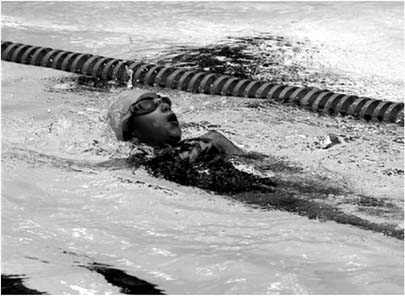
The four competitive swimming strokes are the butterfly, backstroke, breaststroke, and front crawl (freestyle).
The density of water is very near the density of the human body, which not only helps make the body buoyant but makes swimming an ideal form of aerobic exercise: the water supports much of the weight of the body, putting less stress on joints and load-bearing bones. Naturally, competitive swimming can lead to repetitive stress injuries, such as “swimmer's shoulder,” a tendinitis of the rotator cuff.
Different swimming strokes have developed over the years, and swimming was considered a fundamental skill both of the samurai in Japan and the knights of Medieval Europe. The close of the Middle Ages brought about a conservatism in Europe and a new height of body shame that discouraged swimming (which in many cultures had been performed naked). The fact that “swimsuit” and “bathing suit” are synonymous dates to an era when swimming was encouraged only as a form of bathing, and in the Victorian era, this self-consciousness and dislike of public displays of skin led to the use of the bathing machine.
Used primarily in Britain, where beaches were sex-segregated until 1901, the bathing machine was a small changing room on wheels, allowing bathers to change into a bathing suit, be wheeled out into the water, and bathe discreetly, with the bathing machine blocking any view from the shore or other bathers.
At the opposite end of that extreme is skinny dipping. Although swimming has been done naked through most of human history, “skinny dipping” really only refers to unclothed swimming after the adoption of the swimsuit. Among mixed company, skinny dipping may be a racy and forbidden activity, but need not be sexual; throughout the 19th and 20th centuries, it was often part of teenage sexual exploration. Same-sex skinny dipping is likely to be innocent and asexual, and especially in rural areas is often just a pragmatic concern.
Rural communities often have a “swimming hole”—a spot in a river or other running water that accommodates swimming, with a shore near enough the surface of the water to be easy to climb back onto. These are often picturesque locations, especially in nostalgic memory and the popular imagination. In the generations before fast-food restaurants, malls, and the like, a swimming hole was often a gathering spot for teenagers, particularly in the summer.
The urban equivalent of the swimming hole is the public pool, though public pools have lifeguards, rules, and parental supervision, making them characteristically different from the swimming holes of many small towns.
...
- Billiards
- Bowling
- Charades
- Crosswords
- Darts
- Dice
- Dominoes and Variations of
- Hobbies
- I Spy
- Mazes
- Musical Chairs
- Odd Man Out
- Parlor Games
- Password
- Puzzles
- Skittles
- Stock Market Games
- Sudoku
- Tic-Tac-Toe
- Trivial Pursuit
- Twenty Questions
- Who Am I?
- Word Games (Other Than Crosswords)
- Backgammon
- Battleships
- Bingo
- Boggle
- Checkers and Variations of
- Chess and Variations of
- Chinese Checkers
- Diplomacy
- Dungeons & Dragons
- Go
- Hand and Foot
- Life
- Mahjong
- Monopoly and Variations of
- Ouija Board
- Peg Boards
- Probe
- Risk, the Game
- Scrabble
- Snakes and Ladders
- Stratego
- Trivial Pursuit
- Warhammer
- Ace-Deuce-Jack
- All Fives
- Auction Pitch
- Baccarat
- Beggar My Neighbor
- Bezique
- Blackjack
- Boston
- Brag
- Bridge and Variations of
- Casino
- Cribbage
- Donkey
- Ecarté
- Euchre
- Faro
- Fish
- Hearts
- Loo
- Memory and Play
- Mille Bornes
- Monte Bank
- Napoleon
- Old Maid
- Pinochle
- Piquet
- Play or Pay
- Poker and Variations of
- Pope Joan
- Preference
- Racing Demon
- Rolling Stone
- Rummy and Variations of
- Sequence
- Seven Up
- Skat
- Slapjack
- Solitaire and Variations of
- Spit
- Spoil Five
- War
- Whist
- Ziginette
- Blind Man's Bluff
- Car and Travel Games
- Clapping Games
- Erector Sets
- Finger Games
- Frisbee
- Hares and Hounds
- Hide and Seek
- Hit the Rat
- Jacks
- Jump Rope
- Kick the Can
- Leapfrog
- London Bridge
- Marbles
- Marco Polo
- Piggy in the Middle
- Pinball
- Pin the Tail on the Donkey
- Playing “Doctor”
- Playing “House”
- Pokémon
- Pretending
- Punch & Judy
- Rock Paper Scissors
- Sand Play
- Singing Games
- Softball
- Speech Play
- Spinning Tops
- Table Hockey
- Table Soccer
- Tag
- Tiddlywinks
- Tinkertoys
- Tree Houses
- Water Play
- Africa, Traditional Play in
- Ancient China
- Ancient Egypt
- Ancient Greece
- Ancient India
- Ancient Rome
- Assyrian/Babylonian Culture
- Australian Aborigine
- Central Asia, Ancient
- Europe, 1200 to 1600
- Europe, 1600 to 1800
- Europe, 1800 to 1900
- Europe, 1900 to 1940
- Europe, 1940 to 1960
- Europe, 1960 to Present
- History of Playing Cards
- Mesoamerican Cultures
- Native Americans
- New Zealand Maori
- South Americans, Traditional Cultures
- Spanish America
- United States, 1783 to 1860
- United States, 1860 to 1876
- United States, 1876 to 1900
- United States, 1900 to 1930
- United States, 1930 to 1960
- United States, 1960 to Present
- United States, Colonial Period
- Vikings
- Athletics (Amateur)
- Ballooning
- Baseball (Amateur)
- Basketball (Amateur)
- Bicycles
- Bocee
- Boules
- Bungee Jumping
- Cracking the Whip
- Cricket (Amateur)
- Croquet
- Curling (Scottish)
- Dodgeball
- Fishing
- Folk Dancing
- Football (Amateur)
- Highland Games
- Golf (Amateur)
- Hockey (Amateur)
- Horse Racing (Amateur)
- Kayaking and Canoeing
- Kite Flying
- Maypole Dancing
- Morris Dancing
- Music, Playing
- Netball
- Paintball
- Ping Pong
- Rodeos
- Roller Coasters
- Rugby (Amateur)
- Sailing
- Skateboarding
- Skating
- Skiing
- Snail Racing
- Snowboarding
- Soccer (Amateur) Worldwide
- Stilts
- Surfing
- Swimming (Amateur)
- Tennis (Amateur) and Variations of
- Volleyball (Amateur)
- Academic Learning and Play
- Models
- Montessori
- Mother-Child Play
- Play and Evolution
- Play and Literacy
- Play in the Classroom
- Recess
- Teacher-Child Co-Play
- Toys and Child Development
- Afghanistan
- Albania
- Algeria
- Arctic Play (First Nations)
- Argentina
- Armenia
- Australia
- Austria
- Azerbaijan
- Bahamas and Caribbean
- Belarus
- Belgium
- Bolivia
- Bosnia and Herzegovina
- Brazil
- Bulgaria
- Cambodia
- Canada
- Central American Nations
- Chile
- China
- Colombia
- Congo
- Croatia
- Cuba
- Cyprus
- Czech Republic
- Denmark
- Ecuador
- Egypt
- Estonia
- Ethiopia
- Finland
- France
- Georgia
- Germany
- Ghana
- Greece
- Hungary
- Iceland
- India
- Indonesia
- Iran
- Iraq
- Ireland
- Israel
- Italy
- Japan
- Jordan
- Kazakhstan
- Kenya
- Korea, North and South
- Kyrgyzstan
- Laos
- Latvia
- Lebanon
- Liberia
- Lithuania
- Malaysia
- Mexico
- Myanmar
- Netherlands
- New Zealand
- Nigeria
- Norway
- Pakistan
- Paraguay
- Peru
- Philippines
- Poland
- Portugal
- Romania
- Russia
- Samoa
- Saudi Arabia
- Serbia and Montenegro
- South Africa
- Spain
- Sudan
- Sweden
- Switzerland
- Syria
- Tanzania
- Thailand
- Turkey
- Turkmenistan
- Ukraine
- United Kingdom
- Uruguay
- Uzbekistan
- Venezuela
- Vietnam
- Adlerian Play Therapy
- “Bad” Play
- Boys' Play
- Common Adventure Concept
- Daydreaming
- Experiential Learning Definitions and Models
- Fantasy Play
- Female Aggressive Relationships Within Play (Putallaz)
- Gambling
- Gamesmanship
- Games of Deception
- Girls' Play
- Homo Ludens (Huizinga)
- Human Relationships in Play
- Inter-Gender Play
- Luck and Skill in Play
- Piaget and Play
- Play Among Animals
- Play and Learning Theory
- Play and Power, Psychology of
- Play as Catharsis
- Play as Competition, Psychology of
- Play as Entertainment, Psychology of
- Play as Interspecies Communication (Pets)
- Play as Learning, Psychology of
- Play as Mastery of Nature
- Play as Mock War, Psychology of
- Play as Progress (Sutton-Smith)
- Play as Rehearsal of Reality
- Play Frames
- Playing Alone
- Pretending
- Psychoanalytic Theory and Play
- Psychological Benefits of Play
- Psychology of Play (Vygotsky)
- Rhetorics of Play (Sutton-Smith)
- Role-Playing
- Sex Play
- Social Psychology of Play
- Symbol Formation and Play
- Team Play
- Teasing
- Unstructured Play
- Amusement Parks
- Anti-Competition Play
- Arcades
- Caillois: Man, Play and Games
- Cityscapes as Play Sites
- Cooperative Play
- Costumes in Play
- Game Theory
- Organized or Sanctioned Play
- Play and Power, Sociology of
- Play as Competition, Sociology of
- Play as Entertainment, Sociology of
- Play as Learning, Sociology of
- Play as Mock War, Sociology of
- Playground as Politics
- Social Distinctions
- Sociological Benefits of Play
- Spontaneous Group Play
- Theology of Play
- Action Figures
- Blinky Bill
- Dolls, Barbie and Others
- G.I. Joe
- Gollywogs
- Hobby Horses
- Jigsaws
- Lead Soldiers
- LEGOs
- Meccano
- Paddington Bear
- Pet Rocks
- Rocking Horses
- Rubik's Cube
- Teddy Bears
- Wendy Houses
- Yo-Yos
- Airfix
- Amiga
- Avalon Hill
- Bandai
- Coleco
- Fisher-Price
- Galoob
- Hasbro
- Hornby
- Imperial Toy
- JAKKS Pacific Toys
- Kenner
- LEGOs
- Lionel
- LJN
- Matchbox
- McFarlane Toys
- Minifigs
- Parker Brothers
- Playmates
- Playskool
- Revell
- Strong National Museum of Play
- Tiger Electronics
- TOMY
- Toybiz
- Trendmasters
- TSR
- Waddington
- Wargames Research Group
- Age of Empires
- Battlefield 1942
- Civilization (I, II, III, IV)
- Cossacks (Napoleonic Wars)
- Counter-Strike
- Dragon Quest
- Dragon Warrior
- Dungeon Lords
- Flight Simulation
- GoldenEye 007
- Grand Theft Auto
- Legend of Zelda
- Maple Story
- Mario
- Minesweeper
- Mortal Kombat
- Runescape
- Silkroad Online
- SimCity
- Snake
- Solitaire
- Sonic the Hedgehog
- Street Fighter I and II
- Tetris
- Tomb Raider
- World of Warcraft
- Loading...
Get a 30 day FREE TRIAL
-
 Watch videos from a variety of sources bringing classroom topics to life
 -
Read modern, diverse business cases
-
Explore hundreds of books and reference titles

Read next

More like this
Sage Recommends
We found other relevant content for you on other Sage platforms.
Have you created a personal profile? Login or create a profile so that you can save clips, playlists and searches