
Entry
Reader's guide
Entries A-Z
Subject index
Life
There are two significant games bearing the name “The Game of Life,” one of which is not really a game at all, but an experiment in cellular automation, while the second is a popular family board game.
Conway's The Game of Life is named for its inventor, mathematician John Horton Conway, and was presented in the October 1970 issue of Scientific American. It was based on the work of game theorist and mathematician John von Neumann. This “game” is not really a game at all in the common sense of the word, but rather a mathematical simulation of cellular genetics—an intellectual puzzle.
A checkerboard is used and each square is deemed to be a cell that is either “alive” or “dead.” As turns progress, cells either die or come to life, depending on the number of living neighbors they have; a cell with two live neighbors dies, one with more than three dies, one with three stays stable. A dead cell with three live neighbors comes to life.
The Game of Life is fascinating for several reasons. First, it has the characteristics of a Universal Turing Machine, as modeled by Alan Turing, in that it can process any set of well-formed instructions. Second, the complex patterns that emerge from simple rules and an initial set-up has profound implications across a range of sciences. It is important to the study of games because it helps show how simple rules can produce very complex results.
It can be debated whether The Game of Life is, in fact, a game at all: Once the board has been initially set up, there is no player intervention. This has—with some justification—led it to be called a zero-player game, but it would be easy to argue that the initial setup of the game board constitutes “playing” the game, even though there are no set goals, nor any winner.
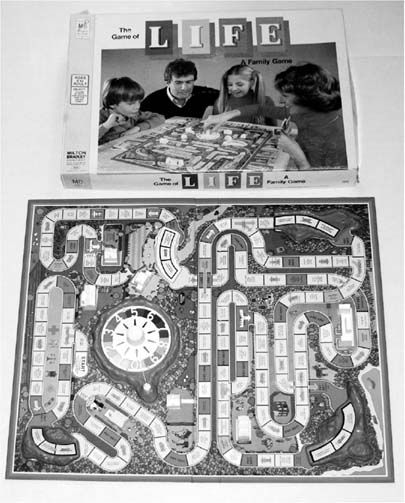
The Game of Life is an ideal game for family members of all ages, as winning is slanted more toward luck than skill.
Life, also known as The Game of Life, is also a popular board game. It was first created in 1860 by Milton Bradley under the name The Checkered Game of Life, and as a result of its success, Bradley was able to form the Milton Bradley Games Company; MB Games, which is now a subsidiary of Hasbro. In 1960 the game was resurrected and redesigned for MB Games's centenary. Now called The Game of Life, it is still published today, though there have been design tweaks since the 1960 version.
Players progress along a track, spinning a wheel numbered one to 10, rather than rolling a dice. A choice can be made between paths: career (business in the 1960 version) or college. College places one in debt, but means a higher salary later on. The playing pieces are cars, to which pegs are affixed to represent extra family members when a player has children or gets married. The board features mountains, giving a pleasing three-dimensional feel. Other features include such things as insurance policies, “major life feats” (like climbing Mount Everest), promissory notes, and stock options. Many of the details vary, depending on the version of the game. The 1992 version adds rewards for such things as recycling and learning CPR.
...
- Billiards
- Bowling
- Charades
- Crosswords
- Darts
- Dice
- Dominoes and Variations of
- Hobbies
- I Spy
- Mazes
- Musical Chairs
- Odd Man Out
- Parlor Games
- Password
- Puzzles
- Skittles
- Stock Market Games
- Sudoku
- Tic-Tac-Toe
- Trivial Pursuit
- Twenty Questions
- Who Am I?
- Word Games (Other Than Crosswords)
- Backgammon
- Battleships
- Bingo
- Boggle
- Checkers and Variations of
- Chess and Variations of
- Chinese Checkers
- Diplomacy
- Dungeons & Dragons
- Go
- Hand and Foot
- Life
- Mahjong
- Monopoly and Variations of
- Ouija Board
- Peg Boards
- Probe
- Risk, the Game
- Scrabble
- Snakes and Ladders
- Stratego
- Trivial Pursuit
- Warhammer
- Ace-Deuce-Jack
- All Fives
- Auction Pitch
- Baccarat
- Beggar My Neighbor
- Bezique
- Blackjack
- Boston
- Brag
- Bridge and Variations of
- Casino
- Cribbage
- Donkey
- Ecarté
- Euchre
- Faro
- Fish
- Hearts
- Loo
- Memory and Play
- Mille Bornes
- Monte Bank
- Napoleon
- Old Maid
- Pinochle
- Piquet
- Play or Pay
- Poker and Variations of
- Pope Joan
- Preference
- Racing Demon
- Rolling Stone
- Rummy and Variations of
- Sequence
- Seven Up
- Skat
- Slapjack
- Solitaire and Variations of
- Spit
- Spoil Five
- War
- Whist
- Ziginette
- Blind Man's Bluff
- Car and Travel Games
- Clapping Games
- Erector Sets
- Finger Games
- Frisbee
- Hares and Hounds
- Hide and Seek
- Hit the Rat
- Jacks
- Jump Rope
- Kick the Can
- Leapfrog
- London Bridge
- Marbles
- Marco Polo
- Piggy in the Middle
- Pinball
- Pin the Tail on the Donkey
- Playing “Doctor”
- Playing “House”
- Pokémon
- Pretending
- Punch & Judy
- Rock Paper Scissors
- Sand Play
- Singing Games
- Softball
- Speech Play
- Spinning Tops
- Table Hockey
- Table Soccer
- Tag
- Tiddlywinks
- Tinkertoys
- Tree Houses
- Water Play
- Africa, Traditional Play in
- Ancient China
- Ancient Egypt
- Ancient Greece
- Ancient India
- Ancient Rome
- Assyrian/Babylonian Culture
- Australian Aborigine
- Central Asia, Ancient
- Europe, 1200 to 1600
- Europe, 1600 to 1800
- Europe, 1800 to 1900
- Europe, 1900 to 1940
- Europe, 1940 to 1960
- Europe, 1960 to Present
- History of Playing Cards
- Mesoamerican Cultures
- Native Americans
- New Zealand Maori
- South Americans, Traditional Cultures
- Spanish America
- United States, 1783 to 1860
- United States, 1860 to 1876
- United States, 1876 to 1900
- United States, 1900 to 1930
- United States, 1930 to 1960
- United States, 1960 to Present
- United States, Colonial Period
- Vikings
- Athletics (Amateur)
- Ballooning
- Baseball (Amateur)
- Basketball (Amateur)
- Bicycles
- Bocee
- Boules
- Bungee Jumping
- Cracking the Whip
- Cricket (Amateur)
- Croquet
- Curling (Scottish)
- Dodgeball
- Fishing
- Folk Dancing
- Football (Amateur)
- Highland Games
- Golf (Amateur)
- Hockey (Amateur)
- Horse Racing (Amateur)
- Kayaking and Canoeing
- Kite Flying
- Maypole Dancing
- Morris Dancing
- Music, Playing
- Netball
- Paintball
- Ping Pong
- Rodeos
- Roller Coasters
- Rugby (Amateur)
- Sailing
- Skateboarding
- Skating
- Skiing
- Snail Racing
- Snowboarding
- Soccer (Amateur) Worldwide
- Stilts
- Surfing
- Swimming (Amateur)
- Tennis (Amateur) and Variations of
- Volleyball (Amateur)
- Academic Learning and Play
- Models
- Montessori
- Mother-Child Play
- Play and Evolution
- Play and Literacy
- Play in the Classroom
- Recess
- Teacher-Child Co-Play
- Toys and Child Development
- Afghanistan
- Albania
- Algeria
- Arctic Play (First Nations)
- Argentina
- Armenia
- Australia
- Austria
- Azerbaijan
- Bahamas and Caribbean
- Belarus
- Belgium
- Bolivia
- Bosnia and Herzegovina
- Brazil
- Bulgaria
- Cambodia
- Canada
- Central American Nations
- Chile
- China
- Colombia
- Congo
- Croatia
- Cuba
- Cyprus
- Czech Republic
- Denmark
- Ecuador
- Egypt
- Estonia
- Ethiopia
- Finland
- France
- Georgia
- Germany
- Ghana
- Greece
- Hungary
- Iceland
- India
- Indonesia
- Iran
- Iraq
- Ireland
- Israel
- Italy
- Japan
- Jordan
- Kazakhstan
- Kenya
- Korea, North and South
- Kyrgyzstan
- Laos
- Latvia
- Lebanon
- Liberia
- Lithuania
- Malaysia
- Mexico
- Myanmar
- Netherlands
- New Zealand
- Nigeria
- Norway
- Pakistan
- Paraguay
- Peru
- Philippines
- Poland
- Portugal
- Romania
- Russia
- Samoa
- Saudi Arabia
- Serbia and Montenegro
- South Africa
- Spain
- Sudan
- Sweden
- Switzerland
- Syria
- Tanzania
- Thailand
- Turkey
- Turkmenistan
- Ukraine
- United Kingdom
- Uruguay
- Uzbekistan
- Venezuela
- Vietnam
- Adlerian Play Therapy
- “Bad” Play
- Boys' Play
- Common Adventure Concept
- Daydreaming
- Experiential Learning Definitions and Models
- Fantasy Play
- Female Aggressive Relationships Within Play (Putallaz)
- Gambling
- Gamesmanship
- Games of Deception
- Girls' Play
- Homo Ludens (Huizinga)
- Human Relationships in Play
- Inter-Gender Play
- Luck and Skill in Play
- Piaget and Play
- Play Among Animals
- Play and Learning Theory
- Play and Power, Psychology of
- Play as Catharsis
- Play as Competition, Psychology of
- Play as Entertainment, Psychology of
- Play as Interspecies Communication (Pets)
- Play as Learning, Psychology of
- Play as Mastery of Nature
- Play as Mock War, Psychology of
- Play as Progress (Sutton-Smith)
- Play as Rehearsal of Reality
- Play Frames
- Playing Alone
- Pretending
- Psychoanalytic Theory and Play
- Psychological Benefits of Play
- Psychology of Play (Vygotsky)
- Rhetorics of Play (Sutton-Smith)
- Role-Playing
- Sex Play
- Social Psychology of Play
- Symbol Formation and Play
- Team Play
- Teasing
- Unstructured Play
- Amusement Parks
- Anti-Competition Play
- Arcades
- Caillois: Man, Play and Games
- Cityscapes as Play Sites
- Cooperative Play
- Costumes in Play
- Game Theory
- Organized or Sanctioned Play
- Play and Power, Sociology of
- Play as Competition, Sociology of
- Play as Entertainment, Sociology of
- Play as Learning, Sociology of
- Play as Mock War, Sociology of
- Playground as Politics
- Social Distinctions
- Sociological Benefits of Play
- Spontaneous Group Play
- Theology of Play
- Action Figures
- Blinky Bill
- Dolls, Barbie and Others
- G.I. Joe
- Gollywogs
- Hobby Horses
- Jigsaws
- Lead Soldiers
- LEGOs
- Meccano
- Paddington Bear
- Pet Rocks
- Rocking Horses
- Rubik's Cube
- Teddy Bears
- Wendy Houses
- Yo-Yos
- Airfix
- Amiga
- Avalon Hill
- Bandai
- Coleco
- Fisher-Price
- Galoob
- Hasbro
- Hornby
- Imperial Toy
- JAKKS Pacific Toys
- Kenner
- LEGOs
- Lionel
- LJN
- Matchbox
- McFarlane Toys
- Minifigs
- Parker Brothers
- Playmates
- Playskool
- Revell
- Strong National Museum of Play
- Tiger Electronics
- TOMY
- Toybiz
- Trendmasters
- TSR
- Waddington
- Wargames Research Group
- Age of Empires
- Battlefield 1942
- Civilization (I, II, III, IV)
- Cossacks (Napoleonic Wars)
- Counter-Strike
- Dragon Quest
- Dragon Warrior
- Dungeon Lords
- Flight Simulation
- GoldenEye 007
- Grand Theft Auto
- Legend of Zelda
- Maple Story
- Mario
- Minesweeper
- Mortal Kombat
- Runescape
- Silkroad Online
- SimCity
- Snake
- Solitaire
- Sonic the Hedgehog
- Street Fighter I and II
- Tetris
- Tomb Raider
- World of Warcraft
- Loading...
Get a 30 day FREE TRIAL
-
 Watch videos from a variety of sources bringing classroom topics to life
 -
Read modern, diverse business cases
-
Explore hundreds of books and reference titles

Read next

More like this
Sage Recommends
We found other relevant content for you on other Sage platforms.
Have you created a personal profile? Login or create a profile so that you can save clips, playlists and searches