
Entry
Reader's guide
Entries A-Z
Subject index
Ireland
Until recent times, research on children's play, or súgradh, in Ireland was limited. However, there are exceptions—the Irish Folklore Association and the Gaelic Athletic Association (GAA) are both a rich resource on the history of play and sports of Irish children during the last century. Recently the issue of play in Ireland was addressed by the Irish government to meet commitments made in the United Nations Convention on the Rights of the Child (1989) and the National Children's Strategy (2000); during the consultation process with children, the lack of play opportunities was the most frequently cited concern of children throughout the country. This led to the first Irish National Play Policy in 2004.
The Gaelic Athletic Association (GAA) was established in 1884 to revive and nurture traditional, indigenous pastimes, especially hurling and Gaelic football. Hurling is a game similar to hockey, in that it is played with a small ball and a curved wooden stick. The stick, or “hurley” camón is curved outwards at the end, to provide the striking surface. The ball or sliothar is similar in size to a hockey ball but has raised ridges. Hurling is thought to be Europe's oldest field game and was introduced to Ireland by the Celts. Hurling features in Irish folklore to illustrate the deeds of heroic mystical figures, and it is chronicled as a distinct Irish pastime for at least 2,000 years. Gaelic football can be described as a mixture of soccer and rugby, although it predates both of those games. It is a field game that has developed as a distinct game similar to the progression of Australian Rules. The GAA is the largest sports organization within the primary education system in Ireland for children aged 4 to 12 years, and both games remain extremely popular with children.
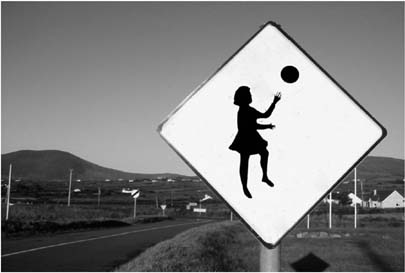
A road sign seen in Ireland attests to the committment to protecting the rights of children at play.
Folklorists in Ireland conducted “The Schools' Scheme” as it is popularly known, which represents the largest folklore collection ever carried out with children in Ireland back in 1937–38. Over a period of 18 months almost 100,000 children aged between 11 and 14 years of age in 5,000 primary schools were involved in researching and recording material dealing with a wide range of Irish folk traditions. Among other topics, the collection includes material on folktales and folk legends, riddles and proverbs, songs, play activities, games, and traditional pastimes. The children collected this material mainly from parents and grandparents, and from older members of the local community. The result of the scheme was the Schools' Manuscript Collection, which extends to more than half a million manuscript pages. This rich resource remains in constant use today by a wide variety of academic disciplines.
In more recent times, the publication of the first National Play Policy in 2004 was an acknowledgement that in the past, children's play has been seriously neglected at policy level. There was a serious deficit of public play spaces; in 2004 Ireland had 405 golf courses but only 168 public playgrounds for a population of 840,955 children under the age of 14. Previously, there had never been any ring-fenced government funding for play, and there was a poorly developed societal awareness of the value of play. While the objective of the National Play Policy is to provide children with more play opportunities in a variety of settings, there has been a strong focus on increasing the number of public playgrounds throughout the country, in which they have been very successful. More recently still, the government launched the National Recreational Policy for Children (2007) which focuses on the play and recreational needs of adolescents.
...
- Billiards
- Bowling
- Charades
- Crosswords
- Darts
- Dice
- Dominoes and Variations of
- Hobbies
- I Spy
- Mazes
- Musical Chairs
- Odd Man Out
- Parlor Games
- Password
- Puzzles
- Skittles
- Stock Market Games
- Sudoku
- Tic-Tac-Toe
- Trivial Pursuit
- Twenty Questions
- Who Am I?
- Word Games (Other Than Crosswords)
- Backgammon
- Battleships
- Bingo
- Boggle
- Checkers and Variations of
- Chess and Variations of
- Chinese Checkers
- Diplomacy
- Dungeons & Dragons
- Go
- Hand and Foot
- Life
- Mahjong
- Monopoly and Variations of
- Ouija Board
- Peg Boards
- Probe
- Risk, the Game
- Scrabble
- Snakes and Ladders
- Stratego
- Trivial Pursuit
- Warhammer
- Ace-Deuce-Jack
- All Fives
- Auction Pitch
- Baccarat
- Beggar My Neighbor
- Bezique
- Blackjack
- Boston
- Brag
- Bridge and Variations of
- Casino
- Cribbage
- Donkey
- Ecarté
- Euchre
- Faro
- Fish
- Hearts
- Loo
- Memory and Play
- Mille Bornes
- Monte Bank
- Napoleon
- Old Maid
- Pinochle
- Piquet
- Play or Pay
- Poker and Variations of
- Pope Joan
- Preference
- Racing Demon
- Rolling Stone
- Rummy and Variations of
- Sequence
- Seven Up
- Skat
- Slapjack
- Solitaire and Variations of
- Spit
- Spoil Five
- War
- Whist
- Ziginette
- Blind Man's Bluff
- Car and Travel Games
- Clapping Games
- Erector Sets
- Finger Games
- Frisbee
- Hares and Hounds
- Hide and Seek
- Hit the Rat
- Jacks
- Jump Rope
- Kick the Can
- Leapfrog
- London Bridge
- Marbles
- Marco Polo
- Piggy in the Middle
- Pinball
- Pin the Tail on the Donkey
- Playing “Doctor”
- Playing “House”
- Pokémon
- Pretending
- Punch & Judy
- Rock Paper Scissors
- Sand Play
- Singing Games
- Softball
- Speech Play
- Spinning Tops
- Table Hockey
- Table Soccer
- Tag
- Tiddlywinks
- Tinkertoys
- Tree Houses
- Water Play
- Africa, Traditional Play in
- Ancient China
- Ancient Egypt
- Ancient Greece
- Ancient India
- Ancient Rome
- Assyrian/Babylonian Culture
- Australian Aborigine
- Central Asia, Ancient
- Europe, 1200 to 1600
- Europe, 1600 to 1800
- Europe, 1800 to 1900
- Europe, 1900 to 1940
- Europe, 1940 to 1960
- Europe, 1960 to Present
- History of Playing Cards
- Mesoamerican Cultures
- Native Americans
- New Zealand Maori
- South Americans, Traditional Cultures
- Spanish America
- United States, 1783 to 1860
- United States, 1860 to 1876
- United States, 1876 to 1900
- United States, 1900 to 1930
- United States, 1930 to 1960
- United States, 1960 to Present
- United States, Colonial Period
- Vikings
- Athletics (Amateur)
- Ballooning
- Baseball (Amateur)
- Basketball (Amateur)
- Bicycles
- Bocee
- Boules
- Bungee Jumping
- Cracking the Whip
- Cricket (Amateur)
- Croquet
- Curling (Scottish)
- Dodgeball
- Fishing
- Folk Dancing
- Football (Amateur)
- Highland Games
- Golf (Amateur)
- Hockey (Amateur)
- Horse Racing (Amateur)
- Kayaking and Canoeing
- Kite Flying
- Maypole Dancing
- Morris Dancing
- Music, Playing
- Netball
- Paintball
- Ping Pong
- Rodeos
- Roller Coasters
- Rugby (Amateur)
- Sailing
- Skateboarding
- Skating
- Skiing
- Snail Racing
- Snowboarding
- Soccer (Amateur) Worldwide
- Stilts
- Surfing
- Swimming (Amateur)
- Tennis (Amateur) and Variations of
- Volleyball (Amateur)
- Academic Learning and Play
- Models
- Montessori
- Mother-Child Play
- Play and Evolution
- Play and Literacy
- Play in the Classroom
- Recess
- Teacher-Child Co-Play
- Toys and Child Development
- Afghanistan
- Albania
- Algeria
- Arctic Play (First Nations)
- Argentina
- Armenia
- Australia
- Austria
- Azerbaijan
- Bahamas and Caribbean
- Belarus
- Belgium
- Bolivia
- Bosnia and Herzegovina
- Brazil
- Bulgaria
- Cambodia
- Canada
- Central American Nations
- Chile
- China
- Colombia
- Congo
- Croatia
- Cuba
- Cyprus
- Czech Republic
- Denmark
- Ecuador
- Egypt
- Estonia
- Ethiopia
- Finland
- France
- Georgia
- Germany
- Ghana
- Greece
- Hungary
- Iceland
- India
- Indonesia
- Iran
- Iraq
- Ireland
- Israel
- Italy
- Japan
- Jordan
- Kazakhstan
- Kenya
- Korea, North and South
- Kyrgyzstan
- Laos
- Latvia
- Lebanon
- Liberia
- Lithuania
- Malaysia
- Mexico
- Myanmar
- Netherlands
- New Zealand
- Nigeria
- Norway
- Pakistan
- Paraguay
- Peru
- Philippines
- Poland
- Portugal
- Romania
- Russia
- Samoa
- Saudi Arabia
- Serbia and Montenegro
- South Africa
- Spain
- Sudan
- Sweden
- Switzerland
- Syria
- Tanzania
- Thailand
- Turkey
- Turkmenistan
- Ukraine
- United Kingdom
- Uruguay
- Uzbekistan
- Venezuela
- Vietnam
- Adlerian Play Therapy
- “Bad” Play
- Boys' Play
- Common Adventure Concept
- Daydreaming
- Experiential Learning Definitions and Models
- Fantasy Play
- Female Aggressive Relationships Within Play (Putallaz)
- Gambling
- Gamesmanship
- Games of Deception
- Girls' Play
- Homo Ludens (Huizinga)
- Human Relationships in Play
- Inter-Gender Play
- Luck and Skill in Play
- Piaget and Play
- Play Among Animals
- Play and Learning Theory
- Play and Power, Psychology of
- Play as Catharsis
- Play as Competition, Psychology of
- Play as Entertainment, Psychology of
- Play as Interspecies Communication (Pets)
- Play as Learning, Psychology of
- Play as Mastery of Nature
- Play as Mock War, Psychology of
- Play as Progress (Sutton-Smith)
- Play as Rehearsal of Reality
- Play Frames
- Playing Alone
- Pretending
- Psychoanalytic Theory and Play
- Psychological Benefits of Play
- Psychology of Play (Vygotsky)
- Rhetorics of Play (Sutton-Smith)
- Role-Playing
- Sex Play
- Social Psychology of Play
- Symbol Formation and Play
- Team Play
- Teasing
- Unstructured Play
- Amusement Parks
- Anti-Competition Play
- Arcades
- Caillois: Man, Play and Games
- Cityscapes as Play Sites
- Cooperative Play
- Costumes in Play
- Game Theory
- Organized or Sanctioned Play
- Play and Power, Sociology of
- Play as Competition, Sociology of
- Play as Entertainment, Sociology of
- Play as Learning, Sociology of
- Play as Mock War, Sociology of
- Playground as Politics
- Social Distinctions
- Sociological Benefits of Play
- Spontaneous Group Play
- Theology of Play
- Action Figures
- Blinky Bill
- Dolls, Barbie and Others
- G.I. Joe
- Gollywogs
- Hobby Horses
- Jigsaws
- Lead Soldiers
- LEGOs
- Meccano
- Paddington Bear
- Pet Rocks
- Rocking Horses
- Rubik's Cube
- Teddy Bears
- Wendy Houses
- Yo-Yos
- Airfix
- Amiga
- Avalon Hill
- Bandai
- Coleco
- Fisher-Price
- Galoob
- Hasbro
- Hornby
- Imperial Toy
- JAKKS Pacific Toys
- Kenner
- LEGOs
- Lionel
- LJN
- Matchbox
- McFarlane Toys
- Minifigs
- Parker Brothers
- Playmates
- Playskool
- Revell
- Strong National Museum of Play
- Tiger Electronics
- TOMY
- Toybiz
- Trendmasters
- TSR
- Waddington
- Wargames Research Group
- Age of Empires
- Battlefield 1942
- Civilization (I, II, III, IV)
- Cossacks (Napoleonic Wars)
- Counter-Strike
- Dragon Quest
- Dragon Warrior
- Dungeon Lords
- Flight Simulation
- GoldenEye 007
- Grand Theft Auto
- Legend of Zelda
- Maple Story
- Mario
- Minesweeper
- Mortal Kombat
- Runescape
- Silkroad Online
- SimCity
- Snake
- Solitaire
- Sonic the Hedgehog
- Street Fighter I and II
- Tetris
- Tomb Raider
- World of Warcraft
- Loading...
Get a 30 day FREE TRIAL
-
 Watch videos from a variety of sources bringing classroom topics to life
 -
Read modern, diverse business cases
-
Explore hundreds of books and reference titles

Read next

More like this
Sage Recommends
We found other relevant content for you on other Sage platforms.
Have you created a personal profile? Login or create a profile so that you can save clips, playlists and searches