
Entry
Reader's guide
Entries A-Z
Subject index
Europe, 1200 to 1600
Play in medieval Europe was considered to be an educational activity for children to learn adult roles. Play was ephemeral—a passing entertainment—designed to instruct naturally. Between 1200 and 1600, Europe experienced sustained urbanization as a result of a series of population explosions. Between the 11th and 13th centuries, Christians traveled in military expeditions to win the Holy Land from Muslims.
Exploration and migration brought new paper and printing technology to Europe that was used to produce the first board games and playing cards. During the late 1390s, the Great Plague killed an estimated 30 to 60 percent of Europe's population, irrevocably altering its social structure. With such a loss of manpower and resources, there was little time, nor inclination, to play. Feudalism allowed for the emergence of city-states that extended trade and cultural exchanges throughout the Mediterranean. The Renaissance, the transitional movement in Europe between medieval and modern times beginning in the 14th century, brought a resurgence of nationalistic spectacles filled with mock battles, processions, athletic competitions, citywide celebrations, revelry for a saint's days, and pageantry for visiting dignitaries.
Early Games
Wandering minstrels traveled and performed songs with lyrics that chronicled romances from distant lands. These itinerate musicians and storytellers declaimed tales of historic events and carried news. Wandering minstrels were often retained by nobility to entertain like jesters and played lutes, harps, violins, bagpipes, pipes, and drums. When the songs ended, jugglers and acrobats performed. From the 1200s to 1400s, troubadours (lyric poets) of knightly rank replaced minstrels in southern France and northern Italy, promoting a sensibility of courtly love.
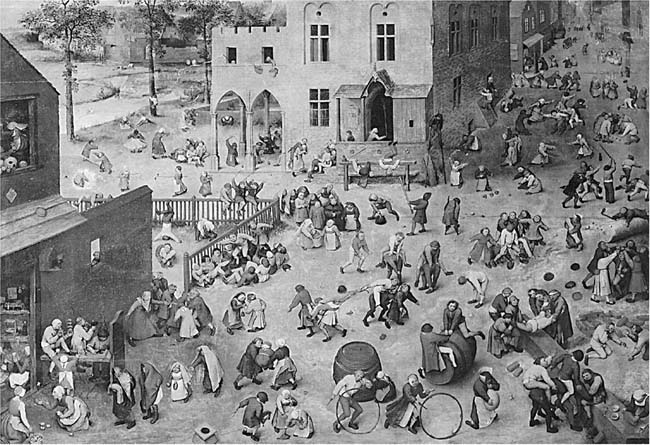
In Pieter Bruegel's 1559 painting Children's Games, children are depicted playing with dolls, hoops, tops, dice, and a hobby horse, and riding on rails and barrels, performing acrobatics, climbing trees, giving piggyback rides, wrestling, and swimming.
Doll play was not restricted to children. Peddlers sold miniature ceramics, jugs, and cookware, as well as utensils. Girls played with dolls to develop practical skills like sewing, along with imagination, role-playing, and imitation. Hobby horses and imitation horses were popular with boys and girls. Metal models of knights in armor have been found that date back to 1300. Playing with marbles developed dexterity. Games such as Dice, Cards, Checkers, and Chess were popular because they developed strategy and memory. Play often incorporated ordinary materials and foodstuffs in games like cherry stones, marrow bone, buckle-pit, spurn point, cobnut, and quoiting. With cobnuts, the objects were used in game play as well as for currency for measuring gains and losses. The popular guessing game Handy-Dandy was played with a small object hidden in the palm of a hand behind the player's back.
With widespread illiteracy, the Catholic Church encouraged parish priests to act out scenes from the Bible. As time passed, the scriptural stories were embellished, so the Bible drama became a form of entertainment. Play also reflected the activities of changing seasons and church calendars. Prior to Lent, boys held cockfighting games on Shrove Tuesday, and children played with tops during Lent. During spring and early summer, holidays including Rogation Week, Pentecost, and Midsummer Day festivals provided occasions for communal play. On Midsummer's Eve, children gathered to entertain each other with music and songs. From late June to September, children participated in the harvest season. Nutting—seeking and harvesting nuts—became popular group play accompanied with bonfires and games. All Saints Day, November 1, came at the time of the pig slaughter, and pig bladders were used to make balls that were used in playing Croquet, Shuttlecock, Skittles, and tennis.
...
- Billiards
- Bowling
- Charades
- Crosswords
- Darts
- Dice
- Dominoes and Variations of
- Hobbies
- I Spy
- Mazes
- Musical Chairs
- Odd Man Out
- Parlor Games
- Password
- Puzzles
- Skittles
- Stock Market Games
- Sudoku
- Tic-Tac-Toe
- Trivial Pursuit
- Twenty Questions
- Who Am I?
- Word Games (Other Than Crosswords)
- Backgammon
- Battleships
- Bingo
- Boggle
- Checkers and Variations of
- Chess and Variations of
- Chinese Checkers
- Diplomacy
- Dungeons & Dragons
- Go
- Hand and Foot
- Life
- Mahjong
- Monopoly and Variations of
- Ouija Board
- Peg Boards
- Probe
- Risk, the Game
- Scrabble
- Snakes and Ladders
- Stratego
- Trivial Pursuit
- Warhammer
- Ace-Deuce-Jack
- All Fives
- Auction Pitch
- Baccarat
- Beggar My Neighbor
- Bezique
- Blackjack
- Boston
- Brag
- Bridge and Variations of
- Casino
- Cribbage
- Donkey
- Ecarté
- Euchre
- Faro
- Fish
- Hearts
- Loo
- Memory and Play
- Mille Bornes
- Monte Bank
- Napoleon
- Old Maid
- Pinochle
- Piquet
- Play or Pay
- Poker and Variations of
- Pope Joan
- Preference
- Racing Demon
- Rolling Stone
- Rummy and Variations of
- Sequence
- Seven Up
- Skat
- Slapjack
- Solitaire and Variations of
- Spit
- Spoil Five
- War
- Whist
- Ziginette
- Blind Man's Bluff
- Car and Travel Games
- Clapping Games
- Erector Sets
- Finger Games
- Frisbee
- Hares and Hounds
- Hide and Seek
- Hit the Rat
- Jacks
- Jump Rope
- Kick the Can
- Leapfrog
- London Bridge
- Marbles
- Marco Polo
- Piggy in the Middle
- Pinball
- Pin the Tail on the Donkey
- Playing “Doctor”
- Playing “House”
- Pokémon
- Pretending
- Punch & Judy
- Rock Paper Scissors
- Sand Play
- Singing Games
- Softball
- Speech Play
- Spinning Tops
- Table Hockey
- Table Soccer
- Tag
- Tiddlywinks
- Tinkertoys
- Tree Houses
- Water Play
- Africa, Traditional Play in
- Ancient China
- Ancient Egypt
- Ancient Greece
- Ancient India
- Ancient Rome
- Assyrian/Babylonian Culture
- Australian Aborigine
- Central Asia, Ancient
- Europe, 1200 to 1600
- Europe, 1600 to 1800
- Europe, 1800 to 1900
- Europe, 1900 to 1940
- Europe, 1940 to 1960
- Europe, 1960 to Present
- History of Playing Cards
- Mesoamerican Cultures
- Native Americans
- New Zealand Maori
- South Americans, Traditional Cultures
- Spanish America
- United States, 1783 to 1860
- United States, 1860 to 1876
- United States, 1876 to 1900
- United States, 1900 to 1930
- United States, 1930 to 1960
- United States, 1960 to Present
- United States, Colonial Period
- Vikings
- Athletics (Amateur)
- Ballooning
- Baseball (Amateur)
- Basketball (Amateur)
- Bicycles
- Bocee
- Boules
- Bungee Jumping
- Cracking the Whip
- Cricket (Amateur)
- Croquet
- Curling (Scottish)
- Dodgeball
- Fishing
- Folk Dancing
- Football (Amateur)
- Highland Games
- Golf (Amateur)
- Hockey (Amateur)
- Horse Racing (Amateur)
- Kayaking and Canoeing
- Kite Flying
- Maypole Dancing
- Morris Dancing
- Music, Playing
- Netball
- Paintball
- Ping Pong
- Rodeos
- Roller Coasters
- Rugby (Amateur)
- Sailing
- Skateboarding
- Skating
- Skiing
- Snail Racing
- Snowboarding
- Soccer (Amateur) Worldwide
- Stilts
- Surfing
- Swimming (Amateur)
- Tennis (Amateur) and Variations of
- Volleyball (Amateur)
- Academic Learning and Play
- Models
- Montessori
- Mother-Child Play
- Play and Evolution
- Play and Literacy
- Play in the Classroom
- Recess
- Teacher-Child Co-Play
- Toys and Child Development
- Afghanistan
- Albania
- Algeria
- Arctic Play (First Nations)
- Argentina
- Armenia
- Australia
- Austria
- Azerbaijan
- Bahamas and Caribbean
- Belarus
- Belgium
- Bolivia
- Bosnia and Herzegovina
- Brazil
- Bulgaria
- Cambodia
- Canada
- Central American Nations
- Chile
- China
- Colombia
- Congo
- Croatia
- Cuba
- Cyprus
- Czech Republic
- Denmark
- Ecuador
- Egypt
- Estonia
- Ethiopia
- Finland
- France
- Georgia
- Germany
- Ghana
- Greece
- Hungary
- Iceland
- India
- Indonesia
- Iran
- Iraq
- Ireland
- Israel
- Italy
- Japan
- Jordan
- Kazakhstan
- Kenya
- Korea, North and South
- Kyrgyzstan
- Laos
- Latvia
- Lebanon
- Liberia
- Lithuania
- Malaysia
- Mexico
- Myanmar
- Netherlands
- New Zealand
- Nigeria
- Norway
- Pakistan
- Paraguay
- Peru
- Philippines
- Poland
- Portugal
- Romania
- Russia
- Samoa
- Saudi Arabia
- Serbia and Montenegro
- South Africa
- Spain
- Sudan
- Sweden
- Switzerland
- Syria
- Tanzania
- Thailand
- Turkey
- Turkmenistan
- Ukraine
- United Kingdom
- Uruguay
- Uzbekistan
- Venezuela
- Vietnam
- Adlerian Play Therapy
- “Bad” Play
- Boys' Play
- Common Adventure Concept
- Daydreaming
- Experiential Learning Definitions and Models
- Fantasy Play
- Female Aggressive Relationships Within Play (Putallaz)
- Gambling
- Gamesmanship
- Games of Deception
- Girls' Play
- Homo Ludens (Huizinga)
- Human Relationships in Play
- Inter-Gender Play
- Luck and Skill in Play
- Piaget and Play
- Play Among Animals
- Play and Learning Theory
- Play and Power, Psychology of
- Play as Catharsis
- Play as Competition, Psychology of
- Play as Entertainment, Psychology of
- Play as Interspecies Communication (Pets)
- Play as Learning, Psychology of
- Play as Mastery of Nature
- Play as Mock War, Psychology of
- Play as Progress (Sutton-Smith)
- Play as Rehearsal of Reality
- Play Frames
- Playing Alone
- Pretending
- Psychoanalytic Theory and Play
- Psychological Benefits of Play
- Psychology of Play (Vygotsky)
- Rhetorics of Play (Sutton-Smith)
- Role-Playing
- Sex Play
- Social Psychology of Play
- Symbol Formation and Play
- Team Play
- Teasing
- Unstructured Play
- Amusement Parks
- Anti-Competition Play
- Arcades
- Caillois: Man, Play and Games
- Cityscapes as Play Sites
- Cooperative Play
- Costumes in Play
- Game Theory
- Organized or Sanctioned Play
- Play and Power, Sociology of
- Play as Competition, Sociology of
- Play as Entertainment, Sociology of
- Play as Learning, Sociology of
- Play as Mock War, Sociology of
- Playground as Politics
- Social Distinctions
- Sociological Benefits of Play
- Spontaneous Group Play
- Theology of Play
- Action Figures
- Blinky Bill
- Dolls, Barbie and Others
- G.I. Joe
- Gollywogs
- Hobby Horses
- Jigsaws
- Lead Soldiers
- LEGOs
- Meccano
- Paddington Bear
- Pet Rocks
- Rocking Horses
- Rubik's Cube
- Teddy Bears
- Wendy Houses
- Yo-Yos
- Airfix
- Amiga
- Avalon Hill
- Bandai
- Coleco
- Fisher-Price
- Galoob
- Hasbro
- Hornby
- Imperial Toy
- JAKKS Pacific Toys
- Kenner
- LEGOs
- Lionel
- LJN
- Matchbox
- McFarlane Toys
- Minifigs
- Parker Brothers
- Playmates
- Playskool
- Revell
- Strong National Museum of Play
- Tiger Electronics
- TOMY
- Toybiz
- Trendmasters
- TSR
- Waddington
- Wargames Research Group
- Age of Empires
- Battlefield 1942
- Civilization (I, II, III, IV)
- Cossacks (Napoleonic Wars)
- Counter-Strike
- Dragon Quest
- Dragon Warrior
- Dungeon Lords
- Flight Simulation
- GoldenEye 007
- Grand Theft Auto
- Legend of Zelda
- Maple Story
- Mario
- Minesweeper
- Mortal Kombat
- Runescape
- Silkroad Online
- SimCity
- Snake
- Solitaire
- Sonic the Hedgehog
- Street Fighter I and II
- Tetris
- Tomb Raider
- World of Warcraft
- Loading...
Get a 30 day FREE TRIAL
-
 Watch videos from a variety of sources bringing classroom topics to life
 -
Read modern, diverse business cases
-
Explore hundreds of books and reference titles

Read next

More like this
Sage Recommends
We found other relevant content for you on other Sage platforms.
Have you created a personal profile? Login or create a profile so that you can save clips, playlists and searches