
Entry
Reader's guide
Entries A-Z
Subject index
Validation Strategies
In the broadest sense, validation refers to the process of establishing the truth, accuracy, or soundness of some judgment, decision, or interpretation. In industrial and organizational psychology, validation generally focuses on the quality of interpretations drawn from psychological tests and other assessment procedures that are used as the basis for decisions about people's work lives. Before discussing validation specifically, it is necessary to clarify some concepts that are integral to the process of decision making based on psychological testing.
Defining the Focus of Validation
It is important to realize that validity is not a characteristic of a test or assessment procedure but of the inferences and decisions made from test or assessment information. Validation is the process of generating and accumulating evidence to support the soundness of the inferences made in a specific situation. Logically, therefore, to examine the concept of validation, it is important to specify (a) the types of inferences involved in applied assessment situations and (b) the nature of evidence that can be used to support such inferences. Different validation strategies reflect different ways to gather and examine the evidence supporting these important inferences.
Applied psychological assessment involves a series of professional activities. A general characterization of these activities includes the following steps: (a) analysis of a work setting to determine (b) the important task and organizational behaviors (and subsequent outcomes) composing a performance domain, which then guide (c) the selection or development of certain assessment procedures (predictors), which make possible (d) predictions about the likelihood that assessees will exhibit important behaviors, and then subsequently (e) measuring individual work behavior using some operational criterion measure. This process implies a conceptual framework, which is presented in Figure 1.
This framework comprises the following inferences:
- Inference 1. The analysis of the work setting yields an accurate description of performance.
- Inference 2. The construct domains tapped by the predictor overlap with the performance domains.
- Inference 3. The predictors are adequate samples of relevant psychological construct domains.
- Inference 4. Predictor scores relate to operational criterion measurements.
- Inference 5. The operational criterion measures adequately sample from the performance domains.
- Inference 6. The predictors relate to the performance domains.
The analysis of a work setting generates a conception of desired performance, or a performance domain. Performance domains are clusters of work activities and outcomes that are especially valued by an organization. Selection decisions based on psychological assessment represent attempts to identify regularities in work behavior—but only those behaviors that are identified by the organization as relevant for goal attainment. Personnel selection, then, is the process of identifying and mapping predictor samples of behavior to effectively overlap with performance domains. Validity can be described as the extent to which the predictor sample meaningfully overlaps with the performance domain.
Figure 1 A Conceptual Framework Detailing the Inferences Involved in Validation
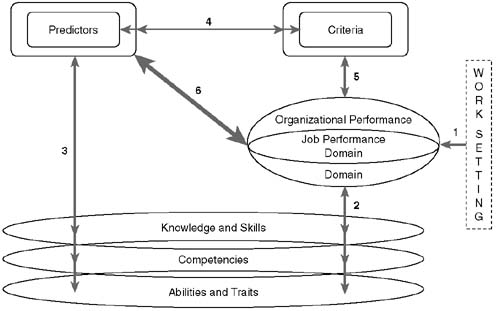
Validation is the process of generating evidence that the inferences drawn from assessment information are accurate. Inference 6 is the keystone inference in applied decision making because it represents whether a specific assessment process yields information that makes possible the prediction of important organizational outcomes. Inference 6 cannot be tested directly because it links predictor measurements with performance domains that are hypothetical domains of idealized work behavior. However, Inference 6 is tied in closed logical loops to other inferences in the framework, and therefore these other inferences play a role in validation. If certain inferences (which will be discussed in the next section) can be substantiated with sufficient evidence, then Inference 6, by implication, is substantiated. To put it another way, validation is the process of generating evidence to support Inference 6, and this involves supporting the other inferences in the framework.
...
- Foundations: History
- Army Alpha/Army Beta
- Hawthorne Studies/Hawthorne Effect
- History of Industrial/Organizational Psychology in Europe and the United Kingdom
- History of Industrial/Organizational Psychology in North America
- History of Industrial/Organizational Psychology in Other Parts of the World
- Human Relations Movement
- Project A
- Scientific Management
- Scientist-Practitioner Model
- Unions
- Foundations: Ethical and Legal Issues
- Adverse Impact/Disparate Treatment/Discrimination at Work
- Affirmative Action
- Age Discrimination in Employment Act
- Americans with Disabilities Act
- Bona Fide Occupational Qualifications
- Civil Rights Act of 1964, Civil Rights Act of 1991
- Comparable Worth
- Corporate Ethics
- Corporate Social Responsibility
- Employment at Will
- Equal Pay Act of 1963
- Ethics in Industrial/Organizational Practice
- Ethics in Industrial/Organizational Research
- Family and Medical Leave Act
- Glass Ceiling
- Labor Law
- National Institute for Occupational Safety and Health/Occupational Safety and Health Administration
- Race Norming
- Sexual Discrimination
- Sexual Harassment at Work
- Stereotyping
- Test Security
- Uniform Guidelines on Employee Selection Procedures
- Workplace Accommodations for the Disabled
- Foundations: Research Methods
- Benchmarking
- Case Study Method
- Competency Modeling
- Content Coding
- Critical Incident Technique
- Cross-Cultural Research Methods and Theory
- Experimental Designs
- Focus Groups
- Lens Model
- Linkage Research and Analyses
- Longitudinal Research/Experience Sampling Technique
- Meta-Analysis
- Naturalistic Observation
- Nonexperimental Designs
- Organizational Surveys
- Policy Capturing
- Program Evaluation
- Qualitative Research Approach
- Quantitative Research Approach
- Quasi-experimental Designs
- Sampling Techniques
- Simulation, Computer Approach
- Survey Approach
- Verbal Protocol Analysis
- Foundations: Measurement Theory and Statistics
- Classical Test Theory
- Confidence Intervals/Hypothesis Testing/Effect Sizes
- Construct
- Criterion Theory
- Descriptive Statistics
- Differential Item Functioning
- Factor Analysis
- Generalizability Theory
- Incremental Validity
- Inferential Statistics
- Item Response Theory
- Measurement Scales
- Measures of Association/Correlation Coefficient
- Moderator and Mediator Variables
- Multilevel Modeling
- Multilevel Modeling Techniques
- Multitrait–Multimethod Matrix
- Nomological Networks
- Normative versus Ipsative Measurement
- Reliability
- Statistical Power
- Structural Equation Modeling
- Utility Analysis
- Validation Strategies
- Validity
- Industrial Psychology: Understanding and Assessing Individual Differences
- Affective Traits
- Big Five Taxonomy of Personality
- Biographical Data
- Cognitive Abilities
- Cognitive Ability Tests
- Computer Assessment
- Core Self-Evaluations
- Emotional Intelligence
- Employment Interview
- Genetics and Industrial/Organizational Psychology
- Graphology
- Gravitational Hypothesis
- Hardiness
- Impression Management
- Individual Assessment
- Individual Differences
- Integrity Testing
- Job Knowledge Testing
- Letters of Recommendation
- Locus of Control
- Machiavellianism
- Motivational Traits
- Need for Achievement, Power, and Affiliation
- Optimism and Pessimism
- Personality
- Personality Assessment
- Physical Performance Assessment
- Practical Intelligence
- Protestant Work Ethic
- Self-Esteem
- Situational Judgment Tests
- Standardized Testing
- Stereotype Threat
- Trainability and Adaptability
- Type A and Type B Personalities
- Work Samples
- Work Values
- Industrial Psychology: Employment, Staffing, and Career Issues
- Dictionary of Occupational Titles
- Applicant/Test-Taker Reactions
- Banding
- Career Development
- Careers
- Compensation
- Credentialing
- Dirty Work
- Drug and Alcohol Testing
- Electronic Human Resources Management
- Employee Selection
- Executive Selection
- Exit Survey (Exit Interview)
- Expatriates
- Gainsharing and Profit Sharing
- Gay, Lesbian, and Bisexual Issues at Work
- Human Resources Strategy
- Job Advertisements
- Job Analysis
- Job Analysis Methods
- Job Choice
- Job Description
- Job Evaluation
- Job Search
- Job Typologies
- Occupational Information Network (O*NET)
- Older Worker Issues
- Person–Environment Fit
- Person–Job Fit
- Person–Organization Fit
- Person–Vocation Fit
- Placement and Classification
- Prescreening Assessment Methods for Personnel Selection
- Realistic Job Preview
- Recruitment
- Recruitment Sources
- Retirement
- Selection Strategies
- Selection: Occupational Tailoring
- Succession Planning
- Underemployment
- Industrial Psychology: Developing, Training, and Evaluating Employees
- 360-Degree Feedback
- Assessment Center
- Assessment Center Methods
- Distance Learning
- Diversity Training
- Electronic Performance Monitoring
- Employee Assistance Program
- Executive Coaching
- Feedback Seeking
- Frame-of-Reference Training
- Leadership Development
- Mentoring
- Organizational Socialization
- Organizational Socialization Tactics
- Performance Appraisal
- Performance Appraisal, Objective Indexes
- Performance Appraisal, Subjective Indexes
- Performance Feedback
- Rating Errors and Perceptual Biases
- Self-Fulfilling Prophecy: Pygmalion Effect
- Socialization: Employee Proactive Behaviors
- Training
- Training Evaluation
- Training Methods
- Training Needs Assessment and Analysis
- Transfer of Training
- Industrial Psychology: Productive and Counterproductive Employee Behavior
- Contextual Performance/Prosocial Behavior/Organizational Citizenship Behavior
- Counterproductive Work Behaviors
- Counterproductive Work Behaviors, Interpersonal Deviance
- Counterproductive Work Behaviors, Organizational Deviance
- Creativity at Work
- Customer Satisfaction with Services
- Cyberloafing at Work
- Innovation
- Integrity at Work
- Job Performance Models
- Organizational Retaliatory Behavior
- Theft at Work
- Time Management
- Violence at Work
- Whistle-Blowers
- Withdrawal Behaviors, Absenteeism
- Withdrawal Behaviors, Lateness
- Withdrawal Behaviors, Turnover
- Workplace Incivility
- Industrial Psychology: Motivation and Job Design
- Action Theory
- Control Theory
- Empowerment
- Expectancy Theory of Work Motivation
- Goal-Setting Theory
- Human–Computer Interaction
- Incentives
- Intrinsic and Extrinsic Work Motivation
- Job Characteristics Theory
- Job Design
- Job Involvement
- Job Rotation
- Job Sharing
- Need Theories of Work Motivation
- Path–Goal Theory
- Positive Psychology Applied to Work
- Self-Concept Theory of Work Motivation
- Self-Efficacy
- Self-Regulation Theory
- Social Cognitive Theory
- Telecommuting
- Theory of Work Adjustment
- Two-Factor Theory
- Work Motivation
- Workaholism
- Industrial Psychology: Leadership and Management
- Abusive Supervision
- Behavioral Approach to Leadership
- Charismatic Leadership Theory
- Employee Grievance Systems
- Global Leadership and Organizational Behavior Effectiveness Project
- Implicit Theory of Leadership
- Judgment and Decision-Making Process
- Judgment and Decision-Making Process: Advice Giving and Taking
- Judgment and Decision-Making Process: Heuristics, Cognitive Biases, and Contextual Influences
- Leader–Member Exchange Theory
- Leadership and Supervision
- Least Preferred Coworker Theory
- Life-cycle Model of Leadership
- Normative Models of Decision Making and Leadership
- Reinforcement Theory of Work Motivation
- Situational Approach to Leadership
- Spirituality and Leadership at Work
- Trait Approach to Leadership
- Transformational and Transactional Leadership
- Trust
- Industrial Psychology: Groups, Teams, and Working with Others
- Conflict at Work
- Conflict Management
- Diversity in the Workplace
- Group Cohesiveness
- Group Decision-Making Quality and Performance
- Group Decision-Making Techniques
- Group Development
- Group Dynamics and Processes
- Groups
- Groupthink
- Input–Process–Output Model of Team Effectiveness
- Intergroup Relations
- Interpersonal Communication
- Interpersonal Communication Styles
- Justice in Teams
- Meetings at Work
- Negotiation, Mediation, and Arbitration
- Networking
- Social Exchange Theory
- Social Loafing
- Social Norms and Conformity
- Social Support
- Team Building
- Team Mental Model
- Team-Based Rewards
- Virtual Teams
- Workplace Romance
- Industrial Psychology: Employee Well-Being and Attitudes
- Affective Events Theory
- Attitudes and Beliefs
- Boredom at Work
- Emotional Burnout
- Emotional Labor
- Emotions
- Eustress
- Job Satisfaction
- Job Satisfaction Measurement
- Job Security/Insecurity
- Mood
- Morale
- Organizational Commitment
- Organizational Cynicism
- Organizational Justice
- Psychological Contract
- Quality of Work Life
- Role Ambiguity
- Role Conflict
- Role Overload and Underload
- Stress, Consequences
- Stress, Coping and Management
- Stress, Models and Theories
- Theory of Reasoned Action/Theory of Planned Behavior
- Union Commitment
- Work–Life Balance
- Industrial Psychology: Organizational Structure, Design, and Change
- Attraction–Selection–Attrition Model
- Automation/Advanced Manufacturing Technology/Computer-Based Integrated Technology
- Balanced Scorecard
- Compressed Workweek
- Downsizing
- Entrepreneurship
- Flexible Work Schedules
- Globalization
- High-Performance Organization Model
- Learning Organizations
- Mergers, Acquisitions, and Strategic Alliances
- Organizational Behavior
- Organizational Behavior Management
- Organizational Change
- Organizational Change, Resistance to
- Organizational Climate
- Organizational Communication, Formal
- Organizational Communication, Informal
- Organizational Culture
- Organizational Development
- Organizational Image
- Organizational Politics
- Organizational Sensemaking
- Organizational Structure
- Outsourcing
- Shiftwork
- Sociotechnical Approach
- Strategic Planning
- Survivor Syndrome
- Terrorism and Work
- Theory of Action
- Total Quality Management
- Virtual Organizations
- Workplace Injuries
- Workplace Safety
- Professional Organizations and Related Fields
- Loading...
Get a 30 day FREE TRIAL
-
 Watch videos from a variety of sources bringing classroom topics to life
 -
Read modern, diverse business cases
-
Explore hundreds of books and reference titles

Read next

More like this
Sage Recommends
We found other relevant content for you on other Sage platforms.
Have you created a personal profile? Login or create a profile so that you can save clips, playlists and searches