
Entry
Reader's guide
Entries A-Z
Subject index
Negotiation
Negotiation is the process whereby two or more parties attempt to settle what each shall give and take, or perform and receive, in a transaction between them. Negotiation situations are characterized by five key components: the process takes place between two or more parties (individuals, groups, or organizations); there is an unresolved conflict of needs and desires between the parties; the parties negotiate by choice, expecting that they can improve upon what the other might simply offer them; the parties expect a giveand-take process; and the parties prefer to negotiate rather than to fight openly, have one side capitulate to the other, or resolve the dispute in some other manner.
Conceptual Overview
Negotiation is a critical managerial skill. Every business discipline requires some form of negotiation: purchasing, selling, proposing and defending budgets, handling conflicts with bosses and subordinates, dealing with regulatory agencies, or coordinating actions between departments in order to deliver the product to market efficiently and effectively. Courses in negotiation skills have become a popular staple in every major business school. The academic study of negotiation dynamics and processes, therefore, is often translated into prescriptive advice that can be given to negotiators on ways to perform more effectively.
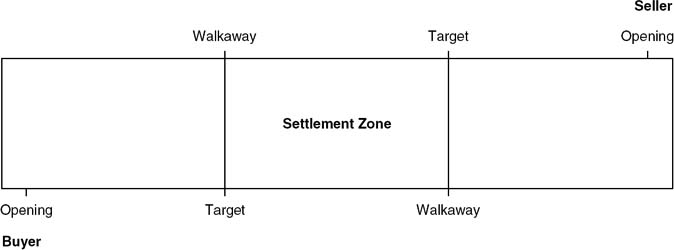
The study of negotiation has focused on two basic fundamentally different negotiation processes: distributive and integrative. The first process is variously called distributive bargaining or claiming value negotiation. (While some authors attempt a formal distinction between bargaining, which is more distributive, and negotiation, which is more integrative, the two terms are used synonymously herein.) Distributive negotiations typically take place between buyers and sellers of some commodity (everything from a dozen apples in a farmers' market to a used car to a collective bargaining agreement); in this kind of negotiation, the amount of resources available is usually fixed, and each party's intent is to maximize the amount of resources they get (the cheapest price, the biggest share, the best contract). The essence of distributive bargaining is often represented as in Figure 1. Negotiators—buyer or seller—are encouraged to set three points for themselves in advance of the negotiation: an opening, where they expect to begin the negotiation; a target, which is the deal they hope to achieve; and a walkaway, or the lowest outcome they will still accept rather than walk away from the negotiation. Naturally, the buyer starts high and plans to make concessions down toward his or her target and walkaway, and the seller starts low and plans to make concessions upward to his or her walkaway. Naturally, neither reveals their target or walkaway, because to do so would give the other important information that would probably lead to a worse settlement for the discloser. If each party knew the other's walkaway, each could discover the size of the settlement zone; any proposed settlement within the settlement zone should be acceptable to both parties and lead to an agreement. Any proposed settlement outside the zone should be rejected.
Figure 1 Buyer and Seller Bargaining Range
Research on distributive negotiation has focused on various strategies and influence tactics that negotiators can use to persuade the other party to yield more than they do. These include tactics of setting a very high or low opening offer, signaling a serious commitment to the opening as a target, making very small concessions (and a very limited number of them) toward the target, asking the other lots of questions to get them to divulge their true target and walkaway, using deception and dishonesty to provide erroneous information, and making threats to walk away if the negotiator doesn't get everything he or she wants.
...
- Approaches to Management Theory
- Classical Management
- Critical Management Education
- Critical Management Studies
- Cross-Cultural Management
- Engineering-Managerial Discourse
- Entrepreneurship
- Hawthorne Studies
- High Involvement Management
- Human Relations School
- International Management
- Management and Organization of Local Governments
- Management and Public Policy
- Management Consultants
- Management Fashions and Fads
- Management Learning
- Managerial and Organizational Cognition
- Managerial Capitalism
- Managerial Rationality
- Managerial Revolution
- Managerialism
- Masculinities and Management
- New Public Management
- Scientific Management
- Strategic Management
- Theory X
- Theory Y
- Theory Z
- Total Quality Management
- Approaches to Organization Theory
- Actor-Network Theory
- Autopoiesis
- Behavioral Theory of the Firm
- Chaos Theory
- Classical Management
- Closed System Approach
- Collective Social Phenomena
- Complex Organizations
- Complexity Theory
- Configuration Theory
- Convergence Model
- Critical Management Studies
- Critical Modernists
- Cybernetics
- Deinstitutionalization
- Economic Sociology
- Engineering-Managerial Discourse
- Environmental Determinism
- Equity Theory
- Ergonomics
- Evolutionary Theory
- Expectancy Theory
- Formal Organizations
- Functionalism
- Gendered Organization
- General Systems Theory
- Hawthorne Studies
- Hermeneutics
- Historical Analysis of Organization Theory
- Human Relations School
- Institutional Isomorphism
- Institutional Legitimacy
- Institutional Theory
- Interaction Analysis
- Interactionism
- Interpretive Theory
- Life Cycle
- Literary Theory
- Long-Wave Theory
- Management Fashions and Fads
- Managerialism
- McDonaldization
- Metaphor and Organization
- Middle-Range Theory
- Narratives
- Neocontingency Model
- Neoinstitutional Theory
- New Institutionalism
- New Public Management
- Open Systems
- Organization Theory, Historical Analysis
- Organizational Adaptation
- Organizational Demography
- Organizational Ecology
- Organizational Economics
- Organizational Environments
- Organizational Field
- Organizational Rhetoric
- Organizational Theory
- Positive Organizational Scholarship
- Postcolonial Theory
- Public Choice Theory
- Radical Feminism
- Radical Humanism
- Rational Choice Theory
- Resource Dependence
- Resource-Based View of the Firm
- Social Constructionism
- Social Identity Theory
- Social System
- Social Theory
- Sociological Approach
- Sociology of Work and Employment
- Strategic Choice
- Structural Contingency Theory
- Structural Functionalism
- Structuration
- Symbolic Interactionism
- Theory X
- Theory Y
- Theory Z
- Time-Space Relations
- Transnational/Postcolonial Feminist Theorizing
- Viable System Model
- Culture and Symbolism
- Aesthetics of Organization
- Alterity (Otherness)
- Anthropology
- Archetypes
- Authenticity
- Consumer Culture
- Corporate Citizenship
- Corporate Culture
- Corporate Values
- Cross-Cultural Management
- Cultural Capital
- Cultural Intelligence
- Dramaturgy
- Enterprise Culture
- Ethnicity
- Fashion
- Humor
- Hypocrisy
- Identity
- Integrity
- Language and Organizations
- Liminality
- Magic in Organizing
- Management and Public Policy
- Managerial Cultural Capital
- Masculinities and Management
- Multiculturalism
- Music and Work
- Narcissism
- National Culture
- Organizational Culture
- Organizational Rituals
- Organizational Subcultures
- Organizational Symbolism
- Organizational Taboos
- Popular Culture
- Reverse Culture Shock
- Self-Employment Identities
- Sexuality
- Socialization
- Utopia
- Human Resource Management
- Balanced Scorecard
- Boundaryless Career
- Coaching
- Contingent Employment
- Contingent Workers
- Downsizing
- Employment Relations
- Glass Ceiling
- Human Resource Management
- Industrial Relations
- International Human Resources Management
- Job Evaluation
- Job Satisfaction
- Labor and Offshoring
- Labor Relations
- Outsourcing
- Performance Appraisal
- Performance-Driven Evaluation
- Professions
- Recruiting
- Reengineering
- Strategic Human Resource Management
- Training
- Unemployment
- Unionism
- Wage Inequities
- Work-Family Balance
- Worker Rights
- Working Time
- Workplace Incivility
- Innovation and Creativity
- International Approaches
- International Business
- International Human Resources Management
- International Management
- Internationalization School
- Japanese Management
- Organizational Literature, African
- Organizational Literature, Anglo-Saxon
- Organizational Literature, Arabic
- Organizational Literature, Asian
- Organizational Literature, Brazilian
- Organizational Literature, Eastern European
- Organizational Literature, Francophone
- Organizational Literature, Germanic
- Organizational Literature, Latin American
- Organizational Literature, Scandinavian
- Transnational Corporations
- Issues in Organizational Structure
- Absorptive Capacity
- Adhocracies
- Architecture and Organizations
- Bureaucracy
- Bureaucratization
- Decentralization
- Demographic Process
- Design Space Management
- Downsizing
- Ecological Change
- Fit
- Five Forces
- Hierarchy
- Locus of Control
- Loose Coupling
- Machine Bureaucracy
- Management and Organization of Local Governments
- Matrix Organization
- Mechanistic Organizations
- Military Organization
- Minimal Network
- Minimal Structure
- Multidivisional Form
- Multisubsidiary Form
- Nongovernmental Organizations
- Nonprofit Organizations
- Organic Organizations
- Organizational Design
- Organizational Evolution
- Organizational Rules
- Organizational Structure
- Post-Bureaucratic Organizations
- Small and Medium-Sized Enterprises
- Spatial Organization
- Structural Determinism
- Virtual Organization
- Virtual Reality
- Issues in Organization Practices
- Balanced Scorecard
- Boundaryless Career
- Complexity of Decision Making
- Contingent Employment
- Contingent Workers
- Control
- Conversation
- Coordination
- Corporate Branding
- Dehumanization
- Diversity
- Dynamic Capabilities
- Effectiveness
- Emotional Patterns in Organizations
- Gender Division
- Gender Stereotypes
- Human Resource Management
- Information
- Irrationality
- Job Evaluation
- Just-in-Time Management
- Karoshi
- Lean Production
- Managerial Revolution
- Normal Accidents
- Organizational Capabilities
- Organizational Citizenship Behaviors
- Organizational Discourse
- Organizational Identity
- Organizational Image
- Organizational Man
- Organizational Misbehavior
- Organizational Mortality
- Organizational Paradox
- Organizational Paranoia
- Ownership and Control
- Panopticism
- Participation
- Perceived Organizational Support
- Performance Appraisal
- Performance-Driven Evaluation
- Play
- Practice
- Procedural Justice
- Procrastination
- Project Management
- Recruiting
- Reengineering
- Risk Management
- Scenario Planning
- Scientific Management
- Strategic Human Resource Management
- Strategic Management
- Total Quality Management
- Vertical Integration
- Knowledge and Learning
- Action Learning
- Actionable Knowledge
- Adaptive Learning
- Adult Learning
- Business Journalism
- Coaching
- Communities of Practice
- Cultural Intelligence
- Dialogue
- Diffusion
- Emotional Intelligence
- Entrepreneurship
- Experiential Learning
- Explicit Knowledge
- Exploitation
- Information
- Information Processing
- Knowledge
- Knowledge Creation
- Knowledge Management
- Knowledge-Intensive Firms
- Learning
- Learning Organization
- Learning, Double-Loop
- Management Learning
- Managerial and Organizational Cognition
- Organizational Knowledge
- Organizational Learning
- Professional Service Firms
- Professions
- Skill
- Storytelling
- Tacit Knowledge
- Training
- Leadership Theory
- Organizational Behavior
- Action
- Affect
- Asset Specificity
- Attitudes
- Attribution Theory
- Bounded Emotionality
- Clinical Perspective
- Cohesion
- Emotion
- Followership
- Goal-Setting Theory
- High Involvement Management
- Identification
- Impression Management
- Individualism
- Influence
- Intergroup Conflict
- Job Satisfaction
- Leadership Theory
- Leadership, Charisma
- Leadership, Dispersed
- Leadership, Servant
- Leadership, Styles
- Leadership, Transactional
- Leadership, Transformational
- Morale
- Motivation
- Negotiation
- Operant Conditioning
- Opportunistic Behavior
- Organizational Behavior
- Organizational Climate
- Organizational Memory
- Organizational Performance
- Organizational Resilience
- Organizational Routines
- Organizational Spirituality
- Organizational Stigma
- Organizational Therapy
- Organizational Toxicity
- Personality, Five-Factor Model
- Self-Efficacy
- Subjectivity
- Trust
- Values
- Organizational Cognition, Change, and Communication
- Bounded Rationality
- Cognitive Approach
- Cognitive Dissonance
- Cognitive Mapping
- Communication
- Communicative Action
- Decision-Making Theory
- Garbage Can Model
- Institutional Entrepreneurship
- Managerial Rationality
- Organizational Change
- Organizational Communication
- Organizational Development
- Positive Psychology
- Prisoner's Dilemma
- Psychological Contract
- Psychological Safety
- Resistance to Change
- Sensemaking
- Organizational Economics
- Agency
- Agency Theory
- Business History
- Capital Markets
- Coase Theorem
- Competition
- Competitive Advantage
- Corporate Governance
- Economic Rationalism
- Free-Rider Problem
- Game Theory
- Joint-Stock Companies
- Law and Economics
- Market-Based Theory
- Moral Hazard
- Multinational Enterprises
- Neoclassical Economics
- Shareholders
- Transaction Cost Theory
- Utilitarianism
- Value Chains
- Organizational Power, Politics, and Conflict
- Alterity (Otherness)
- Authoritarianism
- Authority
- Coercion
- Compliance
- Conflict
- Cynicism
- Discipline
- Discrimination
- Domination
- Empowerment
- Glass Ceiling
- Governmentality
- Hegemony
- Human Rights
- Ideology
- Iron Law of Oligarchy
- Labor and Offshoring
- Labor Relations
- Oppression
- Organizational Democracy
- Organizational Justice
- Organizational Politics
- Political Economy of Organizations
- Politics
- Politics of Organizational Culture
- Power
- Punishment and Violence in Organizations
- Slavery
- Strategic Discourse
- Subordination
- Surveillance
- Sweatshops
- Violence
- Wage Inequities
- Worker Rights
- Workplace Incivility
- Organizational Relations
- Alliances
- Business Networks
- Buyer-Supplier Relationships
- Coalitions
- Collaboration and Cooperation
- Collectivism
- Communities of Practice
- Complex Adaptive Systems
- Employment Relations
- Guanxi
- Industrial Relations
- Interorganizational Relations and Collaboration
- Keiretsu
- Network Coevolution
- Network Society and Organizations
- Networks
- Organizational Strategy
- Outsourcing
- Stakeholders
- Strategic Alliances
- Philosophy of Organizations
- Agency-Structure Debate
- Analytical Empiricism
- Antirationalism
- Antirealism
- Constructivism
- Critical Realism
- Critical Theory
- Deconstruction
- Disorganization
- Epistemic Communities
- Epistemology
- Foucauldian Turn
- Frankfurt School
- Grand Narratives
- Humanism
- Improvisation
- Incommensurability
- Lacanian Psychoanalysis
- Logical Positivism
- Modernism
- Objectivity
- Ontology
- Organizational Existentialism
- Organizational Philosophy
- Paradigm Incommensurability
- Paradigms
- Phenomenology
- Philosophy of Science
- Positivism
- Postmodernism
- Poststructuralism
- Pragmatism
- Realism
- Relativism
- Theory Building
- Truth
- Research Practice and Methodology
- Action Research
- Arts and Organizations
- Behaviorism
- Critical Analysis
- Cross-Level Analysis
- Data
- Delphi Technique
- Discourse Analysis
- Emergent Theory
- Emic
- Ethnography
- Ethnomethodology
- Etic
- Genealogical Analysis
- Grounded Theory Building
- Measurement
- Meta-Analysis
- Organizational Anthropology
- Organizational Ethnography
- Paradox
- Prescriptive Theory
- Psychoanalytic Approach
- Qualitative Approaches
- Qualitative Interview
- Quantitative Models and Methods
- Reflexivity
- Replication Strategy
- Triangulation
- Value-Free Conception of Science
- Social Issues
- Accountability
- Accounting, Impact on Organizations and Society
- Activism
- Business Ethics
- Capital Movement, Migration, and Maquiladoras
- Capitalism, Models of
- Civil Society
- Class
- Clusters
- Community and Organizations
- Conservatism
- Corporate Crime and Corruption
- Corporate Social Responsibility
- Critical Management Education
- Environmentalism and Organizations
- Family Business
- Global Village
- Globalization
- Industrial Democracy
- Industrial Revolution
- Informal Economy
- Liberal Technologies of Regulation
- Liberalism
- Managerial Capitalism
- Marginalization
- Modernity
- Neoliberalism and Organization
- Post-Fordist Economy
- Postmodernity
- Protestant Ethic
- Regionalization and Capital Movement
- Social Capital
- Social Movements
- Sustainable Development
- Unemployment
- Unionism
- Virtue Ethics
- Work-Family Balance
- Working Time
- Teams
- Technologies
- Call Centers
- Computer-Based Learning
- Computer-Based Simulation Research
- Computer-Mediated Communication
- Digital Divide
- E-Commerce
- High-Risk Technologies and Organizations
- Human Engineering
- Human-Computer Interaction
- Information and Communication Technology
- Sociotechnical Systems
- Technological Determinism
- Technology
- Loading...
Get a 30 day FREE TRIAL
-
 Watch videos from a variety of sources bringing classroom topics to life
 -
Read modern, diverse business cases
-
Explore hundreds of books and reference titles

Read next

More like this
Sage Recommends
We found other relevant content for you on other Sage platforms.
Have you created a personal profile? Login or create a profile so that you can save clips, playlists and searches