
Entry
Reader's guide
Entries A-Z
Subject index
Videoconferencing
Videoconferencing refers to the transmission of images (via video) and sounds (via audio) between two or more physically separate locations. Once the sole province of the corporate boardroom, videoconferencing is used today in telemedicine, distance education, theatrical productions, political trials, and anywhere else the ability to “be here now” is desired. Travel fears subsequent to the September 11, 2001, terrorist attacks seem to have bolstered U.S. market interest in videoconferencing even further, prompting TeleSpan publisher Elliot Gold to recently quip, “We are now a 10-year overnight success.”
The Rise and Fall of the Picturephone
The story of videoconferencing began in the United States in the 1920s, when Bell Labs connected two callers between Washington, D.C., and New York City) and continued during the 1930s in Europe, where television technologies were more mature. By 1964, AT&T was ready to introduce its first public videoconferencing tool—the Picturephone—at the World's Fair. After spending $500 million on development and predicting one million users by 1980, AT&T was stunned when the Picturephone turned out to be a financial failure, garnering only 200 subscribers.
Some researchers have suggested that the Picturephone failed because people simply dislike face-to-face communication via telephone. Others maintained that it was wrongly designed for one-to-one communication, whereas “multipoint” communication (à la conference calls) is how most businesses conduct remote conferencing. As industry expert James Wilcox explains, much of the 1970s and 1980s was spent developing multipoint technologies, with British Telecom persuading telephone companies around Europe to conduct country-to-country trials of equipment. These trials paved the way for the videoconferencing interoperability standards that exist today, and allow multipoint videoconferencing like Stanford's “virtual auditorium” project.
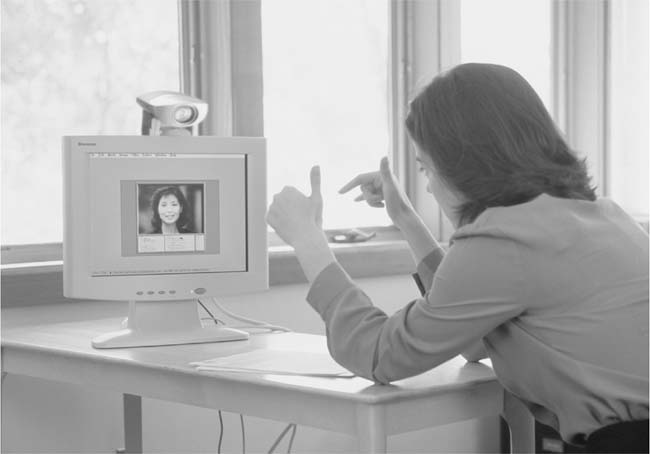
A video conference. (Robert Llewellyn/CORBIS)
From Toy to Tool
In its early days, videoconferencing seemed to many to be more a high-tech toy than a necessary communications tool: Videoconferences could be conducted only out of specially equipped rooms costing from $250,000 to $1,000,000 or more. It was only after the arrival of low-cost solid-state memory in the late 1980s that “set-top” systems started becoming available, with prices at a more manageable $10,000 or so. Set-tops, often configured as rolling carts, were responsible for broadening videoconferencing's uses beyond the traditional office. Director Peter Jackson recently used it to coordinate multiple film crews shooting Lord of the Rings (2001) in remote New Zealand locations, and President George W. Bush conducts videoconferences with his advisers in Washington on days when he is at his Texas ranch.
Whether room-based or set-top, the mechanics of videoconferencing are the same. First, analog signals from video cameras and microphones are translated to digital information inside one's home computer. This is done by way of a codec (a truncated combination of the words “compression” and “decompression”), a compression and decompression standard that is often called the heart of a videoconferencing system. Codecs, which can be either hardware or software, compress outgoing information so it can be quickly and successfully sent via telephone connections; later, the codec decompresses incoming information for viewing. Finally, if multipoint videoconferencing is desired, an expensive multipoint processing unit, sometimes called a “bridge,” must also be implemented. Although another solution, called “multicasting,” does exist, it is not technically feasible for most users today.
...
- Art, Music, and Performance
- Business and Commerce
- http://Amazon.com
- http://MP3.com
- Business-to-Business
- Cookies
- Customer Relationship Management
- Digital Cash
- Disintermediation
- E-Commerce
- Harold Innis
- Internet Service Providers
- Jakob Nielsen
- Jeff Bezos
- Knowledge Management
- Local Area Network
- Margaret Whitman
- Metrics
- Napster
- Narrowcasting
- Personalization
- Peter Drucker
- Security
- Stephen M. Case
- Steven P. Jobs
- Telecommuting
- Trademark
- Video Conferencing
- William H. Gates, III
- Cyberculture
- “A Manifesto for Cyborgs”
- Neuromancer
- The New Hacker's Dictionary
- The Soul of a New Machine
- Understanding Media: The Extensions of Man
- Allucquère Rosanne Stone
- Avatar
- Blog
- Bruce Sterling
- CommuniTree
- Convergence
- Cyberculture
- Cyberethics
- Cyberfeminism
- Cyberpunk
- Cyberspace
- Cyberwarfare
- Donna J. Haraway
- Electronic Civil Disobedience
- Electronic Democracy
- Electronic Frontier Foundation
- Emoticons
- Esther Dyson
- Gender and New Media
- Habitat
- Hacking, Cracking, and Phreaking
- Hacktivism
- Howard Rheingold
- Instant Messaging
- Interactvity
- John Perry Barlow
- Killer Application
- LambdaMOO
- Marshall McLuhan
- Meme
- Metrics
- Mitchell Kapor
- Nicholas Negroponte
- Online Journalism
- Peer-to-Peer
- Race and Ethnicity and New Media
- Sherry Turkle
- Virtual Community
- William Gibson
- Hacking
- 2600: The Hacker Quarterly
- The New Hacker's Dictionary
- CommuniTree
- Computer Emergency Response Team
- Copyleft
- Cyberculture
- Cyberethics
- Cyberwarfare
- DeCSS
- Electronic Civil Disobedience
- Electronic Frontier Foundation
- Encryption and Cryptography
- Eric Raymond
- Hacking, Cracking, and Phreaking
- Hacktivism
- John Perry Barlow
- Mitchell Kapor
- Richard Stallman
- Security
- Virus
- Legal Topics
- 2600: Hacker Quarterly
- Bernstein vs. the U.S. Department of State
- United States vs. Thomas
- Anonymity
- Carnivore
- Child Online Protection Act and Child Online Privacy Protection Act
- Communications Decency Act
- Copyleft
- Copyright
- DeCSS
- Digital Millennium Copyright Act
- Electronic Civil Disobedience
- Electronic Communications Privacy Act
- Electronic Frontier Foundation
- Hacking, Cracking, and Phreaking
- Linking
- Napster
- Obscenity
- Pamela Samuelson
- Privacy
- Security
- Networks and Networking
- ARPANET
- BITNET
- Broadband
- Browser
- Bulletin Board Systems
- Cellular Telephony
- CommuniTree
- Community Networking
- Distributed Computing
- Firewall
- Freenet (Community Network)
- Freenet (File-Sharing Network)
- Internet
- Internet Appliances
- Internet Corporation for Assigned Names and Numbers
- Internet Engineering Task Force
- Internet Relay Chat
- Internet Service Providers
- LISTSERV
- Local Area Network
- Marc Andreessen
- Markup Languages
- Minitel
- MUDs and MOOs
- Napster
- Newsgroups
- Peer-to-Peer
- PLATO
- Satellite Networks
- Short Messaging System
- Telephony
- Tim Berners-Lee
- Usability
- vBNS
- Videotex
- Whole Earth ‘Lectronic Link’
- Wireless Application Protocol
- Wireless Networks
- World Wide Web
- Open-Source Software
- Organizations and Labs
- Association for Computing Machinery
- Computer Emergency Response Team
- Electronic Frontier Foundation
- Institute of Electrical and Electronic Engineers
- Internet Corporation for Assigned Names and Numbers
- Internet Engineering Task Force
- Media Lab, Massachusetts Institute of Technology
- SIGGRAPH
- SRI International
- World Wide Web Consortium
- Xerox Palo Alto Research Center
- People
- Alan Kay
- Alan Turing
- Allucquère Rosanne Stone
- Anita Borg
- Bill Joy
- Brenda Laurel
- Brian Eno
- Bruce Sterling
- Claude Shannon
- Daniel Sandin
- Donna Hoffman
- Donna J. Haraway
- Douglas Englebart
- Edward Tufte
- Eric Raymond
- Esther Dyson
- George Lucas
- Hal Varian
- Hans Moravec
- Harold Innis
- Howard Rheingold
- Ivan Sutherland
- J. C. R. Licklider
- Jakob Nielsen
- Jaron Lanier
- Jeff Bezos
- John Carmack
- John Perry Barlow
- John von Neumann
- Kai Krause
- Laurie Anderson
- Lawrence Lessig
- Manuel Castells
- Marc Andreessen
- Margaret Whitman
- Marshall McLuhan
- Marvin Minsky
- Michael Joyce
- Mitchell Kapor
- Nam June Paik
- Nicholas Negroponte
- Pamela Samuelson
- Pattie Maes
- Peter Drucker
- Raymond Kurzweil
- Richard Stallman
- Robert Moog
- Rodney Brooks
- Seymour Papert
- Sherry Turkle
- Stephen M. Case
- Steven P. Jobs
- Stewart Brand
- Theodor Holm (Ted) Nelson
- Thomas DeFanti
- Tim Berners-Lee
- Vannevar Bush
- Vinton Cerf
- W. Daniel Hillis
- William Gibson
- William H. Gates, III
- Social Issues
- Access
- Anonymity
- Carnivore
- Cyberethics
- Cyberfeminism
- Cyberwarfare
- Digital Divide
- Disposal of Computers
- Education and Computers
- Electronic Civil Disobedience
- Electronic Democracy
- Encryption and Cryptography
- Gender and New Media
- Hacking, Cracking, and Phreaking
- Hacktivism
- Obscenity
- Patent
- Privacy
- Race and Ethnicity and New Media
- Security
- Spam
- Technological Determinism
- Universal Design
- Virtual Community
- Technology
- ARPANET
- Authoring Tools
- Bluetooth
- Broadband
- Browser
- Bulletin Board Systems
- Carnivore
- CAVE
- CD-R, CD-ROM, and DVD
- Cellular Telphony
- Chat
- Codec
- Compression
- Computer-Supported Collaborative Work
- Content Filtering
- Cookies
- DeCSS
- Desktop Video
- Digital Asset Management
- Digital Subscriber Line
- Digital Television
- Distributed Computing
- Emulation
- Encryption and Cryptography
- Expert Systems
- Firewall
- Flash
- Graphical User Interface
- Habitat
- Hypermedia
- Hypertext
- Instant Messaging
- Interactive Television
- Internet
- Internet Appliances
- Internet Relay Chart
- Java
- Linux
- Local Area Network
- Markup Languages
- MIDI
- Minitel
- MP3
- MPEG
- Object-Oriented Programming
- Optical Character Recognition
- Optical Computing and Networking
- Peer-to-Peer
- Personal Digital Assistants
- Photoshop
- Qube
- Robotics
- Satellite Networks
- Shockwave
- Short Messaging System
- Sketchpad
- Software Agents
- Streaming Media
- Telecommuting
- Telephony
- vBNS
- Videoconferencing
- Videotex
- Virus
- Wireless Application Protocol
- Wireless Networks
- World Wide Web
- Writing
- “A Manifesto for Cyborgs”
- “As We May Think”
- “Man-Computer Symbiosis”
- “The Cathedral and the Bazaar”
- 2600: The Hacker Quarterly
- Neuromancer
- The New Hacker's Dictionary
- The Soul of a New Machine
- Understanding Media: The Extensions of Man
- Bruce Sterling
- Cyberpunk
- Electronic Publishing
- Emoticons
- Hypertext
- Michael Joyce
- William Gibson
- Loading...
Get a 30 day FREE TRIAL
-
 Watch videos from a variety of sources bringing classroom topics to life
 -
Read modern, diverse business cases
-
Explore hundreds of books and reference titles

Read next

More like this
Sage Recommends
We found other relevant content for you on other Sage platforms.
Have you created a personal profile? Login or create a profile so that you can save clips, playlists and searches