
Entry
Reader's guide
Entries A-Z
Subject index
Minitel
Minitel is the name of a videotext system instituted in France in 1981. In most areas of the world, videotext, which uses telephone lines to send text and graphics from central computers to terminals, has been surpassed in popularity by the World Wide Web. In France, however, many users remain happily “behind the times,” arguing that Minitel's security and ubiquity serve them just as well (and sometimes better) than the Web.
From Telematique to Minitel
The creation of Minitel began in 1975, after it was determined that only 60 percent of French homes had telephones, a situation that critic Howard Rheingold called “nearly a third world state of telecommunications.” To remedy this, President Giscard d'Estaing commissioned Simon Nora and Alain Minc to issue a report on how to bring France into the technology age. The visionary Nora-Minc study recommended a program called Telematique, which would merge computers and communications technologies for France. The Telematique program involved supplying volunteers with free computer terminals, keyboards, and jacks that fit into telephone wiring slots, to be placed in their homes and businesses. To fund this effort, the researchers recommended that paper telephone directories be abandoned, and instead published on the free computer system.
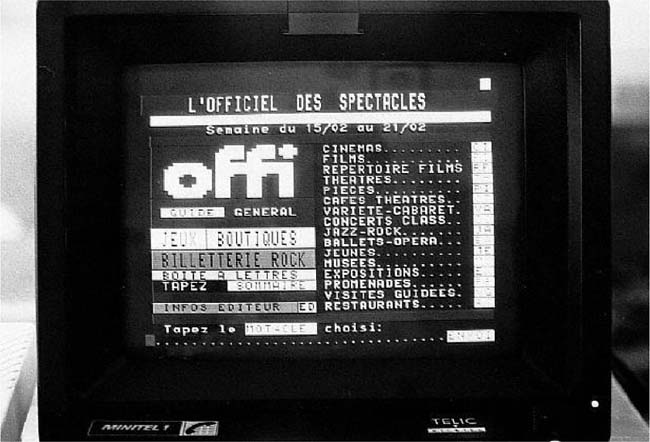
A Minitel terminal from 1989. (Owen Franken/CORBIS)
By 1981, the government was ready to implement Minitel, a teletext system that ran on the donated terminals. As part of its promotional campaign, the first three minutes of a directory search on Minitel were free of charge, and for years the French press ran stories of estranged families reunited through the magic of the new technology. Directories weren't the only thing to be found on Minitel; the service quickly expanded to include (for a fee) weather reports, bank statements, stock-exchange information, and clothes shopping. A decade before the arrival of the Web, universities began to use Minitel to coordinate student registration, course delivery, and examination results.
Out of all of Minitel's 20,000 different services, its messageries, the system's chat services, are the most popular. Minitel chats differ from other sorts of online chats in important ways, notes linguistics expert Anna Livia. Because the average per-minute cost of the messagerie is about $0.38 U.S., brevity becomes an important consideration. In addition, because Minitel exchanges typically take place under conditions of pseudonymity (users are not allowed to list phone numbers or addresses in their bylines), users often wind up inventing masquerade-like identities for themselves. Pseudonymity is certainly important to users of the messageries roses, the name given to Minitel's adult-sex chat lines. Although conservatives have called them “electronic urinals,” a 1991 Harris poll showed that 89 percent of French citizens had no problems with the messageries roses, and thought they should remain on Minitel.
The Price of Success
Minitel was not the first teletext system to find its way to Europe (the British had launched their Prestel system years prior), but as a method for getting shopkeepers, students, farmers, and housewives “wired,” it was certainly the most successful. Some would say that is was too successful. By the late 1990s, Minitel claimed 15 million users, compared to only 12 million French users on the Web. Many French people prefer Minitel to the Web because the former requires no software to load and no hardware to configure. As Rheingold puts it, “It's no mystery why modem dial-up services for PC users in Paris did not grow explosively, when the government was handing out free terminals (with built-in modems) by the millions.”
...
- Art, Music, and Performance
- Business and Commerce
- http://Amazon.com
- http://MP3.com
- Business-to-Business
- Cookies
- Customer Relationship Management
- Digital Cash
- Disintermediation
- E-Commerce
- Harold Innis
- Internet Service Providers
- Jakob Nielsen
- Jeff Bezos
- Knowledge Management
- Local Area Network
- Margaret Whitman
- Metrics
- Napster
- Narrowcasting
- Personalization
- Peter Drucker
- Security
- Stephen M. Case
- Steven P. Jobs
- Telecommuting
- Trademark
- Video Conferencing
- William H. Gates, III
- Cyberculture
- “A Manifesto for Cyborgs”
- Neuromancer
- The New Hacker's Dictionary
- The Soul of a New Machine
- Understanding Media: The Extensions of Man
- Allucquère Rosanne Stone
- Avatar
- Blog
- Bruce Sterling
- CommuniTree
- Convergence
- Cyberculture
- Cyberethics
- Cyberfeminism
- Cyberpunk
- Cyberspace
- Cyberwarfare
- Donna J. Haraway
- Electronic Civil Disobedience
- Electronic Democracy
- Electronic Frontier Foundation
- Emoticons
- Esther Dyson
- Gender and New Media
- Habitat
- Hacking, Cracking, and Phreaking
- Hacktivism
- Howard Rheingold
- Instant Messaging
- Interactvity
- John Perry Barlow
- Killer Application
- LambdaMOO
- Marshall McLuhan
- Meme
- Metrics
- Mitchell Kapor
- Nicholas Negroponte
- Online Journalism
- Peer-to-Peer
- Race and Ethnicity and New Media
- Sherry Turkle
- Virtual Community
- William Gibson
- Hacking
- 2600: The Hacker Quarterly
- The New Hacker's Dictionary
- CommuniTree
- Computer Emergency Response Team
- Copyleft
- Cyberculture
- Cyberethics
- Cyberwarfare
- DeCSS
- Electronic Civil Disobedience
- Electronic Frontier Foundation
- Encryption and Cryptography
- Eric Raymond
- Hacking, Cracking, and Phreaking
- Hacktivism
- John Perry Barlow
- Mitchell Kapor
- Richard Stallman
- Security
- Virus
- Legal Topics
- 2600: Hacker Quarterly
- Bernstein vs. the U.S. Department of State
- United States vs. Thomas
- Anonymity
- Carnivore
- Child Online Protection Act and Child Online Privacy Protection Act
- Communications Decency Act
- Copyleft
- Copyright
- DeCSS
- Digital Millennium Copyright Act
- Electronic Civil Disobedience
- Electronic Communications Privacy Act
- Electronic Frontier Foundation
- Hacking, Cracking, and Phreaking
- Linking
- Napster
- Obscenity
- Pamela Samuelson
- Privacy
- Security
- Networks and Networking
- ARPANET
- BITNET
- Broadband
- Browser
- Bulletin Board Systems
- Cellular Telephony
- CommuniTree
- Community Networking
- Distributed Computing
- Firewall
- Freenet (Community Network)
- Freenet (File-Sharing Network)
- Internet
- Internet Appliances
- Internet Corporation for Assigned Names and Numbers
- Internet Engineering Task Force
- Internet Relay Chat
- Internet Service Providers
- LISTSERV
- Local Area Network
- Marc Andreessen
- Markup Languages
- Minitel
- MUDs and MOOs
- Napster
- Newsgroups
- Peer-to-Peer
- PLATO
- Satellite Networks
- Short Messaging System
- Telephony
- Tim Berners-Lee
- Usability
- vBNS
- Videotex
- Whole Earth ‘Lectronic Link’
- Wireless Application Protocol
- Wireless Networks
- World Wide Web
- Open-Source Software
- Organizations and Labs
- Association for Computing Machinery
- Computer Emergency Response Team
- Electronic Frontier Foundation
- Institute of Electrical and Electronic Engineers
- Internet Corporation for Assigned Names and Numbers
- Internet Engineering Task Force
- Media Lab, Massachusetts Institute of Technology
- SIGGRAPH
- SRI International
- World Wide Web Consortium
- Xerox Palo Alto Research Center
- People
- Alan Kay
- Alan Turing
- Allucquère Rosanne Stone
- Anita Borg
- Bill Joy
- Brenda Laurel
- Brian Eno
- Bruce Sterling
- Claude Shannon
- Daniel Sandin
- Donna Hoffman
- Donna J. Haraway
- Douglas Englebart
- Edward Tufte
- Eric Raymond
- Esther Dyson
- George Lucas
- Hal Varian
- Hans Moravec
- Harold Innis
- Howard Rheingold
- Ivan Sutherland
- J. C. R. Licklider
- Jakob Nielsen
- Jaron Lanier
- Jeff Bezos
- John Carmack
- John Perry Barlow
- John von Neumann
- Kai Krause
- Laurie Anderson
- Lawrence Lessig
- Manuel Castells
- Marc Andreessen
- Margaret Whitman
- Marshall McLuhan
- Marvin Minsky
- Michael Joyce
- Mitchell Kapor
- Nam June Paik
- Nicholas Negroponte
- Pamela Samuelson
- Pattie Maes
- Peter Drucker
- Raymond Kurzweil
- Richard Stallman
- Robert Moog
- Rodney Brooks
- Seymour Papert
- Sherry Turkle
- Stephen M. Case
- Steven P. Jobs
- Stewart Brand
- Theodor Holm (Ted) Nelson
- Thomas DeFanti
- Tim Berners-Lee
- Vannevar Bush
- Vinton Cerf
- W. Daniel Hillis
- William Gibson
- William H. Gates, III
- Social Issues
- Access
- Anonymity
- Carnivore
- Cyberethics
- Cyberfeminism
- Cyberwarfare
- Digital Divide
- Disposal of Computers
- Education and Computers
- Electronic Civil Disobedience
- Electronic Democracy
- Encryption and Cryptography
- Gender and New Media
- Hacking, Cracking, and Phreaking
- Hacktivism
- Obscenity
- Patent
- Privacy
- Race and Ethnicity and New Media
- Security
- Spam
- Technological Determinism
- Universal Design
- Virtual Community
- Technology
- ARPANET
- Authoring Tools
- Bluetooth
- Broadband
- Browser
- Bulletin Board Systems
- Carnivore
- CAVE
- CD-R, CD-ROM, and DVD
- Cellular Telphony
- Chat
- Codec
- Compression
- Computer-Supported Collaborative Work
- Content Filtering
- Cookies
- DeCSS
- Desktop Video
- Digital Asset Management
- Digital Subscriber Line
- Digital Television
- Distributed Computing
- Emulation
- Encryption and Cryptography
- Expert Systems
- Firewall
- Flash
- Graphical User Interface
- Habitat
- Hypermedia
- Hypertext
- Instant Messaging
- Interactive Television
- Internet
- Internet Appliances
- Internet Relay Chart
- Java
- Linux
- Local Area Network
- Markup Languages
- MIDI
- Minitel
- MP3
- MPEG
- Object-Oriented Programming
- Optical Character Recognition
- Optical Computing and Networking
- Peer-to-Peer
- Personal Digital Assistants
- Photoshop
- Qube
- Robotics
- Satellite Networks
- Shockwave
- Short Messaging System
- Sketchpad
- Software Agents
- Streaming Media
- Telecommuting
- Telephony
- vBNS
- Videoconferencing
- Videotex
- Virus
- Wireless Application Protocol
- Wireless Networks
- World Wide Web
- Writing
- “A Manifesto for Cyborgs”
- “As We May Think”
- “Man-Computer Symbiosis”
- “The Cathedral and the Bazaar”
- 2600: The Hacker Quarterly
- Neuromancer
- The New Hacker's Dictionary
- The Soul of a New Machine
- Understanding Media: The Extensions of Man
- Bruce Sterling
- Cyberpunk
- Electronic Publishing
- Emoticons
- Hypertext
- Michael Joyce
- William Gibson
- Loading...
Get a 30 day FREE TRIAL
-
 Watch videos from a variety of sources bringing classroom topics to life
 -
Read modern, diverse business cases
-
Explore hundreds of books and reference titles

Read next

More like this
Sage Recommends
We found other relevant content for you on other Sage platforms.
Have you created a personal profile? Login or create a profile so that you can save clips, playlists and searches