
Entry
Reader's guide
Entries A-Z
Subject index
Eno, Brian
1948–
Musician, Multimedia Artist
Brian Eno is a music innovator whose career has spanned 30 years, during which he pioneered the use of electronics in the recording studio while leaving an indelible stamp on the techno, punk, glam, electronica, and ambient music sub-genres. He is also among the world's most successful recording producers, collaborating at various times with David Bowie, U2, Laurie Anderson, John Cale, Talking Heads, and others to generate some of their greatest works. In the mid-1990s, Eno was a founder of the computer-driven “generative music” scene, which utilizes digital technology to create music pieces that recreate themselves continuously upon playback, so that a particular piece of music never sounds exactly the same way twice. Even within the confines of his music career, his connection to cyberculture is direct: Eno created the 3.5-second arpeggio that sounds when Microsoft Windows and Office programs are booted up.
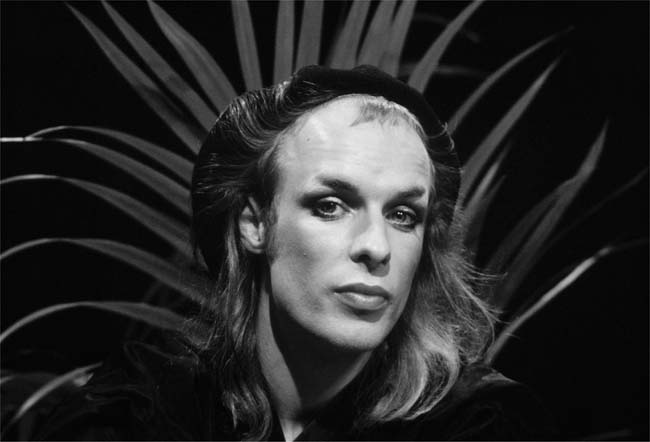
Brian Eno, 1974. (Neal Preston/CORBIS)
While his many achievements have garnered Eno respect and fame worldwide, it's likely that none of them would have earned him space in this book had he not also acquired a reputation as one of the most salient cultural thinkers of the digital age—an influential cyber-critic whose sometimes paradoxical theories landed him on the cover of Wired magazine's third issue. Cyberpunk godfather William Gibson has said that Eno's song “King's Lead Hat” has been a pivotal influence on his work, providing a “benchmark of peculiarity” for him. Today, Eno occupies a place of honor among the cyber-age intelligentsia. Interestingly, Eno insists that he hates computers; they reduce the illogical and intuitive things that artists do, and as such they represent perhaps equal parts threat and promise to the world's cultural vibrancy.
Brian Peter George St. Baptiste de la Salle Eno was born in Woodbridge, Suffolk, England, on May 15, 1948. He was the son of an English postman father and a Belgian immigrant mother, who met in Germany during World War II. Various accounts credit both a grandfather, who habitually tinkered with mechanical musical instruments, and a “peculiar and eccentric” uncle, also a tinkerer, as the family catalysts for Eno's creative talents. Eno attended the Winchester School of Art, now part of the University of Southampton, in the 1960s. There, he learned about conceptual painting and sound sculpture, and first began experimenting with what he calls his first musical instrument, the tape recorder; he earned a Diploma in Fine Art from the school. Afterward, in 1969, Eno moved to London, where he joined Roxy Music, playing synthesizer for Bryan Ferry's famed glam-rock band.
After making two acclaimed albums with Roxy Music, Eno went solo, although his first move, in 1973, was to collaborate with avant-garde guitarist Robert Fripp on a record called No Pussyfooting. During those sessions, Eno invented a tape-manipulation technique, which he dubbed “Frippertronics,” that relied on looped delays, pioneering the use of studio technologies to actually compose music on the spot, as opposed to recording fully finished musical pieces. As such, Eno paved the way for later digital sampling in pop music forms like techno, electronica, and rap.
...
- Art, Music, and Performance
- Business and Commerce
- http://Amazon.com
- http://MP3.com
- Business-to-Business
- Cookies
- Customer Relationship Management
- Digital Cash
- Disintermediation
- E-Commerce
- Harold Innis
- Internet Service Providers
- Jakob Nielsen
- Jeff Bezos
- Knowledge Management
- Local Area Network
- Margaret Whitman
- Metrics
- Napster
- Narrowcasting
- Personalization
- Peter Drucker
- Security
- Stephen M. Case
- Steven P. Jobs
- Telecommuting
- Trademark
- Video Conferencing
- William H. Gates, III
- Cyberculture
- “A Manifesto for Cyborgs”
- Neuromancer
- The New Hacker's Dictionary
- The Soul of a New Machine
- Understanding Media: The Extensions of Man
- Allucquère Rosanne Stone
- Avatar
- Blog
- Bruce Sterling
- CommuniTree
- Convergence
- Cyberculture
- Cyberethics
- Cyberfeminism
- Cyberpunk
- Cyberspace
- Cyberwarfare
- Donna J. Haraway
- Electronic Civil Disobedience
- Electronic Democracy
- Electronic Frontier Foundation
- Emoticons
- Esther Dyson
- Gender and New Media
- Habitat
- Hacking, Cracking, and Phreaking
- Hacktivism
- Howard Rheingold
- Instant Messaging
- Interactvity
- John Perry Barlow
- Killer Application
- LambdaMOO
- Marshall McLuhan
- Meme
- Metrics
- Mitchell Kapor
- Nicholas Negroponte
- Online Journalism
- Peer-to-Peer
- Race and Ethnicity and New Media
- Sherry Turkle
- Virtual Community
- William Gibson
- Hacking
- 2600: The Hacker Quarterly
- The New Hacker's Dictionary
- CommuniTree
- Computer Emergency Response Team
- Copyleft
- Cyberculture
- Cyberethics
- Cyberwarfare
- DeCSS
- Electronic Civil Disobedience
- Electronic Frontier Foundation
- Encryption and Cryptography
- Eric Raymond
- Hacking, Cracking, and Phreaking
- Hacktivism
- John Perry Barlow
- Mitchell Kapor
- Richard Stallman
- Security
- Virus
- Legal Topics
- 2600: Hacker Quarterly
- Bernstein vs. the U.S. Department of State
- United States vs. Thomas
- Anonymity
- Carnivore
- Child Online Protection Act and Child Online Privacy Protection Act
- Communications Decency Act
- Copyleft
- Copyright
- DeCSS
- Digital Millennium Copyright Act
- Electronic Civil Disobedience
- Electronic Communications Privacy Act
- Electronic Frontier Foundation
- Hacking, Cracking, and Phreaking
- Linking
- Napster
- Obscenity
- Pamela Samuelson
- Privacy
- Security
- Networks and Networking
- ARPANET
- BITNET
- Broadband
- Browser
- Bulletin Board Systems
- Cellular Telephony
- CommuniTree
- Community Networking
- Distributed Computing
- Firewall
- Freenet (Community Network)
- Freenet (File-Sharing Network)
- Internet
- Internet Appliances
- Internet Corporation for Assigned Names and Numbers
- Internet Engineering Task Force
- Internet Relay Chat
- Internet Service Providers
- LISTSERV
- Local Area Network
- Marc Andreessen
- Markup Languages
- Minitel
- MUDs and MOOs
- Napster
- Newsgroups
- Peer-to-Peer
- PLATO
- Satellite Networks
- Short Messaging System
- Telephony
- Tim Berners-Lee
- Usability
- vBNS
- Videotex
- Whole Earth ‘Lectronic Link’
- Wireless Application Protocol
- Wireless Networks
- World Wide Web
- Open-Source Software
- Organizations and Labs
- Association for Computing Machinery
- Computer Emergency Response Team
- Electronic Frontier Foundation
- Institute of Electrical and Electronic Engineers
- Internet Corporation for Assigned Names and Numbers
- Internet Engineering Task Force
- Media Lab, Massachusetts Institute of Technology
- SIGGRAPH
- SRI International
- World Wide Web Consortium
- Xerox Palo Alto Research Center
- People
- Alan Kay
- Alan Turing
- Allucquère Rosanne Stone
- Anita Borg
- Bill Joy
- Brenda Laurel
- Brian Eno
- Bruce Sterling
- Claude Shannon
- Daniel Sandin
- Donna Hoffman
- Donna J. Haraway
- Douglas Englebart
- Edward Tufte
- Eric Raymond
- Esther Dyson
- George Lucas
- Hal Varian
- Hans Moravec
- Harold Innis
- Howard Rheingold
- Ivan Sutherland
- J. C. R. Licklider
- Jakob Nielsen
- Jaron Lanier
- Jeff Bezos
- John Carmack
- John Perry Barlow
- John von Neumann
- Kai Krause
- Laurie Anderson
- Lawrence Lessig
- Manuel Castells
- Marc Andreessen
- Margaret Whitman
- Marshall McLuhan
- Marvin Minsky
- Michael Joyce
- Mitchell Kapor
- Nam June Paik
- Nicholas Negroponte
- Pamela Samuelson
- Pattie Maes
- Peter Drucker
- Raymond Kurzweil
- Richard Stallman
- Robert Moog
- Rodney Brooks
- Seymour Papert
- Sherry Turkle
- Stephen M. Case
- Steven P. Jobs
- Stewart Brand
- Theodor Holm (Ted) Nelson
- Thomas DeFanti
- Tim Berners-Lee
- Vannevar Bush
- Vinton Cerf
- W. Daniel Hillis
- William Gibson
- William H. Gates, III
- Social Issues
- Access
- Anonymity
- Carnivore
- Cyberethics
- Cyberfeminism
- Cyberwarfare
- Digital Divide
- Disposal of Computers
- Education and Computers
- Electronic Civil Disobedience
- Electronic Democracy
- Encryption and Cryptography
- Gender and New Media
- Hacking, Cracking, and Phreaking
- Hacktivism
- Obscenity
- Patent
- Privacy
- Race and Ethnicity and New Media
- Security
- Spam
- Technological Determinism
- Universal Design
- Virtual Community
- Technology
- ARPANET
- Authoring Tools
- Bluetooth
- Broadband
- Browser
- Bulletin Board Systems
- Carnivore
- CAVE
- CD-R, CD-ROM, and DVD
- Cellular Telphony
- Chat
- Codec
- Compression
- Computer-Supported Collaborative Work
- Content Filtering
- Cookies
- DeCSS
- Desktop Video
- Digital Asset Management
- Digital Subscriber Line
- Digital Television
- Distributed Computing
- Emulation
- Encryption and Cryptography
- Expert Systems
- Firewall
- Flash
- Graphical User Interface
- Habitat
- Hypermedia
- Hypertext
- Instant Messaging
- Interactive Television
- Internet
- Internet Appliances
- Internet Relay Chart
- Java
- Linux
- Local Area Network
- Markup Languages
- MIDI
- Minitel
- MP3
- MPEG
- Object-Oriented Programming
- Optical Character Recognition
- Optical Computing and Networking
- Peer-to-Peer
- Personal Digital Assistants
- Photoshop
- Qube
- Robotics
- Satellite Networks
- Shockwave
- Short Messaging System
- Sketchpad
- Software Agents
- Streaming Media
- Telecommuting
- Telephony
- vBNS
- Videoconferencing
- Videotex
- Virus
- Wireless Application Protocol
- Wireless Networks
- World Wide Web
- Writing
- “A Manifesto for Cyborgs”
- “As We May Think”
- “Man-Computer Symbiosis”
- “The Cathedral and the Bazaar”
- 2600: The Hacker Quarterly
- Neuromancer
- The New Hacker's Dictionary
- The Soul of a New Machine
- Understanding Media: The Extensions of Man
- Bruce Sterling
- Cyberpunk
- Electronic Publishing
- Emoticons
- Hypertext
- Michael Joyce
- William Gibson
- Loading...
Get a 30 day FREE TRIAL
-
 Watch videos from a variety of sources bringing classroom topics to life
 -
Read modern, diverse business cases
-
Explore hundreds of books and reference titles

Read next

More like this
Sage Recommends
We found other relevant content for you on other Sage platforms.
Have you created a personal profile? Login or create a profile so that you can save clips, playlists and searches