
Entry
Reader's guide
Entries A-Z
Subject index
Digital Art and Animation
Digital art and animation refers to the use of computer-generated visual imaging techniques, which are used most prominently in the film and computer game industries. It also refers to the use of simulated graphics, rendering, and image manipulation in art installations, software, and interface design.
Companies involved in the development and production of these techniques include Industrial Light and Magic, Dreamworks, Klasky Csupo, Pixar, and Disney. Films noted as leading examples in the use of computer-generated animation include Jurassic Park (1993), Titanic (1997), A Bug's Life (1998), Antz (1998), and The Matrix (1999). Types of films such as these fall into two major categories: films that use digitally animated characters and effects alongside, or integrated with, traditional techniques (e.g., Titanic); and those that use these effects to produce an entire film (e.g., A Bug's Life).
The development of digital art and animation techniques can be traced through several intersecting fields. The art of special effects in the film industry has developed from analog effects and animation to computer-generated images. Fine art animation and photography have also had direct input. These developments can be seen through the evolution of cartoon and animated forms, which have developed from the use of models and drawings, which are then filmed to create movement, to the use of simulation, where three-dimensional modeling and computer animation can be rendered directly through the software. Aesthetic influences from print forms such as graphic novels and Japanese anime are also relevant, as are animated film and science fiction.
The development of the field of digital art and animation also owes much to the computer-gaming industry, research into avatars and multi-user environments, and techniques such as motion capture and rendering. Sound and voice synthesis is also an important aspect of this field. It is via computer games that cutting-edge digital art and animation are distributed to the widest consumer groups. The game Quake is often cited as an example of the popular consumption of leading digital-imaging techniques. Also important is the intersection of these techniques with scientific and medical imaging processes, such as endoscopy and magnetic resonance imaging (MRI). The application of digital art and animation techniques thus extends beyond the entertainment industry to other business arenas, the arts, science, medicine, and the military.
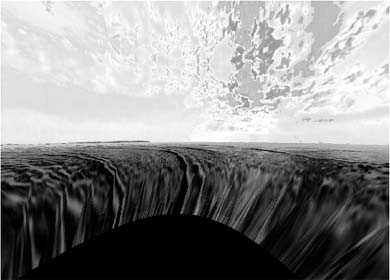
Psychedelic image of a sunset, in which the colors are controlled by the viewer. From Daniel Sandin's installation, “From Death's Door to the Garden Penninsula.” (Courtesy of Daniel Sandin)
The history of digital art and animation is also part of the history of visual culture. The emergence of film and photography as influential and widespread media forms occurred at the end of the nineteenth and beginning of the twentieth centuries. From their inception, these technologies were used to create illusion and spectacle as well as for the purposes of realism. Early cinema was effects-oriented, and the dramatic use of light helped make black-and-white images compelling.
The history of special effects is more properly the history of cinema, but digital art and animation represent the convergence of computing and film. The use of digital effects in film emerged in the 1970s and saw exponential growth in the 1980s and 1990s, growth that can be related to a wider convergence in the media industries more generally. An example of this convergence is the development of Dreamworks SKG, which was formed in 1994 by Steven Spielberg, David Geffen, and Jeffrey Katzenberg. Industrial Light and Magic, an effects company, is one of the forerunners of the field of digital special effects, founded by George Lucas and awarded more than 14 Academy Awards for best visual effects.
...
- Art, Music, and Performance
- Business and Commerce
- http://Amazon.com
- http://MP3.com
- Business-to-Business
- Cookies
- Customer Relationship Management
- Digital Cash
- Disintermediation
- E-Commerce
- Harold Innis
- Internet Service Providers
- Jakob Nielsen
- Jeff Bezos
- Knowledge Management
- Local Area Network
- Margaret Whitman
- Metrics
- Napster
- Narrowcasting
- Personalization
- Peter Drucker
- Security
- Stephen M. Case
- Steven P. Jobs
- Telecommuting
- Trademark
- Video Conferencing
- William H. Gates, III
- Cyberculture
- “A Manifesto for Cyborgs”
- Neuromancer
- The New Hacker's Dictionary
- The Soul of a New Machine
- Understanding Media: The Extensions of Man
- Allucquère Rosanne Stone
- Avatar
- Blog
- Bruce Sterling
- CommuniTree
- Convergence
- Cyberculture
- Cyberethics
- Cyberfeminism
- Cyberpunk
- Cyberspace
- Cyberwarfare
- Donna J. Haraway
- Electronic Civil Disobedience
- Electronic Democracy
- Electronic Frontier Foundation
- Emoticons
- Esther Dyson
- Gender and New Media
- Habitat
- Hacking, Cracking, and Phreaking
- Hacktivism
- Howard Rheingold
- Instant Messaging
- Interactvity
- John Perry Barlow
- Killer Application
- LambdaMOO
- Marshall McLuhan
- Meme
- Metrics
- Mitchell Kapor
- Nicholas Negroponte
- Online Journalism
- Peer-to-Peer
- Race and Ethnicity and New Media
- Sherry Turkle
- Virtual Community
- William Gibson
- Hacking
- 2600: The Hacker Quarterly
- The New Hacker's Dictionary
- CommuniTree
- Computer Emergency Response Team
- Copyleft
- Cyberculture
- Cyberethics
- Cyberwarfare
- DeCSS
- Electronic Civil Disobedience
- Electronic Frontier Foundation
- Encryption and Cryptography
- Eric Raymond
- Hacking, Cracking, and Phreaking
- Hacktivism
- John Perry Barlow
- Mitchell Kapor
- Richard Stallman
- Security
- Virus
- Legal Topics
- 2600: Hacker Quarterly
- Bernstein vs. the U.S. Department of State
- United States vs. Thomas
- Anonymity
- Carnivore
- Child Online Protection Act and Child Online Privacy Protection Act
- Communications Decency Act
- Copyleft
- Copyright
- DeCSS
- Digital Millennium Copyright Act
- Electronic Civil Disobedience
- Electronic Communications Privacy Act
- Electronic Frontier Foundation
- Hacking, Cracking, and Phreaking
- Linking
- Napster
- Obscenity
- Pamela Samuelson
- Privacy
- Security
- Networks and Networking
- ARPANET
- BITNET
- Broadband
- Browser
- Bulletin Board Systems
- Cellular Telephony
- CommuniTree
- Community Networking
- Distributed Computing
- Firewall
- Freenet (Community Network)
- Freenet (File-Sharing Network)
- Internet
- Internet Appliances
- Internet Corporation for Assigned Names and Numbers
- Internet Engineering Task Force
- Internet Relay Chat
- Internet Service Providers
- LISTSERV
- Local Area Network
- Marc Andreessen
- Markup Languages
- Minitel
- MUDs and MOOs
- Napster
- Newsgroups
- Peer-to-Peer
- PLATO
- Satellite Networks
- Short Messaging System
- Telephony
- Tim Berners-Lee
- Usability
- vBNS
- Videotex
- Whole Earth ‘Lectronic Link’
- Wireless Application Protocol
- Wireless Networks
- World Wide Web
- Open-Source Software
- Organizations and Labs
- Association for Computing Machinery
- Computer Emergency Response Team
- Electronic Frontier Foundation
- Institute of Electrical and Electronic Engineers
- Internet Corporation for Assigned Names and Numbers
- Internet Engineering Task Force
- Media Lab, Massachusetts Institute of Technology
- SIGGRAPH
- SRI International
- World Wide Web Consortium
- Xerox Palo Alto Research Center
- People
- Alan Kay
- Alan Turing
- Allucquère Rosanne Stone
- Anita Borg
- Bill Joy
- Brenda Laurel
- Brian Eno
- Bruce Sterling
- Claude Shannon
- Daniel Sandin
- Donna Hoffman
- Donna J. Haraway
- Douglas Englebart
- Edward Tufte
- Eric Raymond
- Esther Dyson
- George Lucas
- Hal Varian
- Hans Moravec
- Harold Innis
- Howard Rheingold
- Ivan Sutherland
- J. C. R. Licklider
- Jakob Nielsen
- Jaron Lanier
- Jeff Bezos
- John Carmack
- John Perry Barlow
- John von Neumann
- Kai Krause
- Laurie Anderson
- Lawrence Lessig
- Manuel Castells
- Marc Andreessen
- Margaret Whitman
- Marshall McLuhan
- Marvin Minsky
- Michael Joyce
- Mitchell Kapor
- Nam June Paik
- Nicholas Negroponte
- Pamela Samuelson
- Pattie Maes
- Peter Drucker
- Raymond Kurzweil
- Richard Stallman
- Robert Moog
- Rodney Brooks
- Seymour Papert
- Sherry Turkle
- Stephen M. Case
- Steven P. Jobs
- Stewart Brand
- Theodor Holm (Ted) Nelson
- Thomas DeFanti
- Tim Berners-Lee
- Vannevar Bush
- Vinton Cerf
- W. Daniel Hillis
- William Gibson
- William H. Gates, III
- Social Issues
- Access
- Anonymity
- Carnivore
- Cyberethics
- Cyberfeminism
- Cyberwarfare
- Digital Divide
- Disposal of Computers
- Education and Computers
- Electronic Civil Disobedience
- Electronic Democracy
- Encryption and Cryptography
- Gender and New Media
- Hacking, Cracking, and Phreaking
- Hacktivism
- Obscenity
- Patent
- Privacy
- Race and Ethnicity and New Media
- Security
- Spam
- Technological Determinism
- Universal Design
- Virtual Community
- Technology
- ARPANET
- Authoring Tools
- Bluetooth
- Broadband
- Browser
- Bulletin Board Systems
- Carnivore
- CAVE
- CD-R, CD-ROM, and DVD
- Cellular Telphony
- Chat
- Codec
- Compression
- Computer-Supported Collaborative Work
- Content Filtering
- Cookies
- DeCSS
- Desktop Video
- Digital Asset Management
- Digital Subscriber Line
- Digital Television
- Distributed Computing
- Emulation
- Encryption and Cryptography
- Expert Systems
- Firewall
- Flash
- Graphical User Interface
- Habitat
- Hypermedia
- Hypertext
- Instant Messaging
- Interactive Television
- Internet
- Internet Appliances
- Internet Relay Chart
- Java
- Linux
- Local Area Network
- Markup Languages
- MIDI
- Minitel
- MP3
- MPEG
- Object-Oriented Programming
- Optical Character Recognition
- Optical Computing and Networking
- Peer-to-Peer
- Personal Digital Assistants
- Photoshop
- Qube
- Robotics
- Satellite Networks
- Shockwave
- Short Messaging System
- Sketchpad
- Software Agents
- Streaming Media
- Telecommuting
- Telephony
- vBNS
- Videoconferencing
- Videotex
- Virus
- Wireless Application Protocol
- Wireless Networks
- World Wide Web
- Writing
- “A Manifesto for Cyborgs”
- “As We May Think”
- “Man-Computer Symbiosis”
- “The Cathedral and the Bazaar”
- 2600: The Hacker Quarterly
- Neuromancer
- The New Hacker's Dictionary
- The Soul of a New Machine
- Understanding Media: The Extensions of Man
- Bruce Sterling
- Cyberpunk
- Electronic Publishing
- Emoticons
- Hypertext
- Michael Joyce
- William Gibson
- Loading...
Get a 30 day FREE TRIAL
-
 Watch videos from a variety of sources bringing classroom topics to life
 -
Read modern, diverse business cases
-
Explore hundreds of books and reference titles

Read next

More like this
Sage Recommends
We found other relevant content for you on other Sage platforms.
Have you created a personal profile? Login or create a profile so that you can save clips, playlists and searches