
Entry
Reader's guide
Entries A-Z
Subject index
Brand, Stewart
1938–
Countercultural Entrepreneur
For the past three decades, Stewart Brand has worn many hats—soldier, lumberjack, photographer, author, editor, publisher, conservationist, corporate consultant—but most of all, he has been a creator of new ideas. Although his interests are expansive and eclectic, one of the strongest threads running through his work is the liberating potential that he sees in technology for individuals and society.
Brand was born on December 14, 1938, in Rockford, Illinois. He completed his undergraduate work at Stanford University, earning a degree in biology in 1960. He then joined the army, returning to the San Francisco Bay area at the end of a two-year stint and blending into the art and hippie scene that was then fermenting. He hooked up with Ken Kesey's Merry Pranksters and toured the California coast, a run that was vividly recorded in Tom Wolfe's 1968 book The Electric Kool-Aid Acid Test. During this period, Brand gained experience in organizing festivals and events, skills that he would use in diverse settings throughout his career.
One of Brand's best-known projects is the Whole Earth Catalog. Initially published in 1968, it became a bible for counter-cultural groups of that era, offering reviews of books, clothes, stoves, and tools for doing anything from gardening to word processing. The final edition, The Last Whole Earth Catalog, received the National Book Award in 1972. The slogan prefacing the volumes reflects the fusion of wit, arrogance, and American pragmatism that Brand had brought together in the project: “We are as Gods, and we might as well get good at it.”
In 1975, Brand launched a new magazine, Co-Evolution Quarterly, that was modeled on the success story of the Catalog. The new publication provided more room for essay-length tracts, and gave greater attention to computers and software. Brand plowed most of the earnings from his Whole Earth Catalog into the Point Foundation, which he established to support creative individuals. Over the course of three years, the foundation gave away $1 million. Through these initiatives, Brand was practicing basic business principles combined with the counterculture idealism and ideology prevalent in the United States during the 1960s. He was, in other words, a product and advocate of both American entrepreneurship and alternative culture.
In 1984, Brand organized the first Hacker's Conference, bringing together representatives of the different strains of ideology and technology involved in creating the personal computer: the brilliant former Massachusetts Institute of Technology students who'd developed the first computer game, called Spacewar! back in the 1960s; the pioneers who were then working on the development of desktop computers; and the community of software designers populating Silicon Valley in the 1980s.
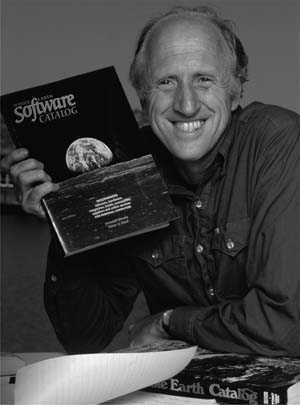
Stewart Brand with the Whole Earth Software Catalog, 1984. (Roger Ressmeyer/CORBIS).
Brand has repeatedly demonstrated an uncanny knack for envisioning future societal developments. He saw the social potential of computers long before Silicon Valley became what it is today, and was the first to use the term “personal computer” in a publication. In 1984, he also co-founded the very first virtual community, the Whole Earth ‘Lectronic Link’ (the WELL). Then, as now, emphasis was placed on the support the computers could give to human communication. Once the WELL was up and running, Brand spent a year at MIT's Media Lab; his book reflecting on his experiences there, The Media Lab: Inventing the Future at MIT, was published in 1987.
...
- Art, Music, and Performance
- Business and Commerce
- http://Amazon.com
- http://MP3.com
- Business-to-Business
- Cookies
- Customer Relationship Management
- Digital Cash
- Disintermediation
- E-Commerce
- Harold Innis
- Internet Service Providers
- Jakob Nielsen
- Jeff Bezos
- Knowledge Management
- Local Area Network
- Margaret Whitman
- Metrics
- Napster
- Narrowcasting
- Personalization
- Peter Drucker
- Security
- Stephen M. Case
- Steven P. Jobs
- Telecommuting
- Trademark
- Video Conferencing
- William H. Gates, III
- Cyberculture
- “A Manifesto for Cyborgs”
- Neuromancer
- The New Hacker's Dictionary
- The Soul of a New Machine
- Understanding Media: The Extensions of Man
- Allucquère Rosanne Stone
- Avatar
- Blog
- Bruce Sterling
- CommuniTree
- Convergence
- Cyberculture
- Cyberethics
- Cyberfeminism
- Cyberpunk
- Cyberspace
- Cyberwarfare
- Donna J. Haraway
- Electronic Civil Disobedience
- Electronic Democracy
- Electronic Frontier Foundation
- Emoticons
- Esther Dyson
- Gender and New Media
- Habitat
- Hacking, Cracking, and Phreaking
- Hacktivism
- Howard Rheingold
- Instant Messaging
- Interactvity
- John Perry Barlow
- Killer Application
- LambdaMOO
- Marshall McLuhan
- Meme
- Metrics
- Mitchell Kapor
- Nicholas Negroponte
- Online Journalism
- Peer-to-Peer
- Race and Ethnicity and New Media
- Sherry Turkle
- Virtual Community
- William Gibson
- Hacking
- 2600: The Hacker Quarterly
- The New Hacker's Dictionary
- CommuniTree
- Computer Emergency Response Team
- Copyleft
- Cyberculture
- Cyberethics
- Cyberwarfare
- DeCSS
- Electronic Civil Disobedience
- Electronic Frontier Foundation
- Encryption and Cryptography
- Eric Raymond
- Hacking, Cracking, and Phreaking
- Hacktivism
- John Perry Barlow
- Mitchell Kapor
- Richard Stallman
- Security
- Virus
- Legal Topics
- 2600: Hacker Quarterly
- Bernstein vs. the U.S. Department of State
- United States vs. Thomas
- Anonymity
- Carnivore
- Child Online Protection Act and Child Online Privacy Protection Act
- Communications Decency Act
- Copyleft
- Copyright
- DeCSS
- Digital Millennium Copyright Act
- Electronic Civil Disobedience
- Electronic Communications Privacy Act
- Electronic Frontier Foundation
- Hacking, Cracking, and Phreaking
- Linking
- Napster
- Obscenity
- Pamela Samuelson
- Privacy
- Security
- Networks and Networking
- ARPANET
- BITNET
- Broadband
- Browser
- Bulletin Board Systems
- Cellular Telephony
- CommuniTree
- Community Networking
- Distributed Computing
- Firewall
- Freenet (Community Network)
- Freenet (File-Sharing Network)
- Internet
- Internet Appliances
- Internet Corporation for Assigned Names and Numbers
- Internet Engineering Task Force
- Internet Relay Chat
- Internet Service Providers
- LISTSERV
- Local Area Network
- Marc Andreessen
- Markup Languages
- Minitel
- MUDs and MOOs
- Napster
- Newsgroups
- Peer-to-Peer
- PLATO
- Satellite Networks
- Short Messaging System
- Telephony
- Tim Berners-Lee
- Usability
- vBNS
- Videotex
- Whole Earth ‘Lectronic Link’
- Wireless Application Protocol
- Wireless Networks
- World Wide Web
- Open-Source Software
- Organizations and Labs
- Association for Computing Machinery
- Computer Emergency Response Team
- Electronic Frontier Foundation
- Institute of Electrical and Electronic Engineers
- Internet Corporation for Assigned Names and Numbers
- Internet Engineering Task Force
- Media Lab, Massachusetts Institute of Technology
- SIGGRAPH
- SRI International
- World Wide Web Consortium
- Xerox Palo Alto Research Center
- People
- Alan Kay
- Alan Turing
- Allucquère Rosanne Stone
- Anita Borg
- Bill Joy
- Brenda Laurel
- Brian Eno
- Bruce Sterling
- Claude Shannon
- Daniel Sandin
- Donna Hoffman
- Donna J. Haraway
- Douglas Englebart
- Edward Tufte
- Eric Raymond
- Esther Dyson
- George Lucas
- Hal Varian
- Hans Moravec
- Harold Innis
- Howard Rheingold
- Ivan Sutherland
- J. C. R. Licklider
- Jakob Nielsen
- Jaron Lanier
- Jeff Bezos
- John Carmack
- John Perry Barlow
- John von Neumann
- Kai Krause
- Laurie Anderson
- Lawrence Lessig
- Manuel Castells
- Marc Andreessen
- Margaret Whitman
- Marshall McLuhan
- Marvin Minsky
- Michael Joyce
- Mitchell Kapor
- Nam June Paik
- Nicholas Negroponte
- Pamela Samuelson
- Pattie Maes
- Peter Drucker
- Raymond Kurzweil
- Richard Stallman
- Robert Moog
- Rodney Brooks
- Seymour Papert
- Sherry Turkle
- Stephen M. Case
- Steven P. Jobs
- Stewart Brand
- Theodor Holm (Ted) Nelson
- Thomas DeFanti
- Tim Berners-Lee
- Vannevar Bush
- Vinton Cerf
- W. Daniel Hillis
- William Gibson
- William H. Gates, III
- Social Issues
- Access
- Anonymity
- Carnivore
- Cyberethics
- Cyberfeminism
- Cyberwarfare
- Digital Divide
- Disposal of Computers
- Education and Computers
- Electronic Civil Disobedience
- Electronic Democracy
- Encryption and Cryptography
- Gender and New Media
- Hacking, Cracking, and Phreaking
- Hacktivism
- Obscenity
- Patent
- Privacy
- Race and Ethnicity and New Media
- Security
- Spam
- Technological Determinism
- Universal Design
- Virtual Community
- Technology
- ARPANET
- Authoring Tools
- Bluetooth
- Broadband
- Browser
- Bulletin Board Systems
- Carnivore
- CAVE
- CD-R, CD-ROM, and DVD
- Cellular Telphony
- Chat
- Codec
- Compression
- Computer-Supported Collaborative Work
- Content Filtering
- Cookies
- DeCSS
- Desktop Video
- Digital Asset Management
- Digital Subscriber Line
- Digital Television
- Distributed Computing
- Emulation
- Encryption and Cryptography
- Expert Systems
- Firewall
- Flash
- Graphical User Interface
- Habitat
- Hypermedia
- Hypertext
- Instant Messaging
- Interactive Television
- Internet
- Internet Appliances
- Internet Relay Chart
- Java
- Linux
- Local Area Network
- Markup Languages
- MIDI
- Minitel
- MP3
- MPEG
- Object-Oriented Programming
- Optical Character Recognition
- Optical Computing and Networking
- Peer-to-Peer
- Personal Digital Assistants
- Photoshop
- Qube
- Robotics
- Satellite Networks
- Shockwave
- Short Messaging System
- Sketchpad
- Software Agents
- Streaming Media
- Telecommuting
- Telephony
- vBNS
- Videoconferencing
- Videotex
- Virus
- Wireless Application Protocol
- Wireless Networks
- World Wide Web
- Writing
- “A Manifesto for Cyborgs”
- “As We May Think”
- “Man-Computer Symbiosis”
- “The Cathedral and the Bazaar”
- 2600: The Hacker Quarterly
- Neuromancer
- The New Hacker's Dictionary
- The Soul of a New Machine
- Understanding Media: The Extensions of Man
- Bruce Sterling
- Cyberpunk
- Electronic Publishing
- Emoticons
- Hypertext
- Michael Joyce
- William Gibson
- Loading...
Get a 30 day FREE TRIAL
-
 Watch videos from a variety of sources bringing classroom topics to life
 -
Read modern, diverse business cases
-
Explore hundreds of books and reference titles

Read next

More like this
Sage Recommends
We found other relevant content for you on other Sage platforms.
Have you created a personal profile? Login or create a profile so that you can save clips, playlists and searches