
Entry
Reader's guide
Entries A-Z
Subject index
Germ Warfare
The use of any disease-causing organism (bacteria or virus) or toxin found in nature, as a weapon to harm, kill, or defeat an enemy; also known as biological warfare or, more recently, bioterrorism. Examples of diseases that have been considered for use as weapons or are known to have already been made into weapons include cholera, pneumonic plague, Ebola virus, anthrax, and smallpox.
Germ warfare was banned as part of the Geneva Conventions by the Protocol for the Prohibition of the Use in War of Asphyxiating, Poisonous or other Gases, and of Bacteriological Methods of Warfare, signed in 1925. This was later supplemented in 1972 by the Convention on the Prohibition of the Development, Production and Stockpiling of Bacteriological (Biological) and Toxin Weapons and on their Destruction, which has the distinction of being the first ban on the production and use of an entire category of weapons. This ban was, in turn, augmented by the Convention on the Prohibition of the Development, Production, Stockpiling and Use of Chemical Weapons and on their Destruction, signed in 1993 and administered by the Organization for the Prohibition of Chemical Weapons.
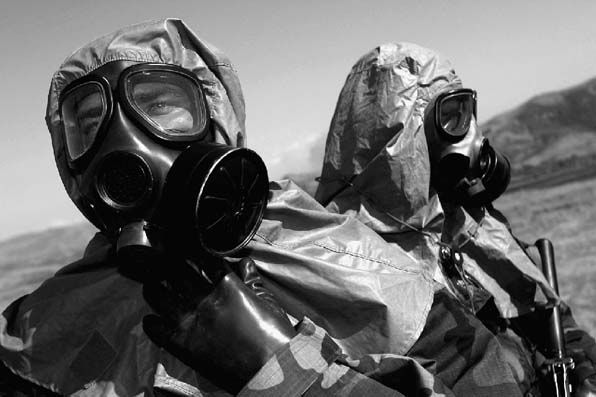
U.S. Marines from the Second Battalion, Fourth Regiment at Camp Pendleton in California participating in exercises to protect themselves during nuclear, biological, or chemical warfare. Although germ warfare has a long history, the recent war on terror has raised the specter of such attacks against civilian populations, as well as armed forces fighting in foreign theaters of war. The hooded gas masks and other gear worn by the marines are designed to protect them against all known forms of chemical compounds
History of Germ Warfare
Germ warfare dates back to ancient times, when the Carthaginian leader Hannibal used poisonous snakes against his enemies. Later, during the Middle Ages, catapults were employed to fling corpses infected with the Black Death over castle walls. Other early examples of biological warfare include the infection of the Aztec population by the Spanish conquistador Hernán Cortes and his troops and the smallpox blankets given to Native Americans by European and American troops.
Incidents of germ warfare were also recorded during the American Civil War. The use of biological weaponry became increasingly popular during World War I, although livestock were the primary targets. During World War II, biological experiments were conducted on human beings in Nazi concentration camps, and Unit 731 of the Japanese Imperial Army conducted similar work. Meanwhile, in 1942, the British began conducting anthrax experiments on Gruinard Island off the coast of Scotland, rendering it uninhabitable for nearly 50 years.
Both the United States and the Soviet Union conducted extensive research into biological weaponry during the Cold War era. A great deal of this research was done by the Soviets on an island in the middle of the rapidly shrinking Aral Sea, which is bordered by Kazakhstan and Uzbekistan.
Pressured by the unpopularity of the Vietnam War, President Richard Nixon terminated the offensive biological warfare program of the United States in 1969. In 1972, the United States signed the Biological and Toxin Weapons Convention; however, because no enforcement mechanism exists, it has not been possible to ensure compliance.
...
- Armed Forces and Other Defenders
- Air Cavalry
- All-Volunteer Force
- Base Closure
- Civil Air Patrol
- Coast Guard, the, and National Security
- Codetalkers
- Conscription/Volunteer Force
- Conventional Forces in Europe Treaty (1990)
- Enlisted Personnel
- Green Berets
- Military Draft
- Militia
- National Guard
- Noncommissioned Officer
- Protective Gear
- Rapid Deployment Force (RDF)
- Reserve Forces
- Reserve Officers' Training Corps (ROTC)
- Rules of Engagement
- Signals Intelligence (SIGINT)
- Special Forces
- Strategic Forces
- U.S. Air Force
- U.S. Army
- U.S. Coast Guard
- U.S. Marine Corps
- U.S. Navy
- U.S. Northern Command
- U.S. Pacific Command
- U.S. Southern Command
- Alliances, Pacts, and Treaties
- Alliance for Progress
- Alliances
- Antiballistic Missile (ABM) Treaty (1972)
- ANZUS Security Treaty (1951)
- ASEAN
- Atlantic Alliance
- Atlantic Charter
- Australia Group
- Biological Weapons Convention
- Bretton Woods Conference
- Chemical Weapons Convention
- Comprehensive Test Ban Treaty (1996–)
- Dayton Accords
- European Union
- General Agreement on Tariffs and Trade (GATT)
- Geneva Conventions
- Hague Convention (1907)
- Holy Alliance
- Limited Test Ban Treaty
- MERCOSUR
- North American Free Trade Agreement (NAFTA)
- North Atlantic Treaty Organization (NATO)
- Nuclear Non-Proliferation Treaty (NPT)
- OPEC (Organization of Petroleum Exporting Countries)
- Organization for Security and Co-Operation in Europe (OSCE)
- Organization of American States
- Southeast Asia Treaty Organization (SEATO)
- U.S.–Japan Alliance
- U.S.–Philippine Alliance
- U.S.–ROK Alliance
- U.S.–Thailand Alliance
- Warsaw Pact
- Armaments and Weapons Systems
- AEGIS Weapon System
- Agent Orange
- Aircraft Carrier
- Antitank Missiles
- Artillery
- Assault Rifles
- Atomic Bomb
- Ballistic Missiles
- Bikini Atoll
- Biological Weapons and Warfare
- Biotechnology
- Chemical Weapons
- Cruise Missile
- Decoys
- Defense Contractors
- Dirty Bomb
- Doomsday Machine
- F-117A Stealth Fighters
- Fighter Aircraft
- Fissile Material
- Future Combat System
- Germ Warfare
- Global Positioning System (GPS)
- HARM Missile
- Helicopters
- Intercontinental Ballistic Missiles (ICBMs)
- Joint Strike Fighter (JSF)
- Land Mines
- Manhattan Project
- Missiles
- Mortar
- Multiple Independently Targetable Reentry Vehicles (MIRVs)
- Naval Aviation
- Neutron Bomb
- NORAD (North American Aerospace Defense Command)
- Nuclear Weapons
- Patriot Missile
- Penetrating Munitions
- Prepositioned Equipment
- Protective Gear
- Radar (Radio Detection and Ranging)
- Radiological Dispersion Device (RDD) or Dirty Bomb
- Sea-Launched Ballistic Missiles (SLBMs)
- Smart Bomb
- Space-Based Weapons
- Spy Satellites
- Stinger Missiles
- Submarine Warfare
- Submarines
- Surface to Air Missile (SAM)
- Tactical Nuclear Weapons
- Tanks
- Tomahawk Cruise Missiles
- Unmanned Aerial Vehicles (UAVs)
- V-22A Osprey
- Weapons of Mass Destruction (WMD)
- Concepts and Theories
- McCarthyism
- Affirmative Action
- Agreed Framework
- All-Volunteer Force
- Amnesty
- Amphibious Warfare
- Anarchy
- Arms Control
- Asymmetric Warfare
- Autarky
- Axis of Evil
- Balance of Power
- Bilateralism
- Biodefense/Biosecurity
- Biotechnology
- Bipolarity
- Bomber Gap
- Bottom-Up Review
- Brinkmanship
- Burdensharing
- Bush Doctrine
- Central Front in Europe
- Civil Liberties
- Civil-Military Relations
- Classification
- Client State
- Coercive Diplomacy
- Collective Security
- Colonialism
- Combat Effectiveness
- Communism
- Communism and National Security
- Compellence
- Computer Security
- Conflict-Resolution Theory
- Containment
- Containment and the Truman Doctrine
- Conversion, Defense
- Cooperative Security
- Cooperative Threat Reduction (Nunn-Lugar)
- Counter-Force doctrine
- Counterterrorism
- Counterthreat
- Countervalue
- Covert Action
- Covert Operations
- Cryptology
- Cyberlaw
- Détente
- Decolonization
- Defense Budgeting
- Demilitarized Zone (DMZ) in Korea
- Democracy, Promotion of, and Terrorism
- Democratic Peace
- Democratization
- Denial
- Deterrence
- Development, Third-World
- Disarmament
- Dissent
- Doctrine
- Domino Theory
- Don't Ask, Don't Tell
- Dual-Use Technology
- Duck and Cover
- Economic Sanctions
- Emergency Preparedness and Response
- Ethnic Cleansing
- Fifth Column
- First Strike
- Flexible Deterrent Options
- Foreign Aid
- Foreign Dependency
- Forward Basing
- Gender Issues
- Genocide
- Geopolitical Intelligence
- Geopolitics
- Geospatial Mapping
- Glasnost
- Globalization and National Security
- Grand Strategy
- Great Power Rivalry
- Guerrilla Warfare
- Hawk/Dove
- Hegemony
- Homeland Security
- Human Intelligence (HUMINT)
- Human Rights
- Humanitarian Aid
- Hyperpower
- Imperialism
- Inadvertent War
- Income Disparity, Global
- Infectious Diseases
- Intelligence and Counterintelligence
- Interdependence
- International Law
- International Peacekeeping and Overseas Deployments
- Interservice Rivalry
- Interventionism
- Iron Curtain
- Islamic Fundamentalism
- Isolationism
- Joint Chiefs of Staff
- Joint Defense Planning
- Just War Theory
- Justice, Military
- Launch on Warning
- Law Enforcement and National Security
- Legal Ramifications of National Security
- Limited Nuclear Option
- Loose Nukes
- Major Theater Wars
- Manifest Destiny
- Marshall Plan
- Mass Army
- McCarthyism
- Media and National Security
- Military Doctrine
- Military Draft
- Military Education and Training
- Military-Industrial Complex
- Missile Gap
- Monetary Policy
- Money Laundering and National Security
- Monroe Doctrine
- Multilateralism
- Multipolarity
- Mutual and Balanced Force Reductions
- Mutually Assured Destruction (MAD)
- Nanotechnology
- Narcotrafficking
- Nation Building
- Nation-State
- National Missile Defense
- National Power, Determinants of
- National Security Strategy of the United States
- Nationalism
- Natural Resources and National Security
- Neoconservatism
- New World Order
- Non- and Counterproliferation
- NSC-68 (National Security Report)
- Nuclear Deterrence
- Nuclear Proliferation
- Nuclear Utilization Theory (NUT)
- Nuclear Winter
- Offensive Biological Weapons Program
- Offshore Balancing
- Open Door Policy
- Operations Other than War (OOTW)
- Order of Battle
- Pacifism
- Peacekeeping Operations
- Perestroika
- Police Action
- Political Assassination
- Positive Sum Game
- Power, World
- Preemption
- Preemptive Force
- Preemptive War Doctrine
- Presidential Decision Directives (PDDs)
- Preventive War
- Prisoner's Dilemma
- Privacy Rights
- Privatization
- Prohibition on Weaponizing Space
- Propaganda
- Psychological Warfare (PSYOPS)
- Public Diplomacy
- Public Health, National Security and
- Quadrennial Defense Review (QDR)
- Rapid Deployment Force (RDF)
- Reagan Doctrine
- Realism
- Realpolitik
- Regionalism
- Reserve Forces
- Rules of Engagement
- Sealift
- Secure Second Strike
- Security Dilemma
- Signals Intelligence (SIGINT)
- Small-Scale Contingencies
- Sovereignty
- Space Race
- Stealth Technologies
- Strategic Bombing
- Strategic Culture
- Strategic Defense Initiative (SDI)
- Strategic Forces
- Strategic Nuclear Triad
- Suicide Bombing
- Superpower
- Surge Capacity
- Sustainable Development
- Tactics, Military
- Terrorism, U.S. (Domestic)
- Terrorism, War on International
- Theater Missile Defense
- Threat Advisory Levels
- Threat Assessment
- Totalitarianism
- Trade and Foreign Aid
- Trade Liberalization
- Treason
- Triad
- Trip Wire
- Tyranny
- UN Peacekeeping
- Unilateralism
- Uranium, Depleted
- Verification
- War Crimes
- War Games
- Zero Sum Game
- Decision Makers and Others
- Johnson v. Eisentrager (1950)
- Armed Services Committees
- Bin Laden, Osama (1957–)
- Brodie, Bernard (1910–1978)
- Brzezinski, Zbigniew (1928–)
- Bundy, McGeorge (1919–1996)
- Bush, George H. W., and National Policy
- Bush, George W., and National Policy
- Carter, Jimmy, and National Policy
- Cheney, Richard (1941–)
- Church, Frank (1924–1984)
- Clinton, Bill (William Jefferson), and National Policy
- De Gaulle, Charles (1890–1970)
- Doolittle, Jimmy (1896–1993)
- Eisenhower, Dwight D., and National Policy
- Ford, Gerald R., and National Policy
- Gorbachev, Mikhail (1931–)
- Hiss, Alger (1904–1996)
- Hoover, J. Edgar (1895–1972)
- Huntington, Samuel P. (1927–)
- Iklé, Fred (1924–)
- Jackson, Henry (1912–1983)
- Kahn, Herman (1922–1983)
- Kennan, George (1904–2005)
- Kennedy, John F., and National Policy
- Khrushchev, Nikita (1894–1971)
- Kissinger, Henry (1923–)
- LeMay, Curtis (1906–1990)
- Lindh, John Walker (1981–)
- Lugar, Richard (1932–)
- MacArthur, Douglas (c. 1880–1964)
- Machiavelli, Niccolò (1469–1527)
- Mao Zedong (1893–1976)
- McNamara, Robert (1916–)
- Mihn, Ho Chi (1890–1969)
- Morgenthau, Hans (1904–1980)
- Moussaoui, Zacarias (1968–)
- Nitze, Paul H. (1907–2004)
- Nixon, Richard, and National Policy
- Nunn, Sam (1938–)
- Oppenheimer, J. Robert (1904–1967)
- Patton, George (1885–1945)
- Powell, Colin (1937–)
- Putin, Vladimir (1952–)
- Reagan, Ronald, and National Policy
- Roosevelt, Franklin D., and National Policy
- Roosevelt, Theodore (1858–1919)
- Rumsfeld, Donald (1938–)
- Saddam Hussein (1937–)
- Schelling, Thomas (1921–)
- Sherman, William Tecumseh (1820–1891)
- Stalin, Joseph (1878–1953)
- Sun-Tzu (300s BCE)
- Teller, Edward (1908–2003)
- Thucydides (c. 460–400 BCE)
- Truman, Harry S., and National Policy
- Unabomber (Theodore J. Kaczynski, 1942–)
- Von Braun, Werner (1912–1977)
- Von Clausewitz, Karl (1780–1831)
- Westmoreland, William (1914–)
- Yeltsin, Boris (1931–)
- Key Events
- Ex Parte Quirin
- In re Territo (1946)
- Afghan Wars
- Afghanistan, War in
- Al-Khobar, Attack on U.S. Troops at (1996)
- Arab Americans
- Arab Oil Embargo
- Arab-Israeli Conflict
- Arms Race
- Bali, Terrorist Bombing in
- Bay of Pigs
- Berlin Airlift
- Berlin Crises
- Berlin Wall
- Blitzkrieg
- Bosnia Intervention
- Bretton Woods Conference
- Bulge, Battle of the
- Camp David Accords
- Cold War
- Comprehensive Test Ban Treaty
- Cuban Missile Crisis
- D-Day
- Dayton Accords
- Dien Bien Phu
- Dresden, Bombing of
- Freedom of Information Act (1967)
- Fulda Gap
- Gas Protocol of 1925
- Grenada Intervention
- Guadalcanal, Battle of (1943)
- Gulf of Tonkin Resolution
- Hague Convention (1907)
- Hiroshima
- House Un-American Activities Committee (HUAC)
- Inchon Landing
- INF Treaty
- Iran-Contra Affair
- Iranian Hostage Crisis
- Iraq War of 2003
- Iraqgate
- Kellogg-Briand Pact (1928)
- Korean War
- Korean War, Entry Into
- Kosovo Intervention
- Lend-Lease
- Leyte Gulf, Battle of (1944)
- Libya Bombing (1986)
- Limited Test Ban Treaty
- London Naval Conferences (1909, 1930)
- Marine Barracks, Beirut (1983)
- Mayaguez Affair
- Middle East Conflicts (1956, 1967, 1973)
- Midway, Battle of (1942)
- Nagasaki
- National Security Act, 1947
- Nixon Shocks
- Normandy Invasion
- North Korea Crises (1994–)
- Nuclear Non-Proliferation Treaty (NPT)
- Nuclear Test-Ban Treaty
- Oklahoma City Bombing
- Operation Desert Storm (1991)
- Pearl Harbor
- Pentagon Papers
- Potsdam Conference (1945)
- Pueblo Incident
- Pusan Perimeter
- Reykjavik
- Ruby Ridge
- September 11/WTC and Pentagon Attacks
- Somalia Intervention (1992)
- Spanish-American War (1898)
- Sputnik
- Strategic Arms Limitation Talks (SALT)
- Strategic Arms Reduction Talks (START)
- Suez Canal Crisis (1956)
- Summit Conferences
- Tailhook Scandal
- Tet Offensive
- Tonkin Gulf Resolution
- U2 Spy Plane Incident (1960)
- USS Cole Bombing
- Washington Naval Treaty (1922)
- Yalta Conference (1945)
- Movements
- Military Hardware
- AEGIS Weapon System
- Aircraft Carrier
- Antitank Missiles
- Cruise Missile
- F-117A Stealth Fighters
- Fighter Aircraft
- HARM Missile
- Helicopters
- Intercontinental Ballistic Missiles (ICBMs)
- Joint Strike Fighter
- Missiles
- Multiple Independently Targetable Reentry Vehicles (MIRVs)
- Patriot Missile
- Sea-Launched Ballistic Missiles (SLBMs)
- Space-Based Weapons
- Stinger Missiles
- Submarines
- Surface to Air Missile (SAM)
- Tanks
- Tomahawk Cruise Missiles
- Unmanned Aerial Vehicles (UAVs)
- V-22A Osprey
- Military and Nonmilitary Strategy
- Agent Orange
- Agreed Framework
- Air Warfare
- Air-Land Battles
- Airborne Warning and Control System (AWACS)
- Airlift
- Anti-Submarine Warfare
- Arms Procurement
- Asymmetric Warfare
- Atlantic Alliance
- Balance of Power System
- Bilateralism
- Biodefense/Biosecurity
- Blitzkrieg
- Bomber Gap
- Bottom-Up Review
- Brinkmanship
- Bush Doctrine
- Carpet Bombing
- Central Front in Europe
- Coalition Building
- Coercive Diplomacy
- Collective Security
- Combat Effectiveness
- Containment
- Containment and the Truman Doctrine
- Counter-Force doctrine
- Counterterrorism
- Covert Action
- Covert Operations
- Cryptology
- Détente
- Defense Budgeting
- Demilitarized Zone (DMZ) in Korea
- Deterrence
- Disarmament
- Distant Early Warning (DEW) Line
- Dual-Use Technology
- Duck and Cover
- Electronic Warfare (EW)
- Emergency Preparedness and Response
- First Strike
- Forward Basing
- Germ Warfare
- Homeland Security Advisory System (Color-Coded Alerts)
- International Peacekeeping and Overseas Deployment
- Joint Chiefs of Staff
- Joint Defense Planning
- Joint Operations
- Limited Nuclear Option
- Major Theater Wars
- Manhattan Project
- Mutually Assured Destruction (MAD)
- National Missile Defense
- National Security Strategy of the United States
- Nuclear Deterrence
- Offensive Biological Weapons Program
- Offshore Balancing
- Preemption
- Preemptive Force
- Preemptive War Doctrine
- Preventive Defense Strategy
- Quadrennial Defense Review (QDR)
- Satellite Reconnaissance
- Sealift
- Secure Second Strike
- Single Integrated Operational Plan (SIOP)
- Space Race
- Strategic Bombing
- Suicide Bombing
- Tactics, Military
- Theater Missile Defense
- Threat Assessment
- Two-Theater War
- War Games
- War Planning
- Organizations, Institutions, and Groups
- Armed Services Committees
- Arms Control and Disarmament Agency
- Ba'ath Party
- Branch Davidians
- Bureau of Alcohol, Tobacco and Firearms
- CENTCOM
- Central Intelligence Agency (CIA)
- Council on Foreign Relations
- Defense Contractors
- Defense Information System Agency (DISA)
- Defense Intelligence Agency (DIA)
- Defense Threat Reduction Agency
- Department of Defense, U.S. (DoD)
- Department of Energy, U.S.
- Department of State, U.S.
- European Union
- Federal Bureau of Investigation (FBI)
- Federal Emergency Management Agency (FEMA)
- Food and Agriculture Organization (FAO)
- Halliburton Corporation
- Homeland Security Council
- Homeland Security, Department of
- House Un-American Activities Committee (HUAC)
- International Atomic Energy Agency
- International Criminal Court
- International Monetary Fund
- INTERPOL
- Irish Republican Army (IRA)
- Jackson Committee
- Johnson, Lyndon B., and National Policy
- Justice, Department of
- League of Nations
- MERCOSUR
- Military Sealift Command (MSC)
- Military Traffic Management Command (MTMC)
- Missile Technology Control Regime (MTCR)
- National Counterintelligence Center (NACIC)
- National Defense Panel (NDP)
- National Defense University
- National Security Agency (NSA)
- National Security Committee
- National Security Council (NSC)
- National Security, U.S. Commission on (USCNS)
- North Atlantic Treaty Organization (NATO)
- Office of Domestic Preparedness
- Office of Naval Research (ONR)
- Office of Net Assessment
- Office of Strategic Services (OSS)
- Office of the Secretary of Defense (OSD)
- OPEC (Organization of Petroleum Exporting Countries)
- Organization for Security and Co-Operation in Europe (OSCE)
- Organization of American States
- Peace Corps
- Pentagon
- RAND Corporation
- Secret Service
- Selective Service
- Signal Corps
- Southeast Asia Treaty Organization (SEATO)
- Strategic Air Command
- Strategic Command, U.S.
- Supreme Court, Role of U.S.
- Think Tanks
- Transportation Security Administration
- U.S. Agency for International Development (USAID)
- U.S. Air Force Academy
- U.S. Central Command (USCENTCOM)
- U.S. Military Academy (West Point)
- U.S. Naval Academy (Annapolis)
- U.S. Northern Command (USNORTHCOM)
- U.S. Pacific Command (USPACOM)
- U.S. Southern Command (USSOUTHCOM)
- UN Security Council
- United Nations
- United Nations Monitoring, Verification, and Inspection Commission (UNMOVIC)
- United Nations Special Commission (UNSCOM)
- UNOSOM
- Veterans Administration
- Voice of America
- War Colleges
- World Bank
- World Customs Organization (WCO)
- World Trade Organization (WTO)
- Places
- Bay of Pigs
- Berlin Airlift
- Berlin Wall
- Bikini Atoll
- China and U.S. Policy
- Commonwealth of Independent States (CIS)
- Cuban Missile Crisis
- Democratic People's Republic of Korea (North Korea)
- Dien Bien Phu
- Early Warning
- Federally Funded Research and Development Centers (FFRDCs)
- Guam
- Guantánamo
- Hiroshima
- Korea, North and South
- Latin America and U.S. Policy
- Los Alamos
- Middle East and U.S. Policy
- Nagasaki
- Okinawa
- Oklahoma City Bombing
- Pearl Harbor
- Pentagon
- Pusan Perimeter
- Republic of China on Taiwan
- Reykjavik
- Rogue State
- Ruby Ridge
- Somalia Intervention (1992)
- Soviet Union, Former (Russia), and U.S. Policy
- U.S. Air Force Academy
- U.S. Military Academy (West Point)
- U.S. Naval Academy (Annapolis)
- Union of Soviet Socialist Republics (USSR)
- Politics and Policy
- Ex Parte Quirin
- In re Territo (1946)
- Johnson v. Eisentrager (1950)
- Affirmative Action
- Agreed Framework
- Amnesty
- Antiballistic Missile (ABM) Treaty (1972)
- Arms Control
- Arms Procurement
- Assassination, U.S. Executive Order Against
- Atlantic Charter (1941)
- Axis of Evil
- Base Closure
- Biological Weapons Convention
- Border and Transportation Security
- Border Policy
- Bretton Woods Conference
- Burdensharing
- Bush Doctrine
- Bush, George H. W., and National Policy
- Bush, George W., and National Policy
- Carter Doctrine
- Carter, Jimmy, and National Policy
- China and U.S. Policy
- Clinton, Bill (William Jefferson), and National Policy
- Coalition Building
- Coercive Diplomacy
- Collective Security
- Communism and National Security
- Computer Security
- Congressional-Executive Agreement
- Constitution of the United States
- Containment
- Containment and the Truman Doctrine
- Cooperative Security
- Cooperative Threat Reduction
- Counter-Terrorism
- Cyberlaw
- Détente
- Declarations of War
- Defense Reorganization Act
- Democracy, Promotion of, and Terrorism
- Democratization
- Development, Third-World
- Disarmament
- Don't Ask, Don't Tell
- Eastern Bloc
- Eisenhower Doctrine
- Eisenhower, Dwight D., and National Policy
- Energy Policy and National Security
- Environment and National Security
- Ethnic Cleansing
- Executive Orders
- Federal Racketeering Statute (RICO)
- First Amendment
- Ford, Gerald R., and National Policy
- Foreign Aid
- Free Trade
- Freedom of Information Act (1967)
- Gas Protocol of 1925
- General Agreement on Tariffs and Trade (GATT)
- Geneva Conventions
- Glasnost
- Globalization and National Security
- Goldwater-Nichols Act
- Good Neighbor Policy
- Gulf of Tonkin Resolution
- Hart-Rudman Commission
- Homeland Security Act (2002)
- Homeland Security Advisory System (Color-Coded Alerts)
- Humanitarian Aid
- Humanitarian Intervention
- Immigration and National Security
- Immigration Policy
- INF Treaty
- Iran-Contra Affair
- Iranian Hostage Crisis
- Iraqgate
- Japanese Internment
- Kellogg-Briand Pact
- Kennedy, John F., and National Policy
- Latin America and U.S. Policy
- Lend-Lease
- London Naval Conferences (1909, 1930)
- Marshall Plan
- Middle East and U.S. Policy
- Monroe Doctrine
- Multilateralism
- Nation Building
- National Defense Education Act (NDEA)
- National Security Act (1947)
- National Security Decision Directive (NSDD)
- National Security Education Act of 1991
- Nixon Doctrine (1969)
- North American Free Trade Agreement (NAFTA)
- NSC-68 (National Security Report)
- Nuclear Test-Ban Treaty
- Nuclear Waste Disposal
- Oil and National Security
- Open Door Policy
- Open Skies Treaty
- Ottawa Landmine Treaty
- Presidential Decision Directives (PDDs)
- Privacy Act
- Prohibition on Weaponizing Space
- Propaganda
- Public Diplomacy
- Public Health, National Security and
- Radio Free Europe
- Reagan Doctrine
- Reagan, Ronald, and National Policy
- Rio Pact
- Roosevelt Corollary
- Roosevelt, Franklin D., and National Policy
- Soviet Union, Former (Russia), and U.S. Policy
- Strategic Arms Limitation Talks (SALT)
- Strategic Arms Reduction Talks (START)
- Strategic Defense Initiative (SDI)
- Strategic Offensive Reduction Treaty (SORT)
- Summit Conferences
- Taiwan Relations Act
- Terrorism, U.S. (Domestic)
- Tonkin Gulf Resolution
- Trade and Foreign Aid
- Trade Liberalization
- Treaties
- Truman Doctrine
- Truman, Harry S., and National Policy
- War Powers Act (1973)
- Washington Naval Treaty (1922)
- Special Populations
- Interpol
- Irish Republican Army (IRA)
- Islamic Fundamentalism
- Johnson, Lyndon B., and National Policy
- Kamikaze
- Militia
- National Guard
- Peace Corps
- PLO
- Portland Six
- Prisoner of War (POW)
- Rapid Deployment Force (RDF)
- Reserve Officers' Training Corps
- Secret Service
- Signal Corps
- Special Forces
- Taliban
- Terrorists, Islamic
- Weathermen, The
- Technology
- AEGIS Weapon System
- Agent Orange
- Airborne Warning and Control System (AWACS)
- Aircraft Carrier
- Ballistic Missiles
- Biological Weapons and Warfare
- Biotechnology
- Bioterrorism
- Chemical Weapons
- Computer Security
- Computer Viruses
- Cruise Missile
- Decoys
- Defense Advanced Research Projects Agency (DARPA)
- Dirty Bomb
- Distant Early Warning (DEW) Line
- Doomsday Machine
- Electronic Warfare
- F-117A Stealth Fighters
- Fighter Aircraft
- Future Combat System
- Global Positioning System (GPS)
- HARM Missile
- Helicopters
- Information Warfare
- Intercontinental Ballistic Missiles (ICBMs)
- Joint Strike Fighter
- Land Mines
- Missiles
- Mortar
- Multiple Independently Targetable Reentry Vehicles (MIRVs)
- Nanotechnology
- Neutron Bomb
- NORAD
- Patriot Missile
- Penetrating Munitions
- Radar
- Radiological Dispersion Device (RDD) or Dirty Bomb
- Science, Technology, and Security
- Sea-Launched Ballistic Missiles (SLBMs)
- Smart Bomb
- Space-Based Weapons
- Sputnik
- Spy Satellites
- Stealth Technologies
- Stinger Missiles
- Submarines
- Surface to Air Missile (SAM)
- Tactical Nuclear Weapons
- Tanks
- Tomahawk Cruise Missiles
- Unmanned Aerial Vehicles (UAVs)
- V-22A Osprey
- Wars and Warfare
- Afghan Wars
- Afghanistan, War in
- Air Warfare
- Air-Land Battles
- Amphibious Warfare
- Antisubmarine Warfare
- Arab-Israeli Conflict
- Arms Race
- Asymmetric Warfare
- Bulge, Battle of the
- Carpet Bombing
- Cold War
- D-Day
- Dresden, Bombing of
- Fulda Gap
- Grenada Intervention
- Guadalcanal, Battle of (1943)
- Guerrilla Warfare
- Gulf War
- Inadvertent War
- Inchon Landing
- Information Warfare
- Iraq War of 2003
- Kamikaze
- Korean War
- Kosovo Intervention (1999)
- Leyte Gulf, Battle of (1944)
- Middle East Conflicts (1956, 1967, 1973)
- Midway, Battle of (1942)
- Narcotics, War on
- Normandy Invasion
- Operation Desert Storm (1991)
- Preventive War
- Psychological Warfare (PSYOPS)
- Spanish-American War (1898)
- Submarine Warfare
- Suez Canal Crisis (1956)
- Terrorism, War on International
- Tet Offensive
- Trade Wars
- Two-Theater War
- Vietnam War
- World War I (1914–1918)
- World War II (1939–1945)
- Loading...
Get a 30 day FREE TRIAL
-
 Watch videos from a variety of sources bringing classroom topics to life
 -
Read modern, diverse business cases
-
Explore hundreds of books and reference titles

Read next

More like this
Sage Recommends
We found other relevant content for you on other Sage platforms.
Have you created a personal profile? Login or create a profile so that you can save clips, playlists and searches