
Entry
Reader's guide
Entries A-Z
Subject index
National Science Foundation (U.S.)
The U.S. National Science Foundation (NSF) is a large funding body that constitutes approximately 20 percent of all federally supported basic research, conducted largely within universities and colleges. Founded in 1950 by the U.S. Congress “to promote the progress of science; to advance the national health, prosperity, and welfare; and to secure the national defense,” the NSF funds all fields of science (including social and behavioral) and engineering research (excluding medical sciences, which the National Institutes of Health are responsible for). The NSF receives nearly 40,000 grant proposals each year for research, education, and training, and funds about 11,000 of those proposals. Additionally, the NSF funds graduate, postgraduate, and postdoctoral fellowships, general education outreach and awareness, and collaborative projects, both nationally and internationally.
The driving concept behind the foundation of the NSF is the idea that the application of scientific knowledge leads to the betterment of society. Vannevar Bush proposed a foundation for national research in his report “Science: The Endless Frontier” (1945). This report presents a model whereby basic scientific research produces technological innovation that fuels the economy and hence reaps benefits for the welfare of people. When tension grew between the Soviet Union and the United States and the launch of Sputnik, federal funding for the NSF ballooned. The initial budget in 1951 was $151,000, and in 1968 it was $500 million. Their budget is currently well over $6 billion dollars annually. This funding is still largely justified by the same model proposed by Vannevar Bush in the 1940s, though this “linear model” of science-technology-economy interaction purported by Bush (whereby basic research leads to technological innovation, which leads to economic growth) has now been largely replaced by more interactive models proposed by science and technology studies scholars.
The NSF's mission is far reaching, and its management is done by presidential appointees. Appointed by the U.S. president and confirmed in the U.S. Senate, the NSF's director, deputy director and 24-member National Science Board (NSB) serve six-year terms. The NSF has around 1,700 people working in their Arlington, Virginia, headquarters, including 1,200 career employees, 150 scientists from research institutes with temporary duties, and about 200 contract workers. The NSF has about 10 advisory committees that consist of experts from various scientific, technical, and social fields.
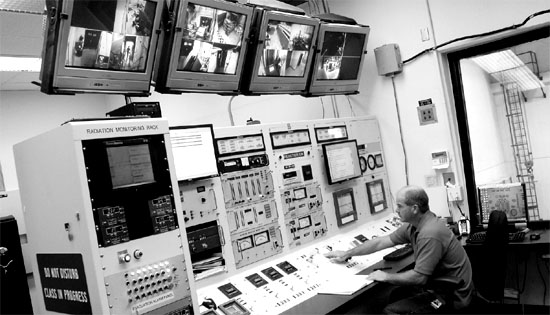
This antimatter, or positron, beam reactor at North Carolina State University was funded by the NSF. The beam has the ability to gravitate toward and get trapped in material defects or pores as minute as a single atom.
With the announcement of the U.S. National Nanotechnology Initiative (NNI) by President Bill Clinton in 2000 at Caltech, nanotechnology became a growing area of funding under the NSF's wide domain of research funding. The 21st Century Nanotechnology Research and Development Act, signed into law by President George W. Bush, furthered the emphasis on nanotechnology in federally funded science and engineering. In 2011, nearly $1.8 million were allotted for nanotechnology research and development (NNI 2010). The NNI is situated between many federal research and funding bodies, not just under the auspices of the NSF. Among other U.S. agencies, the National Aeronautics and Space Administration, the Defense Advanced Research Projects Agency, the Environmental Protection Agency all receive funding for nanotechnology. However, the NSF offers the widest array of funding opportunities in nanotechnology, including the funding nanotechnology interdisciplinary research teams (NIRTs),
...
- Art, Design, and Materials
- Bionanotechnology Centers
- Context
- Clinton, William J.
- Converging Technologies
- Feynman, Richard
- Fullerene
- Human Enhancement
- IPOs of Nanofirms
- Journal of Nanoparticle Research
- Microscopy, Atomic Force
- Microscopy, Electron (Including TEM and SEM)
- Microscopy, Exotic
- Microscopy, Optical
- Microscopy, Scanning Probe
- Microscopy, Scanning Tunneling
- Nanobiotechnology
- Nanohype
- Nanomaterials
- Nanotech Chronicles, The
- National Nanotechnology Coordination Office (U.S.)
- National Nanotechnology Infrastructure Network (U.S.)
- National Nanotechnology Initiative (U.S.)
- Nature Nanotechnology
- Prey
- Roco, Mihail
- Self-Replication
- Social Movements and Nanoscience
- Technology Assessment
- Technoscience
- Economics and Business
- Agrifood
- Artificial Intelligence
- Benny the Bear
- Commercial Incubators
- Commercialization
- Competitiveness and Technonationalism
- Computational Nanotechnology
- Consumer Products Inventory
- Corporate Research and Development
- Electronics and Information Technology
- Energy
- Entrepreneurs in Nanoscience
- Export Controls
- Food
- Food Packaging
- General Purpose Technology
- Globalization
- Intellectual Property Rights
- International Development
- iPod Nano
- IPOs of Nanofirms
- L'Oréal
- Lux Research
- Magic Nano
- Market Projections
- Market Resistance and Acceptance
- Nano-Bible
- NanoBusiness Alliance
- Nanoenabled Products in Commerce
- Nanogate (Tribological Coating for Automobiles)
- Nanointermediaries in Commerce
- Nanomanufacturing
- Nanomaterials in Commerce
- Nanophotovoltaics
- Nanotechnology in Manufacturing
- Nanotechnology Industries Association
- Nanotechnology Law and Business
- Nanotechnology Patent Class
- Patents
- Publicly Traded Nanofirms
- Titanium Dioxide
- Venture Capital
- Workers' Rights
- Workforce Development and Training
- Zinc Oxide
- Engagement and the Public
- Center for Nanotechnology in Society (ASU)
- Center for Nanotechnology in Society (UCSB)
- Center on Nanotechnology and Society (Kent School of Law)
- Centre for Applied Philosophy and Public Ethics (Australia)
- Centre for Bioethics and Public Policy
- Consensus Conference on Nanotechnology
- Democs
- Foresight Institute
- Friends of the Earth Nanotechnology Project
- Hyle
- International Council on Nanotechnology
- International Symposium on Nanotechnology, Occupational and Environmental Health
- Nanoforum
- Nanologues
- Nanoscale Undergraduate Education Program
- Nanotechnology Engagement Group (Involve)
- National Center for Learning and Teaching in Nanoscale Science and Engineering
- National Citizens' Technology Forum
- Popular Culture
- Public Attitudes Toward Nanotechnology
- Public Engagement
- Public Understanding of Nanotechnology
- Public Value Mapping
- Public Values
- Public Well-Being
- Science Cafés
- Environment and Risk
- “Grey Goo” Scenario
- Center for Biological and Environmental Nanotechnology
- Center for the Environmental Implications of NanoTechnology
- Department for Environment, Food and Rural Affairs (UK)
- Desalinization
- Environment Canada
- Environmental Benefits
- Environmental Defense Fund
- Environmental Ethics/Philosophy and Nanotechnology
- Environmental Protection Agency (U.S.)
- Ethics and Risk Analysis
- Federal Institute for Risk Assessment (Germany)
- Green Nanotechnology
- Health and Environmental Risks (Netherlands)
- Human Enhancement, Biological Risks
- International Risk Governance Council
- International Symposium on Nanotechnology, Occupational and Environmental Health
- Magic Nano
- Ministry of Environment (South Korea)
- Nano Risk Framework
- Nanomedicine, Toxicity Issues of
- Nanophotovoltaics
- Nanotech Environmental, Health, and Safety Roadmap
- Nanotoxicology
- Nanoweapons, Ethical Issues of
- National Institute of Environmental Health Sciences (U.S.)
- Occupational Safety and Health Administration (U.S.)
- Occupational Safety and Health Enforcement (U.S.)
- Risk Amplification
- Risk Assessment
- Risk Attenuation
- Risk Communication
- Risk Governance
- Risk Management
- Risk-Benefit Perceptions of Nanotechnology
- Water Purification
- Ethics and Values
- Access
- Bioethics
- Centre for Applied Philosophy and Public Ethics (Australia)
- Centre for Bioethics and Public Policy
- Codes of Conduct, Corporate
- Codes of Conduct, Professional
- Environmental Ethics/Philosophy and Nanotechnology
- Equity
- Ethics and Risk Analysis
- Human Enhancement, Biological Risks
- Journal of Lutheran Ethics
- Nano-Ethics
- NanoEthics
- Nanoethics Group
- NanoEthics Network
- NanoEthicsBank
- Nanomedicine, Ethical Issues of
- Nanoscientists as Moral Agents
- Nanoweapons, Ethical Issues of
- Neuroethics
- Privacy
- Public Attitudes Toward Nanotechnology
- Public Engagement
- Public Value Mapping
- Public Values
- Security
- Speculative Ethics
- United Nations Millennium Development Goals
- Geographies and Distribution
- Argentina
- Australia
- Berkeley, California, Local Regulatory Efforts
- Brazil
- California
- Cambridge, Massachusetts, Local Regulatory Efforts
- Canada
- China
- European Union
- France
- Geopolitical Implications
- Germany
- Global Value Chains
- Globalization
- Grenoble
- India
- Indigenous Nanotechnology
- International Development
- iPod Nano
- Iran
- Israel
- Italy
- Japan
- Mexico
- Nanodistricts
- Nanoenabled Products in Commerce
- Nanogate (Tribological Coating for Automobiles)
- Nanotechnology Foundation of Texas
- Nanotechnology Victoria
- Netherlands
- New York
- Regulation (Europe)
- Regulation (U.S.)
- Russia
- Singapore
- South Korea
- Switzerland
- Taiwan
- Trade Secrets and Nanotechnology
- United Kingdom
- United Nations Millennium Development Goals
- United States
- Governance
- 21st Century Nanotechnology Research and Development Act of 2003
- Anticipatory Governance
- Arms Control
- Berkeley, California, Local Regulatory Efforts
- Cambridge, Massachusetts, Local Regulatory Efforts
- Center for Nanotechnology in Society (ASU)
- Center for Nanotechnology in Society (UCSB)
- Center on Nanotechnology and Society (Kent School of Law)
- Congressional Nanotechnology Caucus
- Department for Environment, Food and Rural Affairs (UK)
- Department of Agriculture (U.S.)
- Department of Defense (U.S.)
- Department of Energy (U.S.)
- Department of Health (UK)
- Environmental Protection Agency (U.S.)
- Federal Institute for Occupational Safety and Health (Germany)
- Federal Ministry of Education and Research (Germany)
- Food and Consumer Goods Authority (Netherlands)
- Food and Drug Administration (U.S.)
- German Research Foundation
- Governance
- Intellectual Property Rights
- International Council on Nanotechnology
- Iran Nanotechnology Policy Studies Committee
- Joint Economic Committee, U.S. Congressional
- Korean Occupational Safety and Health Agency
- Law
- Ministry of Defence (UK)
- Ministry of Environment (South Korea)
- Ministry of Science and Technology (Brazil)
- Ministry of Science and Technology (South Korea)
- Monash Centre for Regulatory Studies
- Moratorium
- Nanotechnology Law and Business
- Nanotechnology Promotion Act of 2002 (South Korea)
- Nanotechnology Safety for Success Dialogue (Food Industry)
- National Academy of Sciences (U.S.)
- National Aeronautics and Space Administration (U.S.)
- National Cancer Institute (U.S.)
- National Institute for Occupational Safety and Health (U.S.)
- National Institutes of Health (U.S.)
- National Nanotechnology Advisory Panel (U.S.)
- National Nanotechnology Coordination Office (U.S.)
- National Nanotechnology Development Plan (South Korea)
- National Nanotechnology Infrastructure Network (U.S.)
- National Nanotechnology Initiative (U.S.)
- National Program of Nanotechnology (Brazil)
- National Research Council (Brazil)
- National Research Council (Canada)
- National Science Foundation (U.S.)
- National Toxicology Program (U.S.)
- Natural Science and Engineering Research Council (Canada)
- Occupational Safety and Health Administration (U.S.)
- Reflexive Governance
- Regulation (Europe)
- Regulation (U.S.)
- Risk Governance
- Sixth Framework Programme
- Technological Determinism
- Therapeutic Goods Administration (Australia)
- Toxic Substances Control Act and Nanotechnology
- Woodrow Wilson International Center
- History and Philosophy
- “Nano Culture”
- Bainbridge, William
- Control
- Converging Technologies
- Drexler, K. Eric
- Emergence
- Engines of Creation
- Feynman, Richard
- Future
- Historical Examples of Nanomaterials
- History-in-the-Making
- IBM
- Indigenous Nanotechnology
- Joy, Bill
- Kabbalah
- Kroto, Sir Harry
- Kurzweil, Ray
- L5 Society
- Nanophilosophy
- Nordmann, Alfred
- Novelty
- Roco, Mihail
- Smalley, Richard
- Taniguchi, Norio
- Transhumanism
- Integration and Interdisciplinarity
- Nanotechnology Companies
- Nanotechnology Organizations
- Asia Pacific Nanotechnology Forum
- Australia Nanobusiness Forum
- Australian Office of Nanotechnology
- Australian Research Council Nanotechnology Network
- Canadian NanoBusiness Alliance
- Center for Biological and Environmental Nanotechnology
- Center for Nanotechnology in Society (ASU)
- Center for Nanotechnology in Society (UCSB)
- Center for Responsible Nanotechnology
- Center for the Environmental Implications of NanoTechnology
- Center on Nanotechnology and Society (Kent School of Law)
- Commission for Atomic Energy (France)
- Commonwealth Scientific and Research Organization
- Community Research and Development Information Service
- Foresight Institute
- Friends of the Earth Nanotechnology Project
- International Council on Nanotechnology
- International Nanotechnology and Society Network
- International Symposium on Nanotechnology, Occupational and Environmental Health
- Iran Nanotechnology Policy Studies Committee
- Latin American Nanotechnology and Society Network (Mexico)
- Nanobase
- Nanoparticle Occupational Safety and Health Consortium
- Nanotechnology Business Alliance
- Nanotechnology Engagement Group (Involve)
- Nanotechnology Enterprise
- Nanotechnology Foundation of Texas
- Nanotechnology Group
- Nanotechnology Industries Association
- Nanotechnology Institute (ASME)
- Nanotechnology Issues Dialogue Group (UK)
- Nanotechnology Safety for Success Dialogue (Food Industry)
- NanoTrust Project (Austria)
- National Nanotechnology Advisory Panel (U.S.)
- National Nanotechnology Coordination Office (U.S.)
- National Nanotechnology Infrastructure Network (U.S.)
- National Nanotechnology Initiative (U.S.)
- National Program of Nanotechnology (Brazil)
- National Science Foundation (U.S.)
- Society for Nanoscience and Technology
- VISION Online
- Loading...
Get a 30 day FREE TRIAL
-
 Watch videos from a variety of sources bringing classroom topics to life
 -
Read modern, diverse business cases
-
Explore hundreds of books and reference titles

Read next

More like this
Sage Recommends
We found other relevant content for you on other Sage platforms.
Have you created a personal profile? Login or create a profile so that you can save clips, playlists and searches