
Entry
Reader's guide
Entries A-Z
Subject index
Immune System
The immune system is a complex network of biological structures and substances within an organism: cells, tissues, and organs working together and protecting against diseases or infections. Infection may be caused by microbes (e.g., bacteria, parasites, fungi) and viruses. The protection given by the immune system is to keep them out or otherwise to identify and annihilate them. The immune system can remember and distinguish millions of such enemies, and by producing secretions (releasing of fluids) and cells, destroy most of them. From the highest to the lowest level of organization of structure, the immune system encompasses sets and subsets of the following: (1) lymphoid organs, (2) lymph vessels, (3) cells involved in immune reactions, and (4) antibodies and cytokines. All these structures, substances, and processes comprising the immune system are responsible for immune responses.
Historical Context
In ancient times it was believed that a disease was a result of supernatural forces imposing a punishment for evil. In those times the Latin word immunis (immunity) meant dismissal from tax, military service, and other public services. The Greek historian Thucydides (ca. 460–395 B.C.E.) is considered to be the first to leave a written description of the concept of immunity. In 430 B.C.E., during an epidemic in Athens, he noticed that people who had fought off the disease could look after the ill and the dying without threat of renewal of the disease. The Islamic physician Al-Razi (865–925 C.E.) is believed to be the first to describe immunity in a clinical way in Kitab fi al-Jadari wa-al-Hasbah (A Treatise on Smallpox and Measles). He concluded that contact with a pathogen contributed to the arousal of immunity in the body.
The great development in immunology came toward the end of the 19th century as a result of research on humoral and cellular immunity. The German physician and scientist Paul Ehrlich (1854–1915), with his side-chain theory, made a special contribution to this branch of medical science. He explained the specificity of the antigen-antibody reaction. In 1908, for his research on humoral immunity, together with Russian biologist Elie Metchnikoff (1845–1916), the founder of cellular immunology, he was awarded the Nobel Prize in Physiology or Medicine.
Types of Immunity
Figure 1 presents types of immunity. There is nonspecific immunity, which is innate, and acquired specific immunity. Nonspecific immunity is genetically based and consists of various mechanical barriers. The first of them is the skin, a kind of natural barrier for most unwanted organisms, and its secretions. Mucus, saliva, tears, sweat, and urine are some examples of them. Pyrogen increases body temperature, lysozyme destroys bacterial cell walls, and interferon represses the process of creation of viruses. There is also a crucial role for reflexes like coughing, sneezing, vomiting, or diarrhea that remove pathogens from the body.
Figure 1Types of immunity
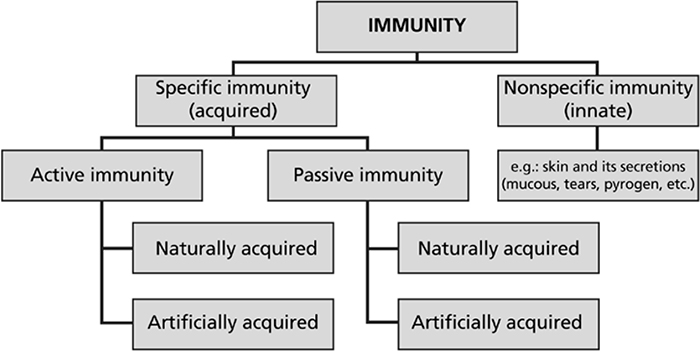
Another kind of immunity is a specific immunity, which is acquired. There are two kinds of specific immunity: active, which develops slowly, and passive, which develops immediately. Active immunity is based on immune memory and is connected with formation of specific antibodies. This kind of immunity is activated after contact with a foreign antigen. There are two types of such contact: natural and artificial. If an organism is infected and fights disease, naturally acquired active immunity is induced; but if an organism is in contact with a substance that contains antigen, like a vaccine, artificially acquired active immunity is induced. Passive immunity, in turn, is not based on immune memory, nor is it connected with the formation of antibodies. These antibodies and lymphocytes come from and are preformed in another host. Passive immunity also may be classified into two kinds: naturally acquired and artificially acquired. Naturally acquired passive immunity is formed during the fetal period and refers to the antibodies passing through the placenta from the mother to the baby. Artificially acquired passive immunity is a kind of short-term immunization induced by the transfer of antibodies, like antisera, blood plasma, pooled human immunoglobulin for intravenous (IVIG) or intramuscular (IG) use, and in the form of monoclonal antibodies (MAb).
...
- Aesthetics and Emotion
- Action Tendencies
- Aesthetic Response
- Affect
- Arousal, Emotional
- Authenticity
- Belief
- Circular Tones
- Cues and Signals
- Emotion
- Emotional Contagion
- Emotions, Aesthetic
- Emotions, Mixed
- Emotions, Primary and Secondary
- Empathy
- Evaluative Conditioning
- Meaning
- Mood
- Music Preference
- Musical Semantics
- Nostalgia
- Personality
- Rating Scales
- Relativism, Cultural
- Repetition
- Sad Music, Psychological Implications of
- Schema
- Style
- Subjectivity
- Syntax
- Tension
- Violence and Aggression
- Business and Technology
- Access, Digital
- Advertising
- Affordance and Appropriation
- Algorithm
- Appraisal
- Arthouse
- Authorship
- Classification, Music Store
- Computer Music
- Consumerism
- Copyright Law
- Copyright, Defined
- Driving While Listening to Music
- Green Music Alliance
- Lyrics
- Marketing
- Music Journalism
- Musical Instrument Digital Interface
- Pay to Play
- Payola (Radio)
- Phonograph
- Royalties
- Sectors, Music Industry
- Song
- Songwriting as Profession
- Touring
- Workout Playlists and Portable Devices
- Communities and Society
- Algerian Raï
- Antiestablishment Music
- Antiwar Music
- Apartheid
- Attunement and Affiliation
- Bards
- Blind Musicians
- Campaigns
- Civil Rights, U.S.
- Database Studies
- Diplomacy
- Ecological Validity
- Enculturation
- Fascism
- Fight Songs
- Generation
- Historical Musicology
- Indigenous Music
- Mass Hysteria
- Music Collectives
- Oral Tradition
- Patriotism
- Poetry
- Political Music
- Protest
- Race
- Revolutions
- Social History
- Spirituals
- Terrorism
- Troubadour
- War Music
- World Music
- Culture and Environment
- Anthems
- Anthropology
- Bimusicality
- Bird Song
- Cantometrics
- Chords, Perception of
- Classics
- Community Music
- Country Music
- Cultural Heritage
- Cultural Identity
- Cultural Meaning of Gender, Music and
- Cultural Renaissance
- Dance
- Death
- Drugs, Recreational
- Ecomusicology
- Environmental Causes and Campaigns
- Ethnocentricity
- Ethnographic Studies
- Ethnomusicology and Ethnomusicologists
- Everyday Uses of Music
- Fans
- Fieldwork
- Folk Music
- Gender
- Globalization
- Habitus
- Human Behavior, Music as
- Hymns
- Identity
- Imagery
- Immigrant Communities
- Inspiration
- Intellectual History
- Marching Bands
- Men
- Music Culture
- Music Festivals
- Music Traditions, Continuing
- Nature, Music in
- Performativity
- Philosophy
- Popular Music
- Primitive Music
- Prosody
- Religion
- Rituals
- Rock Concerts
- Social Networking
- Sociology of Music
- Soundscape
- Sports
- Street Musicians
- Subcultures
- Theater
- Tone Language
- Trance
- Urban Music
- Weddings
- Whale Songs
- Whistled Speech
- Women
- World Soundscape Project
- Elements of Musical Examination
- Analogy, Metaphor, and Narrative
- Analysis by Synthesis
- Architectural Acoustics
- Atonality
- Auditory Stream Segregation: Applications
- Auditory Stream Segregation: Boundaries
- Auditory System
- Behavioral Measures
- Brain Stem
- Case Studies
- Categorical Perception
- Closed Systems
- Closure
- Cochlear Implant
- Computer Models of Music
- Computer-Aided Musical Analysis
- Consonance and Dissonance
- Continuous Response Measurement
- Converging Evidence
- Correlational Study
- Critical Band
- Distraction
- Empirical Musicology
- Feature
- Features, Independence and Interaction of
- Fourier Analysis
- Generative Theory of Tonal Music
- Gesture
- Harmonicity
- Harmony
- Hearing Damage
- High Fidelity
- Humor
- Illusion
- Imaging Techniques
- Information-Processing Paradigm
- Instruments
- Intentionality
- Interval
- Intonation
- Loudness and Intensity
- Melody Processing
- Mode
- Music, Definitions of
- Musical Meme
- Musical Research, Causal Effects in
- Nature–Nurture
- Noise Versus Music
- Observation Techniques, Ethnomusicology
- Pattern
- Pitch Perception
- Pitch Perception: Development
- Pitch, Absolute
- Pitch, Models of
- Pitch, Relative
- Post-Tonal Music
- Probe-Tone Method
- Protolanguage
- Recognition
- Resource Sharing, Music and Language
- Scale
- Silence
- Sound
- Sound Engineering
- Systematic Musicology
- Timbre
- Tonal Pitch Space
- Tonality
- Tone
- Tuning Systems
- Vibrato
- Evolutionary Psychology
- Media and Communication
- Musicianship and Expertise
- Achievement, Musical
- Anxiety, Performance
- Arranging
- Articulation
- Audience
- Automaticity
- Body Movements
- Competitions, Classical and Popular
- Composition
- Conducting
- Creativity, Theories of Musical
- Drumming
- Education, Music
- Elite Performance
- Ensemble Performance
- Expertise
- Expressivity
- Fame and Esteem
- Fingering
- Genius
- Giftedness and Talent
- Grouping
- Improvisation
- Intelligence
- Interpretation
- Large-Scale Structure
- Learning and Teaching
- Lessons, Music
- Motor Skill Acquisition
- Movement
- Music Analysis
- Musical Aptitude, Tests of
- Musicking
- Nonmusical Abilities
- Notation
- Originality, Measures of
- Ornamentation
- Performance
- Practice
- School Bands and Choirs
- Sight Reading
- Singing, Acoustics
- Singing, Pedagogy of
- Singing, Psychology of
- Statistical Learning
- Theory
- Training
- Voice and Musical Identity
- Voice Leading, Rules of
- Neuroscience
- Achievement, Academic
- Applied Musicology
- Arousal, Science of
- Attention
- Brain Specialization for Music
- Brain Waves
- Cognition and Learning, Childhood
- Cognitive Constraints
- Critical Period
- Entrainment
- Episodic Memory
- Facial Expression
- Fetal Development
- Genetic Basis of Music
- Hemispheric Asymmetry
- Hormones
- Immune System
- Melodic Intonation Therapy
- Mirror Neurons
- Modularity
- Motivation
- Mozart Effect
- Music Exposure, Short-Term Effects of
- Music Training, Long-Term Effects of
- Neural Network Models
- Neurotransmitters
- Parkinson's Disease
- Physiological Responses, Peripheral
- Plasticity
- Prodigy
- Psychoacoustics
- Psychoanalysis
- Second Language Acquisition
- Sleep
- Perception, Memory, and Cognition
- Accent
- Agency
- Auditory Stream Segregation: Applications
- Auditory Stream Segregation: Boundaries
- Background Music
- Circle of Fifths
- Complexity
- Decoding
- Dissociation
- Earworms
- Embodied Cognition
- Executive Function
- Expectancy
- Expressive Timing
- Feedback, Role of
- Fusion
- Gestalt
- Hierarchical Organization
- Implication–Realization
- Implicit Learning
- Individual Differences
- Memory
- Meter
- Modulation
- Multimodality
- Music Cognition
- Perception
- Priming
- Rhythm
- Roughness and Beats
- Semiotics
- Similarity, Melodic
- Structure
- Synaesthesia
- Tactus and Pulse
- Tempo
- Theory of Mind
- Timing
- Transfer Effects
- Politics, Economics, and Law
- Therapy, Health, and Well-Being
- Aging
- Autism Spectrum Disorder
- Belonging
- Cancer
- Communicative Musicality
- Cooperation
- Dementia
- Health and Wellness
- Health Care
- Health, Public
- Intimacy and Affiliation
- Language Disorders
- Meditation
- Mental Health
- Music Thanatology and Hospice Care
- Music Therapy
- Music Therapy Methods
- Music Therapy Models
- Musical Disorders
- Pain
- Prevention
- Rehabilitation
- Relaxation
- Rhythmic Auditory Entrainment
- Self-Esteem
- Social Bonding
- Social Exclusion
- Special Needs
- Speech Therapy
- Spirituality
- Stroke
- Suicide
- Synchronization
- Teamwork, Music Education and
- Trauma, Post-Traumatic Stress Disorder
- Vibrotactile Devices for the Deaf
- Well-Being
- Workout Playlists and Portable Devices
- Loading...
Get a 30 day FREE TRIAL
-
 Watch videos from a variety of sources bringing classroom topics to life
 -
Read modern, diverse business cases
-
Explore hundreds of books and reference titles

Read next

More like this
Sage Recommends
We found other relevant content for you on other Sage platforms.
Have you created a personal profile? Login or create a profile so that you can save clips, playlists and searches