
Entry
Reader's guide
Entries A-Z
Subject index
Fascism
- 00:03
[SINGING IN GERMAN]
Fascism emerged during the early years of the 20th century as a totalitarian ideology based upon ideas of national supremacy, and dedication to one leader. It rejects democracy and elections in favor of building a society based on the primacy of the state. The ideological approach of fascism has been channeled through different paths, including the arts. Music has been used by fascist ideological groups in order to enhance their influence, to favor certain composers and musical works that fit their ideology, and as a yardstick for comparison that illustrates their supremacy over other groups and ideologies. Persecution of artistic movements that did not comply with fascist ideology was always on the forefront for fascist regimes.
Music and Fascist Ideology
The most obvious examples of fascism occurred in Germany and Italy. Adolf Hitler and Benito Mussolini established fascist regimes along with some other minor countries that were ruled by fascist governments, introducing an alliance referred to as the Axis powers, which was one of the two main sides during World War II.
The importance of music within these regimes has been widely discussed, and it is generally agreed that music was used as a propaganda tool. The first step taken was toward a centralization of affairs that had to do with music. In 1931 the Reichsmusikkammer (Reich Chamber of Music) was established as one of the branches of the Reichskulturkammer (Reich Chamber of Culture) that was run by Joseph Goebbels, minister of propaganda for Hitler's regime. The Reich Chamber of Music regulated the music-business world and musicians had to prove their Aryan descent in order to be able to join this organization. Thus, Jewish musicians were excluded and the music industry was controlled through central procedures. The first president of the Reich Chamber of Music was the composer and conductor Richard Strauss, and Wilhelm Furtwangler was vice president. Both resigned upon different incidents. Strauss was accused of continuing to work with the Jewish writer Stefan Zweig, and Furtwangler was forced to resign because he defended Paul Hindemith after Joseph Goebbels's remarks that the composer was an “atonal noisemaker.”
Among the duties of the Reich Chamber of Music was to prove the supremacy of German music institutions over those of other nations. This had resulted in a series of collaborations with some countries that seemed to be potential allies in the years to come. One example of this was an exchange of operatic programs between the Greek and the German states in 1940, when World War II had already commenced but had not yet extended to Greece. At that moment, Greece was ruled by Ioannis Metaxas, a dictator who was enforcing a milder and more tolerant though obviously fascist rule in Greece. Within the bounds of this cooperation, the Frankfurt Opera House presented for the first time Richard Wagner's Ring of Nibelungen cycle in Athens. The exchange program also involved the performance of Manolis Kalomiris's opera The Mother's Ring in the Volksoper Berlin under the direction of Carl Moeller.
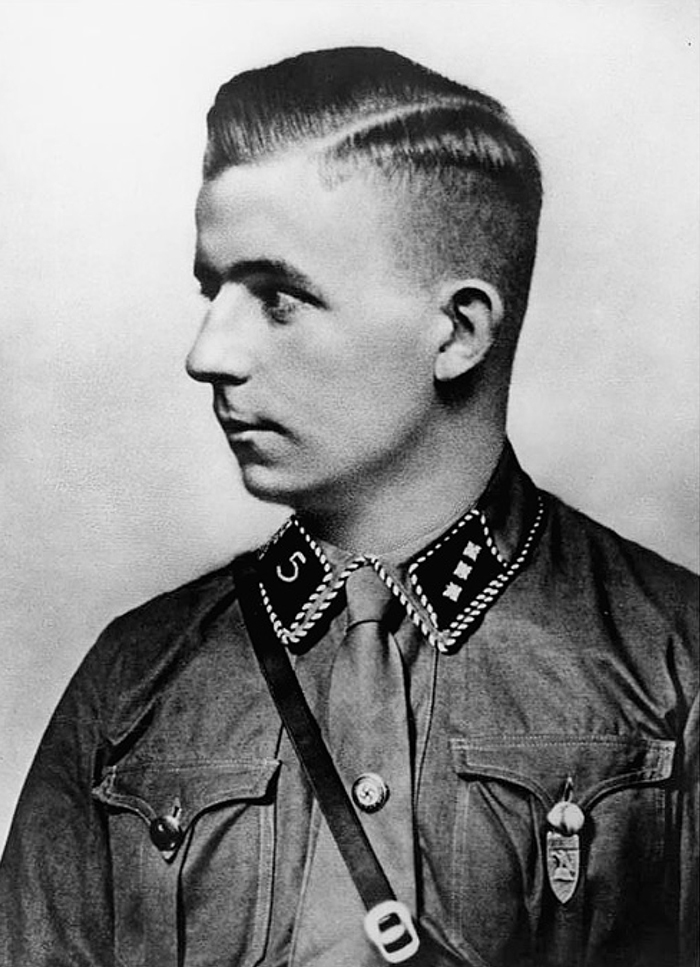
After Horst Wessel, a commander of the Storm Division of Hitler's shock troops, was murdered in 1930 by a communist, he became an instant martyr for Nazi party officials. The song he wrote also immediately became a symbol of the Nazis.
...
- Aesthetics and Emotion
- Action Tendencies
- Aesthetic Response
- Affect
- Arousal, Emotional
- Authenticity
- Belief
- Circular Tones
- Cues and Signals
- Emotion
- Emotional Contagion
- Emotions, Aesthetic
- Emotions, Mixed
- Emotions, Primary and Secondary
- Empathy
- Evaluative Conditioning
- Meaning
- Mood
- Music Preference
- Musical Semantics
- Nostalgia
- Personality
- Rating Scales
- Relativism, Cultural
- Repetition
- Sad Music, Psychological Implications of
- Schema
- Style
- Subjectivity
- Syntax
- Tension
- Violence and Aggression
- Business and Technology
- Access, Digital
- Advertising
- Affordance and Appropriation
- Algorithm
- Appraisal
- Arthouse
- Authorship
- Classification, Music Store
- Computer Music
- Consumerism
- Copyright Law
- Copyright, Defined
- Driving While Listening to Music
- Green Music Alliance
- Lyrics
- Marketing
- Music Journalism
- Musical Instrument Digital Interface
- Pay to Play
- Payola (Radio)
- Phonograph
- Royalties
- Sectors, Music Industry
- Song
- Songwriting as Profession
- Touring
- Workout Playlists and Portable Devices
- Communities and Society
- Algerian Raï
- Antiestablishment Music
- Antiwar Music
- Apartheid
- Attunement and Affiliation
- Bards
- Blind Musicians
- Campaigns
- Civil Rights, U.S.
- Database Studies
- Diplomacy
- Ecological Validity
- Enculturation
- Fascism
- Fight Songs
- Generation
- Historical Musicology
- Indigenous Music
- Mass Hysteria
- Music Collectives
- Oral Tradition
- Patriotism
- Poetry
- Political Music
- Protest
- Race
- Revolutions
- Social History
- Spirituals
- Terrorism
- Troubadour
- War Music
- World Music
- Culture and Environment
- Anthems
- Anthropology
- Bimusicality
- Bird Song
- Cantometrics
- Chords, Perception of
- Classics
- Community Music
- Country Music
- Cultural Heritage
- Cultural Identity
- Cultural Meaning of Gender, Music and
- Cultural Renaissance
- Dance
- Death
- Drugs, Recreational
- Ecomusicology
- Environmental Causes and Campaigns
- Ethnocentricity
- Ethnographic Studies
- Ethnomusicology and Ethnomusicologists
- Everyday Uses of Music
- Fans
- Fieldwork
- Folk Music
- Gender
- Globalization
- Habitus
- Human Behavior, Music as
- Hymns
- Identity
- Imagery
- Immigrant Communities
- Inspiration
- Intellectual History
- Marching Bands
- Men
- Music Culture
- Music Festivals
- Music Traditions, Continuing
- Nature, Music in
- Performativity
- Philosophy
- Popular Music
- Primitive Music
- Prosody
- Religion
- Rituals
- Rock Concerts
- Social Networking
- Sociology of Music
- Soundscape
- Sports
- Street Musicians
- Subcultures
- Theater
- Tone Language
- Trance
- Urban Music
- Weddings
- Whale Songs
- Whistled Speech
- Women
- World Soundscape Project
- Elements of Musical Examination
- Analogy, Metaphor, and Narrative
- Analysis by Synthesis
- Architectural Acoustics
- Atonality
- Auditory Stream Segregation: Applications
- Auditory Stream Segregation: Boundaries
- Auditory System
- Behavioral Measures
- Brain Stem
- Case Studies
- Categorical Perception
- Closed Systems
- Closure
- Cochlear Implant
- Computer Models of Music
- Computer-Aided Musical Analysis
- Consonance and Dissonance
- Continuous Response Measurement
- Converging Evidence
- Correlational Study
- Critical Band
- Distraction
- Empirical Musicology
- Feature
- Features, Independence and Interaction of
- Fourier Analysis
- Generative Theory of Tonal Music
- Gesture
- Harmonicity
- Harmony
- Hearing Damage
- High Fidelity
- Humor
- Illusion
- Imaging Techniques
- Information-Processing Paradigm
- Instruments
- Intentionality
- Interval
- Intonation
- Loudness and Intensity
- Melody Processing
- Mode
- Music, Definitions of
- Musical Meme
- Musical Research, Causal Effects in
- Nature–Nurture
- Noise Versus Music
- Observation Techniques, Ethnomusicology
- Pattern
- Pitch Perception
- Pitch Perception: Development
- Pitch, Absolute
- Pitch, Models of
- Pitch, Relative
- Post-Tonal Music
- Probe-Tone Method
- Protolanguage
- Recognition
- Resource Sharing, Music and Language
- Scale
- Silence
- Sound
- Sound Engineering
- Systematic Musicology
- Timbre
- Tonal Pitch Space
- Tonality
- Tone
- Tuning Systems
- Vibrato
- Evolutionary Psychology
- Media and Communication
- Musicianship and Expertise
- Achievement, Musical
- Anxiety, Performance
- Arranging
- Articulation
- Audience
- Automaticity
- Body Movements
- Competitions, Classical and Popular
- Composition
- Conducting
- Creativity, Theories of Musical
- Drumming
- Education, Music
- Elite Performance
- Ensemble Performance
- Expertise
- Expressivity
- Fame and Esteem
- Fingering
- Genius
- Giftedness and Talent
- Grouping
- Improvisation
- Intelligence
- Interpretation
- Large-Scale Structure
- Learning and Teaching
- Lessons, Music
- Motor Skill Acquisition
- Movement
- Music Analysis
- Musical Aptitude, Tests of
- Musicking
- Nonmusical Abilities
- Notation
- Originality, Measures of
- Ornamentation
- Performance
- Practice
- School Bands and Choirs
- Sight Reading
- Singing, Acoustics
- Singing, Pedagogy of
- Singing, Psychology of
- Statistical Learning
- Theory
- Training
- Voice and Musical Identity
- Voice Leading, Rules of
- Neuroscience
- Achievement, Academic
- Applied Musicology
- Arousal, Science of
- Attention
- Brain Specialization for Music
- Brain Waves
- Cognition and Learning, Childhood
- Cognitive Constraints
- Critical Period
- Entrainment
- Episodic Memory
- Facial Expression
- Fetal Development
- Genetic Basis of Music
- Hemispheric Asymmetry
- Hormones
- Immune System
- Melodic Intonation Therapy
- Mirror Neurons
- Modularity
- Motivation
- Mozart Effect
- Music Exposure, Short-Term Effects of
- Music Training, Long-Term Effects of
- Neural Network Models
- Neurotransmitters
- Parkinson's Disease
- Physiological Responses, Peripheral
- Plasticity
- Prodigy
- Psychoacoustics
- Psychoanalysis
- Second Language Acquisition
- Sleep
- Perception, Memory, and Cognition
- Accent
- Agency
- Auditory Stream Segregation: Applications
- Auditory Stream Segregation: Boundaries
- Background Music
- Circle of Fifths
- Complexity
- Decoding
- Dissociation
- Earworms
- Embodied Cognition
- Executive Function
- Expectancy
- Expressive Timing
- Feedback, Role of
- Fusion
- Gestalt
- Hierarchical Organization
- Implication–Realization
- Implicit Learning
- Individual Differences
- Memory
- Meter
- Modulation
- Multimodality
- Music Cognition
- Perception
- Priming
- Rhythm
- Roughness and Beats
- Semiotics
- Similarity, Melodic
- Structure
- Synaesthesia
- Tactus and Pulse
- Tempo
- Theory of Mind
- Timing
- Transfer Effects
- Politics, Economics, and Law
- Therapy, Health, and Well-Being
- Aging
- Autism Spectrum Disorder
- Belonging
- Cancer
- Communicative Musicality
- Cooperation
- Dementia
- Health and Wellness
- Health Care
- Health, Public
- Intimacy and Affiliation
- Language Disorders
- Meditation
- Mental Health
- Music Thanatology and Hospice Care
- Music Therapy
- Music Therapy Methods
- Music Therapy Models
- Musical Disorders
- Pain
- Prevention
- Rehabilitation
- Relaxation
- Rhythmic Auditory Entrainment
- Self-Esteem
- Social Bonding
- Social Exclusion
- Special Needs
- Speech Therapy
- Spirituality
- Stroke
- Suicide
- Synchronization
- Teamwork, Music Education and
- Trauma, Post-Traumatic Stress Disorder
- Vibrotactile Devices for the Deaf
- Well-Being
- Workout Playlists and Portable Devices
- Loading...
Get a 30 day FREE TRIAL
-
 Watch videos from a variety of sources bringing classroom topics to life
 -
Read modern, diverse business cases
-
Explore hundreds of books and reference titles

Read next

More like this
Sage Recommends
We found other relevant content for you on other Sage platforms.
Have you created a personal profile? Login or create a profile so that you can save clips, playlists and searches