
Entry
Reader's guide
Entries A-Z
Subject index
Expressive Timing
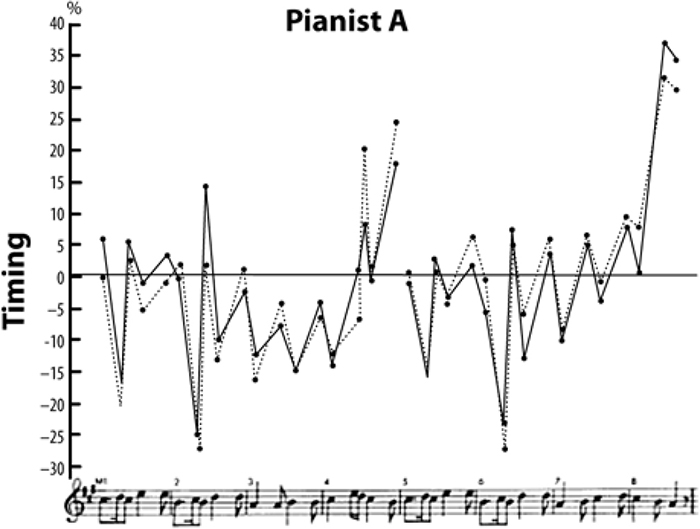
The common meaning of “expressive timing” is any deviation from a template of nominal durations. This template is often the nominal (sometimes called “deadpan”) representation of a piece of music in the form of a musical score in which each note value is represented by its mathematically derived duration, often defined by a metronome indication. Note that this is a mathematical/technical definition rather than a perception-based definition. A perceptually neutral performance actually exhibits small timing variations. Many different types of expressive timing have been found both on a low-context level of a few notes, so-called microtiming, as well as timing patterns for larger note sequences such as phrases and the whole musical piece. One example of expressive timing is provided in Figure 1.
Figure 1Example of expressive timing in terms of timing variations by a pianist performing the theme of Wolfgang Amadeus Mozart's Piano Sonata in A Major (K. 311). The vertical axis shows the relative lengthening of each note compared to the nominal value. Notice that there are both large-scale variations over the two subphrases and smaller microtiming variations in the context of a few notes. The “zig-zag” pattern corresponds to the double duration principle.
Different Principles of Timing Variations
Microtiming is the variation of timing within a small context of a few notes. One example of a performance principle is duration contrast, which emphasizes the difference between different duration categories by lengthening relatively long notes and shortening relatively short notes. Another example is double duration, which represents a special case, only occurring in duration patterns of 2:1 (e.g., a half note followed by a quarter note). In this case, the long note is shortened and the short note is lengthened. A third example is local melody accents. A prominent note such as the peak in a melodic phrase is often accentuated by making local increases of dynamics and note duration.
Metrical patterns are repeated timing patterns that are limited to a specific metrical level, for example, the measure. One example is Viennese waltz, where a characteristic expressive variation is found regarding the duration of the three beats in the bar. The pattern for the three beats in this case is typically short-long-intermediate and seems to be specifically connected to this musical style.
Another, very common metrical variation is the long-short pattern found in traditional jazz (swing), in folk music, and in baroque music (notes inégales). In jazz, this applies to eight notes that divide the beat in two notes. It has been notated either as even eight notes marked “swing” or by a dotted eight note followed by a sixteenth note. Both are just approximations of the actual ratio of the long-short pattern, which typically is played somewhere in between these extremes depending on tempo, style, instrument, and personal playing style (for example, the measurements by Anders Friberg and Andreas Sundström).
Phrasing is the relatively longer variation of tempo and dynamics over phrase units. This expressive device is particularly prominent in music from the Romantic period often exhibiting large variations in both tempo and dynamics. Phrasing is typically realized in terms of an arch-like variation of tempo, thus starting slow, speeding up in the middle, and then slowing down toward the end of the phrase. Different phrasing levels are typically expressed with a more pronounced ritardando for longer phrase units. Thus, this expressive device is to a large extent used for conveying the musical structure.
...
- Aesthetics and Emotion
- Action Tendencies
- Aesthetic Response
- Affect
- Arousal, Emotional
- Authenticity
- Belief
- Circular Tones
- Cues and Signals
- Emotion
- Emotional Contagion
- Emotions, Aesthetic
- Emotions, Mixed
- Emotions, Primary and Secondary
- Empathy
- Evaluative Conditioning
- Meaning
- Mood
- Music Preference
- Musical Semantics
- Nostalgia
- Personality
- Rating Scales
- Relativism, Cultural
- Repetition
- Sad Music, Psychological Implications of
- Schema
- Style
- Subjectivity
- Syntax
- Tension
- Violence and Aggression
- Business and Technology
- Access, Digital
- Advertising
- Affordance and Appropriation
- Algorithm
- Appraisal
- Arthouse
- Authorship
- Classification, Music Store
- Computer Music
- Consumerism
- Copyright Law
- Copyright, Defined
- Driving While Listening to Music
- Green Music Alliance
- Lyrics
- Marketing
- Music Journalism
- Musical Instrument Digital Interface
- Pay to Play
- Payola (Radio)
- Phonograph
- Royalties
- Sectors, Music Industry
- Song
- Songwriting as Profession
- Touring
- Workout Playlists and Portable Devices
- Communities and Society
- Algerian Raï
- Antiestablishment Music
- Antiwar Music
- Apartheid
- Attunement and Affiliation
- Bards
- Blind Musicians
- Campaigns
- Civil Rights, U.S.
- Database Studies
- Diplomacy
- Ecological Validity
- Enculturation
- Fascism
- Fight Songs
- Generation
- Historical Musicology
- Indigenous Music
- Mass Hysteria
- Music Collectives
- Oral Tradition
- Patriotism
- Poetry
- Political Music
- Protest
- Race
- Revolutions
- Social History
- Spirituals
- Terrorism
- Troubadour
- War Music
- World Music
- Culture and Environment
- Anthems
- Anthropology
- Bimusicality
- Bird Song
- Cantometrics
- Chords, Perception of
- Classics
- Community Music
- Country Music
- Cultural Heritage
- Cultural Identity
- Cultural Meaning of Gender, Music and
- Cultural Renaissance
- Dance
- Death
- Drugs, Recreational
- Ecomusicology
- Environmental Causes and Campaigns
- Ethnocentricity
- Ethnographic Studies
- Ethnomusicology and Ethnomusicologists
- Everyday Uses of Music
- Fans
- Fieldwork
- Folk Music
- Gender
- Globalization
- Habitus
- Human Behavior, Music as
- Hymns
- Identity
- Imagery
- Immigrant Communities
- Inspiration
- Intellectual History
- Marching Bands
- Men
- Music Culture
- Music Festivals
- Music Traditions, Continuing
- Nature, Music in
- Performativity
- Philosophy
- Popular Music
- Primitive Music
- Prosody
- Religion
- Rituals
- Rock Concerts
- Social Networking
- Sociology of Music
- Soundscape
- Sports
- Street Musicians
- Subcultures
- Theater
- Tone Language
- Trance
- Urban Music
- Weddings
- Whale Songs
- Whistled Speech
- Women
- World Soundscape Project
- Elements of Musical Examination
- Analogy, Metaphor, and Narrative
- Analysis by Synthesis
- Architectural Acoustics
- Atonality
- Auditory Stream Segregation: Applications
- Auditory Stream Segregation: Boundaries
- Auditory System
- Behavioral Measures
- Brain Stem
- Case Studies
- Categorical Perception
- Closed Systems
- Closure
- Cochlear Implant
- Computer Models of Music
- Computer-Aided Musical Analysis
- Consonance and Dissonance
- Continuous Response Measurement
- Converging Evidence
- Correlational Study
- Critical Band
- Distraction
- Empirical Musicology
- Feature
- Features, Independence and Interaction of
- Fourier Analysis
- Generative Theory of Tonal Music
- Gesture
- Harmonicity
- Harmony
- Hearing Damage
- High Fidelity
- Humor
- Illusion
- Imaging Techniques
- Information-Processing Paradigm
- Instruments
- Intentionality
- Interval
- Intonation
- Loudness and Intensity
- Melody Processing
- Mode
- Music, Definitions of
- Musical Meme
- Musical Research, Causal Effects in
- Nature–Nurture
- Noise Versus Music
- Observation Techniques, Ethnomusicology
- Pattern
- Pitch Perception
- Pitch Perception: Development
- Pitch, Absolute
- Pitch, Models of
- Pitch, Relative
- Post-Tonal Music
- Probe-Tone Method
- Protolanguage
- Recognition
- Resource Sharing, Music and Language
- Scale
- Silence
- Sound
- Sound Engineering
- Systematic Musicology
- Timbre
- Tonal Pitch Space
- Tonality
- Tone
- Tuning Systems
- Vibrato
- Evolutionary Psychology
- Media and Communication
- Musicianship and Expertise
- Achievement, Musical
- Anxiety, Performance
- Arranging
- Articulation
- Audience
- Automaticity
- Body Movements
- Competitions, Classical and Popular
- Composition
- Conducting
- Creativity, Theories of Musical
- Drumming
- Education, Music
- Elite Performance
- Ensemble Performance
- Expertise
- Expressivity
- Fame and Esteem
- Fingering
- Genius
- Giftedness and Talent
- Grouping
- Improvisation
- Intelligence
- Interpretation
- Large-Scale Structure
- Learning and Teaching
- Lessons, Music
- Motor Skill Acquisition
- Movement
- Music Analysis
- Musical Aptitude, Tests of
- Musicking
- Nonmusical Abilities
- Notation
- Originality, Measures of
- Ornamentation
- Performance
- Practice
- School Bands and Choirs
- Sight Reading
- Singing, Acoustics
- Singing, Pedagogy of
- Singing, Psychology of
- Statistical Learning
- Theory
- Training
- Voice and Musical Identity
- Voice Leading, Rules of
- Neuroscience
- Achievement, Academic
- Applied Musicology
- Arousal, Science of
- Attention
- Brain Specialization for Music
- Brain Waves
- Cognition and Learning, Childhood
- Cognitive Constraints
- Critical Period
- Entrainment
- Episodic Memory
- Facial Expression
- Fetal Development
- Genetic Basis of Music
- Hemispheric Asymmetry
- Hormones
- Immune System
- Melodic Intonation Therapy
- Mirror Neurons
- Modularity
- Motivation
- Mozart Effect
- Music Exposure, Short-Term Effects of
- Music Training, Long-Term Effects of
- Neural Network Models
- Neurotransmitters
- Parkinson's Disease
- Physiological Responses, Peripheral
- Plasticity
- Prodigy
- Psychoacoustics
- Psychoanalysis
- Second Language Acquisition
- Sleep
- Perception, Memory, and Cognition
- Accent
- Agency
- Auditory Stream Segregation: Applications
- Auditory Stream Segregation: Boundaries
- Background Music
- Circle of Fifths
- Complexity
- Decoding
- Dissociation
- Earworms
- Embodied Cognition
- Executive Function
- Expectancy
- Expressive Timing
- Feedback, Role of
- Fusion
- Gestalt
- Hierarchical Organization
- Implication–Realization
- Implicit Learning
- Individual Differences
- Memory
- Meter
- Modulation
- Multimodality
- Music Cognition
- Perception
- Priming
- Rhythm
- Roughness and Beats
- Semiotics
- Similarity, Melodic
- Structure
- Synaesthesia
- Tactus and Pulse
- Tempo
- Theory of Mind
- Timing
- Transfer Effects
- Politics, Economics, and Law
- Therapy, Health, and Well-Being
- Aging
- Autism Spectrum Disorder
- Belonging
- Cancer
- Communicative Musicality
- Cooperation
- Dementia
- Health and Wellness
- Health Care
- Health, Public
- Intimacy and Affiliation
- Language Disorders
- Meditation
- Mental Health
- Music Thanatology and Hospice Care
- Music Therapy
- Music Therapy Methods
- Music Therapy Models
- Musical Disorders
- Pain
- Prevention
- Rehabilitation
- Relaxation
- Rhythmic Auditory Entrainment
- Self-Esteem
- Social Bonding
- Social Exclusion
- Special Needs
- Speech Therapy
- Spirituality
- Stroke
- Suicide
- Synchronization
- Teamwork, Music Education and
- Trauma, Post-Traumatic Stress Disorder
- Vibrotactile Devices for the Deaf
- Well-Being
- Workout Playlists and Portable Devices
- Loading...
Get a 30 day FREE TRIAL
-
 Watch videos from a variety of sources bringing classroom topics to life
 -
Read modern, diverse business cases
-
Explore hundreds of books and reference titles

Read next

More like this
Sage Recommends
We found other relevant content for you on other Sage platforms.
Have you created a personal profile? Login or create a profile so that you can save clips, playlists and searches