
Entry
Reader's guide
Entries A-Z
Subject index
Closure
Closure refers to a state of being closed, as well as a tendency to perceive objects and events as closed. The term may be applied at multiple levels of abstraction to a range of static and dynamic media, and the experience of closure depends on perceptual and psychological processes that are not fully understood. Gestalt psychologists considered closure one of several interrelated psychological tendencies or laws that describe the perception of form, along with others such as similarity, proximity, and good continuation.
For static images, a state of closure can be illustrated by a shape such as a circle that has a continuous, unbroken boundary that encloses space within that shape (see Figure 1, left panel), whereas perceptual closure is a psychological tendency to perceive closure in spite of incomplete sensory information (see Figure 1, right panel). At a higher level of abstraction, images such as paintings and sculptures are said to exhibit closure when they are experienced as integrated, complete, and stable. Experiences of closure are not fully determined by stimulus attributes, indicating the existence of processes that function to generate idealized representations of form from limited information. More generally, perceptual mechanisms underlying closure may form part of a suite of mechanisms that assist in auditory and visual scene analysis and that operate under nonoptimal conditions when perceptual information is incomplete or ambiguous. Evidence that people “fill in the gaps” when observing an incomplete visual object supports the view that experiences of closure partially reflect perceptual processes.
Figure 1A circle (left panel) exemplifies a state of closure. The circle is also perceived when sensory information is incomplete (right panel), illustrating perceptual closure.

For dynamic media such as a story, film, dance, or a piece of music, closure describes the experience of a temporary or permanent end point, with the degree of closure varying along a continuum from strong to weak. Strong experiences of closure are associated with conclusiveness, stability, and finality, and little or no expectation for continuation of the ongoing material. Conversely, an expectation for continuation implies an absence of closure and is associated with psychological tension and instability. Closure and expectation are opposite ends of a continuum of experience.
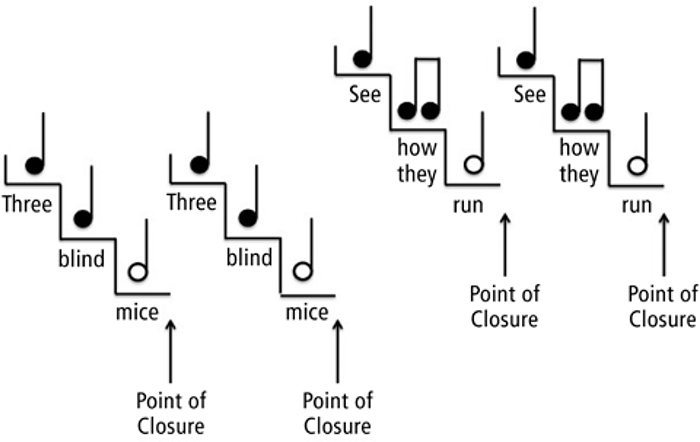
For music, as in other temporal arts, closure both emerges from and gives rise to temporal grouping (see Figure 2). The capacity to detect points of closure is a prerequisite for some of the most meaningful perceptual units in music, such as motifs, themes, phrases, melodies, and movements. Quite often, small groups of events (such as motifs or themes) are nested within larger groups such as phrases, which are nested within sections, movements, and whole pieces. That is, closure is at the heart of musical grouping structure and may be hierarchically organized.
Figure 2Illustration of points of closure in a well-known melody
Expectation and Grouping
Closure is thus intimately tied to two related constructs in music: expectation and grouping. The implication-realization (I-R) model of melodic structure, proposed by Eugene Narmour in 1990, draws on these two constructs. In this model, any melody can be analyzed as an assemblage of more elementary melodic patterns. All melodic groups, by definition, are separated by points of closure. Conversely, events that do not occur at points of closure are said to be implicative (they generate expectations for continuations, which may be fulfilled or denied). According to the I-R model, six musical conditions determine the degree of closure that delineates a melodic group: (1) stopping, (2) metric emphasis, (3) consonance resolving dissonance, (4) durational cumulation (short to long note), (5) intervallic motion from large to small, and (6) a change in registral direction. Depending on these conditions, the strength of melodic closure can be assessed. Weak closure is called articulation, moderate levels of closure are called formation, and strong levels of closure are called transformation.
...
- Aesthetics and Emotion
- Action Tendencies
- Aesthetic Response
- Affect
- Arousal, Emotional
- Authenticity
- Belief
- Circular Tones
- Cues and Signals
- Emotion
- Emotional Contagion
- Emotions, Aesthetic
- Emotions, Mixed
- Emotions, Primary and Secondary
- Empathy
- Evaluative Conditioning
- Meaning
- Mood
- Music Preference
- Musical Semantics
- Nostalgia
- Personality
- Rating Scales
- Relativism, Cultural
- Repetition
- Sad Music, Psychological Implications of
- Schema
- Style
- Subjectivity
- Syntax
- Tension
- Violence and Aggression
- Business and Technology
- Access, Digital
- Advertising
- Affordance and Appropriation
- Algorithm
- Appraisal
- Arthouse
- Authorship
- Classification, Music Store
- Computer Music
- Consumerism
- Copyright Law
- Copyright, Defined
- Driving While Listening to Music
- Green Music Alliance
- Lyrics
- Marketing
- Music Journalism
- Musical Instrument Digital Interface
- Pay to Play
- Payola (Radio)
- Phonograph
- Royalties
- Sectors, Music Industry
- Song
- Songwriting as Profession
- Touring
- Workout Playlists and Portable Devices
- Communities and Society
- Algerian Raï
- Antiestablishment Music
- Antiwar Music
- Apartheid
- Attunement and Affiliation
- Bards
- Blind Musicians
- Campaigns
- Civil Rights, U.S.
- Database Studies
- Diplomacy
- Ecological Validity
- Enculturation
- Fascism
- Fight Songs
- Generation
- Historical Musicology
- Indigenous Music
- Mass Hysteria
- Music Collectives
- Oral Tradition
- Patriotism
- Poetry
- Political Music
- Protest
- Race
- Revolutions
- Social History
- Spirituals
- Terrorism
- Troubadour
- War Music
- World Music
- Culture and Environment
- Anthems
- Anthropology
- Bimusicality
- Bird Song
- Cantometrics
- Chords, Perception of
- Classics
- Community Music
- Country Music
- Cultural Heritage
- Cultural Identity
- Cultural Meaning of Gender, Music and
- Cultural Renaissance
- Dance
- Death
- Drugs, Recreational
- Ecomusicology
- Environmental Causes and Campaigns
- Ethnocentricity
- Ethnographic Studies
- Ethnomusicology and Ethnomusicologists
- Everyday Uses of Music
- Fans
- Fieldwork
- Folk Music
- Gender
- Globalization
- Habitus
- Human Behavior, Music as
- Hymns
- Identity
- Imagery
- Immigrant Communities
- Inspiration
- Intellectual History
- Marching Bands
- Men
- Music Culture
- Music Festivals
- Music Traditions, Continuing
- Nature, Music in
- Performativity
- Philosophy
- Popular Music
- Primitive Music
- Prosody
- Religion
- Rituals
- Rock Concerts
- Social Networking
- Sociology of Music
- Soundscape
- Sports
- Street Musicians
- Subcultures
- Theater
- Tone Language
- Trance
- Urban Music
- Weddings
- Whale Songs
- Whistled Speech
- Women
- World Soundscape Project
- Elements of Musical Examination
- Analogy, Metaphor, and Narrative
- Analysis by Synthesis
- Architectural Acoustics
- Atonality
- Auditory Stream Segregation: Applications
- Auditory Stream Segregation: Boundaries
- Auditory System
- Behavioral Measures
- Brain Stem
- Case Studies
- Categorical Perception
- Closed Systems
- Closure
- Cochlear Implant
- Computer Models of Music
- Computer-Aided Musical Analysis
- Consonance and Dissonance
- Continuous Response Measurement
- Converging Evidence
- Correlational Study
- Critical Band
- Distraction
- Empirical Musicology
- Feature
- Features, Independence and Interaction of
- Fourier Analysis
- Generative Theory of Tonal Music
- Gesture
- Harmonicity
- Harmony
- Hearing Damage
- High Fidelity
- Humor
- Illusion
- Imaging Techniques
- Information-Processing Paradigm
- Instruments
- Intentionality
- Interval
- Intonation
- Loudness and Intensity
- Melody Processing
- Mode
- Music, Definitions of
- Musical Meme
- Musical Research, Causal Effects in
- Nature–Nurture
- Noise Versus Music
- Observation Techniques, Ethnomusicology
- Pattern
- Pitch Perception
- Pitch Perception: Development
- Pitch, Absolute
- Pitch, Models of
- Pitch, Relative
- Post-Tonal Music
- Probe-Tone Method
- Protolanguage
- Recognition
- Resource Sharing, Music and Language
- Scale
- Silence
- Sound
- Sound Engineering
- Systematic Musicology
- Timbre
- Tonal Pitch Space
- Tonality
- Tone
- Tuning Systems
- Vibrato
- Evolutionary Psychology
- Media and Communication
- Musicianship and Expertise
- Achievement, Musical
- Anxiety, Performance
- Arranging
- Articulation
- Audience
- Automaticity
- Body Movements
- Competitions, Classical and Popular
- Composition
- Conducting
- Creativity, Theories of Musical
- Drumming
- Education, Music
- Elite Performance
- Ensemble Performance
- Expertise
- Expressivity
- Fame and Esteem
- Fingering
- Genius
- Giftedness and Talent
- Grouping
- Improvisation
- Intelligence
- Interpretation
- Large-Scale Structure
- Learning and Teaching
- Lessons, Music
- Motor Skill Acquisition
- Movement
- Music Analysis
- Musical Aptitude, Tests of
- Musicking
- Nonmusical Abilities
- Notation
- Originality, Measures of
- Ornamentation
- Performance
- Practice
- School Bands and Choirs
- Sight Reading
- Singing, Acoustics
- Singing, Pedagogy of
- Singing, Psychology of
- Statistical Learning
- Theory
- Training
- Voice and Musical Identity
- Voice Leading, Rules of
- Neuroscience
- Achievement, Academic
- Applied Musicology
- Arousal, Science of
- Attention
- Brain Specialization for Music
- Brain Waves
- Cognition and Learning, Childhood
- Cognitive Constraints
- Critical Period
- Entrainment
- Episodic Memory
- Facial Expression
- Fetal Development
- Genetic Basis of Music
- Hemispheric Asymmetry
- Hormones
- Immune System
- Melodic Intonation Therapy
- Mirror Neurons
- Modularity
- Motivation
- Mozart Effect
- Music Exposure, Short-Term Effects of
- Music Training, Long-Term Effects of
- Neural Network Models
- Neurotransmitters
- Parkinson's Disease
- Physiological Responses, Peripheral
- Plasticity
- Prodigy
- Psychoacoustics
- Psychoanalysis
- Second Language Acquisition
- Sleep
- Perception, Memory, and Cognition
- Accent
- Agency
- Auditory Stream Segregation: Applications
- Auditory Stream Segregation: Boundaries
- Background Music
- Circle of Fifths
- Complexity
- Decoding
- Dissociation
- Earworms
- Embodied Cognition
- Executive Function
- Expectancy
- Expressive Timing
- Feedback, Role of
- Fusion
- Gestalt
- Hierarchical Organization
- Implication–Realization
- Implicit Learning
- Individual Differences
- Memory
- Meter
- Modulation
- Multimodality
- Music Cognition
- Perception
- Priming
- Rhythm
- Roughness and Beats
- Semiotics
- Similarity, Melodic
- Structure
- Synaesthesia
- Tactus and Pulse
- Tempo
- Theory of Mind
- Timing
- Transfer Effects
- Politics, Economics, and Law
- Therapy, Health, and Well-Being
- Aging
- Autism Spectrum Disorder
- Belonging
- Cancer
- Communicative Musicality
- Cooperation
- Dementia
- Health and Wellness
- Health Care
- Health, Public
- Intimacy and Affiliation
- Language Disorders
- Meditation
- Mental Health
- Music Thanatology and Hospice Care
- Music Therapy
- Music Therapy Methods
- Music Therapy Models
- Musical Disorders
- Pain
- Prevention
- Rehabilitation
- Relaxation
- Rhythmic Auditory Entrainment
- Self-Esteem
- Social Bonding
- Social Exclusion
- Special Needs
- Speech Therapy
- Spirituality
- Stroke
- Suicide
- Synchronization
- Teamwork, Music Education and
- Trauma, Post-Traumatic Stress Disorder
- Vibrotactile Devices for the Deaf
- Well-Being
- Workout Playlists and Portable Devices
- Loading...
Get a 30 day FREE TRIAL
-
 Watch videos from a variety of sources bringing classroom topics to life
 -
Read modern, diverse business cases
-
Explore hundreds of books and reference titles

Read next

More like this
Sage Recommends
We found other relevant content for you on other Sage platforms.
Have you created a personal profile? Login or create a profile so that you can save clips, playlists and searches