
Entry
Reader's guide
Entries A-Z
Subject index
Authenticity
Authenticity is a highly debated concept, and there are competing definitions of authenticity operating within social and behavioral approaches to the study of music. Two competing understandings are the realist and constructionist views of authenticity. Realist understandings of authenticity focus on the idea that there is a singular and essentialist way of being. Authentic music is music that is created by musicians whose cultural identities reflect the essence of the genre. Music, in this framework, reflects the cultural identities of those who create it. For example, authentic rap music is created by subcultures of marginalized urban black youth who resist cultural appropriation into dominant mainstream musical culture.
Social constructionist understandings of authenticity, on the other hand, focus on how authenticity is a product that is created by musicians and the cultural industries. Authentic music is fabricated by musicians and profit seekers alike for a variety of purposes. Instead of music reflecting reality, music is actively involved in the shaping and constructing of reality. Within the constructionist framework, authenticity arises as a result of what Richard Peterson referred to as “authenticity work,” people actively involved in creating, marketing, and selling authentic music. Authenticity, according to constructionists, is ascribed by people not inscribed in the music. Instead of arguing that commodified musical forms are effectively inauthentic, constructionist approaches focus on who is being authenticated in the music and how they are being authenticated. Increasingly, there has been a shift toward constructionist understandings of authenticity within music.
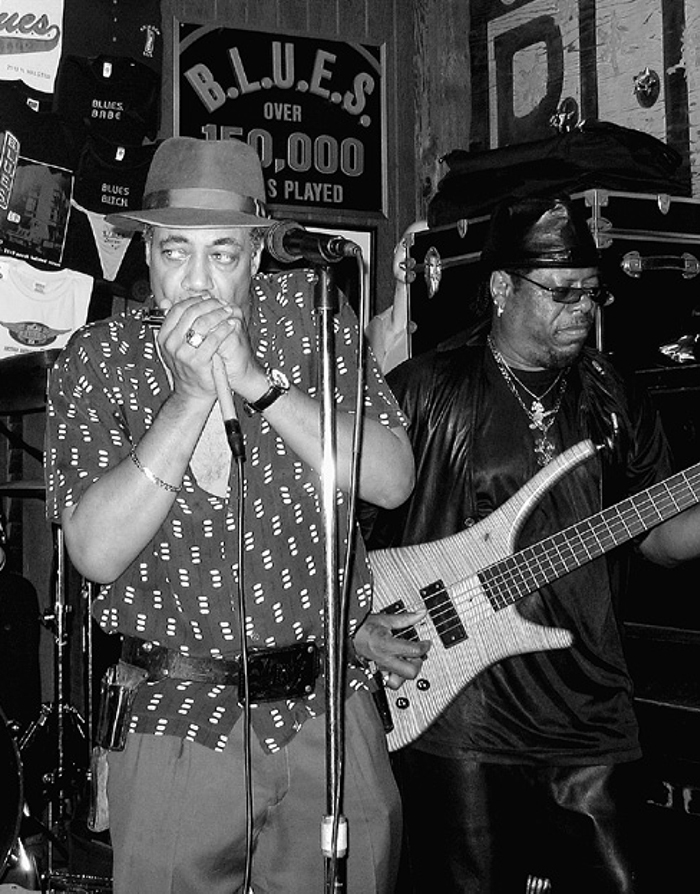
Billy Branch & The Sons of Blues play at B.L.U.E.S. in Chicago, November 13, 2005. In his work on blues culture in Chicago, David Grazian focuses on the search for authenticity and illustrates how the performance of race is a central component.
Theorizing Authenticity
Realist approaches to the study of authenticity in music often focus on how certain sounds and groups of people are seen to reflect the true essence of a musical genre. Often intertwined in these essentialist understandings of authentic music are rigidly defined associations between music and various forms of social difference (race, class, gender, sexuality, etc.). For example, a well-documented essentialist argument within music journalism is that authentic rock music is produced by singer/songwriters who are usually men, whereas inauthentic “pop” music is produced by women performers who do not write or produce their music. The centrality of realist approaches is that authentic music arises out of direct firsthand experience and reflects the essence of one's true cultural identity. Within this framework, authentic music is not commercial. In general, there is a distinction made between authentic culture on the one hand, and commercial culture on the other, with the former being valorized and the latter being demonized. Authentic music is music that has not been commodified and/or is produced by marginalized subcultures outside the musical mainstream.
Increasingly, there has been a shift toward constructionist understandings of authentic music. Social constructionist approaches focus on how authentic music is created through the social processes of “authenticity work” (people actively creating authenticity through authenticity claims) and authentication (people actively accepting or rejecting authenticity claims). People are actively involved in creating, classifying, and consuming what they consider to be authentic music. According to Richard Peterson, authenticity is “a claim that is made by or for someone, thing, or performance and either accepted or rejected by relevant others.”
...
- Aesthetics and Emotion
- Action Tendencies
- Aesthetic Response
- Affect
- Arousal, Emotional
- Authenticity
- Belief
- Circular Tones
- Cues and Signals
- Emotion
- Emotional Contagion
- Emotions, Aesthetic
- Emotions, Mixed
- Emotions, Primary and Secondary
- Empathy
- Evaluative Conditioning
- Meaning
- Mood
- Music Preference
- Musical Semantics
- Nostalgia
- Personality
- Rating Scales
- Relativism, Cultural
- Repetition
- Sad Music, Psychological Implications of
- Schema
- Style
- Subjectivity
- Syntax
- Tension
- Violence and Aggression
- Business and Technology
- Access, Digital
- Advertising
- Affordance and Appropriation
- Algorithm
- Appraisal
- Arthouse
- Authorship
- Classification, Music Store
- Computer Music
- Consumerism
- Copyright Law
- Copyright, Defined
- Driving While Listening to Music
- Green Music Alliance
- Lyrics
- Marketing
- Music Journalism
- Musical Instrument Digital Interface
- Pay to Play
- Payola (Radio)
- Phonograph
- Royalties
- Sectors, Music Industry
- Song
- Songwriting as Profession
- Touring
- Workout Playlists and Portable Devices
- Communities and Society
- Algerian Raï
- Antiestablishment Music
- Antiwar Music
- Apartheid
- Attunement and Affiliation
- Bards
- Blind Musicians
- Campaigns
- Civil Rights, U.S.
- Database Studies
- Diplomacy
- Ecological Validity
- Enculturation
- Fascism
- Fight Songs
- Generation
- Historical Musicology
- Indigenous Music
- Mass Hysteria
- Music Collectives
- Oral Tradition
- Patriotism
- Poetry
- Political Music
- Protest
- Race
- Revolutions
- Social History
- Spirituals
- Terrorism
- Troubadour
- War Music
- World Music
- Culture and Environment
- Anthems
- Anthropology
- Bimusicality
- Bird Song
- Cantometrics
- Chords, Perception of
- Classics
- Community Music
- Country Music
- Cultural Heritage
- Cultural Identity
- Cultural Meaning of Gender, Music and
- Cultural Renaissance
- Dance
- Death
- Drugs, Recreational
- Ecomusicology
- Environmental Causes and Campaigns
- Ethnocentricity
- Ethnographic Studies
- Ethnomusicology and Ethnomusicologists
- Everyday Uses of Music
- Fans
- Fieldwork
- Folk Music
- Gender
- Globalization
- Habitus
- Human Behavior, Music as
- Hymns
- Identity
- Imagery
- Immigrant Communities
- Inspiration
- Intellectual History
- Marching Bands
- Men
- Music Culture
- Music Festivals
- Music Traditions, Continuing
- Nature, Music in
- Performativity
- Philosophy
- Popular Music
- Primitive Music
- Prosody
- Religion
- Rituals
- Rock Concerts
- Social Networking
- Sociology of Music
- Soundscape
- Sports
- Street Musicians
- Subcultures
- Theater
- Tone Language
- Trance
- Urban Music
- Weddings
- Whale Songs
- Whistled Speech
- Women
- World Soundscape Project
- Elements of Musical Examination
- Analogy, Metaphor, and Narrative
- Analysis by Synthesis
- Architectural Acoustics
- Atonality
- Auditory Stream Segregation: Applications
- Auditory Stream Segregation: Boundaries
- Auditory System
- Behavioral Measures
- Brain Stem
- Case Studies
- Categorical Perception
- Closed Systems
- Closure
- Cochlear Implant
- Computer Models of Music
- Computer-Aided Musical Analysis
- Consonance and Dissonance
- Continuous Response Measurement
- Converging Evidence
- Correlational Study
- Critical Band
- Distraction
- Empirical Musicology
- Feature
- Features, Independence and Interaction of
- Fourier Analysis
- Generative Theory of Tonal Music
- Gesture
- Harmonicity
- Harmony
- Hearing Damage
- High Fidelity
- Humor
- Illusion
- Imaging Techniques
- Information-Processing Paradigm
- Instruments
- Intentionality
- Interval
- Intonation
- Loudness and Intensity
- Melody Processing
- Mode
- Music, Definitions of
- Musical Meme
- Musical Research, Causal Effects in
- Nature–Nurture
- Noise Versus Music
- Observation Techniques, Ethnomusicology
- Pattern
- Pitch Perception
- Pitch Perception: Development
- Pitch, Absolute
- Pitch, Models of
- Pitch, Relative
- Post-Tonal Music
- Probe-Tone Method
- Protolanguage
- Recognition
- Resource Sharing, Music and Language
- Scale
- Silence
- Sound
- Sound Engineering
- Systematic Musicology
- Timbre
- Tonal Pitch Space
- Tonality
- Tone
- Tuning Systems
- Vibrato
- Evolutionary Psychology
- Media and Communication
- Musicianship and Expertise
- Achievement, Musical
- Anxiety, Performance
- Arranging
- Articulation
- Audience
- Automaticity
- Body Movements
- Competitions, Classical and Popular
- Composition
- Conducting
- Creativity, Theories of Musical
- Drumming
- Education, Music
- Elite Performance
- Ensemble Performance
- Expertise
- Expressivity
- Fame and Esteem
- Fingering
- Genius
- Giftedness and Talent
- Grouping
- Improvisation
- Intelligence
- Interpretation
- Large-Scale Structure
- Learning and Teaching
- Lessons, Music
- Motor Skill Acquisition
- Movement
- Music Analysis
- Musical Aptitude, Tests of
- Musicking
- Nonmusical Abilities
- Notation
- Originality, Measures of
- Ornamentation
- Performance
- Practice
- School Bands and Choirs
- Sight Reading
- Singing, Acoustics
- Singing, Pedagogy of
- Singing, Psychology of
- Statistical Learning
- Theory
- Training
- Voice and Musical Identity
- Voice Leading, Rules of
- Neuroscience
- Achievement, Academic
- Applied Musicology
- Arousal, Science of
- Attention
- Brain Specialization for Music
- Brain Waves
- Cognition and Learning, Childhood
- Cognitive Constraints
- Critical Period
- Entrainment
- Episodic Memory
- Facial Expression
- Fetal Development
- Genetic Basis of Music
- Hemispheric Asymmetry
- Hormones
- Immune System
- Melodic Intonation Therapy
- Mirror Neurons
- Modularity
- Motivation
- Mozart Effect
- Music Exposure, Short-Term Effects of
- Music Training, Long-Term Effects of
- Neural Network Models
- Neurotransmitters
- Parkinson's Disease
- Physiological Responses, Peripheral
- Plasticity
- Prodigy
- Psychoacoustics
- Psychoanalysis
- Second Language Acquisition
- Sleep
- Perception, Memory, and Cognition
- Accent
- Agency
- Auditory Stream Segregation: Applications
- Auditory Stream Segregation: Boundaries
- Background Music
- Circle of Fifths
- Complexity
- Decoding
- Dissociation
- Earworms
- Embodied Cognition
- Executive Function
- Expectancy
- Expressive Timing
- Feedback, Role of
- Fusion
- Gestalt
- Hierarchical Organization
- Implication–Realization
- Implicit Learning
- Individual Differences
- Memory
- Meter
- Modulation
- Multimodality
- Music Cognition
- Perception
- Priming
- Rhythm
- Roughness and Beats
- Semiotics
- Similarity, Melodic
- Structure
- Synaesthesia
- Tactus and Pulse
- Tempo
- Theory of Mind
- Timing
- Transfer Effects
- Politics, Economics, and Law
- Therapy, Health, and Well-Being
- Aging
- Autism Spectrum Disorder
- Belonging
- Cancer
- Communicative Musicality
- Cooperation
- Dementia
- Health and Wellness
- Health Care
- Health, Public
- Intimacy and Affiliation
- Language Disorders
- Meditation
- Mental Health
- Music Thanatology and Hospice Care
- Music Therapy
- Music Therapy Methods
- Music Therapy Models
- Musical Disorders
- Pain
- Prevention
- Rehabilitation
- Relaxation
- Rhythmic Auditory Entrainment
- Self-Esteem
- Social Bonding
- Social Exclusion
- Special Needs
- Speech Therapy
- Spirituality
- Stroke
- Suicide
- Synchronization
- Teamwork, Music Education and
- Trauma, Post-Traumatic Stress Disorder
- Vibrotactile Devices for the Deaf
- Well-Being
- Workout Playlists and Portable Devices
- Loading...
Get a 30 day FREE TRIAL
-
 Watch videos from a variety of sources bringing classroom topics to life
 -
Read modern, diverse business cases
-
Explore hundreds of books and reference titles

Read next

More like this
Sage Recommends
We found other relevant content for you on other Sage platforms.
Have you created a personal profile? Login or create a profile so that you can save clips, playlists and searches