
Entry
Reader's guide
Entries A-Z
Subject index
Ukrainian Americans
Ukraine is an Eastern European country often erroneously called “the Ukraine” in English. Formerly controlled by the Mongols, Lithuania, Poland, the Russian and Austro-Hungarian Empires, and the Soviet Union, it is today an independent democracy and the second largest country on the European continent after Russia. It was one of the founding republics of the Soviet Union in 1922 and regained its independence in 1991 after the fall of European communism.
As of the 2010 Census, there are 939,746 Ukrainian Americans, making this one of the largest Ukrainian communities in the world. Ukrainians are well distributed through the United States and tend to concentrate mainly in northern cities— New York City, Philadelphia, Chicago, Detroit, and Cleveland, although Los Angeles also has a notable population of 34,000 Ukrainian Americans. Though a Ukrainian was among the settlers of the Jamestown colony in the early 17th century, sustained Ukrainian immigration did not begin until the 1880s. These early immigrants, arriving from the 1880s until the 1920s (when new immigration restrictions curtailed the number of immigrants arriving from eastern Europe), established the country's oldest Ukrainian American enclaves, especially in New York City, Chicago, and Philadelphia. More recent immigration has been in response to the fall of the Soviet Union and has included a substantially greater number of Jewish Ukrainians than did the earlier wave.
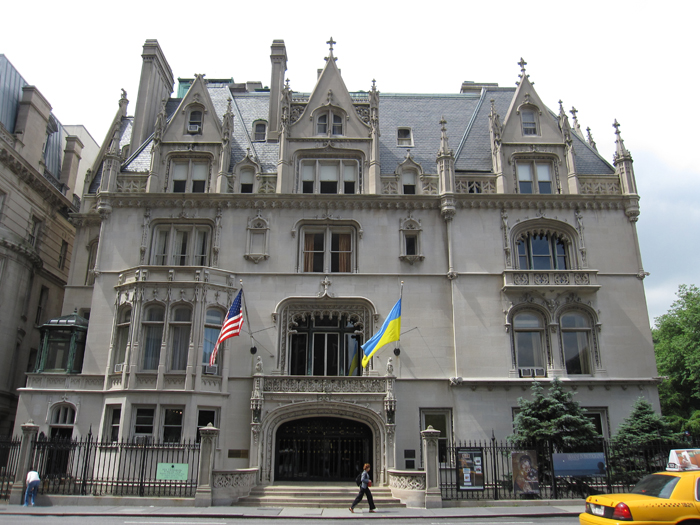
The Harry F. Sinclair House is a mansion in Manhattan in New York City and houses the Ukrainian Institute of America (UIA). It is open to the public and promotes art and literature by hosting exhibitions and other shows. The UIA is a nonprofit organization founded in 1948 to promote Ukrainian culture, history, art, music, and literature.
A number of George Washington's soldiers in the Revolutionary War were Ukrainian Americans, as were several Union soldiers in the Civil War. Thousands more served in World War II, after the community had become better established and larger. Ukrainian Americans have been politically active and have tended to be conservative, especially since the end of World War I; historically, Ukrainian Americans have supported the Republican Party despite usually being pro-labor. Throughout the years between World War I and World War II, Ukrainian Americans were involved in political demonstrations against the occupation of Ukraine by Poland and the treatment of Ukraine by the Soviet Union.
Ukrainian Religion
Ukrainian immigrants in the 19th and early 20th centuries came primarily from the Orthodox Christian faith and Greek Catholicism, though many Greek Catholic families eventually converted to Orthodoxy. An independent Ukrainian Orthodox Church for North America was first founded in 1915 with the union of several unaffiliated parishes that had formed to serve the religious needs of the Ukrainian American community. At the time, Ukrainian religious identity in the larger Orthodox community was under attack; a leader in the Russian Orthodox community, Archbishop Alexander, had dismissed the entire concept of a Ukrainian ethnic identity, describing them as “a Russian political party” who were not sufficiently distinguishable from Russians. It was certainly not comforting that many western European Americans held much the same belief, barely distinguishing between the various countries east of Germany. Despite Alexander's remarks, upon Ukraine's declaration of independence in 1918, the Ukrainian Autocephalous Orthodox Church (UAOC) formed, distinct from Russian Orthodoxy, and the American Ukrainian Orthodox parishes sought association with it. The UAOC appointed Metropolitan John to head a North American diocese in 1924, and he spent the next several years organizing the American parishes. The church became known as the Ukrainian Orthodox Church (UOC) of the USA.
...
- Part I: U.S. Census Essays
- African American Categorization
- Age Distribution
- Alaska Native Categorization
- American Indian Categorization
- Asian American Categorization
- Category Controversies
- Census Data and Multicultural Research
- Demographics and Ethnic Diversity
- Ethnic/Racial Group Data
- Family and Marital Patterns
- Gender/Sex
- Hispanic/Latino Categorization
- History of the Census
- Multiple Race Categorization
- Native Hawai'ian Categorization
- Occupational Patterns
- Pacific Islander Categorization
- Racial and Ethnic Definitions
- Regional Patterns
- Residential Patterns
- Socioeconomic Patterns
- White Categorization
- Part II: A-to-Z Articles Concepts
- E Pluribus Unum
- Abolition
- Acculturation/Assimilation
- Affirmative Action/Equal Opportunity
- Afrocentrism
- Americanization
- Colorism
- Constructivism, Intercultural
- Critical Race Theory
- Cross-Cultural Psychology
- Cultural Competence
- Culture
- Culture Shock
- Desegregation/Integration
- Diaspora
- Digital Divide, The
- Discourse
- Diversity
- Diversity and Inclusion
- Diversity Training
- Equity and Equality
- Ethics
- Ethnicity
- Ethnoburbs
- Ethnocentrism/Xenophobia
- Eugenics
- Genocide
- Gerrymandering
- Hegemony
- High/Low Context Cultures
- Identity Development
- Melting Pot
- Metrics of Diversity (Business)
- Multiculturalism
- Nativism
- Passing/Covering
- Perspectivism
- Pluralism
- Political Correctness
- Privilege
- Race
- Racism
- Relativism
- Research, Cultural Variables in
- Roles, Social and Cultural
- Segregation
- Sharecropping
- Stereotypes/Generalizations
- Tipping
- Tolerance
- Whiteness Studies
- Education
- Brown v. Board of Education of Topeka (1954)
- Cooper v. Aaron (1958)
- Ho v. San Francisco Unified School District (1994)
- Lau v. Nichols (1974)
- McLaurin v. Oklahoma State Regents (1950)
- Mendez v. Westminster (1946)
- Milliken v. Bradley (1974)
- Plyler v. Doe (1982)
- Regents of the University of California v. Bakke (1978)
- Swann v. Charlotte-Mecklenburg Board of Education (1971)
- Sweatt v. Painter (1950)
- Advancement via Individual Determination
- Anti-Racist Education
- Bilingual Education
- Carlisle Indian Industrial School
- Chief Diversity Officers
- Compensatory Education
- Cooperative/Collaborative Learning
- Counseling and Therapy, Multicultural
- Critical Pedagogy
- Culturally Responsive Pedagogy/Culturally Relevant Teaching
- Curricular Integration
- Diversity Assessment Instruments
- Dual (Two-Way) Immersion Education
- Educational Achievement
- Elementary and Secondary Education Act (1965 and Reauthorizations)
- Emotional Intelligence
- English as a Second Language Education
- English-Language Learners
- Ethnic Studies
- Funds of Knowledge
- Global Education
- Haskell Indian Nations University
- Head Start
- Hebrew Union College-Jewish Institute of Religion
- Higher Education
- Hispanic-Serving Institutions
- Historically Black Colleges and Universities
- Indian Boarding Schools
- Indian Education Act (1992)
- Indian Self-Determination and Education Assistance Act (1975)
- Intelligence Testing
- Intercultural Education
- Intergroup Education
- International Education
- Intersectionality
- Jewish Theological Seminary
- Knowledge Construction
- Little Rock School Desegregation
- Movimiento Estudiantil Chicano de Aztlán
- Multicultural Education
- Multiple Intelligences
- Muslim Students Association
- National Association for Bilingual Education
- National Association for Multicultural Education
- No Child Left Behind Act (2001)
- Office of Bilingual Education and Minority Languages
- Office of English Language Acquisition
- Oppositional Culture
- School Desegregation
- School Segregation
- Special Education
- Stereotype Threat
- Teachers of English to Speakers of Other Languages
- Textbook Treatment of Ethnic Groups
- Tuskegee Normal and Industrial Institute
- Whiteness Studies
- Ethnic Culture
- “Lift Every Voice and Sing”
- Apollo Theater
- Barrio
- Chinatowns
- Cinco de Mayo
- Cofradía
- Corrido
- Cotton Club
- Curandero
- Día de los Muertos
- Feng Shui
- Folklórico
- Food
- Ghetto
- Gospel Music
- Harlem Globetrotters
- Harlem Renaissance
- Havurot
- Health Beliefs and Practices
- Herbalism
- Hip-Hop
- Karaoke
- Kwanzaa
- Kye
- Little Italy
- Lore
- Machismo
- Mafia
- Mahjar
- Marianismo
- Martial Arts
- Mutual Aid Societies
- Mutualista
- Negro Baseball Leagues
- Patrón System
- Potlatch
- Powwow
- Quinceañera
- Roles, Social and Cultural
- Santería
- Slave Narratives
- St. Patrick's Day
- Sweat Lodge
- Tanamoshi
- Teatro Campesino, El
- Time, Differing Cultural Conceptions of
- Tong
- Yiddish Theater
- Ethnic Groups and Clusters
- Afghan Americans
- African Americans
- Albanian Americans
- Aleuts
- Algonquian-Speaking Tribes
- Apache
- Appalachians
- Arab Americans
- Arapaho
- Argentine Americans
- Armenian Americans
- Asian Americans
- Australian Americans
- Austrian Americans
- Bangladeshi Americans
- Basque Americans
- Belarusian Americans
- Belgian Americans
- Blackfoot
- Bolivian Americans
- Brazilian Americans
- Bulgarian Americans
- Cajuns
- Cambodian Americans
- Canadian Americans
- Cape Verdean Americans
- Caribbean Americans
- Carpatho-Rusyn Americans
- Chaldean Americans
- Cherokee
- Cheyenne
- Chicanos
- Chickasaw
- Chilean Americans
- Chinese Americans
- Choctaw
- Colombian Americans
- Comanche
- Costa Rican Americans
- Creoles
- Croatian Americans
- Crow
- Cuban Americans
- Cypriot Americans
- Czech Americans
- Danish Americans
- Dominican Americans
- Dutch Americans
- Ecuadorian Americans
- Egyptian Americans
- English Americans
- Eskimos
- Estonian Americans
- European Americans
- Filipino Americans
- Finnish Americans
- Flemish Americans
- French Americans
- French Canadian Americans
- German Americans
- Greek Americans
- Guatemalan Americans
- Guyanese Americans
- Haitian Americans
- Hapa
- Havasupai
- Hawai'ians (Native)
- Hindu Americans
- Hispanic Americans
- Hmong Americans
- Honduran Americans
- Hopi
- Hungarian Americans
- Icelandic Americans
- Indian (Asian) Americans
- Indonesian Americans
- Iranian Americans
- Iraqi Americans
- Irish Americans
- Israeli Americans
- Italian Americans
- Jamaican Americans
- Japanese Americans
- Jordanian Americans
- Kiowa
- Klamath
- Korean Americans
- Kurdish Americans
- Laotian Americans
- Latinos
- Latvian Americans
- Lebanese Americans
- Lenape
- Lithuanian Americans
- Lumbee
- Luxembourgian Americans
- Macedonian Americans
- Maltese Americans
- Mexican Americans
- Mohawk
- Muscogee (Muskogee)
- Narragansett
- Native Americans
- Navajo
- New Zealand Americans
- Nez Perce
- Nicaraguan Americans
- Nigerian Americans
- Northern Irish Americans
- Norwegian Americans
- Nuyoricans
- O'odham Tribes
- Odawa
- Ojibwe
- Omaha
- Oneida
- Osage
- Pacific Islander Americans
- Paiute
- Pakistani Americans
- Palestinian Americans
- Panamanian Americans
- Paraguayan Americans
- Pennsylvania Dutch
- Peruvian Americans
- Polish Americans
- Polynesian Americans
- Portuguese Americans
- Pueblo
- Puerto Ricans
- Roma Americans
- Romanian Americans
- Russian Americans
- Salvadoran Americans
- Samoan Americans
- Saudi Americans
- Scandinavian Americans
- Scots-Irish Americans
- Scottish Americans
- Seminole
- Seneca
- Serbian Americans
- Shawnee
- Shoshone
- Sicilian Americans
- Sioux
- Slovak Americans
- Slovene Americans
- Spanish Americans
- Spokane
- Sri Lankan Americans
- Swedish Americans
- Swiss Americans
- Syrian Americans
- Taiwanese Americans
- Thai Americans
- Trinidadian and Tobagonian Americans
- Turkish Americans
- Ukrainian Americans
- Uruguayan Americans
- Ute
- Venezuelan Americans
- Vietnamese Americans
- Virgin Island Americans
- Wampanoag
- Welsh Americans
- West Indian Americans
- Wyandot
- Yakama
- Federal Government
- Armed Forces, U.S.
- Bureau of Indian Affairs
- Cabinet Secretaries
- Canal Zone
- Commission on Civil Rights, U.S.
- Congressional Black Caucus
- Congressional Hispanic Caucus
- Congressional Hispanic Conference
- Customs and Border Protection, U.S.
- Dillingham Commission (United States Immigration Commission)
- Environmental Protection Agency, U.S.
- Equal Employment Opportunity Commission, U.S.
- Executive Actions
- Freedmen's Bureau
- Gentlemen's Agreement (1907)
- House of Representatives, U.S.
- Immigration and Customs Enforcement, U.S.
- Indian Claims Commission
- Indian Health Service
- Minority Business Development Agency
- Presidency, U.S.
- Senate, U.S.
- Supreme Court, U.S.
- History
- American Dilemma, An
- Audacity of Hope, The Aztlán
- Bury My Heart at Wounded Knee
- Century of Dishonor, A
- Custer Died for Your Sins: An Indian Manifesto
- Different Mirror, A
- El Norte
- Occupied America: A History of Chicanos
- Other America, The Pan-Africanism
- Rage of a Privileged Class, The Reconstruction
- Rise of the Unmeltable Ethnics, The Slave Revolts
- Souls of Black Folk, The Spanish Land Grants
- Uprooted, The White Supremacy
- Abolitionist Movement
- Alaska Purchase
- Alcatraz Island, Occupation of
- American Indian Movement
- Angel Island
- Asian American Movement
- Back to Africa Movement
- BiDil Controversy
- Black Hills Dispute and War
- Black Power Movement
- Boston Tea Party
- Brooklyn Dodgers
- César Chávez Day
- California Gold Rush
- Chicano Moratorium
- Chicano Movement
- Civil Rights Movement
- Columbus Day
- Creek Confederacy
- Declaration of Independence
- Election 2012 and the 2010 Census
- Ellis Island
- Emancipation
- Freedom Riders
- Freedom Schools
- Gadsden Purchase
- Gold Mountain
- Great Depression
- Great Migration
- Hate Crimes
- Hawai'i, Annexation of
- History/Heritage Months
- Holocaust, The
- Indian Casinos
- Indian Territory
- Indigenous People's Day
- Irish Potato Famine
- Iroquois Confederacy
- Japanese American Internment
- Juneteenth
- Kerner Commission Report
- Know-Nothing Movement
- Long Walk of the Navajo
- Louisiana Purchase
- Lynchings
- Manifest Destiny
- March on Washington for Jobs and Freedom
- Martin Luther King, Jr. Day
- Mason-Dixon Line
- Middle Passage
- Million Man March
- Missouri Compromise (1820)
- Montgomery Bus Boycott
- Navajo-Hopi Land Dispute
- New Netherland
- Pan-Indianism
- Picture Brides
- Poll Taxes
- Powhatan Confederacy
- Protocol of Querétaro (1848)
- Race Riots
- Reservations, Native American
- Restrictive Covenant
- Slave Trade
- Slavery
- Spanish Missions
- St. Augustine
- Statue of Liberty
- Trail of Tears
- Tuskegee Syphilis Experiments
- Underground Railroad
- Wounded Knee Massacre and Incident
- Ybor City
- Yellow Peril
- Zionism
- Immigration, Naturalization, and Citizenship
- United States v. Bhagat Singh Thind (1923)
- Adoption, Transnational/Transracial
- Amnesty
- Bracero Program
- Citizenship
- Coverture Laws
- Deportation (Repatriation)
- Displaced Persons Act (1948)
- DREAM Act
- Dual Citizenship
- Illegal Immigration Reform and Immigrant Responsibility Act (1996)
- Immigrants, Undocumented
- Immigration Acts
- Immigration Reform and Control Act (1986)
- Immigration, Illegal
- Indian Citizenship Act (1924)
- Indigenous Transnationality
- Indochina Migration and Refugee Assistance Act (1975)
- Mariel Boatlift
- Naturalization
- Naturalization Acts
- Operation Gatekeeper
- Operation Wetback
- Palmer Raids
- Philippine Independence Act (1934)
- Refugee Act (1980)
- Refugee Relief Act (1953)
- Refugees
- Repatriation Program
- Resident Aliens
- Sanctuary Movement
- War Refugee Board
- Intergroup Contact, Intermarriage, and Multiethnic Identity
- Loving v. Virginia (1967)
- Pérez v. Sharp (1948)
- Amerasian
- Anti-Miscegenation Laws
- Eurasian
- High Yellow
- Implicit Association Test
- Intercultural Communication
- Intercultural Communication Institute
- Intercultural Competence
- Interculturalism
- Intergroup Contact Theory
- Intermarriage Court Decisions
- Intermarriage Demographic Trends
- Intermarriage, History of
- Métis
- Mestizo
- Microaggressions/Microinequities
- Miscegenation
- Mixed-Race Americans
- Mulatto
- Multiracial Movement
- Pigmentocracy
- Quadroon
- Race Mixture in the United States (History)
- Raza Cósmica, La
- War Brides
- Intersections With Ethnicity
- Age and Ethnic Diversity
- Agriculture and Ethnic Diversity
- Art and Ethnic Diversity
- Baseball and Ethnic Diversity
- Basketball and Ethnic Diversity
- Boxing and Ethnic Diversity
- Class and Ethnic Diversity
- Classical Music and Ethnic Diversity
- Clothing and Ethnic Diversity
- Criminal Justice and Ethnic Diversity
- Cuisine and Ethnic Diversity
- Dance and Ethnic Diversity
- Disability and Ethnic Diversity
- Epidemiology and Ethnic Diversity
- Ethnopharmacology
- Family and Ethnic Diversity
- Feminism and Ethnic Diversity
- Folk Music and Ethnic Diversity
- Food Processing and Ethnic Diversity
- Football and Ethnic Diversity
- Gender/Sex and Ethnic Diversity
- Generations and Ethnic Diversity
- Health Disparities and Ethnic Diversity
- Jazz and Ethnic Diversity
- Law and Ethnic Diversity
- Literature and Ethnic Diversity
- Manufacturing and Ethnic Diversity
- Media Treatment of Ethnicity and Race
- Media, Ethnic
- Media, Ethnic Participation in
- Medicine and Ethnic Diversity
- Music and Ethnic Diversity
- Musical Theater and Ethnic Diversity
- Opera and Ethnic Diversity
- Politics and Ethnic Diversity
- Popular Music and Ethnic Diversity
- Public Health and Ethnic Diversity
- Religion and Ethnic Diversity
- Rock Music and Ethnic Diversity
- Science and Technology
- Sexual Orientation and Ethnic Diversity
- Soccer and Ethnic Diversity
- Sports and Ethnic Diversity
- Theater and Ethnic Diversity
- Track and Field and Ethnic Diversity
- Language
- http://GobiernoUSA.gov
- African American Vernacular English
- Algonquian Languages
- Algonquian-Speaking Tribes
- Bilingual Ballots
- Bilingualism
- Caló
- English Language: Ethnic and Regional Variations
- Epithets, Ethnic and Racial
- Estadounidismos
- Hate Speech
- Labels
- Language Brokers
- Language Usage in the United States
- Media, Foreign Language
- N _____ Word, The
- Native American Languages Acts
- Natualization Language Requirements
- Official English Movement
- Spanglish
- Speech Codes
- Telemundo
- Translators/Interpreters
- Tribal Enrollment
- Yiddish
- Laws, Treaties, and Court Decisions
- Brendale v. Confederated Tribes of the Yakima Nation (1989)
- California v. Cabazon Band of Mission Indians (1987)
- Cherokee Nation v. Georgia (1831)
- Dred Scott v. Sandford (1857)
- Fisher v. University of Texas (2013)
- Hernández v. Texas (1954)
- Irene Morgan v. Commonwealth of Virginia (1946)
- Lone Wolf v. Hitchcock (1903)
- Montana v. United States (1981)
- Nishikawa v. Dulles (1958)
- Patterson v. Alabama (1935)
- Plessy v. Ferguson (1896)
- Ricci v. DeStefano (2009)
- Santa Clara Pueblo v. Martinez (1978)
- Shelley v. Kraemer (1948)
- Smith v. Allwright (1944)
- Worcester v. Georgia (1832)
- Adams-Onís Treaty (1819)
- Alaska Native Claims Settlement Act (1971)
- Alien and Sedition Acts (1798)
- Alien Land Laws
- American Indian–U.S. Government Treaties
- Arizona Support Our Law Enforcement and Safe Neighborhoods Act (2010)
- Bill of Rights
- Black Codes
- California Propositions (187, 209, and 227)
- Chinese Exclusion Act (1882)
- Civil Rights Acts
- Constitution, U.S.
- Constitutional Amendments
- Cuban Refugee Adjustment Act (1966)
- Dawes Act (1887)
- Emancipation Proclamation (1863)
- Federal Indian Trust
- Fort Laramie, Treaty of (1868)
- Fugitive Slave Acts
- Gentlemen's Agreement (1907)
- Grandfather Clauses
- Guadalupe Hidalgo, Treaty of (1848)
- Hate Crimes Laws
- Homestead Act (1862)
- Indian Appropriation Acts
- Indian Child Welfare Act (1978)
- Indian Civil Rights Act (1968)
- Indian Removal Act (1830)
- Indian Reorganization Act (1934)
- Jim Crow Laws
- Kansas-Nebraska Act (1854)
- Scottsboro Boys Trials
- Servicemen's Readjustment Act (1944)
- Sleepy Lagoon Case
- Voting Rights Acts
- Wheeler-Howard Act (1934)
- Media
- Organizations and Institutions
- A. Philip Randolph Institute
- Alianza Hispano Americana
- All Indian Pueblo Council
- American Anti-Slavery Society
- American Colonization Society
- American Council for Polish Culture
- American G.I. Forum
- American Jewish Committee
- American Jewish Congress
- American-Arab Anti-Discrimination Committee
- American-Islamic Relations, Council on
- Ancient Order of Hibernians
- Anti-Defamation League
- Arab American Institute
- Armenian Network of America
- Aryan Nations
- Asiatic Exclusion League
- Association for the Study of African American Life and History
- B'nai B'rith
- Black Panther Party
- Brown Berets
- Chinese American Citizens Alliance
- Chinese Consolidated Benevolent Association
- Congress of Racial Equality
- Cuban American National Foundation
- Great Lakes Indian Fish and Wildlife Commission
- Hadassah
- Hispanic Chamber of Commerce, U.S.
- Immigration History Research Center
- Iroquois Confederacy
- Japanese American Citizens League
- Jewish Federation
- Ku Klux Klan
- League of United Latin American Citizens
- Mexican American Legal Defense and Education Fund
- Mexican American Political Association
- Mexican American Youth Organization
- Museum of Tolerance
- NAACP Legal Defense and Educational Fund
- National Association for the Advancement of Colored People
- National Association of Latino Elected and Appointed Officials
- National Civil Rights Museum
- National Conference for Community and Justice
- National Congress of American Indians
- National Congress of Black Women
- National Council of Jewish Women
- National Council of La Raza
- National Council of Negro Women
- National Hispanic Media Coalition
- National Indian Youth Council
- National Museum of the American Indian
- National Negro Business League
- National Puerto Rican Forum
- National Rainbow Coalition/PUSH
- National Urban League
- Order Sons of Italy in America
- Organization of Chinese Americans
- Polish American Historical Association
- Puerto Rican Legal Defense and Education Fund
- Raza Unida, Partido de la
- Southern Christian Leadership Conference
- Southern Poverty Law Center
- Southwest Voter Registration Education Project
- Student Non-Violent Coordinating Committee
- Tomás Rivera Policy Institute
- United Farm Workers of America
- United Negro College Fund
- Universal Negro Improvement Association and African Communities League
- World Jewish Congress
- Young Lords
- People (Groups)
- Popular Culture Image
- Abie's Irish Rose
- All in the Family
- Amos ‘n Andy Show, The
- Annie Hall
- Beloved
- Beulah Show, The
- Birth of a Nation, The
- Boyz N the Hood
- Call Northside 777
- Carmen Jones
- Chan Is Missing
- Cheyenne Autumn
- Cisco Kid, The
- Color Purple, The
- Cosby Show, The
- Dances With Wolves
- Deer Hunter, The
- Defiant Ones, The
- Deliverance
- Dirty Dancing
- Do the Right Thing
- Dora the Explorer
- Ebony
- El Norte
- Fences
- Flower Drum Song
- Funny Girl
- Gentleman's Agreement
- Giant
- Glory
- Go Tell It on the Mountain
- Godfather, The
- Goldbergs, The
- Gone With the Wind
- Gran Torino
- Guess Who's Coming to Dinner
- Help, The
- Home of the Brave
- House Made of Dawn
- I Know Why the Caged Bird Sings
- I Love Lucy
- I Remember Mama
- I Spy
- Imitation of Life
- In the Heat of the Night
- In the Heights
- Jazz Singer, The
- Joy Luck Club, The
- Jungle, The
- Karate Kid, The
- La Bamba
- Last of the Mohicans, The
- Little Big Man
- Moonstruck
- Native Son
- On the Waterfront
- Oprah Winfrey Show, The
- Pawnbroker, The
- Pinky
- Pocahontas
- Porgy and Bess
- Raisin in the Sun, A
- Rocky
- Roots
- Sanford and Son
- Saturday Night Fever
- Scarface
- Searchers, The
- Seinfeld
- Sesame Street
- Shaft
- Show Boat
- Siege, The
- Sounder
- Stand and Deliver
- Stormy Weather
- Streetcar Named Desire, A
- Thriller
- To Kill a Mockingbird
- Tree Grows in Brooklyn, A
- Ugly Betty
- Uncle Tom's Cabin
- West Side Story
- Witness
- Woman Warrior, The
- Zoot Suit
- Academy Awards
- Black Entertainment Television
- Blackface
- Blaxploitation Films
- Chan, Charlie
- Desilu Productions
- Hollywood Film Music and Ethnic Diversity
- Mascots, Native American (Sports)
- Motion Picture Production Code
- Motown
- Univision
- Religion, Spirituality, and Ethnicity
- Abrahamic Religions
- African Methodist Episcopal Church
- Amana Colonies
- American Indian Religious Freedom Act (1978)
- Amish
- Anti-Semitism
- Beth Din
- Black Muslims
- Coptic Christian Americans
- Día de los Reyes Magos
- Gentiles
- Ghost Dance
- Halakha
- Halal
- Hijab
- Jehovah's Witnesses
- Jewish Americans
- Kirpan
- Kosher
- Mormons
- Muslim Americans
- Nation of Islam
- Native American Church
- Penitentes
- Qur'an
- Ramadan
- Santería
- Shaman
- Sharia
- Sikhs
- Yeshiva
- Wars and Revolution
- Korematsu v. United States (1944)
- 442nd Regimental Combat Team
- 65th Infantry Regiment
- Alamo, Battle of the
- American Revolution
- Anglo-Powhatan Wars
- Bay of Pigs Invasion
- Bear Flag Revolt
- Black Hills Dispute and War
- Buffalo Soldiers
- Camp Grant Massacre
- Cart War
- Civil War, U.S.
- Code Talkers
- El Paso Salt War
- Executive Order 8802 (1941)
- Executive Order 9066 (1942)
- Fallen Timbers, Battle of
- French and Indian War
- Great Sioux War
- Harpers Ferry Raid
- King Philip's War
- Little Bighorn, Battle of
- Lord Dunmore's War
- Mexican Revolution
- Mexican-American War
- Philippine-American War
- Pueblo Revolt (1680)
- Red River War
- San Jacinto, Battle of
- San Pascual, Battle of
- Sand Creek Massacre
- Seminole Wars
- Spanish-American War
- Taos Revolt
- Tecumseh's War
- Tuskegee Airmen
- Vietnam War
- War in Afghanistan and Iraq
- War of 1812
- Washita River, Battle of the
- World War I
- World War II
- Zoot Suit Riots
- Loading...
Get a 30 day FREE TRIAL
-
 Watch videos from a variety of sources bringing classroom topics to life
 -
Read modern, diverse business cases
-
Explore hundreds of books and reference titles

Read next

More like this
Sage Recommends
We found other relevant content for you on other Sage platforms.
Have you created a personal profile? Login or create a profile so that you can save clips, playlists and searches