
Entry
Reader's guide
Entries A-Z
Subject index
Medea
In Greek mythology, Medea is portrayed as a witch or sorceress and is treated as a representative of a barbarian, pre-Hellenic culture. Medea is a cultural archetype of a woman seeking revenge, although some modern interpretations emphasize the injustice done to her by Jason, and her role as an outsider in Greek culture.
In Euripides's famous play, Medea falls in love with Jason during his quest for the Golden Fleece, using her magical powers as the priestess of Hecate, the granddaughter of the sun god, Helius, and the niece of Circe, to help him attain his quest. She returns to Greece with him: they marry and have two sons. When Jason casts her off as a foreigner in order to marry the king's daughter, she then uses her significant powers for the first time against him, burning his new wife, and, according to Euripides, killing her own sons as the ultimate punishment against him. Medea is shown as a powerful woman of legend who breaks from the maternal expectations of nurturing. Traditionally regarded as a witch in her use of herbal concoctions to gain her ends, she is a wronged woman who makes use of her skills to assert her will.
The tale begins when Jason journeys to Colchis in search of the Golden Fleece, the king sets various arduous tasks before him in order to allow him to take the fleece back to Greece. Hera and Aphrodite make Medea fall in love with Jason, and when Jason promises Medea marriage, she uses her magical abilities to help him gain the fleece, giving him an ointment to protect him from fire-breathing bulls and a dragon. As Medea leaves with Jason and the Argonauts, they kill and throw her brother into the sea, dismembering his body to delay her father. Only when Medea and Jason marry do the Colchians finally give up pursuit. In these adventures, Medea uses her magical powers controversially, but Jason accepts these actions as they are in his favor. She abandons her family and destroys her brother because of her great love of a foreigner, thereby placing herself in the vulnerable position of becoming an outsider in future events.
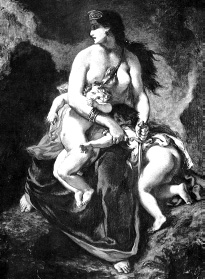
Medea is pictured about to murder her children in an 1862 painting by Eugène Ferdinand Victor Delacroix.
When they return to Iolcus, Pelias reneges on his agreement to restore the throne to Jason. Medea again displays her magic, restoring Jason's father Aeson to youth by cutting him up and placing him in a cauldron with magic herbs, from which he emerges rejuvenated. Persuaded by this demonstration, the daughters of Pelias want her to use the same magic with their father, but this time Medea omits the magic elixir, thereby killing Jason's rival. However, this still does not enable Jason to gain the throne, and they are driven away by Pelias's son into Corinth.
After Medea has two sons, Jason discards his family, and then makes a politically astute marriage to King Creon's daughter Creusa. Medea voices her grief, wishing she were dead, and hints at the murder of her sons. The characters in the play both fear and respect Medea for her unmasterable skills and ruthlessness, which appear all the more striking in a woman, although Jason attempts to diminish her achievements and calls her behavior sexual jealousy. When she confides her plan to the Chorus, they are appalled at the idea of her killing her own children, but she suggests this is the best way to wound Jason, even if she also wounds herself.
...
- History of Motherhood
- Bible, Mothers in the
- Clytemnestra
- History of Motherhood: 1000 to 1500
- History of Motherhood: 1500 to 1750
- History of Motherhood: 1750 to 1900
- History of Motherhood: 1900 to Present
- History of Motherhood: 2000 B.C.E. to 1000 C.E.
- History of Motherhood: American
- History of Motherhood: Ancient Civilizations
- History of Motherhood: Middle Ages
- History of Motherhood: Renaissance
- Jocasta
- Medea
- Myth, Mothers in
- Issues in Motherhood
- “Bad” Mothers
- Abortion
- Anger
- Anxiety
- Attachment Parenting
- Bisexuality
- Body Image
- Celebrity Motherhood
- Child Poverty
- Class and Mothering
- Co-Parenting
- Code Pink
- Conflict Zones, Mothering in
- Cybermothering
- Employment and Motherhood
- Empowered Mothering
- Ethics of Care
- Ethics, Maternal
- Freud, Sigmund
- Girlhood and Motherhood
- Lone Mothers
- Maternal Absence
- Maternal Agency
- Media, Mothers in
- Momism Generation of Vipers
- Motherhood Denied
- Mothering as Work
- Mothering Versus Motherhood
- Mothers Who Leave
- Mothers' Pensions/Allowances
- Myths of Motherhood: Good/Bad
- New Momism
- Nonresidential Mother
- Older Mothers
- Opt-Out Revolution
- Peace and Mothering
- Planned Parenthood
- Poverty and Mothering
- Pronatalism
- Prostitution and Motherhood
- Race and Racism
- Refugee Mothers
- Reproductive Justice/Rights Movements
- Second Shift/Third Shift
- Security Mom
- SisterSong
- Slavery and Mothering
- Social Action and Motherhood
- Spock, Benjamin
- Taxation and Motherhood
- Technology and Motherhood
- Teen Mothers
- Terrorism and Mothering
- Third Wave Foundation
- Transgender Parenting
- Transracial Mothering
- Unions and Mothers
- Unpaid Work
- Unwed Mothers
- War and Mothers
- Welfare and Mothering
- Welfare Warriors
- Work and Mothering
- Working-Class Mothers
- Motherhood and Family
- Absentee Mothers
- Adolescent Children
- Adult Children
- African American Mothers
- Alpha Mom
- Beta Mom
- Birth Mothers
- Care Giving
- Child Abuse
- Child Custody and the Law
- Childcare
- Childhood
- Childlessness
- Children
- Co-Mothering
- Community Mothering
- Dating and Single Mothers
- Daughter-Centricity
- Daughters and Mothers
- Daycare
- Disabled Mothers
- Discipline of Children
- Divorce
- Education and Mothering
- Empty Nest
- Family
- Family Planning
- Family Values
- Father's Rights Movement
- Fathers and Fathering
- Foster Mothering
- Full-Time Mothering
- Grandmothers and Grandmothering
- Grief, Loss of Child
- Home Birth
- Home Schooling
- Homeplace
- Housework
- Humor and Motherhood
- Incarcerated Mothers
- Incest
- Infant Mortality
- Infanticide
- Infertility
- Intensive Mothering
- Internet and Mothering
- Lesbian Mothering
- LGBTQ Families and Motherhood
- Marriage
- Maternity Leave
- Matriarchy
- Mental Illness and Mothers
- Midlife Mothering
- Military Mothers
- Mother Role Versus Wife Role
- Mother-in-Law
- Motherless Daughters
- Motherline
- Mothers and Multiple Partners
- Mothers of Multiples
- Nannies
- Single Mothers
- Soccer Mom
- Stay-at-Home Mothers
- Stepmothers
- Young Mothers
- Motherhood and Health
- Advice Literature for Mothers
- AIDS/HIV and Mothering
- Alcoholism
- Anxiety
- Artificial Insemination
- Attention Deficit Disorder
- Autism
- Becoming a Mother
- Birth Control
- Birth Goddesses
- Breastfeeding
- Breastmilk
- Cancer and Motherhood
- Childbirth
- Depression
- Displacement
- Domestic Labor
- Doula
- Drug Abuse
- Eating Disorders
- Emotions
- Environments and Mothering
- Eugenics
- Fertility
- Fetal Alcohol Syndrome
- Guilt
- Learning Disabilities
- Maternal Alienation
- Maternal Bodies
- Maternal Desire
- Maternal Eroticism
- Maternal Feminism
- Maternal Health
- Maternal Power/Powerlessness
- Maternal Practice
- Miscarriage
- Mommy Brain
- Mother Blame
- Mothering and Creativity
- Mothering Children With Disabilities
- Munchausen Syndrome by Proxy
- Natural Mothering
- Nursing (Profession) and Motherhood
- Obesity and Motherhood
- Obstetrics and Gynecology
- Overwhelmed Mothers
- Postmaternity
- Postpartum Depression
- Pregnancy
- Prenatal Health Care
- Reproduction
- Reproduction of Mothering
- Reproductive Labor
- Reproductive Technologies
- Sexuality and Mothering
- Sons and Mothers
- Sterilization
- Stillbirth
- Sudden Infant Death Syndrome
- Surrogate Motherhood
- Violence Against Mothers/Children
- Wet Nursing
- Motherhood and Society
- Activist Mothers of the Disappeared
- Adoption
- Angel in the House
- Art and Mothering
- Autobiographies
- Brain, Child
- Buddhism and Mothering
- Carework
- Caribbean Mothers
- Chicana Mothering
- Christianity and Mothers
- Cultural Bearing
- Demeter Press
- DES Mothers
- Dramatic Arts, Mothers in
- Earth Mothers
- Equatorial Guinea
- Ethnic Mothers
- European Union
- Fairy Tales, Mothers in
- Film, Mothers in
- First Nations
- Gift Economy
- Hinduism
- Hip Mama
- Honduras
- Immigrant Mothers
- Islam and Motherhood
- Jewish Mothers
- Judaism and Motherhood
- La Leche League
- Latina Mami
- Law and Mothering
- Literary Mama
- Literature, Mothers in
- Mainstreet Moms
- Mamapalooza
- Mamazon
- Mammy
- Mask of Motherhood
- Maternal Wall
- Mexican Spirituality and Motherhood
- Midwifery
- Migration and Mothers
- Militarism and Mothering
- Million Mom March
- Modernism and Motherhood
- Mommy Blogs
- Mommy Lit
- Mommy Track
- Mommy Wars
- MomsRising
- Mother Centers International Network for Empowerment
- Mother Country
- Mother Earth
- Mother Goddess
- Mother Jones
- Mother Nature
- Mother Wit
- Mother-Daughter Project
- Mother's Day
- Motherhood Memoirs
- Motherhood Movement
- Motherhood Penalty
- Motherhood Poets
- Motherhood Project
- Motherhood Studies
- Mothers Acting Up (MAU)
- Mothers Against Drunk Driving (MADD)
- Mothers and More (MAM)
- Mothers Are Women (MAW)
- Mothers Movement Online (MMO)
- Mothers of the Intifada
- Mothers of the Plaza de Mayo
- Mothers Ought To Have Equal Rights (MOTHERS)
- Museum of Motherhood
- Music and Mothers
- National Association of Mothers' Centers
- National Organization for Women
- Native Americans
- Nazi Germany
- Organizations
- Other Mothering
- Peace Movements and Mothering
- Poetry, Mothers in
- Poland
- Politics and Mothers
- Popular Culture and Mothering
- Preschool Children
- Public Policy and Mothers
- Religion and Mothering
- Republican Motherhood
- Residential School and Mothers/First Nations
- Roman Mothers
- Royal Mothers
- Rural Mothers
- Save the Mothers
- Sociology of Motherhood
- South Asian Mothers/Mothering
- Spirituality and Mothering
- Sports and Mothers
- Starhawk
- Suffrage Movement and Mothers
- Teachers as Mothers
- TV Moms
- Wicca and Mothering
- Zines
- Motherhood around the World
- Afghanistan
- Albania
- Algeria
- Angola
- Argentina
- Armenia
- Australia
- Austria
- Azerbaijan
- Bahrain
- Bangladesh
- Belarus
- Belgium
- Belize
- Benin
- Bhutan
- Bolivia
- Bosnia and Herzegovina
- Botswana
- Brazil
- Bulgaria
- Burkina Faso
- Burundi
- Cambodia
- Cameroon
- Canada
- Cape Verde
- Central African Republic
- Chad
- Chile
- China
- Colombia
- Congo
- Congo, Democratic Republic of the
- Costa Rica
- Croatia
- Cuba
- Cyprus
- Czech Republic
- East Timor
- Ecuador
- Egypt
- El Salvador
- Eritrea
- Estonia
- Ethiopia
- Finland
- France
- Gabon
- Gambia
- Georgia (Nation)
- Germany
- Ghana
- Greece (and Ancient Greece)
- Guam
- Guatemala
- Guinea
- Guinea-Bissau
- Guyana
- Haiti
- Hungary
- Iceland
- Indonesia
- Iran
- Iraq
- Ireland
- Israel
- Italy
- Ivory Coast
- Jamaica
- Japan
- Jordan
- Kazakhstan
- Kenya
- Korea, North
- Korea, South
- Kuwait
- Kyrgyzstan
- Laos
- Latvia
- Lebanon
- Lesotho
- Liberia
- Libya
- Lithuania
- Macedonia
- Madagascar
- Malawi
- Malaysia
- Maldives
- Mali
- Mauritania
- Mexico
- Micronesia, Federated States of
- Moldova
- Mongolia
- Morocco
- Mozambique
- Myanmar
- Namibia
- Nauru
- Nepal
- Netherlands
- New Caledonia
- New Zealand
- Nicaragua
- Niger
- Nigeria
- Norway
- Oman
- Pakistan
- Palestine
- Panama
- Papua New Guinea
- Paraguay
- Peru
- Philippines
- Portugal
- Puerto Rico
- Qatar
- Romania
- Russia (and Soviet Union)
- Rwanda
- Samoa
- Saudi Arabia
- Senegal
- Sierra Leone
- Singapore
- Slovakia
- Slovenia
- Somalia
- South Africa
- Spain
- Sri Lanka
- Sudan
- Suriname
- Swaziland
- Sweden
- Switzerland
- Syria
- Tajikistan
- Tanzania
- Thailand
- Togo
- Tunisia
- Turkey
- Turkmenistan
- Uganda
- Ukraine
- United Kingdom
- Uruguay
- Uzbekistan
- Venezuela
- Vietnam
- Yemen
- Zambia
- Zimbabwe
- Motherhood in the United States
- Alabama
- Alaska
- Arizona
- Arkansas
- California
- Colorado
- Connecticut
- Delaware
- Florida
- Georgia
- Hawaii
- Idaho
- Illinois
- Indiana
- Iowa
- Kansas
- Kentucky
- Louisiana
- Maine
- Maryland
- Massachusetts
- Michigan
- Minnesota
- Mississippi
- Missouri
- Montana
- Nebraska
- Nevada
- New Hampshire
- New Jersey
- New Mexico
- New York
- North Carolina
- North Dakota
- Ohio
- Oklahoma
- Oregon
- Pennsylvania
- Rhode Island
- South Carolina
- South Dakota
- Tennessee
- Texas
- Utah
- Vermont
- Virginia
- Washington
- West Virginia
- Wisconsin
- Wyoming
- Motherhood Studies
- Aboriginal Mothering
- Academe and Mothering
- Activism, Maternal
- African Diaspora
- Ambivalence, Maternal
- Animal Species and Motherhood
- Anthropology of Mothering
- Anti-Racist Mothering
- Association for Research on Mothering
- Biography and Motherhood
- Birth Imagery, Metaphor, and Myth
- Capitalism and Motherhood
- Civil Rights Movement and Motherhood
- Communism and Motherhood
- Consumerism and Motherhood
- Cross-Cultural Perspectives on Motherhood
- Dialectics of Reproduction
- Ecofeminism and Mothering
- Economics of Motherhood
- Economy and Motherhood
- Ectogenesis
- Essentialism and Mothering
- Feminism and Mothering
- Feminist Mothering
- Feminist Theory and Mothering
- Future of Motherhood
- Genocide and Motherhood
- Globalization and Mothering
- Idealization of Mothers
- Infidelity and Motherhood
- Institution of Motherhood
- Intergenerational Trauma
- International Mothers Network
- Journal for the Association for Research on Mothering
- Maternal Abject (Kristeva)
- Maternal Authenticity
- Maternal Künstlerroman
- Maternal Mortality
- Maternal Pedogogy
- Maternal Subjectivities
- Maternal Thinking (Ruddick)
- Matricide
- Matrifocality
- Matrilineal
- Matrophobia
- Matroreform
- Mauritius
- Mother Outlaws (Group)
- Mother Outlaws (Rich)
- Mother/Daughter Plot (Hirsch)
- Motherhood Endowment (Rathbone)
- Motherself
- Nationalism and Motherhood
- New French Feminism and Motherhood
- Noncustodial Mother
- Paganism (New Paganism) and Mothering
- Patriarchal Ideology of Motherhood
- Philosophy and Motherhood
- Postcolonialism and Mothering
- Price of Motherhood (Crittenden)
- Psychoanalysis and Motherhood
- Psychology of Motherhood
- Scientific Motherhood
- Self-Identity
- Semiotic, Maternal (Kristeva)
- Sensitive Mothering (Walkerdine and Lucey)
- Social Construction of Motherhood
- Social Reproduction
- Transnationalism
- Waring, Marilyn
- Warner, Judith (Motherhood Religion)
- Prominent Mothers
- Adams, Abigail (Smith)
- Allende, Isabel
- Atwood, Margaret
- Benjamin, Jessica
- Bernard, Jesse
- Blakely, Mary Kay
- Bombeck, Erma
- Brooks, Gwendeolyn
- Buchanan, Andrea
- Bush, Barbara
- Caplan, Paula J.
- Chodorow, Nancy
- Cisneros, Sandra
- Clifton, Lucille
- Clinton, Hillary Rodham
- Collins, Patricia Hill
- Columbus, Christopher, Mother of
- Crittenden, Ann
- Da Vinci, Leonardo, Mother of
- Danticat, Edwidge
- de Beauvoir, Simone
- de Marneffe, Daphne
- Demeter, Goddess
- Dinnerstein, Dorothy
- DiQuinzio, Patrice
- Dove, Rita
- Edelman, Hope
- Edison, Thomas, Mother of
- Einstein, Albert, Mother of
- Eleanor of Aquitaine
- Elizabeth, “Queen Mum”
- Emecheta, Buchi
- Empress Matilda
- Erdrich, Louise
- Firestone, Shulamith
- Forcey, Linda Rennie
- Fox, Faulkner
- Freud, Sigmund, Mother of
- Friedan, Betty
- Gilman, Charlotte Perkins
- Gore, Ariel
- Harper, Frances E.W.
- Hays, Sharon
- Hemings, Sally
- Hitler, Adolf, Mother of
- Hochschild, Arlie Russell
- Hong Kingston, Maxine
- hooks, bell
- Hrdy, Sara Blaffer
- Jackson, Marni
- Jacobs, Harriet
- Jarvis, Anna
- Jefferson, Thomas, Mother of
- Johnson, Miriam
- Kennedy Onassis, Jacqueline
- Kincaid, Jamaica
- Kristeva, Julia
- Kumin, Maxine Winokur
- Lamott, Annie
- Laurence, Margaret
- Lazarre, Jane
- Lessing, Doris
- Lewin, Ellen
- Lincoln, Abraham, Mother of
- Lindbergh, Anne Morrow
- Lorde, Audre
- Mary, Queen of Scots
- Maushart, Susan
- Mead, Margaret
- Mink, Gwendolyn
- Moraga, Cherríe
- Morrison, Toni
- Mother Teresa of Calcutta
- O'Brien, Mary
- Oakley, Ann
- Obama, Michelle
- Olds, Sharon
- Olson, Tillie
- Ostriker, Alicia
- Paley, Grace Goodrich
- Palin, Sarah
- Parks, Rosa
- Pearson, Allison
- Plath, Sylvia
- Pollack, Sandra
- Pratt, Minnie Bruce
- Reagan, Nancy
- Rich, Adrienne
- Roberts, Dorothy
- Ross, Loretta
- Rothman, Barbara Katz
- Ruddick, Sara
- Sanger, Margaret
- Sexton, Anne
- Sheehan, Cindy
- Shelly, Mary
- Shriver, Lionel
- Solinger, Rickie
- Spencer, Anna Garlin
- Stalin, Joseph, Mother of
- Stanton, Elizabeth Cady
- Stone, Lucy
- Suleiman, Susan Rubin
- Tan, Amy
- Thurer, Shari
- Waldman, Ayelet
- Walker, Alice
- Warner, Judith
- Washington, George, Mother of
- Wollstonecraft, Mary
- Womanism
- Loading...
Get a 30 day FREE TRIAL
-
 Watch videos from a variety of sources bringing classroom topics to life
 -
Read modern, diverse business cases
-
Explore hundreds of books and reference titles

Read next

More like this
Sage Recommends
We found other relevant content for you on other Sage platforms.
Have you created a personal profile? Login or create a profile so that you can save clips, playlists and searches