
Entry
Reader's guide
Entries A-Z
Subject index
Father Knows Best
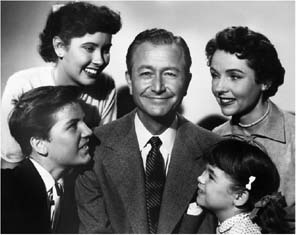
Father Knows Best was a domestic situation comedy (1954–63) set in a typical midwestern community called Springfield. The show revolved around the trials and tribulations of the Anderson family: father and insurance agent Jim (Robert Young), mother and homemaker Margaret (Jane Wyatt), and their three children, seventeen-year-old Betty (Elinor Donahue), fourteen-year-old Jim, Jr., (Billy Gray), and nine-year-old Kathy (Lauren Chapin). The male characters in Father Knows Best represent influential media images of a masculine ideal (white, middle-class, Anglo-Saxon, and Protestant) shaped by emergent post–World War II and Cold War emphases on patriarchal domestic authority, family togetherness, suburban living, and conservatism.
The authoritative, self-assured masculinity of Jim Anderson (who “knew best”) was intended to provide assurance for Americans who, having moved from an economic depression to a world war to the Cold War, sought social stability and moral certainty in American institutions. The bases of Jim's male identity, including moral principle, a middle-class suburban lifestyle, and conventional definitions of gender and sexuality, also represent the foundations of an idealized America. Jim's occupation as an insurance agent not only provides financial stability, but also symbolizes “insurance” against the angst of postwar America. His wisdom and domestic involvement likewise protect his family against perceived threats to the social, moral, and domestic order (particularly a disrespectful wife, a homosexual son, and assertive, career-seeking daughters).
The female characters are crucial to the preservation of this model of manhood. Margaret Anderson reinforces Jim's patriarchal domestic authority and conventional gender definitions through self-effacement. She attends to her domestic duties efficiently yet modestly, defers praise to Jim, and minimizes her own contributions to the family. When Margaret does rebel against these domestic codes, as in episodes such as “Mother Goes to School” (1957) and “It's a Small World” (1959), she suffers embarrassment, humiliation, shame, and regret. Betty, Jim's oldest daughter, is likewise punished when she attempts to assume “masculine” roles. Episodes such as “Betty, Girl Engineer” (1956), “Betty, the Pioneer Woman” (1958), and “Betty's Career Problem” (1960) suggest that girls must learn to channel athletic and career pursuits into romantic ones.
Jim, Jr., embodies postwar American ideals concerning boyhood, adolescence, and emerging manhood. Nicknamed “Bud,” he is an adult male-in-training—a “budding” replica of his father. Like the boys in Leave It to Beaver (1957–63), Bud learns lessons in traits and values associated by postwar Americans with ideal manhood, including positive relationships with girls, hard work, thriftiness, responsibility, selflessness, and middle-class status. For example, episodes such as “Carnival” (1957) teach Bud about ideal fatherhood; “Big Shot Bud” (1959) and “Bud Lives It Up” (1960) examine middle-class lifestyle; “Bud and the Debutante” (1959) confirms Bud's dedication to middle-class status; “Bud, the Willing Worker” (1959) offers lessons about work, determination, and reward; and “Bud Takes Up the Dance” (1954) focuses on Bud's awkward relationship with girls.
...
- Art and Literature
- Adventures of Huckleberry Finn
- Catcher in the Rye, The
- Common Sense Book of Baby and Child Care, The
- Contrast, The
- Death of a Salesman
- Grapes of Wrath, The
- Invisible Man
- Iron John: A Book About Men
- Jungle, The
- Moby Dick
- Organization Man, The
- Alger, Horatio, Jr.
- Art
- Arthur, Timothy Shay
- Beat Movement
- Crèvecoeur, J. Hector St. John
- Emerson, Ralph Waldo
- Fitzgerald, F. Scott
- Hemingway, Ernest
- Jesus, Images of
- Kerouac, Jack
- Lawrence, D.H.
- Leatherstocking Tales
- London, Jack
- Romanticism
- Sawyer, Tom
- Seduction Tales
- Slave Narratives
- Thoreau, Henry David
- Travel Narratives
- Twain, Mark
- Whitman, Walt
- Wright, Richard
- Body and Health
- Atlas, Charles
- Body
- Bodybuilding
- Darwinism
- Eugenics
- Fashion
- Freudian Psychoanalytic Theory
- Graham, Sylvester
- Gulick, Luther Halsey
- Hall, Granville Stanley
- Health
- Higginson, Thomas Wentworth
- Insanity
- James, William
- Kellogg, John Harvey
- Lawrence, D.H.
- Masturbation
- Medicine
- Muscular Christianity
- Old Age
- Reproduction
- Roosevelt, Theodore
- Sandow, Eugen
- Schwarzenegger, Arnold
- Self-Control
- Strenuous Life
- Temperance
- Class, Ethnic, and Racial Identities
- Grapes of Wrath, The
- Invisible Man
- Shaft
- Abolitionism
- African-American Manhood
- Apprenticeship
- Artisan
- Asian-American Manhood
- Beecher, Henry Ward
- Black Panther Party
- Breadwinner Role
- Business/Corporate America
- Civil Rights Movement
- Class
- Douglass, Frederick
- Ethnicity
- Graham, Sylvester
- Hall, Granville Stanley
- Immigration
- Irish-American Manhood
- Italian-American Manhood
- Jewish Manhood
- King, Martin Luther, Jr.
- Labor Movement and Unions
- Latino Manhood
- Malcolm X
- Middle-Class Manhood
- Minstrelsy
- Nation of Islam
- Native American Manhood
- Nativism
- Populism
- Race
- Slavery
- Southern Manhood
- Springsteen, Bruce
- Sunday, Billy
- White Supremacism
- Whiteness
- Work
- Working-Class Manhood
- Wright, Richard
- Concepts and Theories
- Agrarianism
- American Dream
- Breadwinner Role
- Capitalism
- Character
- Chivalry
- Citizenship
- Class
- Conscientious Objection
- Consumerism
- Cult of Domesticity
- Darwinism
- Democratic Manhood
- Emotion
- Ethnicity
- Eugenics
- Evangelicalism and Revivalism
- Fathers' Rights
- Feminism
- Freudian Psychoanalytic Theory
- Heroism
- Imperialism
- Individualism
- Manifest Destiny
- Market Revolution
- Masculine Domesticity
- Men's Studies
- Militarism
- Momism
- Muscular Christianity
- Nationalism
- Nativism
- Passionate Manhood
- Patriarchy
- Patriotism
- Populism
- Postmodernism
- Professionalism
- Property
- Race
- Republicanism
- Romanticism
- Self-Control
- Sentimentalism
- Strenuous Life
- White Supremacism
- Family and Fatherhood
- Common Sense Book of Baby and Child Care, The
- Father Knows Best
- Home Improvement
- Leave It to Beaver
- Mr. Mom
- Adolescence
- Bachelorhood
- Boyhood
- Breadwinner Role
- Cult of Domesticity
- Divorce
- Father's Day
- Fatherhood
- Fathers' Rights
- Freudian Psychoanalytic Theory
- Hall, Granville Stanley
- Marriage
- Masculine Domesticity
- Momism
- Mother–Son Relationships
- Noyes, John Humphrey
- Nuclear Family
- Old Age
- Patriarchy
- Promise Keepers
- Property
- Reproduction
- Suburbia
- Youth
- Historical Events and Processes
- Abolitionism
- American Revolution
- Antiwar Movement
- California Gold Rush
- Civil Rights Movement
- Civil War
- Cold War
- Emancipation
- Gilded Age
- Great Depression
- Immigration
- Imperialism
- Industrialization
- Manifest Destiny
- Market Revolution
- New Deal
- Politics
- Populism
- Progressive Era
- Reform Movements
- Sexual Revolution
- Spanish-American War
- Suffragism
- Urbanization
- Victorian Era
- Vietnam War
- War
- Western Frontier
- World War I
- World War II
- Icons and Symbols
- Lone Ranger, The
- Alger, Horatio, Jr.
- American Dream
- Atlas, Charles
- Automobile
- Bogart, Humphrey
- Boone, Daniel
- Brando, Marlon
- Confidence Man
- Cooper, Gary
- Cowboys
- Crockett, Davy
- Dean, James
- Detectives
- Eastwood, Clint
- Franklin, Benjamin
- Gangsters
- Grant, Cary
- Hoboes
- Hollywood
- Hudson, Rock
- Jesus, Images of
- Kerouac, Jack
- Lincoln, Abraham
- Malcolm X
- Marlboro Man
- Outdoorsmen
- Rambo
- Reagan, Ronald
- Sawyer, Tom
- Self-Made Man
- Sensitive Male
- Springsteen, Bruce
- Suburbia
- Superman
- Tarzan
- Uncle Sam
- Washington, George
- Wayne, John
- Leisure and Work
- Agrarianism
- Alcohol
- Apprenticeship
- Artisan
- Automobile
- Baseball
- Boxing
- Breadwinner Role
- Bureaucratization
- Business/Corporate America
- Consumerism
- Dueling
- Fashion
- Fishing
- Football
- Fraternal Organizations
- Fraternities
- Gambling
- Hunting
- Industrialization
- Labor Movement and Unions
- Leisure
- Male Friendship
- Medicine
- Men's Clubs
- Ministry
- Music
- Outdoorsmen
- Professionalism
- Self-Made Man
- Slavery
- Sports
- Suburbia
- Success Manuals
- Technology
- Travel
- Work
- Working-Class Manhood
- Young Men's Christian Association
- Media and Popular Culture
- Birth of a Nation
- Deliverance
- Easy Rider
- Father Knows Best
- Home Improvement
- Kramer vs. Kramer
- Leave It to Beaver
- Lone Ranger, The
- Mr. Mom
- Odd Couple, The
- Playboy Magazine
- Rebel Without a Cause
- Shaft
- Advertising
- Advice Literature
- Automobile
- Bogart, Humphrey
- Brando, Marlon
- Buddy Films
- Cooper, Gary
- Cop Action Films
- Cowboys
- Crockett, Davy
- Dean, James
- Detectives
- Eastwood, Clint
- Fashion
- Gangsters
- Grant, Cary
- Hollywood
- Hudson, Rock
- Marlboro Man
- Martial Arts Films
- Minstrelsy
- Music
- Rambo
- Reagan, Ronald
- Schwarzenegger, Arnold
- Seduction Tales
- Springsteen, Bruce
- Success Manuals
- Superman
- Tarzan
- Television
- Wayne, John
- Westerns
- Movements and Organizations
- Iron John: A Book About Men
- Abolitionism
- Antiwar Movement
- Beat Movement
- Black Panther Party
- Boy Scouts of America
- Civil Rights Movement
- Counterculture
- Eugenics
- Feminism
- Fraternal Organizations
- Fraternities
- Kerouac, Jack
- King, Martin Luther, Jr.
- Labor Movement and Unions
- Malcolm X
- Men and Religion Forward Movement
- Men's Clubs
- Men's Movements
- Military
- Muscular Christianity
- Nation of Islam
- Nationalism
- Nativism
- Populism
- Promise Keepers
- Reform Movements
- Sexual Revolution
- Social Gospel
- Sons of Liberty
- Suffragism
- Temperance
- White Supremacism
- Young Men's Christian Association
- People
- Alger, Horatio, Jr.
- Arthur, Timothy Shay
- Atlas, Charles
- Beecher, Henry Ward
- Bogart, Humphrey
- Boone, Daniel
- Brando, Marlon
- Cooper, Gary
- Crèvecoeur, J. Hector St. John
- Crockett, Davy
- Dean, James
- Douglass, Frederick
- Eastwood, Clint
- Emerson, Ralph Waldo
- Fitzgerald, F. Scott
- Franklin, Benjamin
- Graham, Sylvester
- Grant, Cary
- Gulick, Luther Halsey
- Hall, Granville Stanley
- Hemingway, Ernest
- Higginson, Thomas Wentworth
- Hudson, Rock
- Jackson, Andrew
- James, William
- Kellogg, John Harvey
- Kerouac, Jack
- King, Martin Luther, Jr.
- Lawrence, D.H.
- Lincoln, Abraham
- London, Jack
- Malcolm X
- Noyes, John Humphrey
- Reagan, Ronald
- Roosevelt, Theodore
- Sandow, Eugen
- Schwarzenegger, Arnold
- Springsteen, Bruce
- Sunday, Billy
- Thoreau, Henry David
- Twain, Mark
- Washington, George
- Wayne, John
- Whitman, Walt
- Wright, Richard
- Political and Social Issues
- Abolitionism
- Adolescence
- Antiwar Movement
- Citizenship
- Civil Rights Movement
- Class
- Conscientious Objection
- Crisis of Masculinity
- Darwinism
- Divorce
- Education
- Emotion
- Ethnicity
- Eugenics
- Fathers' Rights
- Feminism
- Gangs
- Gays in the Military
- Guns
- Health
- Immigration
- Imperialism
- Insanity
- Juvenile Delinquency
- Medicine
- Momism
- Nativism
- Old Age
- Pornography
- Promise Keepers
- Race
- Reform Movements
- Reverse Sexism
- Self-Control
- Sexual Harassment
- Social Gospel
- Temperance
- Violence
- War
- White Supremacism
- Religion and Spirituality
- Iron John: A Book About Men
- Beecher, Henry Ward
- Conscientious Objection
- Emerson, Ralph Waldo
- Evangelicalism and Revivalism
- Gulick, Luther Halsey
- Higginson, Thomas Wentworth
- Jesus, Images of
- Kerouac, Jack
- King, Martin Luther, Jr.
- Malcolm X
- Men and Religion Forward Movement
- Ministry
- Muscular Christianity
- Nation of Islam
- Noyes, John Humphrey
- Promise Keepers
- Religion and Spirituality
- Social Gospel
- Sunday, Billy
- Young Men's Christian Association
- Sexual Identities and Sexuality
- Loading...
Get a 30 day FREE TRIAL
-
 Watch videos from a variety of sources bringing classroom topics to life
 -
Read modern, diverse business cases
-
Explore hundreds of books and reference titles

Read next

More like this
Sage Recommends
We found other relevant content for you on other Sage platforms.
Have you created a personal profile? Login or create a profile so that you can save clips, playlists and searches