
Entry
Reader's guide
Entries A-Z
Subject index
Napoleon (1769–1821)
General and emperor of France
As a French general, leader of France as first consul, and then emperor, Napoleon consolidated and promoted many ideals of the French Revolution, especially equality, and brought political, social, and financial stability to France. Over the objection of many, he promoted equality for the Jews, while reinstating the Catholic Church as a part of France's social fabric. He reformed education and, in his most famous and lasting legacy, he brought the chaotic civil code of France into one unified body of law that eventually become known as the Code Napoléon. Napoleon brought those same reforms to countries that came under his control. Often considered the father of modern Europe, Napoleon sounded the death knell for the last remnants of feudalism.
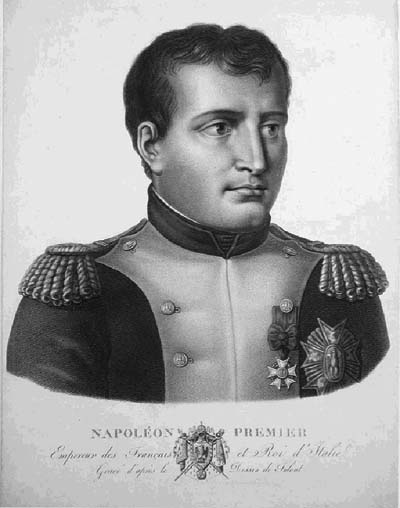
Formal portrait of Napoleon.
Elements of Napoleon's Rise To Power and Leadership
Napoleon's career developed during the chaos of the French Revolution, while France was at war with its neighbors, and amid the instability of the Directory government that followed. His rise was due to an absence of good military leadership, to assistance rendered him by various important people early in his career, and to his considerable talent. He was a natural leader of men and was able to dominate them with the sheer force of his personality and will.
Napoleon excelled in both political and military leadership. His genius of intellect, his ability to seize opportunity and exploit it to the fullest, and his eye for detail and the grand picture were essential to his success as was his ability to communicate and to promote favorable information and imagery. The latter is seen most notably in the Bulletins of his military campaigns, which were carefully written for the consumption of his men, the French public, and his enemies.
Napoleon's leadership style was innovative; people perceived him as a leader who would bring positive social, political, and military change to France. Indeed, Napoleon's domestic reforms alone would have made him a successful leader. His inventive military tactics and organization were advanced beyond those of his opponents. His soldiers recognized his original skills and their benefits as much as the general citizenry; both rallied to his cause.
Using Max Weber's ideal typology as a model, we can regard Napoleon as a charismatic leader since he exhibits many of the model's signal characteristics. His appeal largely was based on his image as a hero, as an exemplary person who could accomplish more than anyone else. Leadership based on heroic charisma, however, depends on victory. Napoleon recognized that, pointing out numerous times that his power rested not on his right to govern but on his accomplishments, especially on the battlefield.
Weber's model of charismatic leadership requires that the leader is aware of his special qualities, believes that he has a “calling,” and that others recognize this quality. It is unclear when Napoleon developed this image of himself, but it seems clear by the end of his career that he had this self-image as did his contemporaries. The devotion of Napoleon's soldiers to him is legend; the civilian population was equally willing to follow him anywhere.
...
- Aristotle
- Arts
- Beatles, The
- Beethoven, Ludwig van
- Carson, Rachel
- Du Bois, W. E. B.
- Film Industry
- Ford, Henry
- Freud, Sigmund
- Graham, Martha
- Hitchcock, Alfred
- Jefferson, Thomas
- Kurosawa, Akira
- Libraries
- Literature
- Marx, Karl
- Mead, Margaret
- Mozart, Wolfgang Amadeus
- Music
- Nietzsche, Friedrich
- Phillips, Sam
- Picasso, Pablo
- Philosophy
- Plato
- Rockefeller, John D.
- Sarnoff, David
- Akbar
- Alexander the Great
- Alinsky, Saul
- Anthony, Susan B.
- Aristotle
- Ataturk, Mustafa Kemal
- Beethoven, Ludwig van
- Buddha
- Carnegie, Andrew
- Carson, Rachel
- Castro, Fidel
- Chanel, Coco
- Charlemagne
- Churchill, Winston
- Confucius
- Cromwell, Oliver
- Disney, Walt
- Du Bois, W. E. B.
- Eddy, Mary Baker
- Edison, Thomas
- Eisenhower, Dwight David
- Elizabeth I
- Ford, Henry
- Freud, Sigmund
- Friedan, Betty
- Gandhi, Mohandas K.
- Genghis Khan
- Goldman, Emma
- Gompers, Samuel
- Graham, Billy
- Graham, Martha
- Grant, Ulysses S.
- Gregory I, St.
- Guevara, Ernesto Che
- Haile Selassie
- Handsome Lake
- Harris, William Wade
- Hitchcock, Alfred
- Hitler, Adolf
- Jefferson, Thomas
- Jesus
- John XXIII, Pope
- Johnson, Lyndon
- Kennedy, John F.
- Kenyatta, Jomo
- King, Billie Jean
- King, Martin Luther, Jr.
- Kroc, Ray
- Kurosawa, Akira
- Lee, Ann
- Lee, Robert E.
- Lenin, Vladimir
- Lincoln, Abraham
- Lombardi, Vince
- Lumumba, Patrice
- Luther, Martin
- Machiavelli, Niccolo
- Malcolm X
- Mandela, Nelson
- Mao Zedong
- Marx, Karl
- Mayer, Louis B.
- Mead, Margaret
- Morgan, Arthur E.
- Morita, Akio
- Moses
- Mother Teresa
- Mozart, Wolfgang Amadeus
- Muhammad
- Nader, Ralph
- Napoleon
- Nasser, Gamal Abdel
- Nelson, Horatio Lord
- Nichiren
- Nietzsche, Friedrich
- Nkrumah, Kwame
- Nyerere, Julius
- Patton, George S.
- Paul, St.
- Phillips, Sam
- Picasso, Pablo
- Plato
- Reagan, Ronald
- Robinson, Jackie
- Rockefeller, John D.
- Roosevelt, Eleanor
- Roosevelt, Franklin Delano
- Roosevelt, Theodore
- Russell, Bill
- Saladin
- Sanger, Margaret
- Sarnoff, David
- Shaka Zulu
- Shibusawa Eiichi
- Sloan, Alfred
- Stalin, Josef
- Süleyman the Magnificent
- Tokugawa Ieyasu
- Tutu, Desmond
- Washington, George
- Watson, Thomas, Jr.
- Welch, Jack
- Wells-Barnett, Ida B.
- Whitefield, George
- Wilson, Woodrow
- Winfrey, Oprah
- Young, Brigham
- Bank of America
- Ben & Jerry's Ice Cream
- Body Shop, The
- Business
- Carnegie, Andrew
- Chanel, Coco
- Disney, Walt
- Dot-Com Meltdown
- Enron Scandal
- Ford, Henry
- Kroc, Ray
- Labor Movement
- Management
- Management, Business
- Mayer, Louis B.
- Morita, Akio
- Nader, Ralph
- Rockefeller, John D.
- Sarnoff, David
- Sears, Roebuck & Co. Catalogue
- Shibusawa Eiichi
- Sloan, Alfred
- Small Business
- Trust Busting
- Watson, Thomas, Jr.
- Welch, Jack
- Winfrey, Oprah
- Women and Business Leadership
- Apartheid in South Africa, Demise of
- Bank of America
- Bay of Pigs
- Beatles, The
- Ben & Jerry's Ice Cream
- Birth Control
- Body Shop, The
- Brighton Declaration
- Christian Right
- Civil Rights Act of 1964
- Cuban Missile Crisis
- D-Day
- Dot-Com Meltdown
- East Timor, Founding of
- Enron Scandal
- Environmental Protection Agency
- Farm Worker Movement
- Free Press in Panama, Creation of
- Green Parties
- Hiroshima
- Iranian Hostage Crisis
- Israel, Founding of
- Jonestown Mass Suicide
- Lewis and Clark Expedition
- Long March
- Manhattan Project
- Mau Mau Rebellion
- Modern Olympics Movement
- Panama Canal, Building of
- Panama Canal Treaties
- Pearl Harbor
- Pueblo Revolt
- Race to the South Pole
- Sears, Roebuck & Co. Catalogue
- September 11th
- Singapore, Founding of
- Stonewall Rebellion
- Suez Crisis of 1956
- Tiananmen Square
- Trust Busting
- Truth and Reconciliation Commissions
- United States Constitution
- War on Terrorism
- Women's Olympics
- Women's Suffrage
- Xian Incident
- Akbar
- Alexander the Great
- Apartheid in South Africa, Demise of
- Ataturk, Mustafa Kemal
- Brighton Declaration
- Buddha
- Confucianism
- Confucius
- Cross-Cultural Leadership
- East Timor, Founding of
- Gandhi, Mohandas K.
- Genghis Khan
- Globalization
- Green Parties
- Guevara, Ernesto Che
- Haile Selassie
- Handsome Lake
- Harris, William Wade
- Hiroshima
- Human Rights
- International Leadership Association
- Iranian Hostage Crisis
- Israel, Founding of
- Kenyatta, Jomo
- Kurosawa, Akira
- Long March
- Lumumba, Patrice
- Mandela, Nelson
- Mao Zedong
- Mau Mau Rebellion
- Modern Olympics Movement
- Morita, Akio
- Moses
- Mother Teresa
- Muhammad
- Nasser, Gamal Abdel
- Nichiren
- Nkrumah, Kwame
- Nyerere, Julius
- Panama Canal, Building of
- Panama Canal Treaties
- Pueblo Revolt
- Religion
- Religious Studies
- Sacred Texts
- Saladin
- Shaka Zulu
- Shibusawa Eiichi
- Singapore, Founding of
- Suez Crisis of 1956
- Suleyman the Magnificent
- Tiananmen Square
- Tokugawa Ieyasu
- Truth and Reconciliation Commissions
- Tutu, Desmond
- Utopian Leaders
- War on Terrorism
- Xian Incident
- Arts
- Business
- Civil Rights Movement
- Coaching
- Community Development
- Congressional Leadership
- E-Commerce
- Education, Higher
- Education, K-2
- Education: Overview
- Entrepreneurship
- Family Businesses
- Family Leadership
- Film Industry
- Gangs
- Human Rights
- Intentional Communities
- Labor Movement
- Libraries
- Literature
- Management, Business
- Military
- Music
- Nonprofit Organizations
- Organizing
- Parliament, British
- Politics
- Presidential Leadership, U.S.
- Public Health
- Religion
- Science and Technology
- Small Business
- Sports
- Traditional Societies
- Utopian Leaders
- Women's Movement
- Youth Leadership
- Alienation
- Altruism
- Collective Action
- Follower-Oriented Leadership
- Followers, Motivation of
- Followership
- Leader-Follower Relationships
- Leaderless Groups
- Mentoring
- Obedience
- Self-Management
- Autocratic Leadership
- Democratic Leadership
- Dysfunctional Leadership
- E-Leadership
- Eupsychian Management
- Individualism and Collectivism
- Innovative Leadership
- Invisible Leadership
- Laissez-Faire Leadership
- Leading at a Distance
- Narcissistic Leadership
- Reconstructive Leadership
- Shared Leadership
- Socio-Emotional Leadership
- Strategic Leadership
- Transformational and Transactional Leadership
- Tyrannical Leadership
- Alexander the Great
- Bay of Pigs
- Eisenhower, Dwight David
- Grant, Ulysses S.
- D-Day
- Genghis Khan
- Hiroshima
- Israel, Founding of
- Lee, Robert E.
- Long March
- Manhattan Project
- Mau Mau Rebellion
- Napoleon
- Nelson, Horatio Lord
- Patton, George S.
- Pearl Harbor
- Pueblo Revolt
- Saladin
- War on Terrorism
- Achievement Motivation
- Authenticity
- Big Five Personality Traits
- Charisma
- Cognitive Structures
- Conformity
- Creativity
- Dominance and Submission
- Efficacy
- Ethics, Contemporary
- Ethics: Overview
- Happiness
- Hope
- Humor
- Idiosyncrasy Credit
- Intelligence, Emotional
- Intelligence, Social
- Intelligence, Verbal
- Intelligences, Other
- Leading from Within
- Modeling and Leading by Example
- Motivation, Intrinsic and Extrinsic
- Narratives
- Negative Capability
- Optimism
- Personality and Group Roles
- Power Motivation
- Resiliency
- Rhetoric
- Risk Taking
- Schemata, Scripts, and Mental Models
- Self-Interest
- Tacit Knowledge
- Trust
- Akbar
- Ataturk, Mustafa Kemal
- Bay of Pigs
- Castro, Fidel
- Charlemagne
- Christian Right
- Churchill, Winston
- Civil Rights Act of 1964
- Congressional Leadership
- Cromwell, Oliver
- Cuban Missile Crisis
- Eisenhower, Dwight David
- Elizabeth I
- Gandhi, Mohandas K.
- Grant, Ulysses S.
- Groupthink
- Guevara, Ernesto Che
- Haile Selassie
- Hiroshima
- History
- Hitler, Adolf
- Iranian Hostage Crisis
- Jefferson, Thomas
- Johnson, Lyndon
- Kennedy, John F.
- Kenyatta, Jomo
- Lenin, Vladimir
- Lincoln, Abraham
- Lumumba, Patrice
- Machiavelli, Niccolo
- Manhattan Project
- Mao Zedong
- Nasser, Gamal Abdel
- Nkrumah, Kwame
- Nyerere, Julius
- Panama Canal, Building of
- Panama Canal Treaties
- Parliament, British
- Pearl Harbor
- Political Science
- Politics
- Presidential Leadership, U.S.
- Reagan, Ronald
- Roosevelt, Franklin Delano
- Roosevelt, Theodore
- Shaka Zulu
- Stalin, Josef
- Suleyman the Magnificent
- Tokugawa Ieyasu
- Trust Busting
- United States Constitution
- Utopian Leaders
- War on Terrorism
- Washington, George
- Wilson, Woodrow
- Women and Political Leadership
- Women's Suffrage
- Coercion
- Influence Tactics
- Power Distance
- Power of Ideas
- Power Sharing
- Power, Six Bases of
- Power: Overview
- Akbar
- Buddha
- Confucius
- Eddy, Mary Baker
- Ethics: Overview
- Gandhi, Mohandas K.
- Graham, Billy
- Gregory I, St.
- Handsome Lake
- Harris, William Wade
- Jesus
- John XXIII, Pope
- Jonestown Mass Suicide
- King, Martin Luther, Jr.
- Lee, Ann
- Luther, Martin
- Malcolm X
- Moses
- Mother Teresa
- Muhammad
- Nichiren
- Paul, St.
- Pueblo Revolt
- Religion
- Religious Studies
- Sacred Texts
- Spirituality
- Tutu, Desmond
- Utopian Leaders
- Whitefield, George
- Young, Brigham
- Aristotle
- Birth Control
- Carnegie, Andrew
- Carson, Rachel
- Disney, Walt
- Dot-Com Meltdown
- Eddy, Mary Baker
- Edison, Thomas
- Environmental Justice
- Environmental Protection Agency
- Ford, Henry
- Hiroshima
- Lewis and Clark Expedition
- Manhattan Project
- Mead, Margaret
- Morgan, Arthur E.
- Morita, Akio
- Panama Canal, Building of
- Plato
- Public Health
- Race to the South Pole
- Rockefeller, John D.
- Sanger, Margaret
- Sarnoff, David
- Science and Technology
- Shibusawa Eiichi
- Sloan, Alfred
- Watson, Thomas, Jr.
- Welch, Jack
- Adaptive Work
- Boundaries and Authority
- Bureaucracy
- Change Management
- Coalitions
- Communication
- Competition
- Conflict
- Contingency Theories
- Corporate Social Responsibility
- Crisis
- Cross-Cultural Leadership
- Decision Making
- Dirty Hands
- Distribution of Leadership
- Economic Justice
- Empowerment
- Ethics, Contemporary
- Friendship
- Globalization
- Group Cohesiveness
- Group Decision Rules
- Group Effectiveness
- Group Norms
- Group Process
- Group Satisfaction
- Groupthink
- Intergroup Processes
- Leadership Effectiveness
- Leadership for the Common Good
- Leadership in the Digital Age
- Leadership Succession
- Learning Organization
- Legacy
- Majority and Minority Influence
- Management
- Moral Imagination
- Motivational Contagion
- Networks and Networked Organizations
- Organizational Climate and Culture
- Organizational Dynamics
- Organizational Justice
- Organizational Theory
- Poverty and Inequality
- Psychological Substructures
- Racial Minorities
- Relational Leadership Approaches
- Resistance
- Romance of Leadership
- Spirituality
- Substitutes for Leadership
- Task Leadership
- Team Leadership
- Teamwork
- Total Quality Management
- Upward Influence
- Alinsky, Saul
- Anthony, Susan B.
- Apartheid in South Africa, Demise of
- Ben & Jerry's Ice Cream
- Birth Control
- Body Shop, The
- Brighton Declaration
- Goldman, Emma
- Farm Worker Movement
- Human Rights
- Green Parties
- Intentional Communities
- King, Martin Luther, Jr.
- Malcolm X
- Mandela, Nelson
- Mau Mau Rebellion
- Nader, Ralph
- Organizing
- Pueblo Revolt
- Sanger, Margaret
- Stonewall Rebellion
- Tiananmen Square
- Utopian Leaders
- Wells-Barnett, Ida B.
- Women's Movement
- Women's Suffrage
- History
- International Leadership Association
- Philosophy
- Political Science
- Religious Studies
- Sacred Texts
- Social Psychology
- Sociology
- Actor Network Theory
- Attribution Processes
- Charismatic Theory
- Confucianism
- Connective Leadership
- Constructivism
- Decision Making: The Vroom/Yetton/Jago Models
- Deep Change
- Discourse Ethics
- Distinctive Competence Approach
- Elite Theory
- GLOBE Research Program
- Grounded Theory
- Group and Systems Theory
- Hot Groups
- Implicit Leadership Theories
- Integrative Theory
- Justice
- Labeling Theory
- Leader Categorization Theory
- Leader-Member Exchange (LMX) Theory
- Leadership Development
- Leadership Theories: Overview
- Mental Models
- Methodologies of Leadership Research
- Path-Goal Analysis
- Psychoanalytic Theory
- Qualitative Methods
- Situational and Contingency Approaches to Leadership
- Social Dilemmas
- Social Identity Theory
- Social Capital Theories
- Sociobiology of Leadership
- Systems Theory
- Theories X, Y, and Z
- Transformational and Visionary Leadership
- Transformistic Theory
- Visionary Leadership Theory
- Anthony, Susan B.
- Barriers to Women's Leadership
- Birth Control
- Body Shop, The
- Business
- Brighton Declaration
- Chanel, Coco
- Children, Socialization and Leadership Development in
- Congressional Leadership
- Elizabeth I
- Enron Scandal
- Film Industry
- Friedan, Betty
- Gender and Authority
- Gender Gap
- Gender Stereotypes
- Gender-Based Structure of Work
- Goldman, Emma
- Green Parties
- King, Billie Jean
- Mead, Margaret
- Mother Teresa
- Patriarchy
- Roosevelt, Eleanor
- Sanger, Margaret
- Wells-Barnett, Ida B.
- Winfrey, Oprah
- Women and Business Leadership
- Women and Men as Leaders
- Women and Political Leadership
- Women and Social Change Leadership
- Women's Movement
- Women's Olympics
- Women's Suffrage
- Women's Value Orientation
- Loading...
Get a 30 day FREE TRIAL
-
 Watch videos from a variety of sources bringing classroom topics to life
 -
Read modern, diverse business cases
-
Explore hundreds of books and reference titles

Read next

More like this
Sage Recommends
We found other relevant content for you on other Sage platforms.
Have you created a personal profile? Login or create a profile so that you can save clips, playlists and searches