
Entry
Reader's guide
Entries A-Z
Subject index
Israel, Founding of
Scholars differ widely as to the weight of the leader's personality in shaping historical events. Opinions range from that of the nineteenth-century Scottish historian Thomas Carlyle, who said that history is simply the biography of leaders, to the argument put forward by Karl Marx and Friedrich Engels, who said that historical processes are deterministic and that leaders are simply borne along on the waves of history. The story of Israel's establishment is a rare example of a case in which the leader was indubitably the decisive factor in the historical event. Without the leadership of David Ben-Gurion (1886–1973), the sequence of events would almost certainly have been different, and the State of Israel might never have been established.
Historical Background
“If I forget thee, O Jerusalem, let my right hand forget her cunning” (Psalms 137:5 JPS). For centuries these words were uttered by Jews in their prayers in the more than seventy countries of the Diaspora. The yearning for the homeland was expressed in prayers and rituals, in the written and oral heritage. True, such themes exist in the collective consciousness of many emigrant communities, but the Jews' return to their ancient homeland more than two thousand years after they were forcibly exiled has no parallel in the history of nations. This unique historical phenomenon was made possible in large measure because of the efforts of two men. The first was Theodor Herzl (1860–1904), a Viennese Jew and one of the darlings of the western Europe intelligentsia, who reached the conclusion that the growing problem of anti-Semitism had to be solved by political measures—by the establishment of a Zionist movement that would serve as a tool for returning Jews to their historical homeland. The second was David Ben-Gurion, who fulfilled Herzl's vision fifty years after the latter's death. Herzl is seen as the prophet who predicted the rise of the State of Israel and BenGurion is regarded as the builder of the state.
David Ben-Gurion, one of the founders of the State of Israel, planting a tree in 1963.
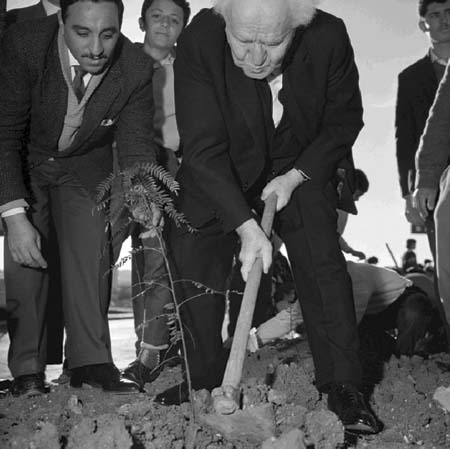
No metaphor for Ben-Gurion's leadership could be more apposite than “builder of the state.” The process of building includes designing and sketching the entire building, planning the stages of building, and executing the plan while constantly dealing with problems that arise in the process. The equivalent in terms of leadership consists of charting a clear course (derived from a vision) and motivating the people to stride resolutely along that course even if it is fraught with difficulties and dangers. In the case of Ben-Gurion, his weight was decisive both in sketching the future picture and in steering the people along the path, although many, including most of his partners in leadership, sometimes experienced moments of despair. BenGurion's leadership at those moments was the only thing that prevented the total loss of hope.
Proclamation of the State
After the Holocaust, in which six million Jews lost their lives, the victors in World War II, headed by the United States, assented to the Zionist movement's request to establish a national home for the Jews. This propitious hour was reflected in the United Nations' recognition of Israel's right to statehood on 29 November 1947. Between this date and 15 May 1948, when the British, who had controlled the region for many years, were to leave and Israel was to become an independent state, hundreds of events threatened to scuttle the fragile boat that was the nascent state. It was clear to all that the months between the United Nations' recognition and the departure of the British would be filled with struggle. The Arabs made every effort to forestall the establishment of a Jewish state, while the Jews attempted to create the conditions for implementing the United Nations resolution. The odds were heavily against Israel. The entire Jewish population numbered only 600,000, and it could muster only a few militia units composed of people who had undergone only partial military training. For the most part they were armed only with rifles and small amounts of ammunition; until the outbreak of war they had no artillery or airplanes. Since it was evident to both sides that the months preceding the departure of the British were critical, the sporadic fighting that gone on for many years became more focused and violent. During the struggle, Ben-Gurion's unwavering persistence, his ability to make difficult and painful decisions, and above all his ability to see the long vista and motivate people to reach it, shone forth.
...
- Aristotle
- Arts
- Beatles, The
- Beethoven, Ludwig van
- Carson, Rachel
- Du Bois, W. E. B.
- Film Industry
- Ford, Henry
- Freud, Sigmund
- Graham, Martha
- Hitchcock, Alfred
- Jefferson, Thomas
- Kurosawa, Akira
- Libraries
- Literature
- Marx, Karl
- Mead, Margaret
- Mozart, Wolfgang Amadeus
- Music
- Nietzsche, Friedrich
- Phillips, Sam
- Picasso, Pablo
- Philosophy
- Plato
- Rockefeller, John D.
- Sarnoff, David
- Akbar
- Alexander the Great
- Alinsky, Saul
- Anthony, Susan B.
- Aristotle
- Ataturk, Mustafa Kemal
- Beethoven, Ludwig van
- Buddha
- Carnegie, Andrew
- Carson, Rachel
- Castro, Fidel
- Chanel, Coco
- Charlemagne
- Churchill, Winston
- Confucius
- Cromwell, Oliver
- Disney, Walt
- Du Bois, W. E. B.
- Eddy, Mary Baker
- Edison, Thomas
- Eisenhower, Dwight David
- Elizabeth I
- Ford, Henry
- Freud, Sigmund
- Friedan, Betty
- Gandhi, Mohandas K.
- Genghis Khan
- Goldman, Emma
- Gompers, Samuel
- Graham, Billy
- Graham, Martha
- Grant, Ulysses S.
- Gregory I, St.
- Guevara, Ernesto Che
- Haile Selassie
- Handsome Lake
- Harris, William Wade
- Hitchcock, Alfred
- Hitler, Adolf
- Jefferson, Thomas
- Jesus
- John XXIII, Pope
- Johnson, Lyndon
- Kennedy, John F.
- Kenyatta, Jomo
- King, Billie Jean
- King, Martin Luther, Jr.
- Kroc, Ray
- Kurosawa, Akira
- Lee, Ann
- Lee, Robert E.
- Lenin, Vladimir
- Lincoln, Abraham
- Lombardi, Vince
- Lumumba, Patrice
- Luther, Martin
- Machiavelli, Niccolo
- Malcolm X
- Mandela, Nelson
- Mao Zedong
- Marx, Karl
- Mayer, Louis B.
- Mead, Margaret
- Morgan, Arthur E.
- Morita, Akio
- Moses
- Mother Teresa
- Mozart, Wolfgang Amadeus
- Muhammad
- Nader, Ralph
- Napoleon
- Nasser, Gamal Abdel
- Nelson, Horatio Lord
- Nichiren
- Nietzsche, Friedrich
- Nkrumah, Kwame
- Nyerere, Julius
- Patton, George S.
- Paul, St.
- Phillips, Sam
- Picasso, Pablo
- Plato
- Reagan, Ronald
- Robinson, Jackie
- Rockefeller, John D.
- Roosevelt, Eleanor
- Roosevelt, Franklin Delano
- Roosevelt, Theodore
- Russell, Bill
- Saladin
- Sanger, Margaret
- Sarnoff, David
- Shaka Zulu
- Shibusawa Eiichi
- Sloan, Alfred
- Stalin, Josef
- Süleyman the Magnificent
- Tokugawa Ieyasu
- Tutu, Desmond
- Washington, George
- Watson, Thomas, Jr.
- Welch, Jack
- Wells-Barnett, Ida B.
- Whitefield, George
- Wilson, Woodrow
- Winfrey, Oprah
- Young, Brigham
- Bank of America
- Ben & Jerry's Ice Cream
- Body Shop, The
- Business
- Carnegie, Andrew
- Chanel, Coco
- Disney, Walt
- Dot-Com Meltdown
- Enron Scandal
- Ford, Henry
- Kroc, Ray
- Labor Movement
- Management
- Management, Business
- Mayer, Louis B.
- Morita, Akio
- Nader, Ralph
- Rockefeller, John D.
- Sarnoff, David
- Sears, Roebuck & Co. Catalogue
- Shibusawa Eiichi
- Sloan, Alfred
- Small Business
- Trust Busting
- Watson, Thomas, Jr.
- Welch, Jack
- Winfrey, Oprah
- Women and Business Leadership
- Apartheid in South Africa, Demise of
- Bank of America
- Bay of Pigs
- Beatles, The
- Ben & Jerry's Ice Cream
- Birth Control
- Body Shop, The
- Brighton Declaration
- Christian Right
- Civil Rights Act of 1964
- Cuban Missile Crisis
- D-Day
- Dot-Com Meltdown
- East Timor, Founding of
- Enron Scandal
- Environmental Protection Agency
- Farm Worker Movement
- Free Press in Panama, Creation of
- Green Parties
- Hiroshima
- Iranian Hostage Crisis
- Israel, Founding of
- Jonestown Mass Suicide
- Lewis and Clark Expedition
- Long March
- Manhattan Project
- Mau Mau Rebellion
- Modern Olympics Movement
- Panama Canal, Building of
- Panama Canal Treaties
- Pearl Harbor
- Pueblo Revolt
- Race to the South Pole
- Sears, Roebuck & Co. Catalogue
- September 11th
- Singapore, Founding of
- Stonewall Rebellion
- Suez Crisis of 1956
- Tiananmen Square
- Trust Busting
- Truth and Reconciliation Commissions
- United States Constitution
- War on Terrorism
- Women's Olympics
- Women's Suffrage
- Xian Incident
- Akbar
- Alexander the Great
- Apartheid in South Africa, Demise of
- Ataturk, Mustafa Kemal
- Brighton Declaration
- Buddha
- Confucianism
- Confucius
- Cross-Cultural Leadership
- East Timor, Founding of
- Gandhi, Mohandas K.
- Genghis Khan
- Globalization
- Green Parties
- Guevara, Ernesto Che
- Haile Selassie
- Handsome Lake
- Harris, William Wade
- Hiroshima
- Human Rights
- International Leadership Association
- Iranian Hostage Crisis
- Israel, Founding of
- Kenyatta, Jomo
- Kurosawa, Akira
- Long March
- Lumumba, Patrice
- Mandela, Nelson
- Mao Zedong
- Mau Mau Rebellion
- Modern Olympics Movement
- Morita, Akio
- Moses
- Mother Teresa
- Muhammad
- Nasser, Gamal Abdel
- Nichiren
- Nkrumah, Kwame
- Nyerere, Julius
- Panama Canal, Building of
- Panama Canal Treaties
- Pueblo Revolt
- Religion
- Religious Studies
- Sacred Texts
- Saladin
- Shaka Zulu
- Shibusawa Eiichi
- Singapore, Founding of
- Suez Crisis of 1956
- Suleyman the Magnificent
- Tiananmen Square
- Tokugawa Ieyasu
- Truth and Reconciliation Commissions
- Tutu, Desmond
- Utopian Leaders
- War on Terrorism
- Xian Incident
- Arts
- Business
- Civil Rights Movement
- Coaching
- Community Development
- Congressional Leadership
- E-Commerce
- Education, Higher
- Education, K-2
- Education: Overview
- Entrepreneurship
- Family Businesses
- Family Leadership
- Film Industry
- Gangs
- Human Rights
- Intentional Communities
- Labor Movement
- Libraries
- Literature
- Management, Business
- Military
- Music
- Nonprofit Organizations
- Organizing
- Parliament, British
- Politics
- Presidential Leadership, U.S.
- Public Health
- Religion
- Science and Technology
- Small Business
- Sports
- Traditional Societies
- Utopian Leaders
- Women's Movement
- Youth Leadership
- Alienation
- Altruism
- Collective Action
- Follower-Oriented Leadership
- Followers, Motivation of
- Followership
- Leader-Follower Relationships
- Leaderless Groups
- Mentoring
- Obedience
- Self-Management
- Autocratic Leadership
- Democratic Leadership
- Dysfunctional Leadership
- E-Leadership
- Eupsychian Management
- Individualism and Collectivism
- Innovative Leadership
- Invisible Leadership
- Laissez-Faire Leadership
- Leading at a Distance
- Narcissistic Leadership
- Reconstructive Leadership
- Shared Leadership
- Socio-Emotional Leadership
- Strategic Leadership
- Transformational and Transactional Leadership
- Tyrannical Leadership
- Alexander the Great
- Bay of Pigs
- Eisenhower, Dwight David
- Grant, Ulysses S.
- D-Day
- Genghis Khan
- Hiroshima
- Israel, Founding of
- Lee, Robert E.
- Long March
- Manhattan Project
- Mau Mau Rebellion
- Napoleon
- Nelson, Horatio Lord
- Patton, George S.
- Pearl Harbor
- Pueblo Revolt
- Saladin
- War on Terrorism
- Achievement Motivation
- Authenticity
- Big Five Personality Traits
- Charisma
- Cognitive Structures
- Conformity
- Creativity
- Dominance and Submission
- Efficacy
- Ethics, Contemporary
- Ethics: Overview
- Happiness
- Hope
- Humor
- Idiosyncrasy Credit
- Intelligence, Emotional
- Intelligence, Social
- Intelligence, Verbal
- Intelligences, Other
- Leading from Within
- Modeling and Leading by Example
- Motivation, Intrinsic and Extrinsic
- Narratives
- Negative Capability
- Optimism
- Personality and Group Roles
- Power Motivation
- Resiliency
- Rhetoric
- Risk Taking
- Schemata, Scripts, and Mental Models
- Self-Interest
- Tacit Knowledge
- Trust
- Akbar
- Ataturk, Mustafa Kemal
- Bay of Pigs
- Castro, Fidel
- Charlemagne
- Christian Right
- Churchill, Winston
- Civil Rights Act of 1964
- Congressional Leadership
- Cromwell, Oliver
- Cuban Missile Crisis
- Eisenhower, Dwight David
- Elizabeth I
- Gandhi, Mohandas K.
- Grant, Ulysses S.
- Groupthink
- Guevara, Ernesto Che
- Haile Selassie
- Hiroshima
- History
- Hitler, Adolf
- Iranian Hostage Crisis
- Jefferson, Thomas
- Johnson, Lyndon
- Kennedy, John F.
- Kenyatta, Jomo
- Lenin, Vladimir
- Lincoln, Abraham
- Lumumba, Patrice
- Machiavelli, Niccolo
- Manhattan Project
- Mao Zedong
- Nasser, Gamal Abdel
- Nkrumah, Kwame
- Nyerere, Julius
- Panama Canal, Building of
- Panama Canal Treaties
- Parliament, British
- Pearl Harbor
- Political Science
- Politics
- Presidential Leadership, U.S.
- Reagan, Ronald
- Roosevelt, Franklin Delano
- Roosevelt, Theodore
- Shaka Zulu
- Stalin, Josef
- Suleyman the Magnificent
- Tokugawa Ieyasu
- Trust Busting
- United States Constitution
- Utopian Leaders
- War on Terrorism
- Washington, George
- Wilson, Woodrow
- Women and Political Leadership
- Women's Suffrage
- Coercion
- Influence Tactics
- Power Distance
- Power of Ideas
- Power Sharing
- Power, Six Bases of
- Power: Overview
- Akbar
- Buddha
- Confucius
- Eddy, Mary Baker
- Ethics: Overview
- Gandhi, Mohandas K.
- Graham, Billy
- Gregory I, St.
- Handsome Lake
- Harris, William Wade
- Jesus
- John XXIII, Pope
- Jonestown Mass Suicide
- King, Martin Luther, Jr.
- Lee, Ann
- Luther, Martin
- Malcolm X
- Moses
- Mother Teresa
- Muhammad
- Nichiren
- Paul, St.
- Pueblo Revolt
- Religion
- Religious Studies
- Sacred Texts
- Spirituality
- Tutu, Desmond
- Utopian Leaders
- Whitefield, George
- Young, Brigham
- Aristotle
- Birth Control
- Carnegie, Andrew
- Carson, Rachel
- Disney, Walt
- Dot-Com Meltdown
- Eddy, Mary Baker
- Edison, Thomas
- Environmental Justice
- Environmental Protection Agency
- Ford, Henry
- Hiroshima
- Lewis and Clark Expedition
- Manhattan Project
- Mead, Margaret
- Morgan, Arthur E.
- Morita, Akio
- Panama Canal, Building of
- Plato
- Public Health
- Race to the South Pole
- Rockefeller, John D.
- Sanger, Margaret
- Sarnoff, David
- Science and Technology
- Shibusawa Eiichi
- Sloan, Alfred
- Watson, Thomas, Jr.
- Welch, Jack
- Adaptive Work
- Boundaries and Authority
- Bureaucracy
- Change Management
- Coalitions
- Communication
- Competition
- Conflict
- Contingency Theories
- Corporate Social Responsibility
- Crisis
- Cross-Cultural Leadership
- Decision Making
- Dirty Hands
- Distribution of Leadership
- Economic Justice
- Empowerment
- Ethics, Contemporary
- Friendship
- Globalization
- Group Cohesiveness
- Group Decision Rules
- Group Effectiveness
- Group Norms
- Group Process
- Group Satisfaction
- Groupthink
- Intergroup Processes
- Leadership Effectiveness
- Leadership for the Common Good
- Leadership in the Digital Age
- Leadership Succession
- Learning Organization
- Legacy
- Majority and Minority Influence
- Management
- Moral Imagination
- Motivational Contagion
- Networks and Networked Organizations
- Organizational Climate and Culture
- Organizational Dynamics
- Organizational Justice
- Organizational Theory
- Poverty and Inequality
- Psychological Substructures
- Racial Minorities
- Relational Leadership Approaches
- Resistance
- Romance of Leadership
- Spirituality
- Substitutes for Leadership
- Task Leadership
- Team Leadership
- Teamwork
- Total Quality Management
- Upward Influence
- Alinsky, Saul
- Anthony, Susan B.
- Apartheid in South Africa, Demise of
- Ben & Jerry's Ice Cream
- Birth Control
- Body Shop, The
- Brighton Declaration
- Goldman, Emma
- Farm Worker Movement
- Human Rights
- Green Parties
- Intentional Communities
- King, Martin Luther, Jr.
- Malcolm X
- Mandela, Nelson
- Mau Mau Rebellion
- Nader, Ralph
- Organizing
- Pueblo Revolt
- Sanger, Margaret
- Stonewall Rebellion
- Tiananmen Square
- Utopian Leaders
- Wells-Barnett, Ida B.
- Women's Movement
- Women's Suffrage
- History
- International Leadership Association
- Philosophy
- Political Science
- Religious Studies
- Sacred Texts
- Social Psychology
- Sociology
- Actor Network Theory
- Attribution Processes
- Charismatic Theory
- Confucianism
- Connective Leadership
- Constructivism
- Decision Making: The Vroom/Yetton/Jago Models
- Deep Change
- Discourse Ethics
- Distinctive Competence Approach
- Elite Theory
- GLOBE Research Program
- Grounded Theory
- Group and Systems Theory
- Hot Groups
- Implicit Leadership Theories
- Integrative Theory
- Justice
- Labeling Theory
- Leader Categorization Theory
- Leader-Member Exchange (LMX) Theory
- Leadership Development
- Leadership Theories: Overview
- Mental Models
- Methodologies of Leadership Research
- Path-Goal Analysis
- Psychoanalytic Theory
- Qualitative Methods
- Situational and Contingency Approaches to Leadership
- Social Dilemmas
- Social Identity Theory
- Social Capital Theories
- Sociobiology of Leadership
- Systems Theory
- Theories X, Y, and Z
- Transformational and Visionary Leadership
- Transformistic Theory
- Visionary Leadership Theory
- Anthony, Susan B.
- Barriers to Women's Leadership
- Birth Control
- Body Shop, The
- Business
- Brighton Declaration
- Chanel, Coco
- Children, Socialization and Leadership Development in
- Congressional Leadership
- Elizabeth I
- Enron Scandal
- Film Industry
- Friedan, Betty
- Gender and Authority
- Gender Gap
- Gender Stereotypes
- Gender-Based Structure of Work
- Goldman, Emma
- Green Parties
- King, Billie Jean
- Mead, Margaret
- Mother Teresa
- Patriarchy
- Roosevelt, Eleanor
- Sanger, Margaret
- Wells-Barnett, Ida B.
- Winfrey, Oprah
- Women and Business Leadership
- Women and Men as Leaders
- Women and Political Leadership
- Women and Social Change Leadership
- Women's Movement
- Women's Olympics
- Women's Suffrage
- Women's Value Orientation
- Loading...
Get a 30 day FREE TRIAL
-
 Watch videos from a variety of sources bringing classroom topics to life
 -
Read modern, diverse business cases
-
Explore hundreds of books and reference titles

Read next

More like this
Sage Recommends
We found other relevant content for you on other Sage platforms.
Have you created a personal profile? Login or create a profile so that you can save clips, playlists and searches