
Entry
Reader's guide
Entries A-Z
Subject index
Edison, Thomas (1847–1931)
U.S. inventor and entrepreneur
Thomas Alva Edison was the greatest inventor in modern history. Since his rise to fame in the 1870s he has been one of history's most mythologized figures. The richness and complexity of his work, combined with the legends that have surrounded it, make Edison's career an especially challenging puzzle for those who seek to recover the “real” Edison. However, because of the availability of millions of pages of Edison laboratory notebooks, correspondence, and other documents, historians now have a much clearer understanding of Edison's life and work. If anything, writings based on the Edison papers have only reinforced the remarkable nature of his career; Edison remains a towering figure in the history of modern technological and business development. At the same time, the “new” Edison differs in several significant ways from the Edison of late nineteenth- and early twentieth-century hagiography (a worshipful or idealized biography). How he established and operated scores of businesses; how he recruited, motivated, and collaborated with other technologists; how he organized and supervised employees; and how he cultivated and leveraged his own public image—in short, how Edison functioned as a leader—have emerged as central themes of his career.
Edison was issued 1,093 U.S. patents and made major contributions to the development of several of the modern world's most important industries—telegraphy, telephony, electric light and power, recorded sound (the phonograph), motion pictures, chemical energy storage (batteries)—as well as less sweeping but still notable contributions to the fields of mimeography, railroads, cement, automobiles, ore separation, and others. His discovery of the socalled Edison effect laid the groundwork for the development of radio. However, Edison was as much an entrepreneur and innovator as he was an inventor. That is, he was centrally occupied not only with creating but also with commercializing. According to many historians of technology, the process of innovation entails both invention and commercial application. This process typically involves applying new ideas to build working prototypes, then (with continual modification) scaling up production for sales. In this way theories, concepts, and designs are first embodied in the physical world, as technology, and then launched in the marketplace, as products. Edison devoted considerable attention to all stages of this process—conceptualization, design, model building, and commercialization—which involved him with a variety of individuals, including scientists and mathematicians, craftsmen and mechanics, investors, politicians, and customers. In his interactions with each kind of stakeholder (a person having an interest in an outcome), Edison exhibited a distinctive and usually quite effective leadership style.
Thomas Alva Edison in his laboratory in Menlo Park, New Jersey.
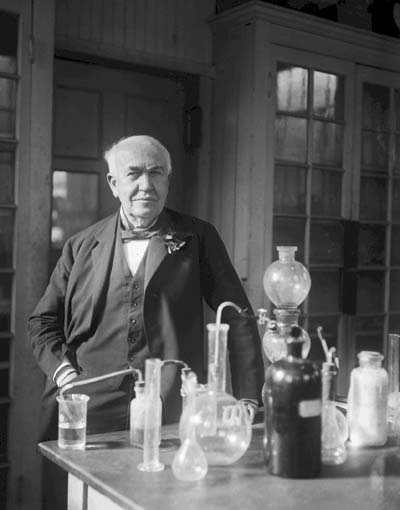
Born on a farm in Milan, Ohio, Edison began his professional career as a telegrapher, which gave him a decent income and plenty of mobility. He hung out his shingle as an inventor and began to attract modest corporate capital in Boston during a stint there in 1868–1869. His initial work focused on improving telegraph, fire alarm, and facsimile telegraph systems. Edison soon moved to New York City, expanded his work into new areas, and achieved some notable success—along with additional venture capital. In 1876 he opened what he called an “invention factory” in the northeastern New Jersey farm community of Menlo Park. It was a predecessor of the twentieth-century research and development laboratory, an institution devoted to controlling the pace and direction of technological development.
...
- Aristotle
- Arts
- Beatles, The
- Beethoven, Ludwig van
- Carson, Rachel
- Du Bois, W. E. B.
- Film Industry
- Ford, Henry
- Freud, Sigmund
- Graham, Martha
- Hitchcock, Alfred
- Jefferson, Thomas
- Kurosawa, Akira
- Libraries
- Literature
- Marx, Karl
- Mead, Margaret
- Mozart, Wolfgang Amadeus
- Music
- Nietzsche, Friedrich
- Phillips, Sam
- Picasso, Pablo
- Philosophy
- Plato
- Rockefeller, John D.
- Sarnoff, David
- Akbar
- Alexander the Great
- Alinsky, Saul
- Anthony, Susan B.
- Aristotle
- Ataturk, Mustafa Kemal
- Beethoven, Ludwig van
- Buddha
- Carnegie, Andrew
- Carson, Rachel
- Castro, Fidel
- Chanel, Coco
- Charlemagne
- Churchill, Winston
- Confucius
- Cromwell, Oliver
- Disney, Walt
- Du Bois, W. E. B.
- Eddy, Mary Baker
- Edison, Thomas
- Eisenhower, Dwight David
- Elizabeth I
- Ford, Henry
- Freud, Sigmund
- Friedan, Betty
- Gandhi, Mohandas K.
- Genghis Khan
- Goldman, Emma
- Gompers, Samuel
- Graham, Billy
- Graham, Martha
- Grant, Ulysses S.
- Gregory I, St.
- Guevara, Ernesto Che
- Haile Selassie
- Handsome Lake
- Harris, William Wade
- Hitchcock, Alfred
- Hitler, Adolf
- Jefferson, Thomas
- Jesus
- John XXIII, Pope
- Johnson, Lyndon
- Kennedy, John F.
- Kenyatta, Jomo
- King, Billie Jean
- King, Martin Luther, Jr.
- Kroc, Ray
- Kurosawa, Akira
- Lee, Ann
- Lee, Robert E.
- Lenin, Vladimir
- Lincoln, Abraham
- Lombardi, Vince
- Lumumba, Patrice
- Luther, Martin
- Machiavelli, Niccolo
- Malcolm X
- Mandela, Nelson
- Mao Zedong
- Marx, Karl
- Mayer, Louis B.
- Mead, Margaret
- Morgan, Arthur E.
- Morita, Akio
- Moses
- Mother Teresa
- Mozart, Wolfgang Amadeus
- Muhammad
- Nader, Ralph
- Napoleon
- Nasser, Gamal Abdel
- Nelson, Horatio Lord
- Nichiren
- Nietzsche, Friedrich
- Nkrumah, Kwame
- Nyerere, Julius
- Patton, George S.
- Paul, St.
- Phillips, Sam
- Picasso, Pablo
- Plato
- Reagan, Ronald
- Robinson, Jackie
- Rockefeller, John D.
- Roosevelt, Eleanor
- Roosevelt, Franklin Delano
- Roosevelt, Theodore
- Russell, Bill
- Saladin
- Sanger, Margaret
- Sarnoff, David
- Shaka Zulu
- Shibusawa Eiichi
- Sloan, Alfred
- Stalin, Josef
- Süleyman the Magnificent
- Tokugawa Ieyasu
- Tutu, Desmond
- Washington, George
- Watson, Thomas, Jr.
- Welch, Jack
- Wells-Barnett, Ida B.
- Whitefield, George
- Wilson, Woodrow
- Winfrey, Oprah
- Young, Brigham
- Bank of America
- Ben & Jerry's Ice Cream
- Body Shop, The
- Business
- Carnegie, Andrew
- Chanel, Coco
- Disney, Walt
- Dot-Com Meltdown
- Enron Scandal
- Ford, Henry
- Kroc, Ray
- Labor Movement
- Management
- Management, Business
- Mayer, Louis B.
- Morita, Akio
- Nader, Ralph
- Rockefeller, John D.
- Sarnoff, David
- Sears, Roebuck & Co. Catalogue
- Shibusawa Eiichi
- Sloan, Alfred
- Small Business
- Trust Busting
- Watson, Thomas, Jr.
- Welch, Jack
- Winfrey, Oprah
- Women and Business Leadership
- Apartheid in South Africa, Demise of
- Bank of America
- Bay of Pigs
- Beatles, The
- Ben & Jerry's Ice Cream
- Birth Control
- Body Shop, The
- Brighton Declaration
- Christian Right
- Civil Rights Act of 1964
- Cuban Missile Crisis
- D-Day
- Dot-Com Meltdown
- East Timor, Founding of
- Enron Scandal
- Environmental Protection Agency
- Farm Worker Movement
- Free Press in Panama, Creation of
- Green Parties
- Hiroshima
- Iranian Hostage Crisis
- Israel, Founding of
- Jonestown Mass Suicide
- Lewis and Clark Expedition
- Long March
- Manhattan Project
- Mau Mau Rebellion
- Modern Olympics Movement
- Panama Canal, Building of
- Panama Canal Treaties
- Pearl Harbor
- Pueblo Revolt
- Race to the South Pole
- Sears, Roebuck & Co. Catalogue
- September 11th
- Singapore, Founding of
- Stonewall Rebellion
- Suez Crisis of 1956
- Tiananmen Square
- Trust Busting
- Truth and Reconciliation Commissions
- United States Constitution
- War on Terrorism
- Women's Olympics
- Women's Suffrage
- Xian Incident
- Akbar
- Alexander the Great
- Apartheid in South Africa, Demise of
- Ataturk, Mustafa Kemal
- Brighton Declaration
- Buddha
- Confucianism
- Confucius
- Cross-Cultural Leadership
- East Timor, Founding of
- Gandhi, Mohandas K.
- Genghis Khan
- Globalization
- Green Parties
- Guevara, Ernesto Che
- Haile Selassie
- Handsome Lake
- Harris, William Wade
- Hiroshima
- Human Rights
- International Leadership Association
- Iranian Hostage Crisis
- Israel, Founding of
- Kenyatta, Jomo
- Kurosawa, Akira
- Long March
- Lumumba, Patrice
- Mandela, Nelson
- Mao Zedong
- Mau Mau Rebellion
- Modern Olympics Movement
- Morita, Akio
- Moses
- Mother Teresa
- Muhammad
- Nasser, Gamal Abdel
- Nichiren
- Nkrumah, Kwame
- Nyerere, Julius
- Panama Canal, Building of
- Panama Canal Treaties
- Pueblo Revolt
- Religion
- Religious Studies
- Sacred Texts
- Saladin
- Shaka Zulu
- Shibusawa Eiichi
- Singapore, Founding of
- Suez Crisis of 1956
- Suleyman the Magnificent
- Tiananmen Square
- Tokugawa Ieyasu
- Truth and Reconciliation Commissions
- Tutu, Desmond
- Utopian Leaders
- War on Terrorism
- Xian Incident
- Arts
- Business
- Civil Rights Movement
- Coaching
- Community Development
- Congressional Leadership
- E-Commerce
- Education, Higher
- Education, K-2
- Education: Overview
- Entrepreneurship
- Family Businesses
- Family Leadership
- Film Industry
- Gangs
- Human Rights
- Intentional Communities
- Labor Movement
- Libraries
- Literature
- Management, Business
- Military
- Music
- Nonprofit Organizations
- Organizing
- Parliament, British
- Politics
- Presidential Leadership, U.S.
- Public Health
- Religion
- Science and Technology
- Small Business
- Sports
- Traditional Societies
- Utopian Leaders
- Women's Movement
- Youth Leadership
- Alienation
- Altruism
- Collective Action
- Follower-Oriented Leadership
- Followers, Motivation of
- Followership
- Leader-Follower Relationships
- Leaderless Groups
- Mentoring
- Obedience
- Self-Management
- Autocratic Leadership
- Democratic Leadership
- Dysfunctional Leadership
- E-Leadership
- Eupsychian Management
- Individualism and Collectivism
- Innovative Leadership
- Invisible Leadership
- Laissez-Faire Leadership
- Leading at a Distance
- Narcissistic Leadership
- Reconstructive Leadership
- Shared Leadership
- Socio-Emotional Leadership
- Strategic Leadership
- Transformational and Transactional Leadership
- Tyrannical Leadership
- Alexander the Great
- Bay of Pigs
- Eisenhower, Dwight David
- Grant, Ulysses S.
- D-Day
- Genghis Khan
- Hiroshima
- Israel, Founding of
- Lee, Robert E.
- Long March
- Manhattan Project
- Mau Mau Rebellion
- Napoleon
- Nelson, Horatio Lord
- Patton, George S.
- Pearl Harbor
- Pueblo Revolt
- Saladin
- War on Terrorism
- Achievement Motivation
- Authenticity
- Big Five Personality Traits
- Charisma
- Cognitive Structures
- Conformity
- Creativity
- Dominance and Submission
- Efficacy
- Ethics, Contemporary
- Ethics: Overview
- Happiness
- Hope
- Humor
- Idiosyncrasy Credit
- Intelligence, Emotional
- Intelligence, Social
- Intelligence, Verbal
- Intelligences, Other
- Leading from Within
- Modeling and Leading by Example
- Motivation, Intrinsic and Extrinsic
- Narratives
- Negative Capability
- Optimism
- Personality and Group Roles
- Power Motivation
- Resiliency
- Rhetoric
- Risk Taking
- Schemata, Scripts, and Mental Models
- Self-Interest
- Tacit Knowledge
- Trust
- Akbar
- Ataturk, Mustafa Kemal
- Bay of Pigs
- Castro, Fidel
- Charlemagne
- Christian Right
- Churchill, Winston
- Civil Rights Act of 1964
- Congressional Leadership
- Cromwell, Oliver
- Cuban Missile Crisis
- Eisenhower, Dwight David
- Elizabeth I
- Gandhi, Mohandas K.
- Grant, Ulysses S.
- Groupthink
- Guevara, Ernesto Che
- Haile Selassie
- Hiroshima
- History
- Hitler, Adolf
- Iranian Hostage Crisis
- Jefferson, Thomas
- Johnson, Lyndon
- Kennedy, John F.
- Kenyatta, Jomo
- Lenin, Vladimir
- Lincoln, Abraham
- Lumumba, Patrice
- Machiavelli, Niccolo
- Manhattan Project
- Mao Zedong
- Nasser, Gamal Abdel
- Nkrumah, Kwame
- Nyerere, Julius
- Panama Canal, Building of
- Panama Canal Treaties
- Parliament, British
- Pearl Harbor
- Political Science
- Politics
- Presidential Leadership, U.S.
- Reagan, Ronald
- Roosevelt, Franklin Delano
- Roosevelt, Theodore
- Shaka Zulu
- Stalin, Josef
- Suleyman the Magnificent
- Tokugawa Ieyasu
- Trust Busting
- United States Constitution
- Utopian Leaders
- War on Terrorism
- Washington, George
- Wilson, Woodrow
- Women and Political Leadership
- Women's Suffrage
- Coercion
- Influence Tactics
- Power Distance
- Power of Ideas
- Power Sharing
- Power, Six Bases of
- Power: Overview
- Akbar
- Buddha
- Confucius
- Eddy, Mary Baker
- Ethics: Overview
- Gandhi, Mohandas K.
- Graham, Billy
- Gregory I, St.
- Handsome Lake
- Harris, William Wade
- Jesus
- John XXIII, Pope
- Jonestown Mass Suicide
- King, Martin Luther, Jr.
- Lee, Ann
- Luther, Martin
- Malcolm X
- Moses
- Mother Teresa
- Muhammad
- Nichiren
- Paul, St.
- Pueblo Revolt
- Religion
- Religious Studies
- Sacred Texts
- Spirituality
- Tutu, Desmond
- Utopian Leaders
- Whitefield, George
- Young, Brigham
- Aristotle
- Birth Control
- Carnegie, Andrew
- Carson, Rachel
- Disney, Walt
- Dot-Com Meltdown
- Eddy, Mary Baker
- Edison, Thomas
- Environmental Justice
- Environmental Protection Agency
- Ford, Henry
- Hiroshima
- Lewis and Clark Expedition
- Manhattan Project
- Mead, Margaret
- Morgan, Arthur E.
- Morita, Akio
- Panama Canal, Building of
- Plato
- Public Health
- Race to the South Pole
- Rockefeller, John D.
- Sanger, Margaret
- Sarnoff, David
- Science and Technology
- Shibusawa Eiichi
- Sloan, Alfred
- Watson, Thomas, Jr.
- Welch, Jack
- Adaptive Work
- Boundaries and Authority
- Bureaucracy
- Change Management
- Coalitions
- Communication
- Competition
- Conflict
- Contingency Theories
- Corporate Social Responsibility
- Crisis
- Cross-Cultural Leadership
- Decision Making
- Dirty Hands
- Distribution of Leadership
- Economic Justice
- Empowerment
- Ethics, Contemporary
- Friendship
- Globalization
- Group Cohesiveness
- Group Decision Rules
- Group Effectiveness
- Group Norms
- Group Process
- Group Satisfaction
- Groupthink
- Intergroup Processes
- Leadership Effectiveness
- Leadership for the Common Good
- Leadership in the Digital Age
- Leadership Succession
- Learning Organization
- Legacy
- Majority and Minority Influence
- Management
- Moral Imagination
- Motivational Contagion
- Networks and Networked Organizations
- Organizational Climate and Culture
- Organizational Dynamics
- Organizational Justice
- Organizational Theory
- Poverty and Inequality
- Psychological Substructures
- Racial Minorities
- Relational Leadership Approaches
- Resistance
- Romance of Leadership
- Spirituality
- Substitutes for Leadership
- Task Leadership
- Team Leadership
- Teamwork
- Total Quality Management
- Upward Influence
- Alinsky, Saul
- Anthony, Susan B.
- Apartheid in South Africa, Demise of
- Ben & Jerry's Ice Cream
- Birth Control
- Body Shop, The
- Brighton Declaration
- Goldman, Emma
- Farm Worker Movement
- Human Rights
- Green Parties
- Intentional Communities
- King, Martin Luther, Jr.
- Malcolm X
- Mandela, Nelson
- Mau Mau Rebellion
- Nader, Ralph
- Organizing
- Pueblo Revolt
- Sanger, Margaret
- Stonewall Rebellion
- Tiananmen Square
- Utopian Leaders
- Wells-Barnett, Ida B.
- Women's Movement
- Women's Suffrage
- History
- International Leadership Association
- Philosophy
- Political Science
- Religious Studies
- Sacred Texts
- Social Psychology
- Sociology
- Actor Network Theory
- Attribution Processes
- Charismatic Theory
- Confucianism
- Connective Leadership
- Constructivism
- Decision Making: The Vroom/Yetton/Jago Models
- Deep Change
- Discourse Ethics
- Distinctive Competence Approach
- Elite Theory
- GLOBE Research Program
- Grounded Theory
- Group and Systems Theory
- Hot Groups
- Implicit Leadership Theories
- Integrative Theory
- Justice
- Labeling Theory
- Leader Categorization Theory
- Leader-Member Exchange (LMX) Theory
- Leadership Development
- Leadership Theories: Overview
- Mental Models
- Methodologies of Leadership Research
- Path-Goal Analysis
- Psychoanalytic Theory
- Qualitative Methods
- Situational and Contingency Approaches to Leadership
- Social Dilemmas
- Social Identity Theory
- Social Capital Theories
- Sociobiology of Leadership
- Systems Theory
- Theories X, Y, and Z
- Transformational and Visionary Leadership
- Transformistic Theory
- Visionary Leadership Theory
- Anthony, Susan B.
- Barriers to Women's Leadership
- Birth Control
- Body Shop, The
- Business
- Brighton Declaration
- Chanel, Coco
- Children, Socialization and Leadership Development in
- Congressional Leadership
- Elizabeth I
- Enron Scandal
- Film Industry
- Friedan, Betty
- Gender and Authority
- Gender Gap
- Gender Stereotypes
- Gender-Based Structure of Work
- Goldman, Emma
- Green Parties
- King, Billie Jean
- Mead, Margaret
- Mother Teresa
- Patriarchy
- Roosevelt, Eleanor
- Sanger, Margaret
- Wells-Barnett, Ida B.
- Winfrey, Oprah
- Women and Business Leadership
- Women and Men as Leaders
- Women and Political Leadership
- Women and Social Change Leadership
- Women's Movement
- Women's Olympics
- Women's Suffrage
- Women's Value Orientation
- Loading...
Get a 30 day FREE TRIAL
-
 Watch videos from a variety of sources bringing classroom topics to life
 -
Read modern, diverse business cases
-
Explore hundreds of books and reference titles

Read next

More like this
Sage Recommends
We found other relevant content for you on other Sage platforms.
Have you created a personal profile? Login or create a profile so that you can save clips, playlists and searches