
Entry
Reader's guide
Entries A-Z
Subject index
Anthony, Susan B. (1820–1906)
U.S. reformer
Susan B. Anthony was a feminist leader and trailblazer for women's rights who spent her life working for positive social change. Anthony dedicated her life to various reform movements, including abolition of slavery and temperance, which eventually gave way to her leading the fight against society's overall oppression of women. Anthony sought legal reforms of restrictive marriage and divorce laws of the nineteenth century that left divorced women without property or a means of support. Likewise, nineteenth-century laws denied divorced women custody of their children and afforded women little or no legal recourse over domestic disputes. These oppressive social conditions for women were too much for Anthony to bear. Along with other like-minded early feminists, Anthony appealed to local and state legislatures of the Northeast to consider the plight of women, especially the most vulnerable who had little or no means of support or way of seeking restitution in a society favoring men and restricting the lives of women. Anthony led the way for general social reforms and fought for equal voting rights for women against opponents who supported disenfranchisement of women. She demonstrated a tenacity and commitment to improving women's lives not typical of most nineteenth-century women, although throughout her long life Anthony did share the limelight with many notable figures such as the U.S. women's suffrage leader Elizabeth Cady Stanton.
Anthony believed that obtaining voting rights would be the best first step in eradicating other oppressive conditions for women and that women's public activism would help level the playing field in the domestic, social, economic, and political arenas. Everything she did was deemed to be for “the cause,” which she regularly referenced as being the central force of her being—to gain the vote so that future generations of women could break free of the chains of oppression and openly participate in public life.
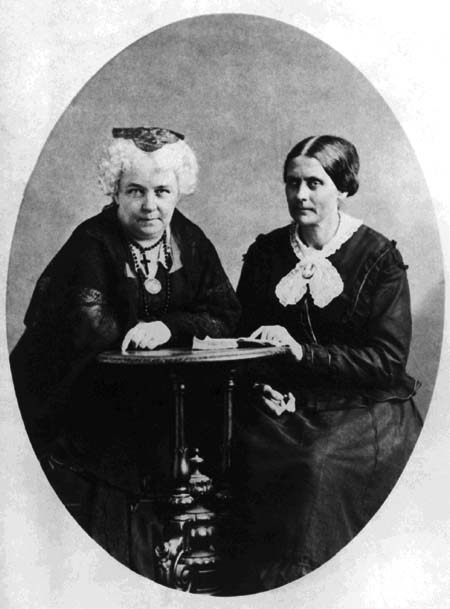
Susan B. Anthony and Elizabeth Cady Stanton, leaders of the women's suffrage movement in the United States, c. 1881.
A National Heroine is Born
Susan Brownell Anthony was born to Quaker parents, Daniel and Lucy Read Anthony. Anthony was born an ordinary female in a typical working-class household. Her father was a devout Quaker, and her mother was a Baptist. Anthony's father, like other Quakers, based his beliefs on egalitarian principles and valued education as a worthy endeavor for both boys and girls. With their father's guidance, the Anthony children briefly attended public school and then were home schooled. As a young girl attending a public school, Susan was denied the opportunity to learn long division because the schoolmaster did not believe that girls should learn mathematics. At this point in her life, Anthony's outraged father removed her from public school and began the process of home schooling under the tutelage of Mary Perkins. In 1837 Anthony's father enrolled Susan in a Quaker female seminary school ran by Deborah Moulson. Anthony's formal schooling was not remarkable; however, her earliest written correspondence and diary reflect Anthony's personal rejection of the overemphasis placed on female piety and morality, which Anthony found were too often taken to the extreme. Like all good Quakers, Anthony found these qualities acceptable within reason and practiced them personally; however, she became more interested in focusing on social and civil responsibility as a way of showing human morality. Throughout her long career as an activist against vice and the ills of society, Anthony demonstrated a natural inclination to stand by her convictions and take on roles of leadership in hopes of improving society.
...
- Aristotle
- Arts
- Beatles, The
- Beethoven, Ludwig van
- Carson, Rachel
- Du Bois, W. E. B.
- Film Industry
- Ford, Henry
- Freud, Sigmund
- Graham, Martha
- Hitchcock, Alfred
- Jefferson, Thomas
- Kurosawa, Akira
- Libraries
- Literature
- Marx, Karl
- Mead, Margaret
- Mozart, Wolfgang Amadeus
- Music
- Nietzsche, Friedrich
- Phillips, Sam
- Picasso, Pablo
- Philosophy
- Plato
- Rockefeller, John D.
- Sarnoff, David
- Akbar
- Alexander the Great
- Alinsky, Saul
- Anthony, Susan B.
- Aristotle
- Ataturk, Mustafa Kemal
- Beethoven, Ludwig van
- Buddha
- Carnegie, Andrew
- Carson, Rachel
- Castro, Fidel
- Chanel, Coco
- Charlemagne
- Churchill, Winston
- Confucius
- Cromwell, Oliver
- Disney, Walt
- Du Bois, W. E. B.
- Eddy, Mary Baker
- Edison, Thomas
- Eisenhower, Dwight David
- Elizabeth I
- Ford, Henry
- Freud, Sigmund
- Friedan, Betty
- Gandhi, Mohandas K.
- Genghis Khan
- Goldman, Emma
- Gompers, Samuel
- Graham, Billy
- Graham, Martha
- Grant, Ulysses S.
- Gregory I, St.
- Guevara, Ernesto Che
- Haile Selassie
- Handsome Lake
- Harris, William Wade
- Hitchcock, Alfred
- Hitler, Adolf
- Jefferson, Thomas
- Jesus
- John XXIII, Pope
- Johnson, Lyndon
- Kennedy, John F.
- Kenyatta, Jomo
- King, Billie Jean
- King, Martin Luther, Jr.
- Kroc, Ray
- Kurosawa, Akira
- Lee, Ann
- Lee, Robert E.
- Lenin, Vladimir
- Lincoln, Abraham
- Lombardi, Vince
- Lumumba, Patrice
- Luther, Martin
- Machiavelli, Niccolo
- Malcolm X
- Mandela, Nelson
- Mao Zedong
- Marx, Karl
- Mayer, Louis B.
- Mead, Margaret
- Morgan, Arthur E.
- Morita, Akio
- Moses
- Mother Teresa
- Mozart, Wolfgang Amadeus
- Muhammad
- Nader, Ralph
- Napoleon
- Nasser, Gamal Abdel
- Nelson, Horatio Lord
- Nichiren
- Nietzsche, Friedrich
- Nkrumah, Kwame
- Nyerere, Julius
- Patton, George S.
- Paul, St.
- Phillips, Sam
- Picasso, Pablo
- Plato
- Reagan, Ronald
- Robinson, Jackie
- Rockefeller, John D.
- Roosevelt, Eleanor
- Roosevelt, Franklin Delano
- Roosevelt, Theodore
- Russell, Bill
- Saladin
- Sanger, Margaret
- Sarnoff, David
- Shaka Zulu
- Shibusawa Eiichi
- Sloan, Alfred
- Stalin, Josef
- Süleyman the Magnificent
- Tokugawa Ieyasu
- Tutu, Desmond
- Washington, George
- Watson, Thomas, Jr.
- Welch, Jack
- Wells-Barnett, Ida B.
- Whitefield, George
- Wilson, Woodrow
- Winfrey, Oprah
- Young, Brigham
- Bank of America
- Ben & Jerry's Ice Cream
- Body Shop, The
- Business
- Carnegie, Andrew
- Chanel, Coco
- Disney, Walt
- Dot-Com Meltdown
- Enron Scandal
- Ford, Henry
- Kroc, Ray
- Labor Movement
- Management
- Management, Business
- Mayer, Louis B.
- Morita, Akio
- Nader, Ralph
- Rockefeller, John D.
- Sarnoff, David
- Sears, Roebuck & Co. Catalogue
- Shibusawa Eiichi
- Sloan, Alfred
- Small Business
- Trust Busting
- Watson, Thomas, Jr.
- Welch, Jack
- Winfrey, Oprah
- Women and Business Leadership
- Apartheid in South Africa, Demise of
- Bank of America
- Bay of Pigs
- Beatles, The
- Ben & Jerry's Ice Cream
- Birth Control
- Body Shop, The
- Brighton Declaration
- Christian Right
- Civil Rights Act of 1964
- Cuban Missile Crisis
- D-Day
- Dot-Com Meltdown
- East Timor, Founding of
- Enron Scandal
- Environmental Protection Agency
- Farm Worker Movement
- Free Press in Panama, Creation of
- Green Parties
- Hiroshima
- Iranian Hostage Crisis
- Israel, Founding of
- Jonestown Mass Suicide
- Lewis and Clark Expedition
- Long March
- Manhattan Project
- Mau Mau Rebellion
- Modern Olympics Movement
- Panama Canal, Building of
- Panama Canal Treaties
- Pearl Harbor
- Pueblo Revolt
- Race to the South Pole
- Sears, Roebuck & Co. Catalogue
- September 11th
- Singapore, Founding of
- Stonewall Rebellion
- Suez Crisis of 1956
- Tiananmen Square
- Trust Busting
- Truth and Reconciliation Commissions
- United States Constitution
- War on Terrorism
- Women's Olympics
- Women's Suffrage
- Xian Incident
- Akbar
- Alexander the Great
- Apartheid in South Africa, Demise of
- Ataturk, Mustafa Kemal
- Brighton Declaration
- Buddha
- Confucianism
- Confucius
- Cross-Cultural Leadership
- East Timor, Founding of
- Gandhi, Mohandas K.
- Genghis Khan
- Globalization
- Green Parties
- Guevara, Ernesto Che
- Haile Selassie
- Handsome Lake
- Harris, William Wade
- Hiroshima
- Human Rights
- International Leadership Association
- Iranian Hostage Crisis
- Israel, Founding of
- Kenyatta, Jomo
- Kurosawa, Akira
- Long March
- Lumumba, Patrice
- Mandela, Nelson
- Mao Zedong
- Mau Mau Rebellion
- Modern Olympics Movement
- Morita, Akio
- Moses
- Mother Teresa
- Muhammad
- Nasser, Gamal Abdel
- Nichiren
- Nkrumah, Kwame
- Nyerere, Julius
- Panama Canal, Building of
- Panama Canal Treaties
- Pueblo Revolt
- Religion
- Religious Studies
- Sacred Texts
- Saladin
- Shaka Zulu
- Shibusawa Eiichi
- Singapore, Founding of
- Suez Crisis of 1956
- Suleyman the Magnificent
- Tiananmen Square
- Tokugawa Ieyasu
- Truth and Reconciliation Commissions
- Tutu, Desmond
- Utopian Leaders
- War on Terrorism
- Xian Incident
- Arts
- Business
- Civil Rights Movement
- Coaching
- Community Development
- Congressional Leadership
- E-Commerce
- Education, Higher
- Education, K-2
- Education: Overview
- Entrepreneurship
- Family Businesses
- Family Leadership
- Film Industry
- Gangs
- Human Rights
- Intentional Communities
- Labor Movement
- Libraries
- Literature
- Management, Business
- Military
- Music
- Nonprofit Organizations
- Organizing
- Parliament, British
- Politics
- Presidential Leadership, U.S.
- Public Health
- Religion
- Science and Technology
- Small Business
- Sports
- Traditional Societies
- Utopian Leaders
- Women's Movement
- Youth Leadership
- Alienation
- Altruism
- Collective Action
- Follower-Oriented Leadership
- Followers, Motivation of
- Followership
- Leader-Follower Relationships
- Leaderless Groups
- Mentoring
- Obedience
- Self-Management
- Autocratic Leadership
- Democratic Leadership
- Dysfunctional Leadership
- E-Leadership
- Eupsychian Management
- Individualism and Collectivism
- Innovative Leadership
- Invisible Leadership
- Laissez-Faire Leadership
- Leading at a Distance
- Narcissistic Leadership
- Reconstructive Leadership
- Shared Leadership
- Socio-Emotional Leadership
- Strategic Leadership
- Transformational and Transactional Leadership
- Tyrannical Leadership
- Alexander the Great
- Bay of Pigs
- Eisenhower, Dwight David
- Grant, Ulysses S.
- D-Day
- Genghis Khan
- Hiroshima
- Israel, Founding of
- Lee, Robert E.
- Long March
- Manhattan Project
- Mau Mau Rebellion
- Napoleon
- Nelson, Horatio Lord
- Patton, George S.
- Pearl Harbor
- Pueblo Revolt
- Saladin
- War on Terrorism
- Achievement Motivation
- Authenticity
- Big Five Personality Traits
- Charisma
- Cognitive Structures
- Conformity
- Creativity
- Dominance and Submission
- Efficacy
- Ethics, Contemporary
- Ethics: Overview
- Happiness
- Hope
- Humor
- Idiosyncrasy Credit
- Intelligence, Emotional
- Intelligence, Social
- Intelligence, Verbal
- Intelligences, Other
- Leading from Within
- Modeling and Leading by Example
- Motivation, Intrinsic and Extrinsic
- Narratives
- Negative Capability
- Optimism
- Personality and Group Roles
- Power Motivation
- Resiliency
- Rhetoric
- Risk Taking
- Schemata, Scripts, and Mental Models
- Self-Interest
- Tacit Knowledge
- Trust
- Akbar
- Ataturk, Mustafa Kemal
- Bay of Pigs
- Castro, Fidel
- Charlemagne
- Christian Right
- Churchill, Winston
- Civil Rights Act of 1964
- Congressional Leadership
- Cromwell, Oliver
- Cuban Missile Crisis
- Eisenhower, Dwight David
- Elizabeth I
- Gandhi, Mohandas K.
- Grant, Ulysses S.
- Groupthink
- Guevara, Ernesto Che
- Haile Selassie
- Hiroshima
- History
- Hitler, Adolf
- Iranian Hostage Crisis
- Jefferson, Thomas
- Johnson, Lyndon
- Kennedy, John F.
- Kenyatta, Jomo
- Lenin, Vladimir
- Lincoln, Abraham
- Lumumba, Patrice
- Machiavelli, Niccolo
- Manhattan Project
- Mao Zedong
- Nasser, Gamal Abdel
- Nkrumah, Kwame
- Nyerere, Julius
- Panama Canal, Building of
- Panama Canal Treaties
- Parliament, British
- Pearl Harbor
- Political Science
- Politics
- Presidential Leadership, U.S.
- Reagan, Ronald
- Roosevelt, Franklin Delano
- Roosevelt, Theodore
- Shaka Zulu
- Stalin, Josef
- Suleyman the Magnificent
- Tokugawa Ieyasu
- Trust Busting
- United States Constitution
- Utopian Leaders
- War on Terrorism
- Washington, George
- Wilson, Woodrow
- Women and Political Leadership
- Women's Suffrage
- Coercion
- Influence Tactics
- Power Distance
- Power of Ideas
- Power Sharing
- Power, Six Bases of
- Power: Overview
- Akbar
- Buddha
- Confucius
- Eddy, Mary Baker
- Ethics: Overview
- Gandhi, Mohandas K.
- Graham, Billy
- Gregory I, St.
- Handsome Lake
- Harris, William Wade
- Jesus
- John XXIII, Pope
- Jonestown Mass Suicide
- King, Martin Luther, Jr.
- Lee, Ann
- Luther, Martin
- Malcolm X
- Moses
- Mother Teresa
- Muhammad
- Nichiren
- Paul, St.
- Pueblo Revolt
- Religion
- Religious Studies
- Sacred Texts
- Spirituality
- Tutu, Desmond
- Utopian Leaders
- Whitefield, George
- Young, Brigham
- Aristotle
- Birth Control
- Carnegie, Andrew
- Carson, Rachel
- Disney, Walt
- Dot-Com Meltdown
- Eddy, Mary Baker
- Edison, Thomas
- Environmental Justice
- Environmental Protection Agency
- Ford, Henry
- Hiroshima
- Lewis and Clark Expedition
- Manhattan Project
- Mead, Margaret
- Morgan, Arthur E.
- Morita, Akio
- Panama Canal, Building of
- Plato
- Public Health
- Race to the South Pole
- Rockefeller, John D.
- Sanger, Margaret
- Sarnoff, David
- Science and Technology
- Shibusawa Eiichi
- Sloan, Alfred
- Watson, Thomas, Jr.
- Welch, Jack
- Adaptive Work
- Boundaries and Authority
- Bureaucracy
- Change Management
- Coalitions
- Communication
- Competition
- Conflict
- Contingency Theories
- Corporate Social Responsibility
- Crisis
- Cross-Cultural Leadership
- Decision Making
- Dirty Hands
- Distribution of Leadership
- Economic Justice
- Empowerment
- Ethics, Contemporary
- Friendship
- Globalization
- Group Cohesiveness
- Group Decision Rules
- Group Effectiveness
- Group Norms
- Group Process
- Group Satisfaction
- Groupthink
- Intergroup Processes
- Leadership Effectiveness
- Leadership for the Common Good
- Leadership in the Digital Age
- Leadership Succession
- Learning Organization
- Legacy
- Majority and Minority Influence
- Management
- Moral Imagination
- Motivational Contagion
- Networks and Networked Organizations
- Organizational Climate and Culture
- Organizational Dynamics
- Organizational Justice
- Organizational Theory
- Poverty and Inequality
- Psychological Substructures
- Racial Minorities
- Relational Leadership Approaches
- Resistance
- Romance of Leadership
- Spirituality
- Substitutes for Leadership
- Task Leadership
- Team Leadership
- Teamwork
- Total Quality Management
- Upward Influence
- Alinsky, Saul
- Anthony, Susan B.
- Apartheid in South Africa, Demise of
- Ben & Jerry's Ice Cream
- Birth Control
- Body Shop, The
- Brighton Declaration
- Goldman, Emma
- Farm Worker Movement
- Human Rights
- Green Parties
- Intentional Communities
- King, Martin Luther, Jr.
- Malcolm X
- Mandela, Nelson
- Mau Mau Rebellion
- Nader, Ralph
- Organizing
- Pueblo Revolt
- Sanger, Margaret
- Stonewall Rebellion
- Tiananmen Square
- Utopian Leaders
- Wells-Barnett, Ida B.
- Women's Movement
- Women's Suffrage
- History
- International Leadership Association
- Philosophy
- Political Science
- Religious Studies
- Sacred Texts
- Social Psychology
- Sociology
- Actor Network Theory
- Attribution Processes
- Charismatic Theory
- Confucianism
- Connective Leadership
- Constructivism
- Decision Making: The Vroom/Yetton/Jago Models
- Deep Change
- Discourse Ethics
- Distinctive Competence Approach
- Elite Theory
- GLOBE Research Program
- Grounded Theory
- Group and Systems Theory
- Hot Groups
- Implicit Leadership Theories
- Integrative Theory
- Justice
- Labeling Theory
- Leader Categorization Theory
- Leader-Member Exchange (LMX) Theory
- Leadership Development
- Leadership Theories: Overview
- Mental Models
- Methodologies of Leadership Research
- Path-Goal Analysis
- Psychoanalytic Theory
- Qualitative Methods
- Situational and Contingency Approaches to Leadership
- Social Dilemmas
- Social Identity Theory
- Social Capital Theories
- Sociobiology of Leadership
- Systems Theory
- Theories X, Y, and Z
- Transformational and Visionary Leadership
- Transformistic Theory
- Visionary Leadership Theory
- Anthony, Susan B.
- Barriers to Women's Leadership
- Birth Control
- Body Shop, The
- Business
- Brighton Declaration
- Chanel, Coco
- Children, Socialization and Leadership Development in
- Congressional Leadership
- Elizabeth I
- Enron Scandal
- Film Industry
- Friedan, Betty
- Gender and Authority
- Gender Gap
- Gender Stereotypes
- Gender-Based Structure of Work
- Goldman, Emma
- Green Parties
- King, Billie Jean
- Mead, Margaret
- Mother Teresa
- Patriarchy
- Roosevelt, Eleanor
- Sanger, Margaret
- Wells-Barnett, Ida B.
- Winfrey, Oprah
- Women and Business Leadership
- Women and Men as Leaders
- Women and Political Leadership
- Women and Social Change Leadership
- Women's Movement
- Women's Olympics
- Women's Suffrage
- Women's Value Orientation
- Loading...
Get a 30 day FREE TRIAL
-
 Watch videos from a variety of sources bringing classroom topics to life
 -
Read modern, diverse business cases
-
Explore hundreds of books and reference titles

Read next

More like this
Sage Recommends
We found other relevant content for you on other Sage platforms.
Have you created a personal profile? Login or create a profile so that you can save clips, playlists and searches