
Entry
Reader's guide
Entries A-Z
Subject index
Alinsky, Saul (1909–1972)
U.S. reformer
Saul Alinsky was a charismatic founder of community organizations in cities across the United States.
He is widely credited with developing a style of aggressive community organizing that confronts powerful interests and seeks to build political power among grassroots constituencies. Alinsky used the “action”—a form of visible protest against powerful people and institutions—to maximize media attention and embarrass his targets. He focused on organizing residents of lower-income neighborhoods to help them build political and economic power. He was perhaps best known for co-founding the Back of the Yards Neighborhood Council (BYNC) in Chicago in a neighborhood south of the Chicago Stockyards and the Industrial Areas Foundation (IAF), a national trainer of community organizers. The BYNC became a substantial political force in Chicago and one of the few organizations that could stand up against the city's political machine.
Alinsky was born in the Maxwell Street area of Chicago—a crowded immigrant community on Chicago's Near West Side. His father was an orthodox Jew who had emigrated from Russia to New York and then to Maxwell Street, where he was remarried to Sarah Tannenbaum, Alinsky's mother. When Saul was about six, his family moved to the more middle-class Douglas Park-Lawndale area on the city's West Side. His mother and father divorced when he was about thirteen.
In 1926, Alinsky entered the University of Chicago and studied in the renowned sociology department. Alinsky struggled in his first two undergraduate years and was put on academic probation. In his junior year he took a course in social pathology with E. W. Burgess, who, along with Robert Park, was a founder of the Chicago School of Sociology. Alinsky also met Helene Simon from Elkins Park, Pennsylvania, at the university. She later became his wife.
After graduating in 1930 Alinsky remained at the University of Chicago to do graduate work in sociology. During this time he began to do fieldwork with Clifford Shaw, who ran the Institute for Juvenile Research on the city's near West Side, in the same neighborhood in which Alinsky was born. In his fieldwork Alinsky interacted with the likes of Al Capone's gang. In 1933 Alinsky began working for the Institute for Juvenile Research at the Illinois State Penitentiary in Joliet, an hour and a half southwest of Chicago. It was a tough place, and no doubt his experiences there had something to do with the development of the tough, openly confrontational style for which he became known.
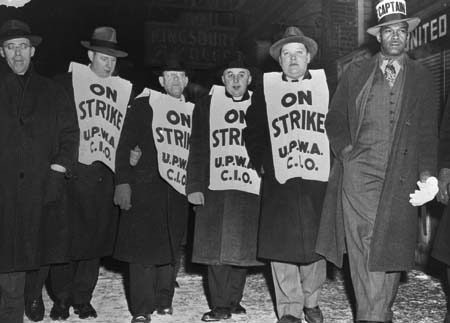
Saul Alinsky (extreme left) on the picket line of the United Packing House Workers at the Chicago stockyards on 16 January 1946.
Alinsky had clearly been left of center in terms of political ideology but had not been particularly active in politics at a young age. His hatred of the German Nazi leader Adolf Hitler and fascism led him to support the antifascist International Brigade during the Spanish Civil War. However, he never became a member of the Communist Party, as did some of his activist contemporaries.
Social Disorganization
Alinsky's mentors at the University of Chicago had developed a theory of “social disorganization” as a cause of delinquency. However, Alinsky asserted that economic defects in the social order are the cause of the social disorganization.
...
- Aristotle
- Arts
- Beatles, The
- Beethoven, Ludwig van
- Carson, Rachel
- Du Bois, W. E. B.
- Film Industry
- Ford, Henry
- Freud, Sigmund
- Graham, Martha
- Hitchcock, Alfred
- Jefferson, Thomas
- Kurosawa, Akira
- Libraries
- Literature
- Marx, Karl
- Mead, Margaret
- Mozart, Wolfgang Amadeus
- Music
- Nietzsche, Friedrich
- Phillips, Sam
- Picasso, Pablo
- Philosophy
- Plato
- Rockefeller, John D.
- Sarnoff, David
- Akbar
- Alexander the Great
- Alinsky, Saul
- Anthony, Susan B.
- Aristotle
- Ataturk, Mustafa Kemal
- Beethoven, Ludwig van
- Buddha
- Carnegie, Andrew
- Carson, Rachel
- Castro, Fidel
- Chanel, Coco
- Charlemagne
- Churchill, Winston
- Confucius
- Cromwell, Oliver
- Disney, Walt
- Du Bois, W. E. B.
- Eddy, Mary Baker
- Edison, Thomas
- Eisenhower, Dwight David
- Elizabeth I
- Ford, Henry
- Freud, Sigmund
- Friedan, Betty
- Gandhi, Mohandas K.
- Genghis Khan
- Goldman, Emma
- Gompers, Samuel
- Graham, Billy
- Graham, Martha
- Grant, Ulysses S.
- Gregory I, St.
- Guevara, Ernesto Che
- Haile Selassie
- Handsome Lake
- Harris, William Wade
- Hitchcock, Alfred
- Hitler, Adolf
- Jefferson, Thomas
- Jesus
- John XXIII, Pope
- Johnson, Lyndon
- Kennedy, John F.
- Kenyatta, Jomo
- King, Billie Jean
- King, Martin Luther, Jr.
- Kroc, Ray
- Kurosawa, Akira
- Lee, Ann
- Lee, Robert E.
- Lenin, Vladimir
- Lincoln, Abraham
- Lombardi, Vince
- Lumumba, Patrice
- Luther, Martin
- Machiavelli, Niccolo
- Malcolm X
- Mandela, Nelson
- Mao Zedong
- Marx, Karl
- Mayer, Louis B.
- Mead, Margaret
- Morgan, Arthur E.
- Morita, Akio
- Moses
- Mother Teresa
- Mozart, Wolfgang Amadeus
- Muhammad
- Nader, Ralph
- Napoleon
- Nasser, Gamal Abdel
- Nelson, Horatio Lord
- Nichiren
- Nietzsche, Friedrich
- Nkrumah, Kwame
- Nyerere, Julius
- Patton, George S.
- Paul, St.
- Phillips, Sam
- Picasso, Pablo
- Plato
- Reagan, Ronald
- Robinson, Jackie
- Rockefeller, John D.
- Roosevelt, Eleanor
- Roosevelt, Franklin Delano
- Roosevelt, Theodore
- Russell, Bill
- Saladin
- Sanger, Margaret
- Sarnoff, David
- Shaka Zulu
- Shibusawa Eiichi
- Sloan, Alfred
- Stalin, Josef
- Süleyman the Magnificent
- Tokugawa Ieyasu
- Tutu, Desmond
- Washington, George
- Watson, Thomas, Jr.
- Welch, Jack
- Wells-Barnett, Ida B.
- Whitefield, George
- Wilson, Woodrow
- Winfrey, Oprah
- Young, Brigham
- Bank of America
- Ben & Jerry's Ice Cream
- Body Shop, The
- Business
- Carnegie, Andrew
- Chanel, Coco
- Disney, Walt
- Dot-Com Meltdown
- Enron Scandal
- Ford, Henry
- Kroc, Ray
- Labor Movement
- Management
- Management, Business
- Mayer, Louis B.
- Morita, Akio
- Nader, Ralph
- Rockefeller, John D.
- Sarnoff, David
- Sears, Roebuck & Co. Catalogue
- Shibusawa Eiichi
- Sloan, Alfred
- Small Business
- Trust Busting
- Watson, Thomas, Jr.
- Welch, Jack
- Winfrey, Oprah
- Women and Business Leadership
- Apartheid in South Africa, Demise of
- Bank of America
- Bay of Pigs
- Beatles, The
- Ben & Jerry's Ice Cream
- Birth Control
- Body Shop, The
- Brighton Declaration
- Christian Right
- Civil Rights Act of 1964
- Cuban Missile Crisis
- D-Day
- Dot-Com Meltdown
- East Timor, Founding of
- Enron Scandal
- Environmental Protection Agency
- Farm Worker Movement
- Free Press in Panama, Creation of
- Green Parties
- Hiroshima
- Iranian Hostage Crisis
- Israel, Founding of
- Jonestown Mass Suicide
- Lewis and Clark Expedition
- Long March
- Manhattan Project
- Mau Mau Rebellion
- Modern Olympics Movement
- Panama Canal, Building of
- Panama Canal Treaties
- Pearl Harbor
- Pueblo Revolt
- Race to the South Pole
- Sears, Roebuck & Co. Catalogue
- September 11th
- Singapore, Founding of
- Stonewall Rebellion
- Suez Crisis of 1956
- Tiananmen Square
- Trust Busting
- Truth and Reconciliation Commissions
- United States Constitution
- War on Terrorism
- Women's Olympics
- Women's Suffrage
- Xian Incident
- Akbar
- Alexander the Great
- Apartheid in South Africa, Demise of
- Ataturk, Mustafa Kemal
- Brighton Declaration
- Buddha
- Confucianism
- Confucius
- Cross-Cultural Leadership
- East Timor, Founding of
- Gandhi, Mohandas K.
- Genghis Khan
- Globalization
- Green Parties
- Guevara, Ernesto Che
- Haile Selassie
- Handsome Lake
- Harris, William Wade
- Hiroshima
- Human Rights
- International Leadership Association
- Iranian Hostage Crisis
- Israel, Founding of
- Kenyatta, Jomo
- Kurosawa, Akira
- Long March
- Lumumba, Patrice
- Mandela, Nelson
- Mao Zedong
- Mau Mau Rebellion
- Modern Olympics Movement
- Morita, Akio
- Moses
- Mother Teresa
- Muhammad
- Nasser, Gamal Abdel
- Nichiren
- Nkrumah, Kwame
- Nyerere, Julius
- Panama Canal, Building of
- Panama Canal Treaties
- Pueblo Revolt
- Religion
- Religious Studies
- Sacred Texts
- Saladin
- Shaka Zulu
- Shibusawa Eiichi
- Singapore, Founding of
- Suez Crisis of 1956
- Suleyman the Magnificent
- Tiananmen Square
- Tokugawa Ieyasu
- Truth and Reconciliation Commissions
- Tutu, Desmond
- Utopian Leaders
- War on Terrorism
- Xian Incident
- Arts
- Business
- Civil Rights Movement
- Coaching
- Community Development
- Congressional Leadership
- E-Commerce
- Education, Higher
- Education, K-2
- Education: Overview
- Entrepreneurship
- Family Businesses
- Family Leadership
- Film Industry
- Gangs
- Human Rights
- Intentional Communities
- Labor Movement
- Libraries
- Literature
- Management, Business
- Military
- Music
- Nonprofit Organizations
- Organizing
- Parliament, British
- Politics
- Presidential Leadership, U.S.
- Public Health
- Religion
- Science and Technology
- Small Business
- Sports
- Traditional Societies
- Utopian Leaders
- Women's Movement
- Youth Leadership
- Alienation
- Altruism
- Collective Action
- Follower-Oriented Leadership
- Followers, Motivation of
- Followership
- Leader-Follower Relationships
- Leaderless Groups
- Mentoring
- Obedience
- Self-Management
- Autocratic Leadership
- Democratic Leadership
- Dysfunctional Leadership
- E-Leadership
- Eupsychian Management
- Individualism and Collectivism
- Innovative Leadership
- Invisible Leadership
- Laissez-Faire Leadership
- Leading at a Distance
- Narcissistic Leadership
- Reconstructive Leadership
- Shared Leadership
- Socio-Emotional Leadership
- Strategic Leadership
- Transformational and Transactional Leadership
- Tyrannical Leadership
- Alexander the Great
- Bay of Pigs
- Eisenhower, Dwight David
- Grant, Ulysses S.
- D-Day
- Genghis Khan
- Hiroshima
- Israel, Founding of
- Lee, Robert E.
- Long March
- Manhattan Project
- Mau Mau Rebellion
- Napoleon
- Nelson, Horatio Lord
- Patton, George S.
- Pearl Harbor
- Pueblo Revolt
- Saladin
- War on Terrorism
- Achievement Motivation
- Authenticity
- Big Five Personality Traits
- Charisma
- Cognitive Structures
- Conformity
- Creativity
- Dominance and Submission
- Efficacy
- Ethics, Contemporary
- Ethics: Overview
- Happiness
- Hope
- Humor
- Idiosyncrasy Credit
- Intelligence, Emotional
- Intelligence, Social
- Intelligence, Verbal
- Intelligences, Other
- Leading from Within
- Modeling and Leading by Example
- Motivation, Intrinsic and Extrinsic
- Narratives
- Negative Capability
- Optimism
- Personality and Group Roles
- Power Motivation
- Resiliency
- Rhetoric
- Risk Taking
- Schemata, Scripts, and Mental Models
- Self-Interest
- Tacit Knowledge
- Trust
- Akbar
- Ataturk, Mustafa Kemal
- Bay of Pigs
- Castro, Fidel
- Charlemagne
- Christian Right
- Churchill, Winston
- Civil Rights Act of 1964
- Congressional Leadership
- Cromwell, Oliver
- Cuban Missile Crisis
- Eisenhower, Dwight David
- Elizabeth I
- Gandhi, Mohandas K.
- Grant, Ulysses S.
- Groupthink
- Guevara, Ernesto Che
- Haile Selassie
- Hiroshima
- History
- Hitler, Adolf
- Iranian Hostage Crisis
- Jefferson, Thomas
- Johnson, Lyndon
- Kennedy, John F.
- Kenyatta, Jomo
- Lenin, Vladimir
- Lincoln, Abraham
- Lumumba, Patrice
- Machiavelli, Niccolo
- Manhattan Project
- Mao Zedong
- Nasser, Gamal Abdel
- Nkrumah, Kwame
- Nyerere, Julius
- Panama Canal, Building of
- Panama Canal Treaties
- Parliament, British
- Pearl Harbor
- Political Science
- Politics
- Presidential Leadership, U.S.
- Reagan, Ronald
- Roosevelt, Franklin Delano
- Roosevelt, Theodore
- Shaka Zulu
- Stalin, Josef
- Suleyman the Magnificent
- Tokugawa Ieyasu
- Trust Busting
- United States Constitution
- Utopian Leaders
- War on Terrorism
- Washington, George
- Wilson, Woodrow
- Women and Political Leadership
- Women's Suffrage
- Coercion
- Influence Tactics
- Power Distance
- Power of Ideas
- Power Sharing
- Power, Six Bases of
- Power: Overview
- Akbar
- Buddha
- Confucius
- Eddy, Mary Baker
- Ethics: Overview
- Gandhi, Mohandas K.
- Graham, Billy
- Gregory I, St.
- Handsome Lake
- Harris, William Wade
- Jesus
- John XXIII, Pope
- Jonestown Mass Suicide
- King, Martin Luther, Jr.
- Lee, Ann
- Luther, Martin
- Malcolm X
- Moses
- Mother Teresa
- Muhammad
- Nichiren
- Paul, St.
- Pueblo Revolt
- Religion
- Religious Studies
- Sacred Texts
- Spirituality
- Tutu, Desmond
- Utopian Leaders
- Whitefield, George
- Young, Brigham
- Aristotle
- Birth Control
- Carnegie, Andrew
- Carson, Rachel
- Disney, Walt
- Dot-Com Meltdown
- Eddy, Mary Baker
- Edison, Thomas
- Environmental Justice
- Environmental Protection Agency
- Ford, Henry
- Hiroshima
- Lewis and Clark Expedition
- Manhattan Project
- Mead, Margaret
- Morgan, Arthur E.
- Morita, Akio
- Panama Canal, Building of
- Plato
- Public Health
- Race to the South Pole
- Rockefeller, John D.
- Sanger, Margaret
- Sarnoff, David
- Science and Technology
- Shibusawa Eiichi
- Sloan, Alfred
- Watson, Thomas, Jr.
- Welch, Jack
- Adaptive Work
- Boundaries and Authority
- Bureaucracy
- Change Management
- Coalitions
- Communication
- Competition
- Conflict
- Contingency Theories
- Corporate Social Responsibility
- Crisis
- Cross-Cultural Leadership
- Decision Making
- Dirty Hands
- Distribution of Leadership
- Economic Justice
- Empowerment
- Ethics, Contemporary
- Friendship
- Globalization
- Group Cohesiveness
- Group Decision Rules
- Group Effectiveness
- Group Norms
- Group Process
- Group Satisfaction
- Groupthink
- Intergroup Processes
- Leadership Effectiveness
- Leadership for the Common Good
- Leadership in the Digital Age
- Leadership Succession
- Learning Organization
- Legacy
- Majority and Minority Influence
- Management
- Moral Imagination
- Motivational Contagion
- Networks and Networked Organizations
- Organizational Climate and Culture
- Organizational Dynamics
- Organizational Justice
- Organizational Theory
- Poverty and Inequality
- Psychological Substructures
- Racial Minorities
- Relational Leadership Approaches
- Resistance
- Romance of Leadership
- Spirituality
- Substitutes for Leadership
- Task Leadership
- Team Leadership
- Teamwork
- Total Quality Management
- Upward Influence
- Alinsky, Saul
- Anthony, Susan B.
- Apartheid in South Africa, Demise of
- Ben & Jerry's Ice Cream
- Birth Control
- Body Shop, The
- Brighton Declaration
- Goldman, Emma
- Farm Worker Movement
- Human Rights
- Green Parties
- Intentional Communities
- King, Martin Luther, Jr.
- Malcolm X
- Mandela, Nelson
- Mau Mau Rebellion
- Nader, Ralph
- Organizing
- Pueblo Revolt
- Sanger, Margaret
- Stonewall Rebellion
- Tiananmen Square
- Utopian Leaders
- Wells-Barnett, Ida B.
- Women's Movement
- Women's Suffrage
- History
- International Leadership Association
- Philosophy
- Political Science
- Religious Studies
- Sacred Texts
- Social Psychology
- Sociology
- Actor Network Theory
- Attribution Processes
- Charismatic Theory
- Confucianism
- Connective Leadership
- Constructivism
- Decision Making: The Vroom/Yetton/Jago Models
- Deep Change
- Discourse Ethics
- Distinctive Competence Approach
- Elite Theory
- GLOBE Research Program
- Grounded Theory
- Group and Systems Theory
- Hot Groups
- Implicit Leadership Theories
- Integrative Theory
- Justice
- Labeling Theory
- Leader Categorization Theory
- Leader-Member Exchange (LMX) Theory
- Leadership Development
- Leadership Theories: Overview
- Mental Models
- Methodologies of Leadership Research
- Path-Goal Analysis
- Psychoanalytic Theory
- Qualitative Methods
- Situational and Contingency Approaches to Leadership
- Social Dilemmas
- Social Identity Theory
- Social Capital Theories
- Sociobiology of Leadership
- Systems Theory
- Theories X, Y, and Z
- Transformational and Visionary Leadership
- Transformistic Theory
- Visionary Leadership Theory
- Anthony, Susan B.
- Barriers to Women's Leadership
- Birth Control
- Body Shop, The
- Business
- Brighton Declaration
- Chanel, Coco
- Children, Socialization and Leadership Development in
- Congressional Leadership
- Elizabeth I
- Enron Scandal
- Film Industry
- Friedan, Betty
- Gender and Authority
- Gender Gap
- Gender Stereotypes
- Gender-Based Structure of Work
- Goldman, Emma
- Green Parties
- King, Billie Jean
- Mead, Margaret
- Mother Teresa
- Patriarchy
- Roosevelt, Eleanor
- Sanger, Margaret
- Wells-Barnett, Ida B.
- Winfrey, Oprah
- Women and Business Leadership
- Women and Men as Leaders
- Women and Political Leadership
- Women and Social Change Leadership
- Women's Movement
- Women's Olympics
- Women's Suffrage
- Women's Value Orientation
- Loading...
Get a 30 day FREE TRIAL
-
 Watch videos from a variety of sources bringing classroom topics to life
 -
Read modern, diverse business cases
-
Explore hundreds of books and reference titles

Read next

More like this
Sage Recommends
We found other relevant content for you on other Sage platforms.
Have you created a personal profile? Login or create a profile so that you can save clips, playlists and searches