
Entry
Reader's guide
Entries A-Z
Subject index
Combined DNA Index System
Imagine a law enforcement tool that can take biological information from a crime scene, enter it into a computer, and obtain information sufficient to tentatively identify a suspect for investigation. Similar to automated fingerprinting systems, genetic profiles can be obtained from a crime scene, people (to include victims or offenders), or items belonging to missing persons. The Combined DNA Index System (CODIS) is a computerized, hierarchical system that allows the entry and storage of genetic profiles for law enforcement purposes.
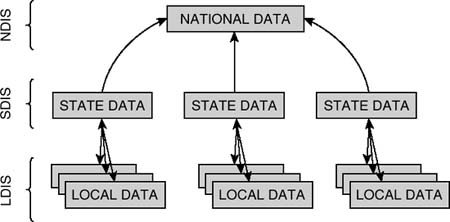
Figure 1 The CODIS Database Chain
The system was initially developed by the Federal Bureau of Investigation (FBI) in 1990 and operated on a limited basis. The DNA Identification Act of 1994 provided the FBI with the authorization to expand the project on a national level and it was four years later, in October 1998, the National DNA Index System (NDIS) officially went online.
The CODIS database has a three-level structure (see Figure 1) that includes the local law enforcement community (Local DNA Index System, LDIS), the state level (State DNA Index System, SDIS), and the national level (NDIS). The FBI maintains the database but the local level is instrumental in the process, with the majority of DNA profiles generated at the lower levels. The flow of information moves from the LDIS level upward to SDIS level where state agencies and laboratories may retrieve and further exchange information within the state. From this point the profiles become accessible to agencies across the nation, via NDIS. This structure allows for differences in local and state law but facilitates national access and utilization.
What is Entered into the System?
It is well known today that genetic information can identify individuals and that a database system can hold this information, but most people cannot explain how the system works. There are actually multiple types of specific genetic information, obtained from different sources and by various methods, that are incorporated into the system. The entire DNA makeup of an individual contains a vast amount of material and is referred to as genomic DNA. Scientists have narrowed down this tremendous amount of information to several specific, short segments that are highly variable and can be used to individualize a sample to a particular individual. These short segments are known as microsatellites or short tandem repeats (STRs) and are taken from nuclear DNA (nuDNA). Nuclear DNA comes from the nucleus. What makes STRs so helpful is that original DNA typing required relatively large, pure (uncontaminated) samples to provide information. Obvious problems, from an investigatory stance, are that samples are rarely large or pure. STRs are very small, short segments of information that can be chemically copied quickly (polymerase chain reaction) to create a larger sample for testing. The FBI system has isolated 13 STRs on the nuDNA that can be used together (multiplexed) to calculate the probability that a sample came from no one but a particular individual. This is not a sample-to-sample direct match system, but is based on frequencies of known populations. Thus the chance of 1 in 67 billion that a sample came from someone other than the offender is a pretty good estimate that the sample and offender are one and the same.
...
- Agencies/Associations/Organizations
- Academy of Criminal Justice Sciences
- Airborne Law Enforcement Association
- American Society of Criminology
- Burns Detective Agency
- Child Welfare
- Commission on the Accreditation of Law Enforcement Agencies
- Crime Stoppers
- Federal Law Enforcement Officers Association
- Fraternal Organizations
- Hispanic American Police Command Officers Association
- International Association of Campus Law Enforcement Administrators
- International Association of Chiefs of Police
- International Association of Women Police
- Mothers against Drunk Driving
- National Association of Women Law Enforcement Executives
- National Black Police Officers Association
- National Native American Law Enforcement Association
- National Organization of Black Law Enforcement Executives
- National Rifle Association
- National Sheriffs' Association
- Police Executive Research Forum
- Police Foundation
- U.S. Police Canine Association, Inc.
- Civilian/Private Involvement
- Communications
- Crime Statistics
- Culture/Media
- Drug Enforcement
- Asset Forfeiture, State
- Comprehensive Drug Abuse Prevention and Control Act
- Drug Enforcement Administration
- Drug Enforcement in the United States
- Drug Policy and Legislation
- Drug Prevention Education
- Drug Testing of Employees
- Drug Testing of Police
- Drug Trafficking
- Federal Drug Seizure System
- Food and Drug Administration
- Harrison Act
- Marijuana Tax Act
- Narcotics Control Act
- Office of National Drug Control Policy
- Pure Food, Drink, and Drug Act
- Federal Agencies/Organizations
- Bureau of Engraving and Printing Police
- Bureau of Engraving and Printing Police
- Bureau of Immigration and Customs Enforcement
- Bureau of Industry and Security
- Bureau of Land Management Law Enforcement
- Bureau of Reclamation, Office of Security, Safety, and Law Enforcement
- Critical Incident Response Group
- Department of Health and Human Services
- Department of Homeland Security
- Department of Justice
- Diplomatic Security Service
- Drug Enforcement Administration
- Federal Air Marshal Program
- Federal Aviation Administration
- Federal Bureau of Investigation
- Federal Law Enforcement Training Center
- Federal Protective Service
- Financial Crimes Enforcement Network
- Fish and Wildlife Service, Division of Law Enforcement
- Forest Service, Law Enforcement and Investigations
- Inspectors General
- Inspectors General, Offices of
- Internet Fraud Complaint Center
- Law Enforcement Assistance Administration, Federal
- Law Enforcement Assistance Administration, State and Local
- Library of Congress Police
- National Crime Information Center
- National Highway Traffic Safety Administration
- National Institutes of Health, Department of Health and Human Services
- National Marine Fisheries Service, Department of Commerce
- National Public Safety Information Bureau
- National Security Agency
- National Transportation Safety Board
- National Zoological (Smithsonian) Park Protective Services
- Nuclear Security, Department of Energy
- Office of Security, Central Intelligence Agency
- Office of Surface Mining Reclamation and Enforcement
- Pentagon Police
- Secret Service
- Tennessee Valley Authority Police
- Transportation Security Administration
- U.S. Capitol Police
- U.S. Coast Guard
- U.S. Customs Service
- U.S. Marshals Service
- U.S. Postal Inspection Service
- International Law Enfrocement
- Community Policing, International
- Community Policing: A Caribbean Case Study
- EUROPOL
- History of Police
- International Criminal Justice Mechanisms
- International Police Association
- International Police Cooperation
- INTERPOL
- Police and Peacekeeping in the United Nations
- Police and Terrorism
- Police Corruption
- Police Corruption: Combating Strategies
- Police Structure: Centralized/Decentralized
- Police Training: A Comparative Perspective
- Private Security Industry Growth in Western Countries
- Suicide by Cop: International Perspective (Police-Involved, Victim-Provoked Shooting)
- United Nations and Criminal Justice Policy
- Women in Policing
- Investigation Techniques
- American Society of Crime Laboratory Directors
- Ballistics
- Ballistics Recognition and Identification Systems
- Combined DNA Index System
- Coroner and Medical Examiner Systems
- Crime Laboratories
- Crime Laboratory Accreditation
- Crime Mapping
- Crime Scene Investigation
- Detectives
- DNA
- DNA Testing
- Document Examiners
- Encryption
- Evidence
- Fingerprints
- Forensic Accounting
- Forensic Art
- Forensic Science
- Geographic Information System
- Information Technologies
- Interrogation
- Investigative Techniques
- Lie Detection
- Profiling, Criminal Personality
- Profiling, Drug Courier
- Profiling, Geographic
- Task Forces
- Undercover Operations, Federal
- Undercover Operations, State and Local
- Investigation, Types of
- AMBER Alert
- Arson Investigation
- Art Theft Investigation
- Child Abduction Investigations
- Child Molestation
- Child Pornography
- Cold Case Investigations
- Computer Crime
- Crime Scene Investigation
- Domestic Violence Enforcement
- Drunk Driving Enforcement
- Gangs Investigation
- Homicide Investigation
- Identity Theft and Identity Crimes
- Missing Persons Investigations
- Office of Security, Central Intelligence Agency
- Organized Crime Control
- Serial Murder Investigation
- Sex Crime Investigation
- Vidocq Society
- Investigative Commissions
- Christopher Commission, The
- Crown Heights Report
- Knapp Commission, The
- McCone Commission, The
- Mollen Commission, The
- National Advisory Commission on Civil Disorder (Kerner Commission)
- National Commission on Law Observance and Enforcement (Wickersham Commission)
- President's Commission on Law Enforcement and the Administration of Justice
- Rampart Investigation, The
- Law and Justice
- Legislation/Legal Issues
- Antiterrorism and Effective Death Penalty Act
- Brady Handgun Violence Prevention Act
- Campus Safety and Security Acts
- Children's Online Privacy Protection Act
- Church Arson Prevention Act
- Comprehensive Drug Abuse Prevention and Control Act
- Consent Decrees
- Freedom of Information Act
- Fugitive Felon Act
- Gun Control
- Gun Control Act
- Harrison Act
- Hate Crimes
- Hate Crimes Statistics Act
- Hate Crimes, Law Enforcement Response to
- Immigrants (Policy Toward)
- Mann Act
- Marijuana Tax Act
- Motor Vehicle Theft Act
- Narcotics Control Act
- Omnibus Crime Control and Safe Streets Act
- Posse Comitatus Act
- Privacy Act
- Prohibition Law Enforcement
- Pure Food, Drink, and Drug Act
- Racketeer Influenced and Corrupt Organizations Act
- Sexual Offender Civil Commitment
- USA PATRIOT Act
- Violence against Women Act
- Violent Crime Control and Law Enforcement Act (1994)
- Volstead Act
- Military
- Intelligence and Security Command, Department of the Army, Department of Defense
- Militarization of American Police
- Military Police, Department of the Army, Department of Defense
- Military Policing
- National Guard
- Naval Criminal Investigative Service
- U.S. Air Force Office of Special Investigations
- U.S. Air Force Security Forces
- U.S. Criminal Investigation Command, Department of the Army, Department of Defense
- Minority Issues
- Affirmative Action in Policing
- Cultural Competency Training/Sensitivity Training
- Depolicing
- Gays in Policing
- Hate Crimes
- Hate Crimes, Law Enforcement Response to
- Immigrants (Policy Toward)
- International Association of Women Police
- National Association of Women Law Enforcement Executives
- National Native American Law Enforcement Association
- National Organization of Black Law Enforcement Executives
- Profiling, Racial
- Race Relations
- Tribal Policing
- Women in Federal Agency Law Enforcement
- Women in Federal Law Enforcement
- Women in Policing, State and Local
- Personnel Issues
- Affirmative Action in Policing
- Assaults on the Police
- Body Armor
- Cultural Competency Training/Sensitivity Training
- Drug Testing of Employees
- Drug Testing of Police
- Early Warning Systems
- Education of Police
- Evaluation of Officers
- Fraternal Organizations
- Hiring Standards for Police
- Morale
- Patrol Shifts
- Patrol Work
- Physical Fitness and Training
- Police Corps
- Police Discretion
- Police Management
- Police Officers' Bill of Rights
- Police Residency Requirements
- Police Shootings
- Police Strikes/“Blue Flu”
- Police Training in the United States
- Psychologists/Psychological Services
- Quotas (Tickets, Arrests)
- Rank Structure
- Stress
- Unions
- Police Conduct
- Accountability
- Assaults on the Police
- Civil Liability
- Civil Rights Violations by Police
- Civilian Complaint Review Boards
- Complaints against Police
- Consent Decrees
- Corruption/Integrity
- Early Warning Systems
- Ethics
- Evaluation of Officers
- Internal Affairs
- Police Brutality
- Police Code of Silence
- Police Discretion
- Police Misconduct
- Police Shootings
- Suicide by Cop
- Use of Force
- Whistle-Blowing
- Police Procedures
- Arrest
- Canine (K-9) Units
- Chain of Custody
- Confessions
- Duty Belt
- Electronic Surveillance, Federal
- Electronic Surveillance, State and Local
- Exclusionary Rule
- Eyewitnesses
- Hostage Negotiations
- Informants
- Interrogation
- Lie Detection
- Lineups
- Miranda Warnings
- Nonlethal Weapons
- Plain View Doctrine
- Police Discretion
- Police Pursuits
- Probable Cause
- Search and Seizure
- Search Warrants
- Stop and Frisk
- SWAT Teams
- Undercover Operations, Federal
- Undercover Operations, State and Local
- Use of Force
- Vehicle Searches
- Video in Patrol Cars
- Weapons
- Policing Strategies
- Safety and Security
- Airport Security
- Auxiliary/Reserve/Part-Time Police
- Burns Detective Agency
- Campus Policing
- Emergency Services Units
- National Domestic Preparedness Office
- National Guard
- Peace Officers
- Pinkerton National Detective Agency
- Private Policing
- School Crime/Security/Response
- Special Jurisdiction Law Enforcement Agencies
- Wackenhut Corporation
- Specialized Law Enforcement Agencies
- Tactics
- Arrest
- Bombs and Bomb Squads
- Canine (K-9) Units
- Counterterrorism
- Crime Mapping
- Crime Prevention Units
- Crisis Intervention
- Duty Belt
- Emergency Services Units
- Geographic Information System
- Hostage Negotiations
- Juvenile Crimes/Programs/Units
- Mentally Ill, Police Response to the
- Militarization of American Police
- Misdemeanors
- Nonlethal Weapons
- Police Mediation
- Radar
- Riots/Demonstrations (Response to)
- Special Victims Units
- Stop and Frisk
- SWAT Teams
- Task Forces
- Traffic Enforcement
- Truancy
- Use of Force
- Vehicle Searches
- Weapons
- Terrorism
- Victims/Witnesses
- Loading...
Get a 30 day FREE TRIAL
-
 Watch videos from a variety of sources bringing classroom topics to life
 -
Read modern, diverse business cases
-
Explore hundreds of books and reference titles

Read next

More like this
Sage Recommends
We found other relevant content for you on other Sage platforms.
Have you created a personal profile? Login or create a profile so that you can save clips, playlists and searches