
Entry
Reader's guide
Entries A-Z
Subject index
Azerbaijan
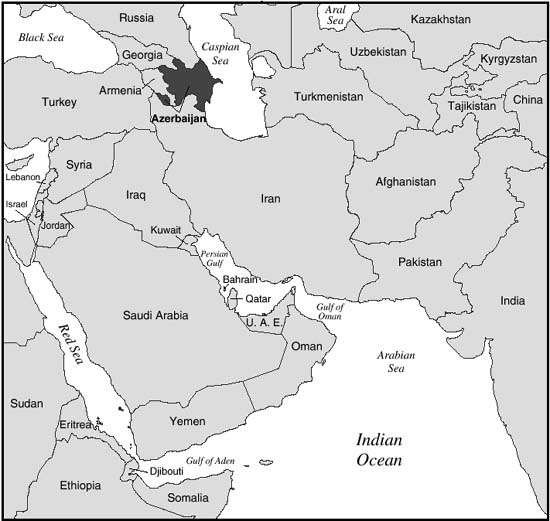
Azerbaijan, also known as the Azerbaijani Republic, is situated in Transcaucasia, bordering the Caspian Sea and having frontiers with the Russian Federation, Georgia, Armenia, Turkey, and Iran. It covers approximately 86,600 square kilometers and currently has approximately 8 million inhabitants, 53% of whom live in towns. The majority religion, followed by 80% of the population, is Islam. The government is a mixed parliamentary-presidential regime with a very strong president. The judicial power is vested in a Constitutional Court, a Supreme Court, an Economic Court, specialized courts, and ordinary courts. The Supreme Court is the highest court on criminal, civil, administrative, and nonconstitutional matters.
Criminal Justice System
The criminal justice system in Azerbaijan includes two centralized executive agencies: the Ministry of Justice and the Ministry of Internal Affairs. The Ministry of Justice oversees the judicial system. The Office of the Prokuratura (Prosecutor) General is responsible for ensuring that investigative agencies and court proceedings are in compliance with the constitution. The Ministry of Internal Affairs oversees the law enforcement agencies. The militia is the major police force in Azerbaijan. It is a single system, which is incorporated into the structure of the Ministry of Internal Affairs. The Minister of Internal Affairs appoints the heads of regional militia departments. The heads of city and district militia departments are appointed by the heads of regional militia departments. The militia consists of several subdivisions, including criminal division (detectives), public safety, transportation militia, traffic patrol, and special forces. Under the Law on Militia, the militia's major tasks are providing personal security for citizens, protecting their rights and freedoms, preventing and combating crime, maintaining public order, uncovering and investigating crime, arresting offenders, maintaining safety on the roads, protecting public and private property, and executing criminal sentences and administrative penalties.
Policing in the Soviet Era
The country was under the control of the Soviet Union for 71 years, between 1920 and 1991, and the police in Azerbaijan, like many other state agencies, still reflect the organizational and functional characteristics of the Soviet system of policing. Even though Azerbaijan is working toward adopting or revising all its institutions in order to comply with the needs of a democratic society, it is still important to address the Soviet legacy to better analyze policing in post-Soviet Azerbaijan.
The militia in the former Soviet Union was a standardized police organization, which existed in a vast territory that extended from East Germany to the Pacific Ocean. It was developed in Moscow and exported throughout the socialist societies. The Ministry of Interior Academy in Moscow trained personnel from all over what was then the Soviet Union. The militia was the primary law enforcement body responsible for social and economic order during more than 70 years of Soviet rule. The relationship between the militia and the political structure in the Soviet Union remained much closer than in democratic societies, allowing the Communist Party to direct the militia to suppress political opposition. This close relationship harmed the militia deeply. By the end of the Soviet Union, the organization had entirely lost credibility with the public. Many members left the organization at the end of the 1980s leaving the police without the qualified, experienced personnel needed to fulfill increasingly difficult duties. Despite the final efforts to democratize during the perestroika years, the Soviet militia remained as an authoritarian police force.
...
- Agencies/Associations/Organizations
- Academy of Criminal Justice Sciences
- Airborne Law Enforcement Association
- American Society of Criminology
- Burns Detective Agency
- Child Welfare
- Commission on the Accreditation of Law Enforcement Agencies
- Crime Stoppers
- Federal Law Enforcement Officers Association
- Fraternal Organizations
- Hispanic American Police Command Officers Association
- International Association of Campus Law Enforcement Administrators
- International Association of Chiefs of Police
- International Association of Women Police
- Mothers against Drunk Driving
- National Association of Women Law Enforcement Executives
- National Black Police Officers Association
- National Native American Law Enforcement Association
- National Organization of Black Law Enforcement Executives
- National Rifle Association
- National Sheriffs' Association
- Police Executive Research Forum
- Police Foundation
- U.S. Police Canine Association, Inc.
- Civilian/Private Involvement
- Communications
- Crime Statistics
- Culture/Media
- Drug Enforcement
- Asset Forfeiture, State
- Comprehensive Drug Abuse Prevention and Control Act
- Drug Enforcement Administration
- Drug Enforcement in the United States
- Drug Policy and Legislation
- Drug Prevention Education
- Drug Testing of Employees
- Drug Testing of Police
- Drug Trafficking
- Federal Drug Seizure System
- Food and Drug Administration
- Harrison Act
- Marijuana Tax Act
- Narcotics Control Act
- Office of National Drug Control Policy
- Pure Food, Drink, and Drug Act
- Federal Agencies/Organizations
- Bureau of Engraving and Printing Police
- Bureau of Engraving and Printing Police
- Bureau of Immigration and Customs Enforcement
- Bureau of Industry and Security
- Bureau of Land Management Law Enforcement
- Bureau of Reclamation, Office of Security, Safety, and Law Enforcement
- Critical Incident Response Group
- Department of Health and Human Services
- Department of Homeland Security
- Department of Justice
- Diplomatic Security Service
- Drug Enforcement Administration
- Federal Air Marshal Program
- Federal Aviation Administration
- Federal Bureau of Investigation
- Federal Law Enforcement Training Center
- Federal Protective Service
- Financial Crimes Enforcement Network
- Fish and Wildlife Service, Division of Law Enforcement
- Forest Service, Law Enforcement and Investigations
- Inspectors General
- Inspectors General, Offices of
- Internet Fraud Complaint Center
- Law Enforcement Assistance Administration, Federal
- Law Enforcement Assistance Administration, State and Local
- Library of Congress Police
- National Crime Information Center
- National Highway Traffic Safety Administration
- National Institutes of Health, Department of Health and Human Services
- National Marine Fisheries Service, Department of Commerce
- National Public Safety Information Bureau
- National Security Agency
- National Transportation Safety Board
- National Zoological (Smithsonian) Park Protective Services
- Nuclear Security, Department of Energy
- Office of Security, Central Intelligence Agency
- Office of Surface Mining Reclamation and Enforcement
- Pentagon Police
- Secret Service
- Tennessee Valley Authority Police
- Transportation Security Administration
- U.S. Capitol Police
- U.S. Coast Guard
- U.S. Customs Service
- U.S. Marshals Service
- U.S. Postal Inspection Service
- International Law Enfrocement
- Community Policing, International
- Community Policing: A Caribbean Case Study
- EUROPOL
- History of Police
- International Criminal Justice Mechanisms
- International Police Association
- International Police Cooperation
- INTERPOL
- Police and Peacekeeping in the United Nations
- Police and Terrorism
- Police Corruption
- Police Corruption: Combating Strategies
- Police Structure: Centralized/Decentralized
- Police Training: A Comparative Perspective
- Private Security Industry Growth in Western Countries
- Suicide by Cop: International Perspective (Police-Involved, Victim-Provoked Shooting)
- United Nations and Criminal Justice Policy
- Women in Policing
- Investigation Techniques
- American Society of Crime Laboratory Directors
- Ballistics
- Ballistics Recognition and Identification Systems
- Combined DNA Index System
- Coroner and Medical Examiner Systems
- Crime Laboratories
- Crime Laboratory Accreditation
- Crime Mapping
- Crime Scene Investigation
- Detectives
- DNA
- DNA Testing
- Document Examiners
- Encryption
- Evidence
- Fingerprints
- Forensic Accounting
- Forensic Art
- Forensic Science
- Geographic Information System
- Information Technologies
- Interrogation
- Investigative Techniques
- Lie Detection
- Profiling, Criminal Personality
- Profiling, Drug Courier
- Profiling, Geographic
- Task Forces
- Undercover Operations, Federal
- Undercover Operations, State and Local
- Investigation, Types of
- AMBER Alert
- Arson Investigation
- Art Theft Investigation
- Child Abduction Investigations
- Child Molestation
- Child Pornography
- Cold Case Investigations
- Computer Crime
- Crime Scene Investigation
- Domestic Violence Enforcement
- Drunk Driving Enforcement
- Gangs Investigation
- Homicide Investigation
- Identity Theft and Identity Crimes
- Missing Persons Investigations
- Office of Security, Central Intelligence Agency
- Organized Crime Control
- Serial Murder Investigation
- Sex Crime Investigation
- Vidocq Society
- Investigative Commissions
- Christopher Commission, The
- Crown Heights Report
- Knapp Commission, The
- McCone Commission, The
- Mollen Commission, The
- National Advisory Commission on Civil Disorder (Kerner Commission)
- National Commission on Law Observance and Enforcement (Wickersham Commission)
- President's Commission on Law Enforcement and the Administration of Justice
- Rampart Investigation, The
- Law and Justice
- Legislation/Legal Issues
- Antiterrorism and Effective Death Penalty Act
- Brady Handgun Violence Prevention Act
- Campus Safety and Security Acts
- Children's Online Privacy Protection Act
- Church Arson Prevention Act
- Comprehensive Drug Abuse Prevention and Control Act
- Consent Decrees
- Freedom of Information Act
- Fugitive Felon Act
- Gun Control
- Gun Control Act
- Harrison Act
- Hate Crimes
- Hate Crimes Statistics Act
- Hate Crimes, Law Enforcement Response to
- Immigrants (Policy Toward)
- Mann Act
- Marijuana Tax Act
- Motor Vehicle Theft Act
- Narcotics Control Act
- Omnibus Crime Control and Safe Streets Act
- Posse Comitatus Act
- Privacy Act
- Prohibition Law Enforcement
- Pure Food, Drink, and Drug Act
- Racketeer Influenced and Corrupt Organizations Act
- Sexual Offender Civil Commitment
- USA PATRIOT Act
- Violence against Women Act
- Violent Crime Control and Law Enforcement Act (1994)
- Volstead Act
- Military
- Intelligence and Security Command, Department of the Army, Department of Defense
- Militarization of American Police
- Military Police, Department of the Army, Department of Defense
- Military Policing
- National Guard
- Naval Criminal Investigative Service
- U.S. Air Force Office of Special Investigations
- U.S. Air Force Security Forces
- U.S. Criminal Investigation Command, Department of the Army, Department of Defense
- Minority Issues
- Affirmative Action in Policing
- Cultural Competency Training/Sensitivity Training
- Depolicing
- Gays in Policing
- Hate Crimes
- Hate Crimes, Law Enforcement Response to
- Immigrants (Policy Toward)
- International Association of Women Police
- National Association of Women Law Enforcement Executives
- National Native American Law Enforcement Association
- National Organization of Black Law Enforcement Executives
- Profiling, Racial
- Race Relations
- Tribal Policing
- Women in Federal Agency Law Enforcement
- Women in Federal Law Enforcement
- Women in Policing, State and Local
- Personnel Issues
- Affirmative Action in Policing
- Assaults on the Police
- Body Armor
- Cultural Competency Training/Sensitivity Training
- Drug Testing of Employees
- Drug Testing of Police
- Early Warning Systems
- Education of Police
- Evaluation of Officers
- Fraternal Organizations
- Hiring Standards for Police
- Morale
- Patrol Shifts
- Patrol Work
- Physical Fitness and Training
- Police Corps
- Police Discretion
- Police Management
- Police Officers' Bill of Rights
- Police Residency Requirements
- Police Shootings
- Police Strikes/“Blue Flu”
- Police Training in the United States
- Psychologists/Psychological Services
- Quotas (Tickets, Arrests)
- Rank Structure
- Stress
- Unions
- Police Conduct
- Accountability
- Assaults on the Police
- Civil Liability
- Civil Rights Violations by Police
- Civilian Complaint Review Boards
- Complaints against Police
- Consent Decrees
- Corruption/Integrity
- Early Warning Systems
- Ethics
- Evaluation of Officers
- Internal Affairs
- Police Brutality
- Police Code of Silence
- Police Discretion
- Police Misconduct
- Police Shootings
- Suicide by Cop
- Use of Force
- Whistle-Blowing
- Police Procedures
- Arrest
- Canine (K-9) Units
- Chain of Custody
- Confessions
- Duty Belt
- Electronic Surveillance, Federal
- Electronic Surveillance, State and Local
- Exclusionary Rule
- Eyewitnesses
- Hostage Negotiations
- Informants
- Interrogation
- Lie Detection
- Lineups
- Miranda Warnings
- Nonlethal Weapons
- Plain View Doctrine
- Police Discretion
- Police Pursuits
- Probable Cause
- Search and Seizure
- Search Warrants
- Stop and Frisk
- SWAT Teams
- Undercover Operations, Federal
- Undercover Operations, State and Local
- Use of Force
- Vehicle Searches
- Video in Patrol Cars
- Weapons
- Policing Strategies
- Safety and Security
- Airport Security
- Auxiliary/Reserve/Part-Time Police
- Burns Detective Agency
- Campus Policing
- Emergency Services Units
- National Domestic Preparedness Office
- National Guard
- Peace Officers
- Pinkerton National Detective Agency
- Private Policing
- School Crime/Security/Response
- Special Jurisdiction Law Enforcement Agencies
- Wackenhut Corporation
- Specialized Law Enforcement Agencies
- Tactics
- Arrest
- Bombs and Bomb Squads
- Canine (K-9) Units
- Counterterrorism
- Crime Mapping
- Crime Prevention Units
- Crisis Intervention
- Duty Belt
- Emergency Services Units
- Geographic Information System
- Hostage Negotiations
- Juvenile Crimes/Programs/Units
- Mentally Ill, Police Response to the
- Militarization of American Police
- Misdemeanors
- Nonlethal Weapons
- Police Mediation
- Radar
- Riots/Demonstrations (Response to)
- Special Victims Units
- Stop and Frisk
- SWAT Teams
- Task Forces
- Traffic Enforcement
- Truancy
- Use of Force
- Vehicle Searches
- Weapons
- Terrorism
- Victims/Witnesses
- Loading...
Get a 30 day FREE TRIAL
-
 Watch videos from a variety of sources bringing classroom topics to life
 -
Read modern, diverse business cases
-
Explore hundreds of books and reference titles

Read next

More like this
Sage Recommends
We found other relevant content for you on other Sage platforms.
Have you created a personal profile? Login or create a profile so that you can save clips, playlists and searches