
Entry
Reader's guide
Entries A-Z
Subject index
Prevention Strategies
Prevention strategies attempt to stop juvenile crime from occurring, while intervention strategies look at ways to educate, reform, or treat those who have already committed offenses and have come to the attention of the criminal justice system. While some intervention strategies are more informal, such as diversion and teen courts, they still focus on the small percentage of youth who face the risk of being labeled juvenile delinquents.
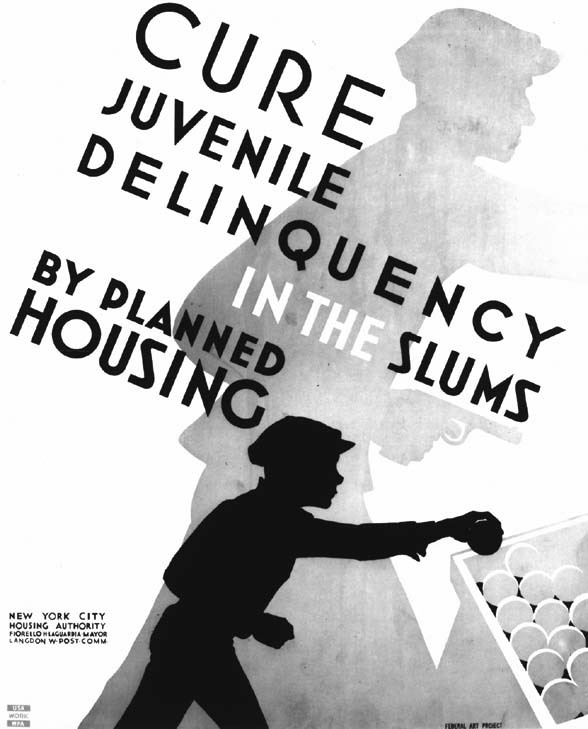
Photo 8. 1936 Work Projects Administration poster promoting planned housing as a method to deter juvenile delinquency, showing silhouettes of a child stealing a piece of fruit and a child involved in armed robbery
Prevention efforts, on the other hand, can be aimed at all youth in broadly focused programs offered in schools or communities. Delinquency prevention programs are identified by their philosophies or target populations. Positive preventive efforts are those aimed at encouraging socially appropriate behaviors and rule-abiding interactions rather than those that seek to deter behavior with the threat of sanctions or punishments. Social control theorists look at ways of reinforcing ties to conventional norms in society, either through activities, such as Boy Scouts or 4-H, or through bonds to significant others, such as teachers, Big Brothers Big Sisters, or religious leaders.
There are three basic phases of prevention. Primary prevention addresses children at risk of becoming juvenile offenders, and secondary prevention involves intervention with young offenders in the early stages of delinquency to help them avoid further involvement in the justice system. Tertiary prevention deals with the rehabilitation or intervention efforts applied to more serious offenders, such as those who are sent to detention centers or other court placements. Programming at this phase is geared toward reintegrating the offender back into society with no further involvement in crime.
Historical Efforts at Prevention
For centuries, sacred and secular initiatives have made attempts to guide parents in delinquency prevention. Phrases such as “spare the rod and spoil the child” indicate that corporal punishment was viewed as an acceptable if not necessary aspect of discipline and control.
The Industrial Revolution was marked by immigration, the growth of urban centers, and a wave of juvenile crime and delinquency thought to be linked to everything from social disorganization to poor breeding and absent, ill-mannered parents. While trying to address the proposed underlying causes of delinquency, sociologists from the Chicago School attempted to assist communities in preventing delinquency with holistic, grassroots initiatives in the format of the Chicago Area Project (CAP). One of the oldest and longest running programs, CAP used local community leadership to effect bonding and self-help within the neighborhood units.
New York City was also very proactive in organizing delinquency prevention programs, particularly those that involved police officer participation. The Juvenile Aid Bureau dates back to the 1930s, as do the police athletic leagues (PALs) and precinct coordinating councils.
Government Initiatives in Delinquency Prevention
In 1968, Congress passed the Juvenile Delinquency Prevention and Control Act, which was revised in 1974 and renamed the Juvenile Justice and Delinquency Prevention Act. The Office of Juvenile Justice and Delinquency Prevention (OJJDP) evolved from that initiative and is geared to assisting states and local communities in researching and setting up effective prevention programs. The OJJDP acts as a clearinghouse of information on best practices and provides technical assistance to agencies as they initiate and evaluate programs.
...
- Delinquency Theories and Theorists
- Albert Cohen
- Biological Theories
- Clifford Shaw
- Cycle of Violence
- Edwin Sutherland
- Fredrick Thrasher
- Henry McKay
- James Short
- Joan McCord
- Lamar T. Empey
- Lloyd Ohlin
- Marvin Wolfgang
- Psychological Theories
- Richard Cloward
- Ruth Shonle Cavan
- Sheldon and Eleanor Glueck
- Sociological Theories
- Solomon Kobrin
- Stanley G. Hall
- Thorsten Sellin
- Travis Hirschi
- Walter Miller
- Walter Reckless
- Historical References: People and Projects
- Delinquent Behavior
- Treatment and Interventions for Delinquency
- Aftercare
- Alternative Schools
- Assessment
- Boot Camps
- Boys and girls Clubs
- community action boards
- Culturally Specific Programming
- curfews
- DARE
- Detention Facilities
- family therapy
- Group Homes
- group therapy
- mediation
- out of home placement
- police responses to delinquency
- Prevention strategies
- probation
- Scared Straight
- Teen courts
- victim offender
- Wilderness Programs
- Juvenile Law and Legislative Initiatives
- California Street Terrorism Enforcement & Prevention
- California Youth Authority
- Death Penalty
- Diversion
- Foster Care
- Guardian Ad Litem
- Juvenile Courts
- Juvenile Justice and Delinquency Prevention Act
- Juvenile Law
- National Council of Juvenile & Family Court Judges
- National Council on Crime & Delinquency
- Office of Juvenile Justice and Delinquency Prevention
- parens patriae
- Parental liability laws
- Waivers to Adult Court
- Juvenile Issues and Public Policy
- Loading...
Get a 30 day FREE TRIAL
-
 Watch videos from a variety of sources bringing classroom topics to life
 -
Read modern, diverse business cases
-
Explore hundreds of books and reference titles

Read next

More like this
Sage Recommends
We found other relevant content for you on other Sage platforms.
Have you created a personal profile? Login or create a profile so that you can save clips, playlists and searches