
Entry
Reader's guide
Entries A-Z
Subject index
Parens Patriae Doctrine
Parens patriae is one of the essential tenets upon which the U.S. juvenile court system is built. This doctrine, literally translated from the Latin as “state as parent,” was adopted during the child-saving movement of the late 1890s and early 1900s from the British Common Law system.
Historical Foundation of Parens Patriae
The child-saving movement was born of the Reformation. The child savers were predominantly Anglo-Saxon, Protestant, middle- to upper-class women whose intentions were to prevent the children of the immigrant working class from developing criminality. This movement was spirited by a duality in goals: the humanitarian rehabilitation and reform of youth, and social control to protect the privileged positions of the middle and upper class (Platt, 1995:16).
The majority of the women involved in the child-saving movement held strong convictions regarding the need for women to nurture and take care of children. As the child savers possessed the financial means to provide child care for their own children by employing nannies and domestic help, they turned their attention to those they perceived to be in need of their assistance. They held the view that criminals were a distinct and separate class, spawned of the working-class culture, and a threat to mainstream society (Platt, 1995:19). Concurrently evolving during this period was the medical, or therapeutic, approach to criminality. The control and reform of youth and the therapeutic approach to crime congealed to produce fertile ground for the rationale for juvenile court, parens patriae.
Legal Precedents in the Evolution of Parens Patriae
The 1838 case of Ex Parte Crouse served to establish precedent for the legal standing of parens patriae in the American court system. Mary Ann Crouse was committed to the Philadelphia House of Refuge by her mother for incorrigibility, against her father's wishes (Elrod and Ryder, 1999:113). Mr. Crouse contended Mary Ann had not committed a criminal offense and therefore should not be punished. The Pennsylvania Supreme Court held the following:
- The function of the house of refuge was to reform and rehabilitate children, not to punish them.
- As Mary Ann was not being punished, the formal due process protections afforded to adults in criminal proceedings were not applicable to Mary Ann.
- The state has a legal obligation to protect children when parents are either unable or unwilling to do so.
The protection intended by the court was to prevent the child from engaging in further delinquency and future criminality.
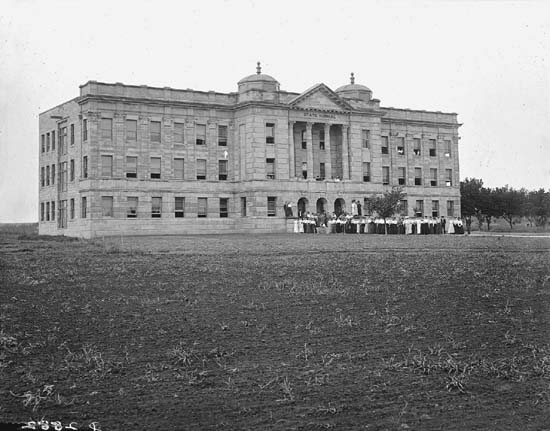
Photo 7. Students in front of the Industrial School for Boys, Kearney, Nebraska, 1909. Judges acting under the parens patriae doctrine institutionalized many youth in the belief that it was the best option for them
In 1870, the Illinois Supreme Court ruled in the case of People v. Turner that placement in the house of refuge was a punishment, not a preventative protection. Similar to the case of Mary Ann Crouse, Daniel O'Connell had been placed in the house of refuge without having committed any criminal offense, based on the perception that he was in danger of becoming a criminal (Elrod and Ryder, 1999:114). This decision threatened the precedent established in Ex Parte Crouse. The child savers viewed this ruling as an impediment to efforts to assist, reform, and control youth. This concern shortly thereafter led to the establishment of the first juvenile court in Cook County, Illinois, with the passage of the 1899 Juvenile Court Act.
...
- Delinquency Theories and Theorists
- Albert Cohen
- Biological Theories
- Clifford Shaw
- Cycle of Violence
- Edwin Sutherland
- Fredrick Thrasher
- Henry McKay
- James Short
- Joan McCord
- Lamar T. Empey
- Lloyd Ohlin
- Marvin Wolfgang
- Psychological Theories
- Richard Cloward
- Ruth Shonle Cavan
- Sheldon and Eleanor Glueck
- Sociological Theories
- Solomon Kobrin
- Stanley G. Hall
- Thorsten Sellin
- Travis Hirschi
- Walter Miller
- Walter Reckless
- Historical References: People and Projects
- Delinquent Behavior
- Treatment and Interventions for Delinquency
- Aftercare
- Alternative Schools
- Assessment
- Boot Camps
- Boys and girls Clubs
- community action boards
- Culturally Specific Programming
- curfews
- DARE
- Detention Facilities
- family therapy
- Group Homes
- group therapy
- mediation
- out of home placement
- police responses to delinquency
- Prevention strategies
- probation
- Scared Straight
- Teen courts
- victim offender
- Wilderness Programs
- Juvenile Law and Legislative Initiatives
- California Street Terrorism Enforcement & Prevention
- California Youth Authority
- Death Penalty
- Diversion
- Foster Care
- Guardian Ad Litem
- Juvenile Courts
- Juvenile Justice and Delinquency Prevention Act
- Juvenile Law
- National Council of Juvenile & Family Court Judges
- National Council on Crime & Delinquency
- Office of Juvenile Justice and Delinquency Prevention
- parens patriae
- Parental liability laws
- Waivers to Adult Court
- Juvenile Issues and Public Policy
- Loading...
Get a 30 day FREE TRIAL
-
 Watch videos from a variety of sources bringing classroom topics to life
 -
Read modern, diverse business cases
-
Explore hundreds of books and reference titles

Read next

More like this
Sage Recommends
We found other relevant content for you on other Sage platforms.
Have you created a personal profile? Login or create a profile so that you can save clips, playlists and searches