
Entry
Reader's guide
Entries A-Z
Subject index
Juvenile Detention Facilities
Locking children away in secure detention facilities has posed problems for the juvenile system since its inception in 1899. Who should be detained and in what kind of setting are questions we are still struggling with today, and the answers depend on the prevailing political and social climate. For many years, there were no clear guidelines for detention. Children were detained for various reasons, including delinquency, neglect, abuse, or for their own safety, and in deplorable conditions, usually with adult criminals. While the rest of the juvenile system was recognizing that juveniles and adults cannot be treated the same, detained juveniles were still being treated as adults.
The removal of children from their homes and parents has always been considered a last resort. Detention can be a very traumatic event in a child's life. Studies suggest that the child's self-esteem may be damaged in the detention setting, where they are subject to strip searches, institutional clothing, and dictated routines. The child also may begin associating with negative peers and view him- or herself as a criminal, thereby promoting future criminal behavior (Kilm, 1980; Brown, 1980). For children held in adult facilities, educational, medical, and counseling services were generally nonexistent.
In light of the recognized negative effects of detention on children, the obvious answer would seem to be to detain few children. That has not been the case, however. In the 1990s, with juvenile crime receiving increased media attention, the “get tough” policies of the federal and local governments resulted in increased detention, even though the juvenile crime rate began declining in the mid-1990s.
A look at the history of juvenile detention will illustrate the difficulty this country has experienced in determining the role of the juvenile detention facility.
History
Since the first juvenile court was established in 1899, the problem of detaining children in suitable facilities has plagued the juvenile system. A 1923 report by the United States Children's Bureau and the National Probation Association addressed detention conditions and pushed for improvements. However, a study of detention centers in 1932 by the National Probation Association (NPA) found that children were still regularly detained in adult jail facilities. Detention homes were not much better than jails, and policies for detaining and releasing children were inadequate. The NPA also determined that the wrong type of children were being detained, frequently for long periods (National Council Crime and Delinquency [NCCD], 1961).
A second study by the NPA, conducted in 1945, found little change in detention conditions in the best facilities in 22 states. They found that jurisdictions varied greatly in the way they used detention, with some detaining less than 5 percent of children referred to court while others detained all children and released them with no formal court referral. Since no standards for juvenile detention centers existed at that time, the Association produced two publications: Detention for the Juvenile Court: A Discussion of Principles and Practices and The Design and Construction of Detention Homes for the Juvenile Court.
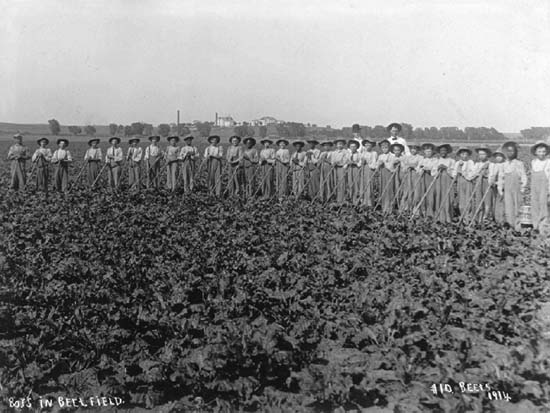
Photo 5. Boys in a Beet Field at the State Industrial School, Kearney, Nebraska, 1914
...
- Delinquency Theories and Theorists
- Albert Cohen
- Biological Theories
- Clifford Shaw
- Cycle of Violence
- Edwin Sutherland
- Fredrick Thrasher
- Henry McKay
- James Short
- Joan McCord
- Lamar T. Empey
- Lloyd Ohlin
- Marvin Wolfgang
- Psychological Theories
- Richard Cloward
- Ruth Shonle Cavan
- Sheldon and Eleanor Glueck
- Sociological Theories
- Solomon Kobrin
- Stanley G. Hall
- Thorsten Sellin
- Travis Hirschi
- Walter Miller
- Walter Reckless
- Historical References: People and Projects
- Delinquent Behavior
- Treatment and Interventions for Delinquency
- Aftercare
- Alternative Schools
- Assessment
- Boot Camps
- Boys and girls Clubs
- community action boards
- Culturally Specific Programming
- curfews
- DARE
- Detention Facilities
- family therapy
- Group Homes
- group therapy
- mediation
- out of home placement
- police responses to delinquency
- Prevention strategies
- probation
- Scared Straight
- Teen courts
- victim offender
- Wilderness Programs
- Juvenile Law and Legislative Initiatives
- California Street Terrorism Enforcement & Prevention
- California Youth Authority
- Death Penalty
- Diversion
- Foster Care
- Guardian Ad Litem
- Juvenile Courts
- Juvenile Justice and Delinquency Prevention Act
- Juvenile Law
- National Council of Juvenile & Family Court Judges
- National Council on Crime & Delinquency
- Office of Juvenile Justice and Delinquency Prevention
- parens patriae
- Parental liability laws
- Waivers to Adult Court
- Juvenile Issues and Public Policy
- Loading...
Get a 30 day FREE TRIAL
-
 Watch videos from a variety of sources bringing classroom topics to life
 -
Read modern, diverse business cases
-
Explore hundreds of books and reference titles

Read next

More like this
Sage Recommends
We found other relevant content for you on other Sage platforms.
Have you created a personal profile? Login or create a profile so that you can save clips, playlists and searches