
Entry
Reader's guide
Entries A-Z
Subject index
Recording
Recording is the process of making a record, to preserve data, words, sounds, or images in some tangible form. Newspapers and magazines use quotations to capture the verbatim statements of people or documents. Photographs provide a visual record of how something looks, and photojournalism creates visual documentation of events. All of these applications may be journalistic forms of recording. In popular usage, recording is used more specifically to refer to the electronic preservation of sounds and images using audio and video technology. Even more narrowly defined, recording is used to refer to the music business itself, the “recording industry.” In this entry, “recording” is used to describe the processes used to capture and preserve journalistic sounds and images.
Analog Sound Recording
Sound recording refers to the ability to convert acoustical energy (the vibrations of air molecules) into a preservable form for storage and distribution; this converted energy can be mechanical (i.e., the bumps in the groove of a vinyl record) or magnetic (i.e., polarized particles on magnetic tape). The resulting recorded forms in “analog” media, such as vinyl records and recording tape, are analogous to the original sound vibrations. Digital sound media, such as CDs, MP3 players, and the Internet, on the other hand, use a binary numerical representation of analog waveform measurements to manipulate and preserve a mathematical equivalent of sound vibrations. These digital representations are converted to analog acoustical energy when played back.
Thomas Edison is usually credited with inventing the first practical device capable of recording the human voice. Speaking the words of a simple nursery rhyme, “Mary had a little lamb,” Edison launched sound recording history. His hand crank driven tinfoil cylinder “phonograph” (a Greek word for “sound writer”), patented in 1878, converted sound vibrations into corresponding indentations in a spiral groove pattern on a cylinder. Among other applications, Edison thought the phonograph could be used for dictation; for educational purposes; to record speeches, books, and music; to make toys, clocks, and music boxes; and to preserve lasting records of telegraph and telephone messages.
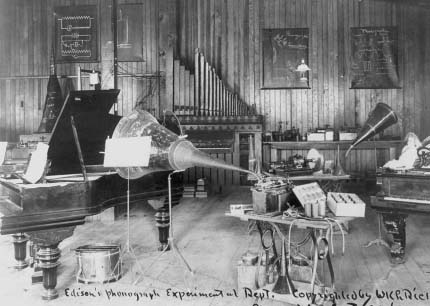
An image of Edison's early phonograph equipment photographed in his lab in 1892.
Source: Library of Congress.
Major improvements to the phonograph soon followed. Working with Alexander Graham Bell in 1886, Chichester Bell (Alexander's cousin) and Charles Tainter developed the “grapho-phone,” a wax cylinder machine that increased the number of times a cylinder could be played. Emile Berliner's hard shellac flat disc system, called the “gramophone,” improved sound quality and made both duplication and storage more convenient. In 1929, Berliner sold his patent and “His Master's Voice” logo (a painting showing a dog “Nipper” cocking his head by the horn speaker of a phonograph) to the Victor Talking Machine Company, which later became a division of the Radio Corporation of America. Improved methods of molding cylinders and discs for mass duplication, spring (wind-up) and electric motor drive systems, and significant accomplishments in radio electronics, contributed to developments in microphone, amplifier and loudspeaker technologies. Although an effort was made to market the phonograph as an office dictation machine, consumers adopted these early systems for home entertainment and music recording. RCA Victor became a major producer of phonograph records and the company's “Victrola” players became a prominent piece of furniture in many homes. In 1929, RCA introduced a 16-inch diameter transcription disc, made from “Vitrolac.” This recordable “electronic transcription” (ET) disc system enabled radio stations to record and playback music and talk programs.
...
- Audience
- Audience Research
- Audience Research Companies
- Circulation, Controlled
- Mass Media, Decline of
- News Audiences, Decline of
- Polls and Public Opinion
- Academic Accreditation
- Academic Associations
- Advocacy Groups
- Archives and Museums
- Criticism of Journalism
- Education, Journalism
- Foundations, Research Centers, and Institutes
- Media Accountability Systems
- News Councils
- Scholarly Journals
- Student Journalism
- African American News Media
- Asian American News Media
- Diversity: Content
- Diversity: Employment
- Diversity: Policy
- Émigré News Media
- Ethnic Minority Networks
- Feminist News Media
- Gay and Lesbian Journalism
- Gay and Lesbian News Media
- Latino News Media
- Native American News Media
- Race and Ethnicity, Coverage of
- Women in Journalism
- Women's Magazines
- Agenda Setting
- Books as Journalism
- Comparative Models of Journalism
- Education, Journalism
- Framing
- Free Expression, History of
- Gatekeeping
- Hard Versus Soft News
- History of Journalism: Before 1861
- History of Journalism: 1861–1930
- History of Journalism: 1930–1995
- History of Journalism: 1995 to Present
- Infotainment
- Internet Impact on Media
- Mass Media, Decline of
- Muckrakers
- New Journalism
- News as Narrative
- News Audiences, Decline of
- Newsroom Culture
- News Values
- Objectivity
- Parody of News
- Satire of News
- Social Movements and Journalism
- Theories of Journalism
- Advertising
- Antitrust
- Circulation, Controlled
- Diversity: Policy
- Employment
- Internet Impact on Media
- Joint Operating Agreements
- Labor Unions
- Marketing
- Media Ownership
- Newspaper Preservation Act
- Access to Media
- Advertorials
- Antitrust
- Bandwagon Journalism
- Bias
- Blacklisting
- Censorship
- Checkbook Journalism
- Copyright
- Credibility
- Deception
- Diversity: Content
- Diversity: Employment
- Embedded Reporters
- Ethics
- First Amendment
- Free Press and Fair Trial
- Indecency and Obscenity
- Infotainment
- Juvenile Offenders, Coverage of
- Libel
- Media Accountability Systems
- Media Literacy
- Military and the Media
- News Syndication
- Objectivity
- Plagiarism
- Press Pools
- Privacy
- Professionalism
- Risk and News
- Secrecy and Leaks
- Sound Bites
- Spin
- Video News Releases
- Violence Against Journalists
- Anchors, Television
- Cartoonists, Political
- Columns and Columnists
- Commentators, Radio
- Commentators, Television
- Editors
- Foreign Correspondents, Electronic
- Foreign Correspondents, Print
- Interviewers
- Investigative Reporters
- Newscasters, Radio
- Photo Editors
- Photojournalists
- Political Reporters
- Producers
- Publishers
- Reporters, Online
- Reporters, Print
- Reporters, Radio
- Reporters, Television
- Satirists, Political
- Sportscasters, Radio
- Sportscasters, Television
- Sportswriters
- War Correspondents
- Access to Media
- Antitrust
- Censorship
- Copyright
- Diversity: Policy
- Federal Communications Commission
- First Amendment
- Freedom of Information Act
- Free Press and Fair Trial
- Gag Orders
- Images, Ownership of
- Indecency and Obscenity
- International and Comparative Journalism Law
- Libel
- Media Accountability Systems
- News Councils
- Newspaper Preservation Act
- Newsroom Culture
- Privacy
- Self-Regulation
- Shield Law
- Sunshine Law
- Supreme Court and Journalism
- Business Magazines
- Celebrity and Fan Magazines
- Newsweekly Magazines
- Photo Magazines
- Quality and Opinion Magazines
- Scholarly Journals
- Trade Magazines
- Women's Magazines
- Distribution, Online
- Documentaries, Motion Picture
- Film in Television News
- Motion Pictures, Journalism in
- Newsreels
- ABC News
- Air America
- Al Arabiya
- Al Jazeera
- Al-Manar
- British Broadcasting Corporation
- Cable News
- CBS News
- Chinese Television
- Deutsche Welle
- Ethnic Minority Networks
- EuroNews
- Fox News
- Mutual Broadcasting System
- National Public Radio
- NBC News
- Public Broadcasting Service
- Star News (Asia)
- Agence France-Presse
- Associated Press
- Audio and Video News Services
- Bloomberg
- Clipping Services
- Digital Media Europe
- Dow Jones
- Feature Syndicates
- Gannett
- Havas
- International News Service
- New China (Xinhua) News Agency
- PanAfrican News Agency
- Photo Agencies
- Reuters
- TASS and Russian News Agencies
- United Press International
- Wolff
- Agriculture Journalism, Electronic
- Agriculture Journalism, Print
- Business Journalism
- Citizen Journalism
- Civic Journalism
- Civil Unrest, Coverage of
- Columns and Columnists
- Comics
- Congress and Journalism
- Crime and the Courts
- Criticism and Critics
- Diversity: Content
- Docudrama
- Documentaries, Motion Picture
- Documentaries, Television
- Editorials
- Education, Coverage of
- Entertainment Journalism
- Environmental Journalism
- Food Journalism
- Globalization, Coverage of
- Government, Federal Coverage of
- Government, State and Local, Coverage of
- Health and Medicine Journalism
- Hoaxes
- Human Interest Journalism
- Immigration, Coverage of
- Innovation Journalism
- International Journalism
- Investigative Journalism
- Labor Journalism
- Letters to the Editor
- Lifestyle Journalism
- Literary Journalism
- Maps in Journalism
- Natural Disasters, Coverage of
- Obituaries
- Op-Ed Page
- Peace Journalism
- Poverty, Coverage of
- Precision Journalism
- Presidential Families, Coverage of
- Presidential Scandals, Coverage of
- Presidents, Coverage of
- Race and Ethnicity, Coverage of
- Religion Journalism
- Science and Technology Journalism
- Sensationalism
- Sports Journalism
- Terrorism, Coverage of
- Travel Journalism
- War and Military Journalism
- Weather Journalism
- Atlanta
- Baltimore
- Boston
- Chicago
- Dallas–Ft. Worth
- Denver
- Houston
- Kansas City
- Los Angeles
- Miami
- Milwaukee
- Minneapolis–St. Paul
- New York
- New York Times, The
- Philadelphia
- Publick Occurrences
- San Francisco
- Stars and Stripes
- St. Louis
- USA Today
- Wall Street Journal, The
- Washington, D.C.
- Africa, North
- Africa, Sub-Saharan
- Agence France-Presse
- Arab Countries
- Asia, Central, South, and East
- Australia
- British Broadcasting Corporation
- British Broadcasting Regulation
- British Commercial News Broadcasting
- British Literary Journalism
- British Magazines
- British New Media
- British Newspapers
- British Press Regulation
- British Tabloid Press
- Canada
- Central America and the Caribbean
- China
- Comparative Models of Journalism
- Development Journalism
- English Roots of the Free Press
- Europe
- France
- Free Flow of Information
- Germany
- Globalization, Coverage of
- Havas
- Hong Kong
- India
- International Herald Tribune
- International Journalism
- Israel
- Japan
- Mexico
- New World Information and Communication Order (NWICO)
- Pacific Area
- PanAfrican News Agency
- Reuters
- Russian Federation
- Scandinavia
- Singapore
- South America
- Star News (Asia)
- TASS and Russian News Agencies
- U.S. International Communication
- Wolff
- Advocacy Newspapers
- Alternative and Underground Newspapers
- Broadsheet Newspapers
- Free Newspapers
- Student Journalism
- Tabloid Newspapers
- Weekly Newspapers
- Blogs and Bloggers
- Chat Rooms
- Classified Advertising
- Computers in Journalism
- Convergence
- Desktop Publishing
- Digital Journalism Tools
- Discussion Boards
- Distribution, Online
- Editing, Online and Digital
- Internet Impact on Media
- News Aggregators
- Podcasting
- Reporters, Online
- Social Network Websites
- Streaming Media
- Academic Associations
- Archives and Museums
- Audience Research Companies
- Consultants, News
- Editors' Organizations
- Electronic Media Organizations
- Foundations, Research Centers, and Institutes
- International Journalism Organizations
- Investigative Journalism Organizations
- Labor Unions
- News Councils
- Photo Agencies
- Publishers' Organizations
- Reporters' Organizations
- Special Interest Journalism Organizations
- U.S. International Communications
- Audio and Video News Services
- Advocacy Groups
- Cartoonists, Political
- Congress and Journalism
- Election Coverage
- Equal Time
- First Amendment
- Freedom of Information Act
- Government, Federal, Coverage of
- Government, State and Local, Coverage, of
- News Conferences
- Political Action Committees
- Political Reporters
- Presidential Families, Coverage of
- Presidential Scandals, Coverage of
- Presidents, Coverage of
- Press and Government Relations
- Press Pools
- Satirists, Political
- Spin
- Supreme Court and Journalism
- Washington, D.C.
- Agenda Setting
- Automation
- Diffusion
- Digital Journalism Tools
- Distribution
- Distribution, Online
- Editing, Newspaper
- Editing, Online and Digital
- Electronic News Gathering
- Framing
- Freelance Writers and Stringers
- Graphics
- Labor Unions
- Layout
- Magazine Design
- News Hole
- News Syndication
- Newspaper Design
- Newsprint
- Printing
- Recording
- Satellite News Gathering
- Sound Bites
- ABC News
- Agriculture Journalism, Electronic
- Air America
- Audio and Video News Services
- British Broadcasting Corporation
- British Broadcasting Regulation
- British Commercial News Broadcasting
- CBS News
- Commentators, Radio
- Community Radio
- Digital Sound
- Electronic Media Organizations
- Equal Time
- Federal Communications Commission
- Foreign Correspondents, Electronic
- Mutual Broadcasting System
- National Public Radio
- NBC News
- Newscasters, Radio
- Pacifica Radio
- Podcasting
- Public Radio Journalism
- Recording
- Reporters, Radio
- Rip-and-Read News
- Shortwave Radio
- Simulcasting
- Sportscasters, Radio
- Streaming Media
- Talk and News Radio
- Automation
- Blogs and Bloggers
- Cables, Undersea
- Cable Television
- Chat Rooms
- Computers in Journalism
- Convergence
- Desktop Publishing
- Digital Journalism Tools
- Digital Photography
- Digital Sound
- Digital Television
- Discussion Boards
- Distribution, Online
- Electronic News Gathering
- Facsimile
- Graphics
- Internet Impact on Media
- News Aggregators
- Newsprint
- Photography
- Podcasting
- Printing
- Recording
- Satellite News Gathering
- Shortwave Radio
- Streaming Media
- Telegraph
- Telephone
- Teletype
- Type and Typography
- Videotex and Teletext
- ABC News
- Agriculture Journalism, Electronic
- Anchors, Television
- British Broadcasting Corporation
- British Broadcasting Regulation
- British Commercial News Broadcasting
- Cable Television
- CBS News
- Commentators, Television
- Digital Television
- Docudrama
- Documentaries, Television
- Electronic Media Organizations
- Electronic Newsgathering
- Equal Time
- Evening News, Television
- Facsimile
- Foreign Correspondents, Electronic
- Fox News
- Morning News
- National Public Radio
- NBC News
- Producers
- Public Broadcasting Service
- Public Television Journalism
- Reporters, Television
- Satellite News Gathering
- Simulcasting
- Sound Bites
- Sportscasters, Television
- Streaming Media
- Tabloid Television
- Television News Magazines
- Video News Release
- Videotex and Teletext
- About the Volume Editor
- Volume Introduction
- Introduction
- Constitutional Amendments
- Antigovernment Issues and National Security
- Clear and Present Danger Speech
- Prior Restraint
- Libel Issues
- Privacy Protection
- Access to Public Records
- Reporter's Privilege to Withhold Information
- Intellectual Property Protection
- Regulating Electronic Media
- Further Readings
- Introduction
- General Professional Associations
- General Broadcast Organizations
- Print Organizations
- Interactive Media Organizations
- News Wire Services
- Further Readings
- Reporting Specializations
- Introduction
- Accreditation Standards in Journalism Education
- Journalism White Papers on Changes in Education and Media
- Schools of Journalism: Values and Curriculum
- Further Readings
- Audience Research
- Introduction
- Public Opinion
- Internet Impact on Media
- Newsroom Diversity
- Journalism Employment/Careers
- Key Trends in Journalism
- Further Readings
- Introduction
- The Pulitzer Prizes
- General Journalism Awards
- Specialized Journalism Awards
- Electronic Journalism Awards
- Photography and Editorial Cartooning Awards
- Introduction
- Afghanistan
- Albania
- Algeria
- Andorra
- Angola
- Antigua And Barbuda
- Argentina
- Armenia
- Australia
- Austria
- Azerbaijan
- Bahamas
- Bahrain
- Bangladesh
- Barbados
- Belarus
- Belgium
- Belize
- Benin
- Bhutan
- Bolivia
- Bosnia And Herzegovina
- Botswana
- Brazil
- Brunei Darussalam
- Bulgaria
- Burkina Faso
- Burundi
- Cambodia
- Cameroon
- Canada
- Capeverde
- Central African Republic
- Chad
- Chile
- China
- Colombia
- Comoros
- Congo, Republic Of
- Costa Rica
- Cote D'Ivoire
- Croatia
- Cuba
- Cyprus
- Czech Republic
- Democratic Republic Of The Congo
- Denmark
- Djibouti
- Dominica
- Dominican Republic
- Ecuador
- Egypt
- El Salvador
- Equatorial Guinea
- Eritrea
- Estonia
- Ethiopia
- Fiji
- Finland
- France
- Gabon
- Gambia
- Georgia
- Germany
- Ghana
- Greece
- Grenada
- Guatemala
- Guinea
- Guinea-Bissau
- Guyana
- Haiti
- Honduras
- Hong Kong
- Hungary
- Iceland
- India
- Indonesia
- Iran
- Iraq
- Ireland
- Israel
- Italy
- Jamaica
- Japan
- Jordan
- Kazakhstan
- Kenya
- Kiribati
- Kuwait
- Kyrgyzstan
- Laos
- Latvia
- Lebanon
- Lesotho
- Liberia
- Libya
- Liechtenstein
- Lithuania
- Luxembourg
- Macedonia
- Madagascar
- Malawi
- Malaysia
- Maldives
- Mali
- Malta
- Marshall Islands
- Mauritania
- Mauritius
- Mexico
- Micronesia
- Moldova
- Monaco
- Mongolia
- Morocco
- Mozambique
- Myanmar (Burma)
- Namibia
- Nauru
- Nepal
- Netherlands
- New Zealand
- Nicaragua
- Niger
- Nigeria
- North Korea
- Norway
- Oman
- Pakistan
- Palau
- Panama
- Papua New Guinea
- Paraguay
- Peru
- Philippines
- Poland
- Portugal
- Qatar
- Romania
- Russian Federation
- Rwanda
- Saint Kitts And Nevis
- Saint Lucia
- Saint Vincent And The Grenadines
- Samoa
- San Marino
- Sao Tome And Principe
- Saudi Arabia
- Senegal
- Serbia And Montenegro
- Seychelles
- Sierra Leone
- Singapore
- Slovakia
- Slovenia
- Solomon Islands
- Somalia
- South Africa
- South Korea
- Spain
- Sri Lanka
- Sudan
- Suriname
- Swaziland
- Sweden
- Switzerland
- Syrian Arab Republic
- Taiwan
- Tajikistan
- Tanzania
- Thailand
- Timor-Leste
- Togo
- Tonga
- Trinidad And Tobago
- Tunisia
- Turkey
- Turkmenistan
- Tuvalu
- Uganda
- Ukraine
- United Arab Emirates
- United Kingdom
- United States Of America
- Uruguay
- Uzbekistan
- Vanuatu
- Venezuela
- Vietnam
- West Bank And Gaza Strip
- Yemen
- Zambia
- Zimbabwe
- Notes to the User
- Acknowledgments
- Section 1. General Reference
- Section 2. History
- Section 3. Technology
- Section 4. Journalism Business and Process
- Section 5. News Categories
- Section 6. Political Communication
- Section 7. Journalists
- Section 8. Regulation, Ethics, and Critique
- Section 9. Audiences
- Section 10. Global and Comparative Journalism
- Section 11. Journalism Periodicals
- Section 12. A Library User's Guide for Journalism and Mass Communication Subjects
- Loading...
Get a 30 day FREE TRIAL
-
 Watch videos from a variety of sources bringing classroom topics to life
 -
Read modern, diverse business cases
-
Explore hundreds of books and reference titles

Read next

More like this
Sage Recommends
We found other relevant content for you on other Sage platforms.
Have you created a personal profile? Login or create a profile so that you can save clips, playlists and searches