
Entry
Reader's guide
Entries A-Z
Subject index
Helena's Exploited Resources
In the summer of 1864, Helena's pristine wilderness teemed with wildlife—pronghorn antelope, grizzly bears, coyotes, wolves, and rattlesnakes. The area was rich in other natural resources as well: water, timber, and especially gold. As the men worked, Indians of various tribes watched in silence as the men began to destroy ancestral hunting grounds. Miners trickled in that summer, and those who decided to stay began to harvest the hillsides, which were overgrown with large trees. Before winter set in, two hundred men swarmed the gulch, building sluice boxes and log shelters along the stream that ran through it and provided miners with the necessary water to placer their claims.
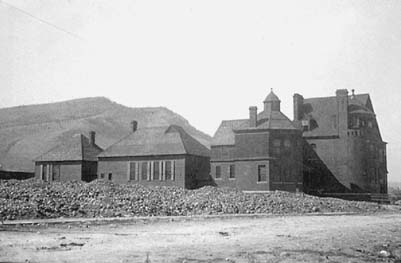
Helena's impressive St. Peter's Hospital, constructed in 1890, reveals a bleak landscape littered with tailing piles.
As placer operations along the gulch expanded and men and their animals trampled through the gulch, it was not long before the water source—sufficient for the small party of discoverers—became polluted. By 1865, the water that was so fortuitously located was unfit to drink. Miners relied on teams to bring in a daily supply of potable water. Although once plentiful, there was not enough water to serve so many, and newcomers sometimes left in disgust over its scarcity. Construction of the Yaw Yaw Ditch (also known as the Chessman and Cowan Ditch) remedied the water situation. A wooden flume, built around the base of Mount Helena, harnessed water from a reservoir supplied by Ten Mile Creek. This made sluicing, and further upheaval of the land, much more efficient. In 1869, the Park Ditch Company brought a second water source into Helena from Park Lake twenty miles away. Other water systems followed, and numerous small companies supplied water from various sources.
By the middle of summer in 1865, three thousand people choked Last Chance Gulch. The countryside was barren; stumps remained on the once-forested slopes. The gulch was a jumble of claims where prospect holes and mine shafts made the area treacherous. Tunnels undermined buildings, and stilts held them up. Streets ended abruptly in tailing piles, and prospect holes filled with water put residents and especially children at grave risk. By 1868, sluicing on the gulch had ended and a city covered the old placer diggings.
Some men worked to recover the more easily obtained gold along the gulch near the discovery site; others discovered gold veins south of Last Chance where the main gulch divides into Grizzly and Oro Fino gulches. James Whitlach made the first lode discovery in the fall of 1864. Discovery of the Whitlach-Union Mine inspired others to comb the surrounding hillsides and explore the gulches. Discoveries followed, and small mining camps dotted the area, with Helena at the hub of these smaller operations. The main lode-mining settlement was Unionville, where the Whitlach-Union Mine produced $3.5 million worth of gold between 1864 and 1872. The Spring Hill was discovered in 1870 in Grizzly Gulch. The Spring Hill's major contribution lay in the twenty-three thousand tons of flux it provided between 1885 and 1890 for the territory's first silver-lead smelter at Wickes, eighteen miles south of Helena. Mining at the Whitlach-Union and the Spring Hill mines continued into the mid-20th century.
...
- American Indians
- American Indian Migration to Phoenix, Arizona Apache
- Arapaho
- Assiniboine
- Blackfoot Nation
- Bureau of Indian Affairs
- Cahuilla Nation
- California Indians of the North Coast and Northwestern Coast
- California Indians of the Northern Mountains
- California Indians of the Northern Valley
- Chemehuevi
- Cheyennes
- Creek Nation
- Crow Nation
- Cupeños
- Gabrielino
- Gros Ventre
- Hopi
- Juaneños
- Kumeyaay (Diegueño, I'ipay, and Tipai)
- Lakotas
- Luiseño
- Maidu
- Mojave
- Nez Perce
- Northern Pueblo
- Palouse Indians
- Trail of Tears
- Upland Yumans
- Utes
- Washoe
- Yakama
- Yokuts
- Biography
- Austin, Stephen Fuller
- Bartleson, John
- Bass, Charlotta A. Spear(s)
- Bidwell, John
- Bloom, Jessie S.
- Brent, Joseph Lancaster
- Carr, Jeanne Carver Smith
- Chapman, Joseph
- Dellums, Cottrell Lawrence
- Duniway, Abigail Scott
- Feldenheimer, Edith
- Foltz, Clara Shortridge
- Foote, Mary Hallock
- Frank, Ray
- Fremont, John Charles
- Gale, William Alden
- Gianforte, Greg
- Hartnell, William
- Harvey, Frederick Henry
- Irvine, James Harvey
- Jacks, David Baird
- Percival, Olive May
- Pittman, Tarea Hall
- Reed, John Thomas
- Singleton, Benjamin
- Strauss, Levi
- Sutter, Johann August
- Thrall, William H.
- Van Nuys, Isaac Newton
- Wilson, Benjamin Davis
- Winnemucca, Sarah
- Cities and Towns
- Billings, Montana
- Bisbee and Douglas, Arizona
- Boise, Idaho
- Boyle Heights, California
- Bozeman, Montana
- Brigham City, Utah
- Butte, Montana
- China Lake, Inyokern, and Ridgecrest, California
- Cody, Wyoming
- Dearfield, Colorado
- Denver, Pueblo, Boulder, Fort Collins, and Colorado Springs, Colorado
- Fort Worth, Texas
- Fresno, California
- Gilead, Kansas
- Goldfield, Nevada
- Grass Valley, California
- Great Falls, Montana
- Helena, Montana
- Huntington Beach, California
- Jackson, Wyoming
- Julian, California
- Kalispell, Montana
- Lake Havasu City, Arizona
- Las Vegas, Nevada
- Last Chance Gulch, Montana
- Leadville, Colorado
- Lewiston and Coeur d'Alene, Idaho
- Libby, Montana
- Lincoln, Nebraska
- Los Angeles, California
- Miles City, Montana
- Mining Ghost Towns
- Missoula, Montana
- Moab, Utah
- Moscow, Idaho
- Nampa, Idaho
- Nicodemus, Kansas
- Northwood, North Dakota
- Omaha, Nebraska
- Park City, Utah
- Phoenix, Arizona
- Prescott, Arizona
- Price, Utah
- Rawhide, Nevada
- Rexburg, Idaho, and the Minidoka Project
- Rhyolite, Nevada
- Salt Lake City, Utah
- San Antonio, Texas
- San Diego, California
- San Dimas, California
- San Francisco, California
- Santa Ana River Valley
- Santa Ana, California
- Santa Fe, New Mexico
- St. George, Utah
- Sun City, Arizona
- Tacoma, Washington
- Temecula, California
- Tombstone, Arizona
- Tonopah, Nevada
- Topeka, Kansas
- Tucson, Arizona
- Virginia City, Montana
- Visalia, California
- Wichita, Kansas
- Economic Change and War
- Defense Industry
- Dry Farming
- Farming Families on the Oregon Frontier
- Iran-Iraq War and the Migration of Iranian Youth to California
- Military Base Closures
- United States Marine Corps Recruit Depot San Diego
- World War I Americanization Programs in California
- World War II Defense Industries
- World War II–Postwar Effects on Western Migration
- Ethnic and Racial Groups
- African American Communities in California
- Anglo Migration to Southern California Before the Depression
- Basque Americans
- Chileans and the California Gold Rush
- Chinese Immigration
- Czechs and Swedes in Saunders County, Nebraska
- Euro-American Migration on the Overland Trails
- French Basques of Bakersfield, California
- Frisians
- Irish in the West
- Koreatown
- Little Italy
- Little Tokyo and Japantown
- Mexican Migration to California
- Okies
- Pacific Islanders
- Slaves in California
- Vietnamese American Women
- Immigration Laws and Policies
- Asian Immigration Law
- Chinese Exclusion Act
- Forced Migration of Anarchists
- Forced Migration of Italians During World War II
- Gentleman's Agreement
- German and Italian Internment
- Immigration Act of 1965
- Immigration and Naturalization Service (INS)
- Immigration Reform and Control Act of 1986
- Indian Removal Act of 1830
- Japanese Internment
- Lawyers and Legislation
- Operation Wetback
- Proposition 187
- War Brides of Montana
- World War II Relocation Program
- Libraries
- Natural Resources Events and Laws
- Alien Land Law of 1913
- Arizona Copper Discoveries
- Black Hills Gold Rush of 1874
- Comstock Lode, 1859
- Enlarged Homestead Act of 1909
- Fraser River Gold Rush of 1858
- Frisco Mine, Beaver County, Utah
- Helena's Exploited Resources
- Homestead Act
- Idaho Silver Strikes
- Logging
- Mineral Land Policy
- Nevada's Mining Discoveries of the 20th Century
- Nineteenth-Century Land Policy
- Pick-Sloan Plan of 1944
- Pike's Peak Rush
- Rexburg, Idaho, and the Minidoka Project
- The Way West
- Loading...
Get a 30 day FREE TRIAL
-
 Watch videos from a variety of sources bringing classroom topics to life
 -
Read modern, diverse business cases
-
Explore hundreds of books and reference titles

Read next

More like this
Sage Recommends
We found other relevant content for you on other Sage platforms.
Have you created a personal profile? Login or create a profile so that you can save clips, playlists and searches