
Entry
Reader's guide
Entries A-Z
Subject index
Fractal
Fractals, a term coined by their originator Benoit Mandelbrot, are objects of any kind whose spatial form is nowhere smooth (i.e., they are irregular) and whose irregularity repeats itself geometrically across many scales. The irregularity of form is similar from scale to scale, and the objects are said to possess the property of self-similarity or scale invariance. A classic fractal structure is the Koch Island or snowflake (Figure 1). It can be described as follows:
- Draw an equilateral triangle (an initial shape or initiator [Figure 1A]).
- Divide each line that makes up the figure into three parts and “glue” a smaller equilateral triangle (a generator) onto the middle of each of the three parts (Figure 1B).
- Repeat procedure (b) on each of the 12 resulting parts (4 per side of the original triangle).
- Repeat procedure (b) on each of the 48 resulting parts (16 per side of the original triangle) and so on.
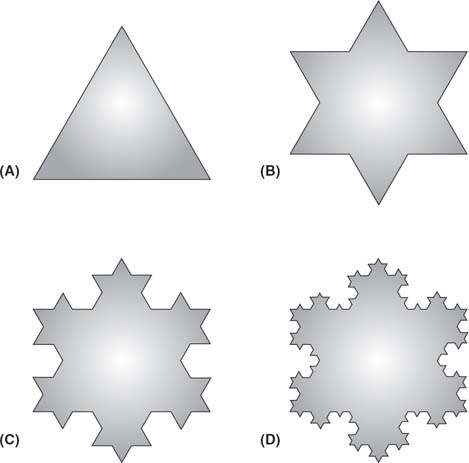
Figure 1 The Koch Island or Snowflake
This can ultimately result in an infinitely complex shape.
We use the term fractal dimension to measure fractals. The Euclidean dimensions are composed of 0 (points), 1 (straight lines), 2 (areas), and 3 (volumes). Fractal dimensions lie between these dimensions. Thus, a wiggly coastline (perhaps like each side of the Koch Island in Figure 1) fills more space than a straight line (Dimension 1) but is not so wiggly as to fill an area (Dimension 2). Its fractal dimension thus lies between 1 and 2. (The fractal dimension of each side of Figure 1 is actually approximately 1.262; the dimension of a more intricate, fjordlike coastline would be higher, closer to 2.) The tower blocks on the skyline of a city fill part of, but not all of, the vertical dimension, and so we can think of cities as having dimensions between 2 and 3.
The Koch Island shown in Figure 1 is a pure fractal shape because the shapes that are glued onto the island at each level of recursion are exact replicas of the initiator. The kinds of features and shapes that characterize our rather messier real world rarely exhibit perfect regularity, yet self-similarity over successive levels of recursion often can be established statistically. Just because recursion is not observed to be perfectly regular does not mean that the ideas of self-similarity are irrelevant. Christaller's central place theory provides one good example of a theory of idealized landscapes of nested hexagons that is applicable even though it is never observed exactly in realworld retail and settlement hierarchies.
Fractal ideas are important, and measures of fractal dimension can be as useful as spatial autocorrelation statistics or of medians and modes. Paul Longley and his colleagues described how the fractal dimension of an object may be ascertained by identifying the scaling relation between its length or extent and the yardstick that is used to measure it. Regression analysis provides one (of many) means of establishing this relationship. If we can demonstrate that an object is fractal, this can help us to identify the processes that give rise to different forms.
...
- Cartography/Geographic Information Systems
- Agent-Based Modeling
- Automated Geography
- Cartogram
- Cartography
- Cellular Automata
- Computational Models of Space
- Digital Earth
- Ecological Fallacy
- Fractal
- Geodemographics
- Geoslavery
- GIS
- GPS
- Humanistic GIScience
- Information Ecology
- Limits of Computation
- Location-Based Services
- Multicriteria Analysis
- Neural Computing
- Ontology
- Overlay
- Social Informatics
- Spatial Autocorrelation
- Spatial Dependence
- Spatial Heterogeneity
- Spatially Integrated Social Science
- Tessellation
- Time, Representation of
- Uncertainty
- Economic Geography
- Agglomeration Economies
- Agriculture, Industrialized
- Agriculture, Preindustrial
- Agro-Food System
- Applied Geography
- Capital
- Carrying Capacity
- Cartels
- Census
- Census Tracts
- Circuits of Capital
- Class
- Class War
- Colonialism
- Commodity
- Comparative Advantage
- Competitive Advantage
- Conservation
- Consumption, Geography and
- Core–Periphery Models
- Crisis
- Debt and Debt Crisis
- Deindustrialization
- Dependency Theory
- Developing World
- Development Theory
- Division of Labor
- Economic Geography
- Economies of Scale
- Economies of Scope
- Export Processing Zones
- Externalities
- Factors of Production
- Flexible Production
- Fordism
- Globalization
- Gravity Model
- Gross Domestic Product
- Growth Pole
- High Technology
- Import Substitution
- Incubator
- Industrial Districts
- Industrial Revolution
- Informal Economy
- Infrastructure
- Innovation, Geography of
- Input–Output Models
- Labor Theory of Value
- Labor, Geography of
- Location Theory
- Mode of Production
- Modernization Theory
- Money, Geography of
- Neocolonialism
- Neoliberalism
- New International Division of Labor
- Newly Industrializing Countries
- Postindustrial Society
- Producer Services
- Product Cycle
- Profit
- Resource
- Restructuring
- Rural Development
- Rustbelt
- Structural Adjustment
- Sustainable Development
- Telecommunications, Geography and
- Terms of Trade
- Trade
- Transnational Corporations
- Transportation Geography
- Underdevelopment
- Uneven Development
- World Economy
- Geographic Theory and History
- Anthropogeography
- Berkeley School
- Chorology
- Discourse
- Ethnocentrism
- Eurocentrism
- Existentialism
- Exploration, Geography and
- History of Geography
- Human Agency
- Humanistic Geography
- Ideology
- Idiographic
- Imaginative Geographies
- Interviewing
- Locality
- Logical Positivism
- Marxism, Geography and
- Model
- Nomothetic
- Orientalism
- Paradigm
- Participant Observation
- Phenomenology
- Place
- Postcolonialism
- Postmodernism
- Poststructuralism
- Qualitative Research
- Quantitative Methods
- Quantitative Revolution
- Queer Theory
- Radical Geography
- Realism
- Regional Geography
- Scale
- Situated Knowledge
- Spaces of Representation
- Spatial Analysis
- Structuralism
- Structuration Theory
- Subaltern Studies
- Subject and Subjectivity
- Theory
- Tobler's First Law of Geography
- Political Geography
- Anticolonialism
- Boundaries
- Bureaucracy
- Civil Society
- Communism
- Critical Geopolitics
- Decolonization
- Democracy
- Electoral Geography
- Environmental Determinism
- Environmental Justice
- Geopolitics
- Gerrymandering
- Hegemony
- Imperialism
- Institutions
- Justice, Geography of
- Law, Geography of
- Local State
- Nation-State
- Nationalism
- Political Ecology
- Political Geography
- Power
- Redistricting
- Resistance
- Social Movement
- Socialism
- Sovereignty
- State
- World Systems Theory
- Social/Cultural Geography
- AIDS
- Animals
- Art, Geography and
- Behavioral Geography
- Body, Geography of
- Children, Geography of
- Communications, Geography of
- Crime, Geography of
- Critical Human Geography
- Cultural Ecology
- Cultural Geography
- Cultural Landscape
- Cultural Turn
- Culture
- Culture Hearth
- Cyberspace
- Demographic Transition
- Diaspora
- Diffusion
- Disability, Geography of
- Domestic Sphere
- Emotions, Geography and
- Empiricism
- Enlightenment, The
- Environmental Perception
- Epistemology
- Ethics, Geography and
- Ethnicity
- Femininity
- Feminisms
- Feminist Geographies
- Feminist Methodologies
- Fertility Rates
- Fieldwork
- Film, Geography and
- Food, Geography of
- Gays, Geography and/of
- Gender and Geography
- Geography Education
- Health and Healthcare, Geography of
- Heterosexism
- Historic Preservation
- Historical Geography
- Home
- Homophobia
- Hunger and Famine, Geography of
- Identity, Geography and
- Languages, Geography of
- Lesbians, Geography of/and
- Literature, Geography and
- Malthusianism
- Masculinities
- Medical Geography
- Mental Maps
- Migration
- Mobility
- Modernity
- Mortality Rates
- Music and Sound, Geography of
- Natural Growth Rate
- Nature and Culture
- Nomadism
- Other/Otherness
- Peasants/Peasantry
- Photography, Geography and
- Place Names
- Popular Culture, Geography and
- Population Pyramid
- Population, Geography and
- Poverty
- Production of Space
- Psychoanalysis, Geography and
- Race and Racism
- Religion, Geography of
- Rural Geography
- Segregation
- Sense of Place
- Sequent Occupance
- Sexuality, Geography of
- Social Geography
- Social Justice
- Space, Human Geography and
- Spatial Inequality
- Spatiality
- Sport, Geography of
- Symbols and Symbolism
- Text and Textuality
- Time Geography
- Time–Space Compression
- Topophilia
- Tourism, Geography of
- Travel Writing, Geography and
- Virtual Geographies
- Vision
- Whiteness
- Wilderness
- Writing
- Urban Geography
- Built Environment
- Central Business District
- Chicago School
- City Government
- Cognitive Models of Space
- Derelict Zones
- Edge Cities
- Exurbs
- Gated Community
- Gentrification
- Ghetto
- Global Cities
- Growth Machine
- Homelessness
- Housing and Housing Markets
- HUD
- Invasion–Succession
- Locally Unwanted Land Uses
- Neighborhood
- Neighborhood Change
- New Urbanism
- NIMBY
- Open Space
- Public Space
- Rent Gap
- Rural–Urban Continuum
- Squatter Settlement
- Suburbs
- Sunbelt
- Urban and Regional Planning
- Urban Ecology
- Urban Entrepreneurialism
- Urban Fringe
- Urban Geography
- Urban Managerialism
- Urban Social Movements
- Urban Spatial Structure
- Urban Sprawl
- Urban Underclass
- Urbanization
- Zoning
- Loading...
Get a 30 day FREE TRIAL
-
 Watch videos from a variety of sources bringing classroom topics to life
 -
Read modern, diverse business cases
-
Explore hundreds of books and reference titles

Read next

More like this
Sage Recommends
We found other relevant content for you on other Sage platforms.
Have you created a personal profile? Login or create a profile so that you can save clips, playlists and searches