
Entry
Reader's guide
Entries A-Z
Subject index
Chicago School
Between the two world wars, Chicago emerged as the epicenter of American social science, particularly with regards to urban analysis. As the prototype of the rapidly growing, industrialized city populated by streams of immigrants, Chicago became the prototypical example of American urbanization. The University of Chicago played a major role in disciplines such as economics, sociology, and geography. Within this context, the Chicago School of urban studies arose and was enormously influential in sociology and geography for the next several decades.
The origins and success of the Chicago School lay largely with its nominal leader, Robert E. Park, a former journalist turned teacher. The Chicago School is credited with the first systematic attempt to understand the dynamics of urban areas, including social change, urban planning, and territoriality. In 1925, Park, Ernest Burgess, and Roderick McKenzie published The City, a series of interpretive essays about the cultural patterns of urban life, a volume that both summarized and inspired a long tradition of urban ethnography. Chicago School practitioners, who inaugurated the creation of the tradition of detailed case studies, ranged far and wide over the city, studying the wealthy, immigrants, hobos, the destitute, dance halls, criminals, prostitutes, and anyone else they could in an attempt to draw as rich and detailed a portrait of the city as possible. In the process, they irrevocably fused the study of space and the study of society.
The first paradigm of urban structure offered by Chicago School theorists, particularly McKenzie, centered on a biological metaphor of the city as an urban jungle, a view derived in large part from the social Darwinism prevalent during the early 20th century. Thus, for example, the displacement of one ethnic group by another in a given neighborhood was framed as a process of invasion and succession, a model that drew directly from studies of how one plant species displaced another through successive stages in the evolution of ecosystems. Later, this biological metaphor would be dropped in the face of stinging criticisms that it lacked a coherent account of social relations and naturalized the inequality of urban areas. Throughout the Chicago School's worldview, competition appears repeatedly as a driving force behind ethnic and class segregation.
Chicago School theorists also drew on the urban sociology of Ferdinand Tönnies and notions such as Gemeinschaft and Gesellschaft to examine the phenomenology of urbanization in light of the massive rural-to-urban migration that was then characteristic of most U.S. cities. In this reading, urbanization represented the annihilation of mythologized rural communities in which everyone knew everyone else. In contrast to small towns in which everyone ostensibly was intimately connected to everyone else and presented the same sense of self under all contexts, urbanization was held to decompose these traditional bonds and erode the foundations of mutual trust. Cities, it was held, were not conducive to the formation of a sense of community. Louis Wirth, in particular, advocated a desolate but compelling view of city life as structured around three major axes: size, density, and heterogeneity. Size or total population, he held, created a climate that was inherently predatory, utilitarian, uncaring, and commodified; strangers were rare in small towns but were the norm in large cities. Density, he argued, led people to be close physically but not emotionally; indeed, alienation was the norm. Finally, social and cultural heterogeneity, manifested in the diverse lifestyles found in large cities, generated few of the common values necessary to the success of healthy communities. The result was allegedly the widespread presence of crime and other social pathologies ranging from suicide to psychoses. (Subsequent work, it should be noted, has rectified this stereotype by pointing to the high crime rates in many small cities and the presence of healthy, vibrant urban neighborhoods.)
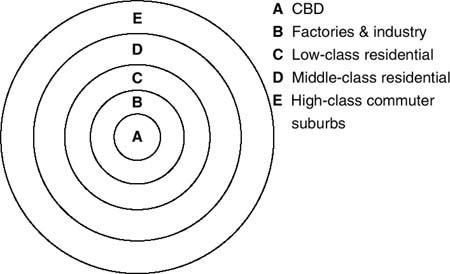
Figure 1 Burgess's Concentric Ring
...
- Cartography/Geographic Information Systems
- Agent-Based Modeling
- Automated Geography
- Cartogram
- Cartography
- Cellular Automata
- Computational Models of Space
- Digital Earth
- Ecological Fallacy
- Fractal
- Geodemographics
- Geoslavery
- GIS
- GPS
- Humanistic GIScience
- Information Ecology
- Limits of Computation
- Location-Based Services
- Multicriteria Analysis
- Neural Computing
- Ontology
- Overlay
- Social Informatics
- Spatial Autocorrelation
- Spatial Dependence
- Spatial Heterogeneity
- Spatially Integrated Social Science
- Tessellation
- Time, Representation of
- Uncertainty
- Economic Geography
- Agglomeration Economies
- Agriculture, Industrialized
- Agriculture, Preindustrial
- Agro-Food System
- Applied Geography
- Capital
- Carrying Capacity
- Cartels
- Census
- Census Tracts
- Circuits of Capital
- Class
- Class War
- Colonialism
- Commodity
- Comparative Advantage
- Competitive Advantage
- Conservation
- Consumption, Geography and
- Core–Periphery Models
- Crisis
- Debt and Debt Crisis
- Deindustrialization
- Dependency Theory
- Developing World
- Development Theory
- Division of Labor
- Economic Geography
- Economies of Scale
- Economies of Scope
- Export Processing Zones
- Externalities
- Factors of Production
- Flexible Production
- Fordism
- Globalization
- Gravity Model
- Gross Domestic Product
- Growth Pole
- High Technology
- Import Substitution
- Incubator
- Industrial Districts
- Industrial Revolution
- Informal Economy
- Infrastructure
- Innovation, Geography of
- Input–Output Models
- Labor Theory of Value
- Labor, Geography of
- Location Theory
- Mode of Production
- Modernization Theory
- Money, Geography of
- Neocolonialism
- Neoliberalism
- New International Division of Labor
- Newly Industrializing Countries
- Postindustrial Society
- Producer Services
- Product Cycle
- Profit
- Resource
- Restructuring
- Rural Development
- Rustbelt
- Structural Adjustment
- Sustainable Development
- Telecommunications, Geography and
- Terms of Trade
- Trade
- Transnational Corporations
- Transportation Geography
- Underdevelopment
- Uneven Development
- World Economy
- Geographic Theory and History
- Anthropogeography
- Berkeley School
- Chorology
- Discourse
- Ethnocentrism
- Eurocentrism
- Existentialism
- Exploration, Geography and
- History of Geography
- Human Agency
- Humanistic Geography
- Ideology
- Idiographic
- Imaginative Geographies
- Interviewing
- Locality
- Logical Positivism
- Marxism, Geography and
- Model
- Nomothetic
- Orientalism
- Paradigm
- Participant Observation
- Phenomenology
- Place
- Postcolonialism
- Postmodernism
- Poststructuralism
- Qualitative Research
- Quantitative Methods
- Quantitative Revolution
- Queer Theory
- Radical Geography
- Realism
- Regional Geography
- Scale
- Situated Knowledge
- Spaces of Representation
- Spatial Analysis
- Structuralism
- Structuration Theory
- Subaltern Studies
- Subject and Subjectivity
- Theory
- Tobler's First Law of Geography
- Political Geography
- Anticolonialism
- Boundaries
- Bureaucracy
- Civil Society
- Communism
- Critical Geopolitics
- Decolonization
- Democracy
- Electoral Geography
- Environmental Determinism
- Environmental Justice
- Geopolitics
- Gerrymandering
- Hegemony
- Imperialism
- Institutions
- Justice, Geography of
- Law, Geography of
- Local State
- Nation-State
- Nationalism
- Political Ecology
- Political Geography
- Power
- Redistricting
- Resistance
- Social Movement
- Socialism
- Sovereignty
- State
- World Systems Theory
- Social/Cultural Geography
- AIDS
- Animals
- Art, Geography and
- Behavioral Geography
- Body, Geography of
- Children, Geography of
- Communications, Geography of
- Crime, Geography of
- Critical Human Geography
- Cultural Ecology
- Cultural Geography
- Cultural Landscape
- Cultural Turn
- Culture
- Culture Hearth
- Cyberspace
- Demographic Transition
- Diaspora
- Diffusion
- Disability, Geography of
- Domestic Sphere
- Emotions, Geography and
- Empiricism
- Enlightenment, The
- Environmental Perception
- Epistemology
- Ethics, Geography and
- Ethnicity
- Femininity
- Feminisms
- Feminist Geographies
- Feminist Methodologies
- Fertility Rates
- Fieldwork
- Film, Geography and
- Food, Geography of
- Gays, Geography and/of
- Gender and Geography
- Geography Education
- Health and Healthcare, Geography of
- Heterosexism
- Historic Preservation
- Historical Geography
- Home
- Homophobia
- Hunger and Famine, Geography of
- Identity, Geography and
- Languages, Geography of
- Lesbians, Geography of/and
- Literature, Geography and
- Malthusianism
- Masculinities
- Medical Geography
- Mental Maps
- Migration
- Mobility
- Modernity
- Mortality Rates
- Music and Sound, Geography of
- Natural Growth Rate
- Nature and Culture
- Nomadism
- Other/Otherness
- Peasants/Peasantry
- Photography, Geography and
- Place Names
- Popular Culture, Geography and
- Population Pyramid
- Population, Geography and
- Poverty
- Production of Space
- Psychoanalysis, Geography and
- Race and Racism
- Religion, Geography of
- Rural Geography
- Segregation
- Sense of Place
- Sequent Occupance
- Sexuality, Geography of
- Social Geography
- Social Justice
- Space, Human Geography and
- Spatial Inequality
- Spatiality
- Sport, Geography of
- Symbols and Symbolism
- Text and Textuality
- Time Geography
- Time–Space Compression
- Topophilia
- Tourism, Geography of
- Travel Writing, Geography and
- Virtual Geographies
- Vision
- Whiteness
- Wilderness
- Writing
- Urban Geography
- Built Environment
- Central Business District
- Chicago School
- City Government
- Cognitive Models of Space
- Derelict Zones
- Edge Cities
- Exurbs
- Gated Community
- Gentrification
- Ghetto
- Global Cities
- Growth Machine
- Homelessness
- Housing and Housing Markets
- HUD
- Invasion–Succession
- Locally Unwanted Land Uses
- Neighborhood
- Neighborhood Change
- New Urbanism
- NIMBY
- Open Space
- Public Space
- Rent Gap
- Rural–Urban Continuum
- Squatter Settlement
- Suburbs
- Sunbelt
- Urban and Regional Planning
- Urban Ecology
- Urban Entrepreneurialism
- Urban Fringe
- Urban Geography
- Urban Managerialism
- Urban Social Movements
- Urban Spatial Structure
- Urban Sprawl
- Urban Underclass
- Urbanization
- Zoning
- Loading...
Get a 30 day FREE TRIAL
-
 Watch videos from a variety of sources bringing classroom topics to life
 -
Read modern, diverse business cases
-
Explore hundreds of books and reference titles

Read next

More like this
Sage Recommends
We found other relevant content for you on other Sage platforms.
Have you created a personal profile? Login or create a profile so that you can save clips, playlists and searches