
Entry
Reader's guide
Entries A-Z
Subject index
Photography of the Dead
Many Christian societies used the photographic method to depict the dead. Whereas this practice may now appear unusual, it had been in fashion from the 19th century to the beginning of the 20th century all over the Christian world. Such a phenomenon raises two issues. The first is the necessity to understand the sense and the social uses of these pictures in the social context of the period. Second is the desire to understand the causes of the disappearance of this practice. Indeed, the refiguring of the family structures and the waning of the importance of religion in the Western societies had a great impact on this practice. This means that the photography of the dead makes sense in a particular social context in which people used it to face the reality of death, then perceived through Christian cosmological ideals. The following discussion presents the association between this form of human experience of death and the social context within which it occurred.
The first part of this entry addresses the recourse to the photographic method to represent the dead in different Christian countries. Then, the discussion focuses on the process of idealization of the dead. Indeed, during funerals the social group creates an idealized memory of the deceased fixed by the pictures. Fixing this idealized memory, these pictures serve three main functions: (1) to create family ancestors, (2) to perpetuate the family identity, and (3) to enhance the process of mourning. Lastly, the phenomena responsible for the disappearance of this practice are discussed in order to present a more global perspective on the association between the photography of the dead and the social context.
Postmortem Pictures as Representations of the Dead
In keeping with the tradition of representation of the dead—which involves recumbent effigies, postmortem depictions, and mortuary masks—the photographic method was used in the 19th century in order to depict the dead. This medium was initially used by painters as a model for the postmortem painted portraits, but photographs progressively became actual representations of the dead. Indeed, the photographic method had major advantages in that pictures were considered faithful reproductions of reality, were infinitely reproducible, and were affordable. Whereas the postmortem portraits were initially intended for the rich and public characters, the appearance of the photographic method allowed a complete democratization of this practice.
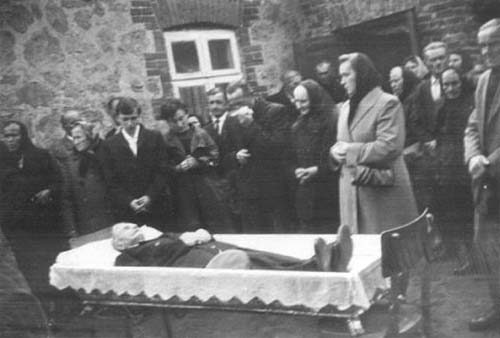
Deceased person lying in state, Poland, 1967
Source: Nadine Mielzareck. Used with permission.
Postmortem pictures mainly consist of taking pictures of the deceased lying in state, or of the entire funeral, including the deceased lying in state, the mass, the procession, and the inhumation (see photos). Nevertheless, pictures are found in which dead children are represented in a state of sleep. Indeed, the parents who lost a young child but did not take a picture of him or her when living could, through this medium, still have such a memory in which the death does not appear so obvious.
As with other means of representing the dead, postmortem pictures are associated with Christian conceptions of death. They can be considered as an expression not only of the ars moriendi but also of the belief in resurrection. According to this belief, each individual is composed of a body and a soul which are separated after death but which are supposedly reunified after the Last Judgment. In this view the corpse represents strong meanings and the postmortem pictures make sense. Each picture is not only a representation of a deceased person but also a representation of an individual.
...
- Death, Anthropological Perspectives
- Death, Clinical Perspectives
- Death, Humanistic Perspectives
- Death, Philosophical Perspectives
- Death, Psychological Perspectives
- Death, Sociological Perspectives
- Defining and Conceptualizing Death
- Eschatology
- Forensic Anthropology
- Forensic Science
- Medicalization of Death and Dying
- Thanatology
- Dance of Death (Danse Macabre)
- Death-Related Music
- Depictions of Death in Art Form
- Depictions of Death in Sculpture and Architecture
- Depictions of Death in Television and the Movies
- Elegy
- Literary Depictions of Death
- Loved One, The
- Museums of Death
- Photography of the Dead
- Popular Culture and Images of Death
- Pornography, Portrayals of Death in
- Taxidermy
- Video Games
- Wax Museums
- Abortion
- Accidental Death
- Acute and Chronic Diseases
- Alcohol Use and Death
- Alzheimer's Disease
- Anorexia and Bulimia
- Autoerotic Asphyxia
- Cancer and Oncology
- Capital Punishment
- Cardiovascular Disease
- Causes of Death, Contemporary
- Causes of Death, Historical Perspectives
- Cult Deaths
- Databases
- Death, Line of Duty
- Disasters, Man-Made
- Disasters, Natural
- Drug Use and Abuse
- Dueling
- Food Poisoning and Contamination
- HIV/AIDS
- Karoshi
- Medical Malpractice
- Medical Mistakes
- Military Executions
- Miscarriage and Stillbirth
- Neonatal Deaths
- Prison Deaths
- Spontaneous Combustion
- Subintentional Death
- Sudden Death
- Sudden Infant Death Syndrome (SIDS)
- Tobacco Use
- War Deaths
- After-Death Communication
- Ambiguous Loss and Unresolved Grief
- Anniversary Reaction Phenomenon
- Bereavement, Grief, and Mourning
- Chronic Sorrow
- Communal Bereavement
- Communicating with the Dead
- Condolences
- Coping with the Loss of Loved Ones
- Death Anxiety
- Death Education
- Denial of Death
- Disenfranchised Grief
- Elegy
- Friends, Impact of Death of
- Gold Star Mothers
- Grief, Bereavement, and Mourning in Cross-Cultural Perspective
- Grief, Bereavement, and Mourning in Historical Perspective
- Grief, Types of
- Grief and Bereavement Counseling
- Grief and Dementia
- Humor and Fear of Death
- Instrumental Grieving: Gender Differences
- Lamentations
- Memorials
- Memorials, Quilts
- Memorials, Roadside
- Memorials, War
- Missing in Action (MIA)
- Monuments
- Orphans
- Postself
- Spontaneous Shrines
- Suicide, Counseling and Prevention
- Survivor Guilt
- Widows and Widowers
- African Beliefs and Traditions
- American Indian Beliefs and Traditions
- Ancient Egyptian Beliefs and Traditions
- Australian Aboriginal Beliefs and Traditions
- Chinese Death Taboos
- Death Care Industry
- Egyptian Perceptions of Death in Antiquity
- Funerals and Funeralization in Cross-Cultural Perspective
- Kamikaze Pilots
- Mesoamerican Pre-Columbian Beliefs and Traditions
- Social Functions of Death, Cross-Cultural Perspectives
- Suicide, Cross-Cultural Perspectives
- Tibetan Book of Living and Dying, The
- Totemism
- Adolescence and Death
- Adulthood and Death
- Aging, the Elderly, and Death
- Appropriate Death
- Childhood, Children, and Death
- Databases
- Demographic Transition Model
- Economic Evaluation of Life
- Economic Impact of Death on the Family
- Gender and Death
- Infant Mortality
- Life Cycle and Death
- Life Expectancy
- Malthusian Theory of Population Growth
- Middle Age and Death
- Mortality Rates, Global
- Mortality Rates, U.S.
- Race and Death
- Sex and Death
- Social Class and Death
- Body Disposition
- Body Farms
- Burial, Paleolithic
- Burial at Sea
- Burial Insurance
- Burial Laws
- Buried Alive
- Cannibalism
- Cemeteries
- Cemeteries, Ancient (Necropolises)
- Cemeteries, Pet
- Cemeteries, Unmarked Graves and Potter's Field
- Cemeteries, Virtual
- Cemeteries and Columbaria, Military and Battlefield
- Columbarium
- Cremation
- Cryonics
- Decomposition
- Exhumation
- Funeral Pyre
- Grave Robbing
- Green Burials
- Mummies of Ancient Egypt
- Mummification, Contemporary
- Necrophilia
- Neomort
- Putrefaction Research
- Second Burial
- Tomb of the Unknowns
- Tombs and Mausoleums
- Tombstones
- Caskets and the Casket Industry
- Clothing and Fashion, Death-Related
- Commodification of Death
- Cosmetic Restoration
- Cyberfunerals
- Death Care Industry, Economics of
- Death Mask
- Death Notification Process
- Embalming
- Epitaphs
- Eulogy
- Funeral Director
- Funeral Home
- Funeral Industry
- Funeral Industry, Unethical Practices
- Mortuary Science Education
- Obituaries, Death Notices, and Necrology
- Pre-Need Arrangements
- Coroner
- Coroner's Jury
- Death Certificate
- Death-Related Crime
- Economic Evaluation of Life
- Equivocal Death
- Estate Planning
- Estate Tax
- Fatwa
- Forensic Anthropology
- Forensic Science
- Hate Crimes and Death Threats
- Inheritance
- Last Will and Testament
- Legalities of Death
- Life Insurance
- Life Insurance Fraud
- Living Wills and Advance Directives
- Medical Examiner
- Posthumous Reproduction
- Psychological Autopsy
- Viatical Settlements
- Wrongful Death
- Angel Makers
- Atrocities
- Epidemics and Plagues
- Famine
- Genocide
- Holocaust
- Massacres
- Megadeath and Nuclear Annihilation
- School Shootings
- Terrorism, Domestic
- Terrorism, International
- War Deaths
- Appropriate Death
- Art of Dying, The (Ars Moriendi)
- Awareness of Death in Open and Closed Contexts
- Brain Death
- Caregiver Stress
- Caregiving
- Deathbed Scene
- Discretionary Death
- End-of-Life Decision Making
- Halo Nurses Program
- Hospice, Contemporary
- Hospice, History of
- Informed Consent
- Isolation
- KÜBler-Ross's Stages of Dying
- Life Review
- Life Support Systems and Life-Extending Technologies
- Make-A-Wish Foundation
- Medicalization of Death and Dying
- Near-Death Experiences
- Organ and Tissue Donation and Transplantation
- Palliative Care
- Pediatric Palliative Care
- Persistent Vegetative State
- Quality of Life
- Resuscitation
- Terminal Care
- Terminal Illness and Imminent Death
- Ancestor Veneration, Japanese
- Angels
- Animism
- Apocalypse
- Armageddon
- Atheism and Death
- Baptism for the Dead
- Buddhist Beliefs and Traditions
- Christian Beliefs and Traditions
- Clergy
- Confucian Beliefs and Traditions
- Daoist Beliefs and Traditions
- Deities of Life and Death
- Devil
- Eschatology
- Eschatology in Major Religious Traditions
- Funerals and Funeralization in Major Religious Traditions
- Ghost Dance
- Heaven
- Hell
- Hindu Beliefs and Traditions
- Jewish Beliefs and Traditions
- Jihad
- Last Judgment, The
- Martyrs and Martyrdom
- Muslim Beliefs and Traditions
- Mythology
- Necromancy
- Reincarnation
- Resurrection
- Shinto Beliefs and Traditions
- Soul
- Spiritualist Movement
- Spirituality
- Transcending Death
- Valhalla
- Day of the Dead
- Funeral Conveyances
- Funeral Music
- Funerals
- Funerals, Military
- Funerals, State
- Ghost Month
- Halloween
- Holidays of the Dead
- Immortality
- Living a Legacy
- Memorial Day
- Mortuary Rites
- Mythology
- Postself
- Sin Eating
- Symbolic Immortality
- Symbols of Death and Memento Mori
- Wakes and Visitation
- Altruistic Suicide
- Assassination
- Assisted Suicide
- Death Squads
- Domestic Violence
- Euthanasia
- Familicide
- Homicide
- Honor Killings
- Infanticide
- Lynching and Vigilante Justice
- Manslaughter
- Mass Suicide
- Neonaticide
- Psychache
- Serial Murder
- Sex and Death
- Sexual Homicide
- Suicide
- Suicide Survivors
- Ariès's Social History of Death
- Bioethics, History of
- Cloning
- Commodification of Death
- Cremation Movements
- Death, Philosophical Perspectives
- Death Awareness Movement
- Death Education
- Death in the Future
- Death Superstitions
- Defining and Conceptualizing Death
- Demographic Transition Model
- Deviance, Dying as
- Disengagement Theory
- Economic Evaluation of Life
- Economic Impact of Death on the Family
- Freudian Theory
- Good Death
- Language of Death
- Life Expectancy
- Malthusian Theory of Population Growth
- Personifications of Death
- Right-to-Die Movement
- Stephenson's Historical Ages of Death in the United States
- Terror Management Theory
- Thanatology
- Banshee
- Curses and Hexes
- Death Superstitions
- Frankenstein
- Ghost Photography
- Ghosts
- Halloween
- Mythology
- Witches
- Zombies, Revenants, Vampires, and Reanimated Corpses
- Loading...
Get a 30 day FREE TRIAL
-
 Watch videos from a variety of sources bringing classroom topics to life
 -
Read modern, diverse business cases
-
Explore hundreds of books and reference titles

Read next

More like this
Sage Recommends
We found other relevant content for you on other Sage platforms.
Have you created a personal profile? Login or create a profile so that you can save clips, playlists and searches