
Entry
Reader's guide
Entries A-Z
Subject index
Memorial Day
The origins of Memorial Day (or Decoration Day, reflecting its primary activity of decorating soldiers' graves) in the United States have long been disputed. Essentially a day set aside to commemorate the dead of the Civil War, the debate over its origins—a debate that has now moved online—involves a variety of dates and a broad geographical range of places from Boalsburg, Pennsylvania, to Columbus, Mississippi, and several cities in between laying claim to the “first” Decoration Day ceremonies. In 1966, President Lyndon Johnson officially designated Waterloo, New York, as the birthplace of Memorial Day, because Waterloo had celebrated the occasion in 1866 and had made it an annual event afterward. In 2001, historian David Blight pushed this date back further with a plausible argument that the first Decoration Day had, in fact, been organized by black South Carolinians and white abolitionists, and took place at Charleston's Race Course Cemetery in South Carolina on May 1, 1865.
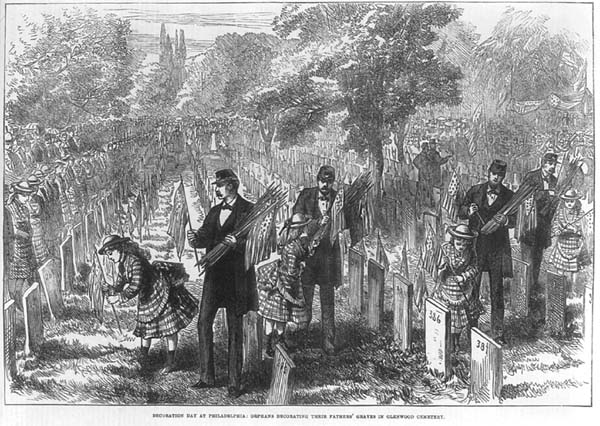
Orphans decorating their fathers' graves in Glenwood Cemetery, Philadelphia, on Memorial Day
Source: The Illustrated London News. Courtesy of the Library of Congress.
Memorial Day's official incarnation, for the Union side at least, is generally dated to May 30, 1868, with a ceremony at Arlington (which later became the National Cemetery) and credited to the efforts of John Alexander Logan, founder of the Union veterans' organization, the Grand Army of the Republic (GAR). Logan had announced in General Orders No. 11 that May 30 of each year be “designated for the purpose of strewing with flowers, or otherwise decorating the graves of comrades who died in defense of their country during the late rebellion, and whose bodies now lie in almost every city, village, and hamlet churchyard in the land. In this observance,” Logan proposed, “no form of ceremony is prescribed, but posts and comrades will in their own way arrange such fitting services and testimonials of respect as circumstances may permit.” It was through the efforts of the GAR that Memorial Day became a national holiday. Because it was largely due to the GAR, Logan argued, that “an annual commemoration to the departed heroes of the war had been inaugurated,” to the GAR, therefore, fell the “mournful and pleasing duty of perpetuating it.” In the aftermath of an internecine war that had cost over 600,000 lives, the need for such a ceremony was strong and universal. Memorial Day became, as historian Michael Kammen notes, “an instant national tradition,” and over 31 states had adopted the day as a holiday by 1869.
The pattern that Memorial Day followed can be compared to early Armistice Day ceremonies in Europe. It was primarily a funereal occasion, constructed around and following the precepts of antebellum mourning ritual. A parade to the cemetery frequently led by veterans was followed by the laying of wreaths or flags on each individual grave and later, when the ceremony became more elaborate and, arguably, more political, formal speeches by politicians became a central focus for the proceedings, which usually had a musical accompaniment. By 1891, for example, Memorial Day in New York, as described by The New York Times, was a day-long event, beginning at 8:00 in the morning with parades, speeches, and the traditional oration and musical entertainment held in the Metropolitan Opera House, concluding with organized detachments of veterans decorating the various memorials to the Civil War (and to the Mexican War of 1846–1848) around the city. However elaborate it became in the city environment, for much of the 19th and early 20th centuries, Memorial Day remained focused on the local cemetery and on the graves of the dead, which were decorated with flowers. Civil War veterans were positioned at the center of the ceremony, but public officials, noncombatants, and ministers of religion offered prayers, eulogies, and speeches. Children were a significant element in Memorial Day, as they were in Armistice Day ceremonies. Sometimes their involvement was symbolic of Union sacrifice, as when the children of the Union Orphan Asylum in Baltimore were brought along to decorate their fathers' graves; at other times their involvement had a broader significance and symbolized the importance of Memorial Day as an occasion for reinforcing civic values and precepts among the generations growing up after war.
...
- Death, Anthropological Perspectives
- Death, Clinical Perspectives
- Death, Humanistic Perspectives
- Death, Philosophical Perspectives
- Death, Psychological Perspectives
- Death, Sociological Perspectives
- Defining and Conceptualizing Death
- Eschatology
- Forensic Anthropology
- Forensic Science
- Medicalization of Death and Dying
- Thanatology
- Dance of Death (Danse Macabre)
- Death-Related Music
- Depictions of Death in Art Form
- Depictions of Death in Sculpture and Architecture
- Depictions of Death in Television and the Movies
- Elegy
- Literary Depictions of Death
- Loved One, The
- Museums of Death
- Photography of the Dead
- Popular Culture and Images of Death
- Pornography, Portrayals of Death in
- Taxidermy
- Video Games
- Wax Museums
- Abortion
- Accidental Death
- Acute and Chronic Diseases
- Alcohol Use and Death
- Alzheimer's Disease
- Anorexia and Bulimia
- Autoerotic Asphyxia
- Cancer and Oncology
- Capital Punishment
- Cardiovascular Disease
- Causes of Death, Contemporary
- Causes of Death, Historical Perspectives
- Cult Deaths
- Databases
- Death, Line of Duty
- Disasters, Man-Made
- Disasters, Natural
- Drug Use and Abuse
- Dueling
- Food Poisoning and Contamination
- HIV/AIDS
- Karoshi
- Medical Malpractice
- Medical Mistakes
- Military Executions
- Miscarriage and Stillbirth
- Neonatal Deaths
- Prison Deaths
- Spontaneous Combustion
- Subintentional Death
- Sudden Death
- Sudden Infant Death Syndrome (SIDS)
- Tobacco Use
- War Deaths
- After-Death Communication
- Ambiguous Loss and Unresolved Grief
- Anniversary Reaction Phenomenon
- Bereavement, Grief, and Mourning
- Chronic Sorrow
- Communal Bereavement
- Communicating with the Dead
- Condolences
- Coping with the Loss of Loved Ones
- Death Anxiety
- Death Education
- Denial of Death
- Disenfranchised Grief
- Elegy
- Friends, Impact of Death of
- Gold Star Mothers
- Grief, Bereavement, and Mourning in Cross-Cultural Perspective
- Grief, Bereavement, and Mourning in Historical Perspective
- Grief, Types of
- Grief and Bereavement Counseling
- Grief and Dementia
- Humor and Fear of Death
- Instrumental Grieving: Gender Differences
- Lamentations
- Memorials
- Memorials, Quilts
- Memorials, Roadside
- Memorials, War
- Missing in Action (MIA)
- Monuments
- Orphans
- Postself
- Spontaneous Shrines
- Suicide, Counseling and Prevention
- Survivor Guilt
- Widows and Widowers
- African Beliefs and Traditions
- American Indian Beliefs and Traditions
- Ancient Egyptian Beliefs and Traditions
- Australian Aboriginal Beliefs and Traditions
- Chinese Death Taboos
- Death Care Industry
- Egyptian Perceptions of Death in Antiquity
- Funerals and Funeralization in Cross-Cultural Perspective
- Kamikaze Pilots
- Mesoamerican Pre-Columbian Beliefs and Traditions
- Social Functions of Death, Cross-Cultural Perspectives
- Suicide, Cross-Cultural Perspectives
- Tibetan Book of Living and Dying, The
- Totemism
- Adolescence and Death
- Adulthood and Death
- Aging, the Elderly, and Death
- Appropriate Death
- Childhood, Children, and Death
- Databases
- Demographic Transition Model
- Economic Evaluation of Life
- Economic Impact of Death on the Family
- Gender and Death
- Infant Mortality
- Life Cycle and Death
- Life Expectancy
- Malthusian Theory of Population Growth
- Middle Age and Death
- Mortality Rates, Global
- Mortality Rates, U.S.
- Race and Death
- Sex and Death
- Social Class and Death
- Body Disposition
- Body Farms
- Burial, Paleolithic
- Burial at Sea
- Burial Insurance
- Burial Laws
- Buried Alive
- Cannibalism
- Cemeteries
- Cemeteries, Ancient (Necropolises)
- Cemeteries, Pet
- Cemeteries, Unmarked Graves and Potter's Field
- Cemeteries, Virtual
- Cemeteries and Columbaria, Military and Battlefield
- Columbarium
- Cremation
- Cryonics
- Decomposition
- Exhumation
- Funeral Pyre
- Grave Robbing
- Green Burials
- Mummies of Ancient Egypt
- Mummification, Contemporary
- Necrophilia
- Neomort
- Putrefaction Research
- Second Burial
- Tomb of the Unknowns
- Tombs and Mausoleums
- Tombstones
- Caskets and the Casket Industry
- Clothing and Fashion, Death-Related
- Commodification of Death
- Cosmetic Restoration
- Cyberfunerals
- Death Care Industry, Economics of
- Death Mask
- Death Notification Process
- Embalming
- Epitaphs
- Eulogy
- Funeral Director
- Funeral Home
- Funeral Industry
- Funeral Industry, Unethical Practices
- Mortuary Science Education
- Obituaries, Death Notices, and Necrology
- Pre-Need Arrangements
- Coroner
- Coroner's Jury
- Death Certificate
- Death-Related Crime
- Economic Evaluation of Life
- Equivocal Death
- Estate Planning
- Estate Tax
- Fatwa
- Forensic Anthropology
- Forensic Science
- Hate Crimes and Death Threats
- Inheritance
- Last Will and Testament
- Legalities of Death
- Life Insurance
- Life Insurance Fraud
- Living Wills and Advance Directives
- Medical Examiner
- Posthumous Reproduction
- Psychological Autopsy
- Viatical Settlements
- Wrongful Death
- Angel Makers
- Atrocities
- Epidemics and Plagues
- Famine
- Genocide
- Holocaust
- Massacres
- Megadeath and Nuclear Annihilation
- School Shootings
- Terrorism, Domestic
- Terrorism, International
- War Deaths
- Appropriate Death
- Art of Dying, The (Ars Moriendi)
- Awareness of Death in Open and Closed Contexts
- Brain Death
- Caregiver Stress
- Caregiving
- Deathbed Scene
- Discretionary Death
- End-of-Life Decision Making
- Halo Nurses Program
- Hospice, Contemporary
- Hospice, History of
- Informed Consent
- Isolation
- KÜBler-Ross's Stages of Dying
- Life Review
- Life Support Systems and Life-Extending Technologies
- Make-A-Wish Foundation
- Medicalization of Death and Dying
- Near-Death Experiences
- Organ and Tissue Donation and Transplantation
- Palliative Care
- Pediatric Palliative Care
- Persistent Vegetative State
- Quality of Life
- Resuscitation
- Terminal Care
- Terminal Illness and Imminent Death
- Ancestor Veneration, Japanese
- Angels
- Animism
- Apocalypse
- Armageddon
- Atheism and Death
- Baptism for the Dead
- Buddhist Beliefs and Traditions
- Christian Beliefs and Traditions
- Clergy
- Confucian Beliefs and Traditions
- Daoist Beliefs and Traditions
- Deities of Life and Death
- Devil
- Eschatology
- Eschatology in Major Religious Traditions
- Funerals and Funeralization in Major Religious Traditions
- Ghost Dance
- Heaven
- Hell
- Hindu Beliefs and Traditions
- Jewish Beliefs and Traditions
- Jihad
- Last Judgment, The
- Martyrs and Martyrdom
- Muslim Beliefs and Traditions
- Mythology
- Necromancy
- Reincarnation
- Resurrection
- Shinto Beliefs and Traditions
- Soul
- Spiritualist Movement
- Spirituality
- Transcending Death
- Valhalla
- Day of the Dead
- Funeral Conveyances
- Funeral Music
- Funerals
- Funerals, Military
- Funerals, State
- Ghost Month
- Halloween
- Holidays of the Dead
- Immortality
- Living a Legacy
- Memorial Day
- Mortuary Rites
- Mythology
- Postself
- Sin Eating
- Symbolic Immortality
- Symbols of Death and Memento Mori
- Wakes and Visitation
- Altruistic Suicide
- Assassination
- Assisted Suicide
- Death Squads
- Domestic Violence
- Euthanasia
- Familicide
- Homicide
- Honor Killings
- Infanticide
- Lynching and Vigilante Justice
- Manslaughter
- Mass Suicide
- Neonaticide
- Psychache
- Serial Murder
- Sex and Death
- Sexual Homicide
- Suicide
- Suicide Survivors
- Ariès's Social History of Death
- Bioethics, History of
- Cloning
- Commodification of Death
- Cremation Movements
- Death, Philosophical Perspectives
- Death Awareness Movement
- Death Education
- Death in the Future
- Death Superstitions
- Defining and Conceptualizing Death
- Demographic Transition Model
- Deviance, Dying as
- Disengagement Theory
- Economic Evaluation of Life
- Economic Impact of Death on the Family
- Freudian Theory
- Good Death
- Language of Death
- Life Expectancy
- Malthusian Theory of Population Growth
- Personifications of Death
- Right-to-Die Movement
- Stephenson's Historical Ages of Death in the United States
- Terror Management Theory
- Thanatology
- Banshee
- Curses and Hexes
- Death Superstitions
- Frankenstein
- Ghost Photography
- Ghosts
- Halloween
- Mythology
- Witches
- Zombies, Revenants, Vampires, and Reanimated Corpses
- Loading...
Get a 30 day FREE TRIAL
-
 Watch videos from a variety of sources bringing classroom topics to life
 -
Read modern, diverse business cases
-
Explore hundreds of books and reference titles

Read next

More like this
Sage Recommends
We found other relevant content for you on other Sage platforms.
Have you created a personal profile? Login or create a profile so that you can save clips, playlists and searches