
Entry
Reader's guide
Entries A-Z
Subject index
Tenure Sectors
Residential property can be divided into three sectors: housing that is privately owned and conveyed through market means, housing that is publicly owned and conveyed through nonmarket means, and housing that is privately owned and conveyed through nonmarket means. Different forms of tenure are to be found within each of these three housing sectors. Different public policies have been developed to support each sector. Some forms of housing straddle the line dividing one tenure sector from another. There is sometimes a blurring of the boundaries, therefore, between “public” and “private” housing, as well as between “market” and “nonmarket” housing.
Housing Tenure
Housing tenure (from the Latin tenere to hold) refers to any number of legal arrangements for securing, either permanently or temporarily, a possessory interest in land and buildings that are used for human shelter. Residential real estate may be held in many different ways. There exist, therefore, many different forms of tenure.
These multiple forms of tenure can be classified and clustered by sector according to who holds the possessory interest and how that interest is priced and conveyed from one owner to another. Thus, housing may be owned by an individual, by a group of individuals, or by a for-profit or nonprofit corporation within the private sector; or it may be owned by a governmental or quasi-governmental entity within the public sector. Housing may be priced and conveyed through the market, where access and occupancy are determined solely by ability to pay, or housing may be priced and conveyed through nonmarket means, with prospective owners or renters gaining access to housing only if they meet certain social criteria for eligibility. Three tenure sectors are differentiated when housing is classified by ownership and conveyance (see Table 1): (1) privately owned market housing, (2) publicly owned nonmarket housing, and (3) privately owned non-market housing. A fourth sector of publicly owned market-priced housing is too rare to warrant more than a passing mention.
Table 1 Classification of Tenure Sectors
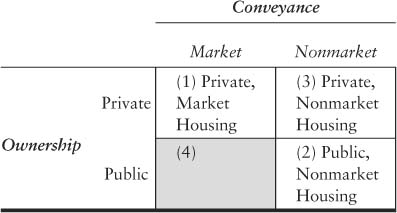
Each tenure sector exhibits a distinctive approach to owning and conveying residential real estate, but there are also multiple variations contained within each sector. To employ a traditional metaphor, each sector contains a variety of ways in which a property's “bundle of rights” may be possessed, utilized, and transferred. Many “sticks” are to be found in this bundle, including the following:
- The right to occupy the property
- The right to exclude others
- The right to convey (i.e., alienate) the property by selling it, subletting it, or bequeathing it to one's heirs
- The right to profit from the property's sale, pocketing all of the equity as one's own
- The right to improve or remove existing buildings
- The right to mine the minerals underneath
- The right to enjoy the air, light, and “view corridors” overhead
All of these rights may be permanently held by a single owner or temporarily held by a single renter. The popular perception of tenure tends to divide residential property into precisely this dichotomy of owning versus renting. The legal reality is much more complex. Any property's bundle of rights may be held in total by more than one owner—or by more than one renter. Alternatively, the bundle of rights may be untied and split apart, with individual sticks separately apportioned among different owners or renters. The rights that are held by the owner-occupant of residential real estate, moreover, along with many of the responsibilities, risks, and rewards that come with homeownership, may be shared with an outside party that continues to exercise a degree of control over what the present owner (and future owners) can and cannot do with the property.
...
- Abandonment
- Blight
- Displacement
- Eviction
- Filtering
- Not in My Back Yard (NIMBY)
- Obsolescence
- Substandard Housing
- Vacancy Rate
- Affordability
- Employer-Assisted Housing
- Extended-Stay Motels
- Fair Market Rent
- Foreclosures
- Housing Costs
- Housing Trust Funds
- Impact Fees
- Linkage
- Shared Group Housing
- Shelter Poverty
- Usury Laws
- Workforce Housing
- Behavioral Aspects
- Castle Doctrine
- Commuting
- Crime Prevention
- Crowding
- Cultural Aspects
- Feng Shui
- Home
- Housing Adjustment Theory
- Immigration and Housing
- Migration
- Mortgage Fraud
- Postoccupancy Evaluation
- Residential Autobiographies
- Residential Location
- Residential Mobility
- Residential Preferences
- Tenant Organizing in the United States, History of
- Cohousing
- Common Interest Development
- Community Development Block Grant
- Community Development Corporations
- Community Land Trust
- Community-Based Housing
- Company Housing
- Condominium
- Cooperative Housing
- Gated Community
- Homeowners’ Association
- Housing Counseling
- Land Bank
- Limited-Equity Cooperatives
- Military-Related Housing
- Mutual Housing
- Native Americans
- Neighborhood Stabilization Program
- Nonprofit Housing
- Participatory Design and Planning
- Planned Unit Development
- Pueblos
- Religion and Housing
- Resident Management
- Rural Housing
- Self-Help Housing
- Slaves, Housing of
- Social Housing
- Squatter Settlements
- Student Housing
- Vernacular Housing
- Zoning
- American Housing Survey
- Centrally Planned Housing Systems
- Colonias
- Global Strategy for Shelter
- Hedonic Pricing Model
- Hogan
- Household
- Housing Abroad: Africa
- Housing Abroad: Asia
- Housing Abroad: Canada
- Housing Abroad: Central and Eastern Europe
- Housing Abroad: Latin America
- Housing Abroad: Middle East
- Housing Abroad: Western and Northern Europe
- Housing Indicators
- Housing Markets
- Igloo
- Kibbutz
- Residential Satisfaction
- World Bank
- Exurbia
- Growth Machines
- Housing Bubble
- Housing Demand
- Housing Starts
- Housing Supply
- Infrastructure
- Levittowns
- McMansion
- Mixed-Use Development
- New Towns
- Open Space and Parks
- Real Estate Developers and Housing
- Smart Growth
- Space Standards
- Speculation
- Subdivision
- Subdivision Controls
- Suburbanization
- Blockbusting
- Discrimination
- Exclusionary Zoning
- Fair Housing Act
- Hispanic Americans
- Housing Courts
- Inclusionary Zoning
- Mount Laurel
- Predatory Lending
- Redlining
- Restrictive Covenants
- Right to Housing
- Segregation
- Eminent Domain
- Farmers Home Administration (Rural Housing Service)
- Federal Government
- Federal Housing Administration
- Government-Sponsored Enterprises
- HOPE VI
- Housing Act of 1949
- Housing Act of 1954
- Housing and Urban Development Act of 1968
- President's Committee on Urban Housing (Kaiser Commission)
- Real Estate Settlement Procedures Act of 1974
- Resolution Trust Corporation
- United States Census Bureau
- United States Department of Housing and Urban Development
- United States Department of Veterans Affairs
- Single-Parent Households
- Women as Housing Producers
- Women as Users of Housing
- Environment and Housing
- Environmental Contamination: Asbestos
- Environmental Contamination: Lead
- Environmental Contamination: Mold
- Environmental Contamination: Radon
- Environmental Contamination: Toxic Waste
- Environmental Hazards: Earthquakes
- Environmental Hazards: Flooding
- Environmental Hazards: Hurricanes
- Health Codes
- Indoor Air Quality
- Restoration of Damaged Housing
- Slums
- Homelessness
- Hoovervilles
- Single-Room Occupancy Housing
- Tent Cities
- Appraisal Industry
- First-Time Home Buyer
- Homeownership
- Liens
- Multiple Listing Service
- Property Rights
- Property Tax
- Refinancing
- Warranties
- Ancient Housing
- Automated Valuation Model
- Building Codes
- Computer-Aided Design
- Construction Technology
- Decision Models for Housing and Community Development
- Disaster-Resistant Housing
- Earth-Sheltered Housing
- Flexible Housing
- Housing Codes
- HUD Minimum Property Standards
- In Situ Construction
- Innovation in Housing
- Lean Construction
- Manufactured Housing
- Model Codes
- Modular Construction
- New Urbanism
- Operation Breakthrough
- Panic Room (Safe Room)
- Prefabrication
- Smart House and Automation Technologies
- Solar Housing
- Building Cycle
- Building Permit
- Consolidated Plans
- Home Improvement
- Housing Finance Agencies
- Landscape Architecture
- Maintenance
- Savings and Loan Industry
- Adjustable-Rate Mortgages
- Equity
- Mortgage Credit Certificates
- Mortgage Finance
- Mortgage Insurance
- Mortgage Revenue Bonds
- Mortgage-Backed Securities
- Negative Amortization
- Proposition 13
- Second Mortgage
- Subprime Mortgage Crisis
- Tax Expenditures
- Tax Incentives
- Accessory Dwelling Units
- Aging in Place
- Assisted Living
- Congregate Housing
- Continuing Care Retirement Communities
- Dementia
- Disabilities, Housing of Persons with
- Elderly
- Home Care
- Hospice Care
- Nursing Homes
- Retirement Communities
- Reverse-Equity Mortgage
- Second Homes
- Universal Design
- Depreciation of Property
- Lease
- Multifamily Housing
- Rent Control
- Rent Strikes
- Residential Hotels
- Residential Property Management
- Gautreaux Program
- Low-Income Housing Tax Credits
- Pruitt-Igoe
- Public Housing
- Public-Private Housing Partnership
- Demand-Side Subsidies
- Moving to Opportunity
- Supply-Side Subsidies
- Energy Conservation
- Green Building
- Housing Careers
- Shared-Equity Homeownership
- Tenure Sectors
- Adaptive Reuse
- Brownfields
- Community Reinvestment Act
- Gentrification
- High-Rise Housing
- Historic Preservation
- Homestead
- Incumbent Upgrading
- Infill Housing
- Mixed-Income Housing
- Model Cities Program
- Tax Increment Financing
- Urban Redevelopment
- Loading...
Get a 30 day FREE TRIAL
-
 Watch videos from a variety of sources bringing classroom topics to life
 -
Read modern, diverse business cases
-
Explore hundreds of books and reference titles

Read next

More like this
Sage Recommends
We found other relevant content for you on other Sage platforms.
Have you created a personal profile? Login or create a profile so that you can save clips, playlists and searches