
Entry
Reader's guide
Entries A-Z
Subject index
Housing Adjustment Theory
The theory of housing adjustment states that households judge their housing in accordance with culturally derived norms. First posited in 1975, Earl W. Morris and Mary Winter's theory of housing adjustment became the crux of the text Housing, Family, and Society published in 1978. Since then, many articles published in the housing journal Housing and Society have employed the Morris and Winter theoretical framework to explain households’ norms and preferences for housing.
According to the theory, decisions about where to live are made at the household level. Household members use societal rules and standards, or norms, to evaluate their current residential circumstances regarding tenure and structure type, space, expenditures, quality, and neighborhood. Norms also are established at the household level and may sometimes differ from societal norms. Generally, normative housing in the United States is by owner-occupancy, preferably a single-family dwelling that includes a prescribed number of bedrooms based on the age and sex of household members. Housing expenditures should be no more than 30% of annual household income, and the neighborhood attributes and amenities should support household needs. Households experience dissatisfaction with housing that is non-normative due to deficits; in turn, their quality of life is compromised. According to Morris and Winter, a specific housing condition or set of conditions becomes a deficit when the condition has been subjectively defined as undesirable in comparison with a norm. Deficits result from constraints that keep a household from attaining the housing desired and together affect housing satisfaction and ultimately predict housing decision-making outcomes, that is, housing adjustments.
Figure 1 Model of Housing Adjustment Theory
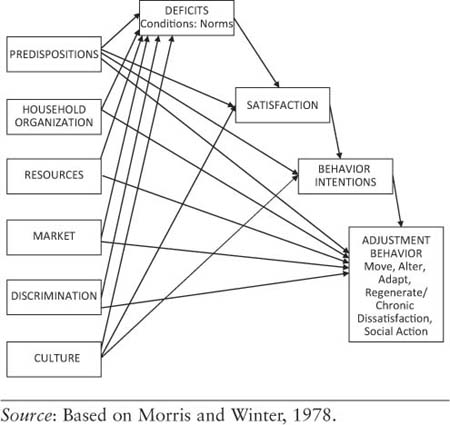
Figure 1 illustrates the important role of constraints impeding the availability of normative housing, such as predispositions, household organization, market, resources, and discrimination.
Constraints
Five broad areas of constraint shape housing adjustments according to the model. Predisposition refers to constraints due to the psychological dimension of the household members similar to the personality of the individual. For example, locus of control, self-efficacy, motivation, or apathy may have a bearing on how households assess their housing deficits and, in turn, affect satisfaction with their housing situation. A household's organization, the allocation of roles, and the effective performance of them can also stymie or propel its ability to garner resources and to make and implement housing decisions. Heretofore, proxy variables have been most widely used to examine predispositional and household organizational constraints; little research has focused specifically on them. Market and resource constraints are often found to affect a household's ability to secure preferred housing. Previous research shows clearly that a lack of money, education, and skills among household members and the availability and supply of housing and financing in the marketplace influence housing decision making. The effect of discrimination has an equally well established effect on housing choices. Many minority populations have experienced discrimination, which thwarts housing availability. Blacks, Latinos, single-parent women, gay and lesbian couples, and those with physical and cognitive disabilities experience constraints that can reduce their ability to attain normative housing or achieve housing satisfaction. Even anticipated discrimination can result in limiting housing decisions.
...
- Abandonment
- Blight
- Displacement
- Eviction
- Filtering
- Not in My Back Yard (NIMBY)
- Obsolescence
- Substandard Housing
- Vacancy Rate
- Affordability
- Employer-Assisted Housing
- Extended-Stay Motels
- Fair Market Rent
- Foreclosures
- Housing Costs
- Housing Trust Funds
- Impact Fees
- Linkage
- Shared Group Housing
- Shelter Poverty
- Usury Laws
- Workforce Housing
- Behavioral Aspects
- Castle Doctrine
- Commuting
- Crime Prevention
- Crowding
- Cultural Aspects
- Feng Shui
- Home
- Housing Adjustment Theory
- Immigration and Housing
- Migration
- Mortgage Fraud
- Postoccupancy Evaluation
- Residential Autobiographies
- Residential Location
- Residential Mobility
- Residential Preferences
- Tenant Organizing in the United States, History of
- Cohousing
- Common Interest Development
- Community Development Block Grant
- Community Development Corporations
- Community Land Trust
- Community-Based Housing
- Company Housing
- Condominium
- Cooperative Housing
- Gated Community
- Homeowners’ Association
- Housing Counseling
- Land Bank
- Limited-Equity Cooperatives
- Military-Related Housing
- Mutual Housing
- Native Americans
- Neighborhood Stabilization Program
- Nonprofit Housing
- Participatory Design and Planning
- Planned Unit Development
- Pueblos
- Religion and Housing
- Resident Management
- Rural Housing
- Self-Help Housing
- Slaves, Housing of
- Social Housing
- Squatter Settlements
- Student Housing
- Vernacular Housing
- Zoning
- American Housing Survey
- Centrally Planned Housing Systems
- Colonias
- Global Strategy for Shelter
- Hedonic Pricing Model
- Hogan
- Household
- Housing Abroad: Africa
- Housing Abroad: Asia
- Housing Abroad: Canada
- Housing Abroad: Central and Eastern Europe
- Housing Abroad: Latin America
- Housing Abroad: Middle East
- Housing Abroad: Western and Northern Europe
- Housing Indicators
- Housing Markets
- Igloo
- Kibbutz
- Residential Satisfaction
- World Bank
- Exurbia
- Growth Machines
- Housing Bubble
- Housing Demand
- Housing Starts
- Housing Supply
- Infrastructure
- Levittowns
- McMansion
- Mixed-Use Development
- New Towns
- Open Space and Parks
- Real Estate Developers and Housing
- Smart Growth
- Space Standards
- Speculation
- Subdivision
- Subdivision Controls
- Suburbanization
- Blockbusting
- Discrimination
- Exclusionary Zoning
- Fair Housing Act
- Hispanic Americans
- Housing Courts
- Inclusionary Zoning
- Mount Laurel
- Predatory Lending
- Redlining
- Restrictive Covenants
- Right to Housing
- Segregation
- Eminent Domain
- Farmers Home Administration (Rural Housing Service)
- Federal Government
- Federal Housing Administration
- Government-Sponsored Enterprises
- HOPE VI
- Housing Act of 1949
- Housing Act of 1954
- Housing and Urban Development Act of 1968
- President's Committee on Urban Housing (Kaiser Commission)
- Real Estate Settlement Procedures Act of 1974
- Resolution Trust Corporation
- United States Census Bureau
- United States Department of Housing and Urban Development
- United States Department of Veterans Affairs
- Single-Parent Households
- Women as Housing Producers
- Women as Users of Housing
- Environment and Housing
- Environmental Contamination: Asbestos
- Environmental Contamination: Lead
- Environmental Contamination: Mold
- Environmental Contamination: Radon
- Environmental Contamination: Toxic Waste
- Environmental Hazards: Earthquakes
- Environmental Hazards: Flooding
- Environmental Hazards: Hurricanes
- Health Codes
- Indoor Air Quality
- Restoration of Damaged Housing
- Slums
- Homelessness
- Hoovervilles
- Single-Room Occupancy Housing
- Tent Cities
- Appraisal Industry
- First-Time Home Buyer
- Homeownership
- Liens
- Multiple Listing Service
- Property Rights
- Property Tax
- Refinancing
- Warranties
- Ancient Housing
- Automated Valuation Model
- Building Codes
- Computer-Aided Design
- Construction Technology
- Decision Models for Housing and Community Development
- Disaster-Resistant Housing
- Earth-Sheltered Housing
- Flexible Housing
- Housing Codes
- HUD Minimum Property Standards
- In Situ Construction
- Innovation in Housing
- Lean Construction
- Manufactured Housing
- Model Codes
- Modular Construction
- New Urbanism
- Operation Breakthrough
- Panic Room (Safe Room)
- Prefabrication
- Smart House and Automation Technologies
- Solar Housing
- Building Cycle
- Building Permit
- Consolidated Plans
- Home Improvement
- Housing Finance Agencies
- Landscape Architecture
- Maintenance
- Savings and Loan Industry
- Adjustable-Rate Mortgages
- Equity
- Mortgage Credit Certificates
- Mortgage Finance
- Mortgage Insurance
- Mortgage Revenue Bonds
- Mortgage-Backed Securities
- Negative Amortization
- Proposition 13
- Second Mortgage
- Subprime Mortgage Crisis
- Tax Expenditures
- Tax Incentives
- Accessory Dwelling Units
- Aging in Place
- Assisted Living
- Congregate Housing
- Continuing Care Retirement Communities
- Dementia
- Disabilities, Housing of Persons with
- Elderly
- Home Care
- Hospice Care
- Nursing Homes
- Retirement Communities
- Reverse-Equity Mortgage
- Second Homes
- Universal Design
- Depreciation of Property
- Lease
- Multifamily Housing
- Rent Control
- Rent Strikes
- Residential Hotels
- Residential Property Management
- Gautreaux Program
- Low-Income Housing Tax Credits
- Pruitt-Igoe
- Public Housing
- Public-Private Housing Partnership
- Demand-Side Subsidies
- Moving to Opportunity
- Supply-Side Subsidies
- Energy Conservation
- Green Building
- Housing Careers
- Shared-Equity Homeownership
- Tenure Sectors
- Adaptive Reuse
- Brownfields
- Community Reinvestment Act
- Gentrification
- High-Rise Housing
- Historic Preservation
- Homestead
- Incumbent Upgrading
- Infill Housing
- Mixed-Income Housing
- Model Cities Program
- Tax Increment Financing
- Urban Redevelopment
- Loading...
Get a 30 day FREE TRIAL
-
 Watch videos from a variety of sources bringing classroom topics to life
 -
Read modern, diverse business cases
-
Explore hundreds of books and reference titles

Read next

More like this
Sage Recommends
We found other relevant content for you on other Sage platforms.
Have you created a personal profile? Login or create a profile so that you can save clips, playlists and searches