
Entry
Reader's guide
Entries A-Z
Subject index
Hogan
The hogan is the traditional house of the Navajo people, an American Indian tribe located in the Southwest region of the United States that includes the states of Arizona, Colorado, New Mexico, and Utah. The traditional name of the Navajo people is Diné, meaning “The People.” Hogan is a Diné word, translating roughly into “home place.” It may have additional meanings of shelter, house, and a place for family activities. In Navajo mythology, the gods and spirits journeyed from other worlds, and the first hogan was built on this Earth for a newly born Navajo goddess, Changing Woman. Because of this supernatural beginning, the Navajo hogan is viewed as sacred. Therefore, a hogan must be constructed in a certain cultural manner. After construction is completed and before occupation, a Navajo House Blessing Ceremony must be conducted to bless the new home to ensure good fortune for the new hogan and the extended three-generation family household that will occupy it.
Traditional hogans are windowless, one-room dwellings. The single room is never subdivided. Female and male forms of the hogan exist. The female hogan is the well-known rounded form while the male is a pointed-cone shape. While Navajos construct the female hogan with different local materials, such as adobe, logs and stone, the male cone-shaped hogan uses a wooden forked log with two supportive logs. This forms the central support as other logs are placed in a circular manner. Completion occurs by placing smaller tree branches between the larger logs and finishing with adobe mud to seal the structure. These hogans can be constructed very easily and fit the precontact Navajo mobile lifestyle. Today, the male hogan is constructed mainly for ceremonial purposes.
The larger female hogans are the norm and are found throughout Navajo land. The traditional female hogans represent Changing Woman and are never rectangular. The hogan is a circular and dome structure. This hogan form is typical and represents the female element. These hogans are ordinarily a circular polygonal shape with the octagon being popular. The diameter may vary from 12 to 16 feet in diameter. A female family member typically owns the hogan and surrounding land.
The hogan walls are constructed of overlapping mud-covered logs or sandstone. The perimeter walls are about 5.5 to 6 feet high. The domed ceiling is constructed by overlapping and diminishing the size of the logs, with a smoke hole placed off center in an eastern direction. On average, the interior height of the dome will reach 10 to 12 feet. The dome roof is a cribbed ceiling made also of overlapping plastered mud-covered logs. The dome form represents the Male Sky while an earthen floor represents the Female Earth.
Evolution of the Navajo Hogan
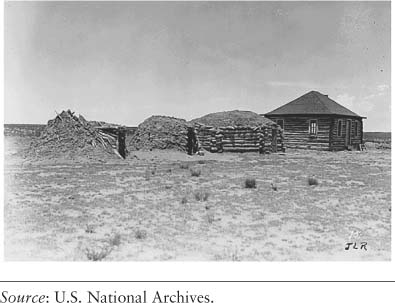
The floors of old style hogans were about 24 inches below ground level. This allowed a natural bench to be created inside the hogan. Today's modern hogans, which are widespread on the Navajo reservation, do not have this bench since they are constructed at ground level. The female hogan has an east-facing door, and on the first day of construction, the hogan's single doorway is centrally oriented toward the rising morning sun. The first rays of light mark the central point of the doorway. The traditional doorway was covered with animal hides or by a woven ruglike covering. Contemporary hogans use wooden doors with hinges attached to a door frame with dimensional lumber for the walls and roof.
...
- Abandonment
- Blight
- Displacement
- Eviction
- Filtering
- Not in My Back Yard (NIMBY)
- Obsolescence
- Substandard Housing
- Vacancy Rate
- Affordability
- Employer-Assisted Housing
- Extended-Stay Motels
- Fair Market Rent
- Foreclosures
- Housing Costs
- Housing Trust Funds
- Impact Fees
- Linkage
- Shared Group Housing
- Shelter Poverty
- Usury Laws
- Workforce Housing
- Behavioral Aspects
- Castle Doctrine
- Commuting
- Crime Prevention
- Crowding
- Cultural Aspects
- Feng Shui
- Home
- Housing Adjustment Theory
- Immigration and Housing
- Migration
- Mortgage Fraud
- Postoccupancy Evaluation
- Residential Autobiographies
- Residential Location
- Residential Mobility
- Residential Preferences
- Tenant Organizing in the United States, History of
- Cohousing
- Common Interest Development
- Community Development Block Grant
- Community Development Corporations
- Community Land Trust
- Community-Based Housing
- Company Housing
- Condominium
- Cooperative Housing
- Gated Community
- Homeowners’ Association
- Housing Counseling
- Land Bank
- Limited-Equity Cooperatives
- Military-Related Housing
- Mutual Housing
- Native Americans
- Neighborhood Stabilization Program
- Nonprofit Housing
- Participatory Design and Planning
- Planned Unit Development
- Pueblos
- Religion and Housing
- Resident Management
- Rural Housing
- Self-Help Housing
- Slaves, Housing of
- Social Housing
- Squatter Settlements
- Student Housing
- Vernacular Housing
- Zoning
- American Housing Survey
- Centrally Planned Housing Systems
- Colonias
- Global Strategy for Shelter
- Hedonic Pricing Model
- Hogan
- Household
- Housing Abroad: Africa
- Housing Abroad: Asia
- Housing Abroad: Canada
- Housing Abroad: Central and Eastern Europe
- Housing Abroad: Latin America
- Housing Abroad: Middle East
- Housing Abroad: Western and Northern Europe
- Housing Indicators
- Housing Markets
- Igloo
- Kibbutz
- Residential Satisfaction
- World Bank
- Exurbia
- Growth Machines
- Housing Bubble
- Housing Demand
- Housing Starts
- Housing Supply
- Infrastructure
- Levittowns
- McMansion
- Mixed-Use Development
- New Towns
- Open Space and Parks
- Real Estate Developers and Housing
- Smart Growth
- Space Standards
- Speculation
- Subdivision
- Subdivision Controls
- Suburbanization
- Blockbusting
- Discrimination
- Exclusionary Zoning
- Fair Housing Act
- Hispanic Americans
- Housing Courts
- Inclusionary Zoning
- Mount Laurel
- Predatory Lending
- Redlining
- Restrictive Covenants
- Right to Housing
- Segregation
- Eminent Domain
- Farmers Home Administration (Rural Housing Service)
- Federal Government
- Federal Housing Administration
- Government-Sponsored Enterprises
- HOPE VI
- Housing Act of 1949
- Housing Act of 1954
- Housing and Urban Development Act of 1968
- President's Committee on Urban Housing (Kaiser Commission)
- Real Estate Settlement Procedures Act of 1974
- Resolution Trust Corporation
- United States Census Bureau
- United States Department of Housing and Urban Development
- United States Department of Veterans Affairs
- Single-Parent Households
- Women as Housing Producers
- Women as Users of Housing
- Environment and Housing
- Environmental Contamination: Asbestos
- Environmental Contamination: Lead
- Environmental Contamination: Mold
- Environmental Contamination: Radon
- Environmental Contamination: Toxic Waste
- Environmental Hazards: Earthquakes
- Environmental Hazards: Flooding
- Environmental Hazards: Hurricanes
- Health Codes
- Indoor Air Quality
- Restoration of Damaged Housing
- Slums
- Homelessness
- Hoovervilles
- Single-Room Occupancy Housing
- Tent Cities
- Appraisal Industry
- First-Time Home Buyer
- Homeownership
- Liens
- Multiple Listing Service
- Property Rights
- Property Tax
- Refinancing
- Warranties
- Ancient Housing
- Automated Valuation Model
- Building Codes
- Computer-Aided Design
- Construction Technology
- Decision Models for Housing and Community Development
- Disaster-Resistant Housing
- Earth-Sheltered Housing
- Flexible Housing
- Housing Codes
- HUD Minimum Property Standards
- In Situ Construction
- Innovation in Housing
- Lean Construction
- Manufactured Housing
- Model Codes
- Modular Construction
- New Urbanism
- Operation Breakthrough
- Panic Room (Safe Room)
- Prefabrication
- Smart House and Automation Technologies
- Solar Housing
- Building Cycle
- Building Permit
- Consolidated Plans
- Home Improvement
- Housing Finance Agencies
- Landscape Architecture
- Maintenance
- Savings and Loan Industry
- Adjustable-Rate Mortgages
- Equity
- Mortgage Credit Certificates
- Mortgage Finance
- Mortgage Insurance
- Mortgage Revenue Bonds
- Mortgage-Backed Securities
- Negative Amortization
- Proposition 13
- Second Mortgage
- Subprime Mortgage Crisis
- Tax Expenditures
- Tax Incentives
- Accessory Dwelling Units
- Aging in Place
- Assisted Living
- Congregate Housing
- Continuing Care Retirement Communities
- Dementia
- Disabilities, Housing of Persons with
- Elderly
- Home Care
- Hospice Care
- Nursing Homes
- Retirement Communities
- Reverse-Equity Mortgage
- Second Homes
- Universal Design
- Depreciation of Property
- Lease
- Multifamily Housing
- Rent Control
- Rent Strikes
- Residential Hotels
- Residential Property Management
- Gautreaux Program
- Low-Income Housing Tax Credits
- Pruitt-Igoe
- Public Housing
- Public-Private Housing Partnership
- Demand-Side Subsidies
- Moving to Opportunity
- Supply-Side Subsidies
- Energy Conservation
- Green Building
- Housing Careers
- Shared-Equity Homeownership
- Tenure Sectors
- Adaptive Reuse
- Brownfields
- Community Reinvestment Act
- Gentrification
- High-Rise Housing
- Historic Preservation
- Homestead
- Incumbent Upgrading
- Infill Housing
- Mixed-Income Housing
- Model Cities Program
- Tax Increment Financing
- Urban Redevelopment
- Loading...
Get a 30 day FREE TRIAL
-
 Watch videos from a variety of sources bringing classroom topics to life
 -
Read modern, diverse business cases
-
Explore hundreds of books and reference titles

Read next

More like this
Sage Recommends
We found other relevant content for you on other Sage platforms.
Have you created a personal profile? Login or create a profile so that you can save clips, playlists and searches