
Entry
Reader's guide
Entries A-Z
Subject index
Elderly
Over the last several decades, older adults have benefited from general public policies that encourage homeownership and attempt to reduce housing costs. These policies, along with income-related programs such as Social Security and Supplemental Security Income (SSI), have assisted the elderly in improving their housing situation. Nevertheless, a substantial number of older persons still pay an excessive portion of their income for housing, live in physically deficient housing, or reside in housing that lacks needed services and features to ensure they can safely age in place.
As of 2010, older persons aged 65 years and older in the United States numbered over 40 million persons or 13% of the total population. By the year 2030, the number of Americans aged 65 and older is expected to grow to over 71.5 million, composing approximately 20% of the population. Of significant importance is the rapid growth of the old-old—those who are over 75 years of age—who are more likely to experience both physical and cognitive limitations. To reduce stays in institutional settings, such as nursing homes, these older persons need physically supportive housing linked with services and health care. The resolution of these problems is constrained, however, by continual reductions in housing programs; the difficulties in bridging housing, services, and health care; and the need for new models of housing embedded in the context of communities.
The Continuum of Housing
The vast majority of persons enter old age living in homes or apartments that were chosen for their appropriateness in midlife when they were healthy and independent. However, as persons age, they may find that these settings no longer fit their needs or preferences. A variety of housing types have arisen over the last several decades that provide a range of lifestyle, environment, and service options. The concept of a continuum in housing recognizes that as people age and become less independent, they may require increased services and more physically supportive environments. Figure 1 illustrates how different housing types, such as single-family homes, conventional apartments, congregate housing (multi-unit living arrangements that generally provide group meals), assisted living (residential settings that provide individualized health and personal care services), and nursing homes, generally meet the needs of older persons who can be categorized as independent, semi-dependent, and dependent. The semi-dependent and dependent categories may include persons with physical and cognitive impairments. Although semi-dependent and even dependent older persons can be found throughout the housing continuum, supported by caregivers and the formal service system, independent older persons are unlikely to reside in housing types such as assisted living. A major exception are the approximately 1,800 continuing care retirement communities (CCRCs), which each house 400 to 600 older persons in settings that include independent living, assisted living, and nursing care. The number of older Americans living in CCRCs was shown to nearly double over a single decade, from 350,000 in 1997 to 745,000 in 2007.
Figure 1 The Continuum of Housing: Level of Support to Various Housing Options
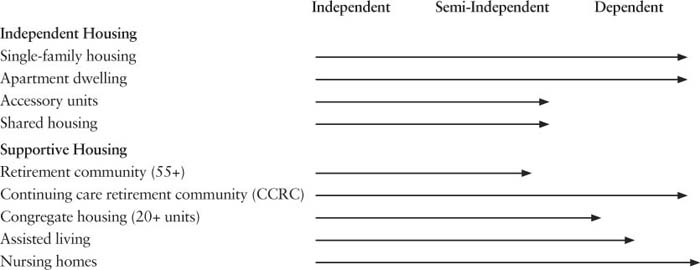
Ideally, the needs and preferences of older persons would be matched to appropriate housing types. The reality is that many housing options are limited by political opposition, lack of affordability, and the bias of long-term care expenditures toward institutional care. Accessory units and shared housing often face local zoning restrictions, while congregate housing, assisted living, CCRCs, and retirement communities are typically too expensive for low-income older persons. Policies that encourage aging in place—the desire of older people to live in their own housing and communities as long as possible—through retrofitting housing with special features have generally been underfunded. Medicaid has provided incentives for housing frail older adults in institutional settings rather than offering funds for community-based services. Over the last several decades, efforts have been made to address these issues through a number of housing approaches that encourage aging in place and the development of supportive housing arrangements that are residential in nature.
...
- Abandonment
- Blight
- Displacement
- Eviction
- Filtering
- Not in My Back Yard (NIMBY)
- Obsolescence
- Substandard Housing
- Vacancy Rate
- Affordability
- Employer-Assisted Housing
- Extended-Stay Motels
- Fair Market Rent
- Foreclosures
- Housing Costs
- Housing Trust Funds
- Impact Fees
- Linkage
- Shared Group Housing
- Shelter Poverty
- Usury Laws
- Workforce Housing
- Behavioral Aspects
- Castle Doctrine
- Commuting
- Crime Prevention
- Crowding
- Cultural Aspects
- Feng Shui
- Home
- Housing Adjustment Theory
- Immigration and Housing
- Migration
- Mortgage Fraud
- Postoccupancy Evaluation
- Residential Autobiographies
- Residential Location
- Residential Mobility
- Residential Preferences
- Tenant Organizing in the United States, History of
- Cohousing
- Common Interest Development
- Community Development Block Grant
- Community Development Corporations
- Community Land Trust
- Community-Based Housing
- Company Housing
- Condominium
- Cooperative Housing
- Gated Community
- Homeowners’ Association
- Housing Counseling
- Land Bank
- Limited-Equity Cooperatives
- Military-Related Housing
- Mutual Housing
- Native Americans
- Neighborhood Stabilization Program
- Nonprofit Housing
- Participatory Design and Planning
- Planned Unit Development
- Pueblos
- Religion and Housing
- Resident Management
- Rural Housing
- Self-Help Housing
- Slaves, Housing of
- Social Housing
- Squatter Settlements
- Student Housing
- Vernacular Housing
- Zoning
- American Housing Survey
- Centrally Planned Housing Systems
- Colonias
- Global Strategy for Shelter
- Hedonic Pricing Model
- Hogan
- Household
- Housing Abroad: Africa
- Housing Abroad: Asia
- Housing Abroad: Canada
- Housing Abroad: Central and Eastern Europe
- Housing Abroad: Latin America
- Housing Abroad: Middle East
- Housing Abroad: Western and Northern Europe
- Housing Indicators
- Housing Markets
- Igloo
- Kibbutz
- Residential Satisfaction
- World Bank
- Exurbia
- Growth Machines
- Housing Bubble
- Housing Demand
- Housing Starts
- Housing Supply
- Infrastructure
- Levittowns
- McMansion
- Mixed-Use Development
- New Towns
- Open Space and Parks
- Real Estate Developers and Housing
- Smart Growth
- Space Standards
- Speculation
- Subdivision
- Subdivision Controls
- Suburbanization
- Blockbusting
- Discrimination
- Exclusionary Zoning
- Fair Housing Act
- Hispanic Americans
- Housing Courts
- Inclusionary Zoning
- Mount Laurel
- Predatory Lending
- Redlining
- Restrictive Covenants
- Right to Housing
- Segregation
- Eminent Domain
- Farmers Home Administration (Rural Housing Service)
- Federal Government
- Federal Housing Administration
- Government-Sponsored Enterprises
- HOPE VI
- Housing Act of 1949
- Housing Act of 1954
- Housing and Urban Development Act of 1968
- President's Committee on Urban Housing (Kaiser Commission)
- Real Estate Settlement Procedures Act of 1974
- Resolution Trust Corporation
- United States Census Bureau
- United States Department of Housing and Urban Development
- United States Department of Veterans Affairs
- Single-Parent Households
- Women as Housing Producers
- Women as Users of Housing
- Environment and Housing
- Environmental Contamination: Asbestos
- Environmental Contamination: Lead
- Environmental Contamination: Mold
- Environmental Contamination: Radon
- Environmental Contamination: Toxic Waste
- Environmental Hazards: Earthquakes
- Environmental Hazards: Flooding
- Environmental Hazards: Hurricanes
- Health Codes
- Indoor Air Quality
- Restoration of Damaged Housing
- Slums
- Homelessness
- Hoovervilles
- Single-Room Occupancy Housing
- Tent Cities
- Appraisal Industry
- First-Time Home Buyer
- Homeownership
- Liens
- Multiple Listing Service
- Property Rights
- Property Tax
- Refinancing
- Warranties
- Ancient Housing
- Automated Valuation Model
- Building Codes
- Computer-Aided Design
- Construction Technology
- Decision Models for Housing and Community Development
- Disaster-Resistant Housing
- Earth-Sheltered Housing
- Flexible Housing
- Housing Codes
- HUD Minimum Property Standards
- In Situ Construction
- Innovation in Housing
- Lean Construction
- Manufactured Housing
- Model Codes
- Modular Construction
- New Urbanism
- Operation Breakthrough
- Panic Room (Safe Room)
- Prefabrication
- Smart House and Automation Technologies
- Solar Housing
- Building Cycle
- Building Permit
- Consolidated Plans
- Home Improvement
- Housing Finance Agencies
- Landscape Architecture
- Maintenance
- Savings and Loan Industry
- Adjustable-Rate Mortgages
- Equity
- Mortgage Credit Certificates
- Mortgage Finance
- Mortgage Insurance
- Mortgage Revenue Bonds
- Mortgage-Backed Securities
- Negative Amortization
- Proposition 13
- Second Mortgage
- Subprime Mortgage Crisis
- Tax Expenditures
- Tax Incentives
- Accessory Dwelling Units
- Aging in Place
- Assisted Living
- Congregate Housing
- Continuing Care Retirement Communities
- Dementia
- Disabilities, Housing of Persons with
- Elderly
- Home Care
- Hospice Care
- Nursing Homes
- Retirement Communities
- Reverse-Equity Mortgage
- Second Homes
- Universal Design
- Depreciation of Property
- Lease
- Multifamily Housing
- Rent Control
- Rent Strikes
- Residential Hotels
- Residential Property Management
- Gautreaux Program
- Low-Income Housing Tax Credits
- Pruitt-Igoe
- Public Housing
- Public-Private Housing Partnership
- Demand-Side Subsidies
- Moving to Opportunity
- Supply-Side Subsidies
- Energy Conservation
- Green Building
- Housing Careers
- Shared-Equity Homeownership
- Tenure Sectors
- Adaptive Reuse
- Brownfields
- Community Reinvestment Act
- Gentrification
- High-Rise Housing
- Historic Preservation
- Homestead
- Incumbent Upgrading
- Infill Housing
- Mixed-Income Housing
- Model Cities Program
- Tax Increment Financing
- Urban Redevelopment
- Loading...
Get a 30 day FREE TRIAL
-
 Watch videos from a variety of sources bringing classroom topics to life
 -
Read modern, diverse business cases
-
Explore hundreds of books and reference titles

Read next

More like this
Sage Recommends
We found other relevant content for you on other Sage platforms.
Have you created a personal profile? Login or create a profile so that you can save clips, playlists and searches