
Entry
Reader's guide
Entries A-Z
Subject index
Adaptive Reuse
Adaptive reuse is the reconfiguration of a geographic area, property, or structure, rendering it better suited to a more current function. The original function is no longer relevant, and a new function is conceived. Adaptive reuse in its largest-scale sense is a land-use term that relates to geographic area. In a middle-scale sense, it is a real estate term that relates to the property that several structures occupy. In its smallest-scale sense, it is an architectural term that relates to the reconfiguration of a specific structure.
The word adaptive refers to the adjustment made to better render the area/property/structure more in keeping with its future use. The word reuse means that the adjustment is part of a formal reconfiguration or reconceptualization of the area/property/structure.
The recurrent theme, regardless of the scale at which intervention takes place, is to retain the frame or appearance of the area/property/structure while reconfiguring its basic purpose or function. The assumption is that the adapted reuse will be better for society and the area/property/structure than the original use. In most cases, this has proven to be true; in several cases, it has not. An unsuccessful outcome relates to reuse efforts that have uncovered wetlands or floodplains; underground fuel oil and gasoline tanks; asbestos in walls, ceilings, or pipe coverings; the need for lead-based paint removal; structural concerns with the building frame; inadequate parking or road facilities; zoning incompatibilities; and so on.
Adaptive Reuse at the Neighborhood Scale
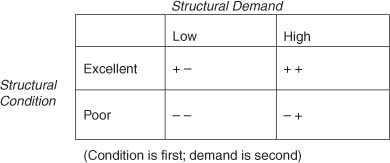
At the neighborhood scale, adaptive reuse involves measures that extend from virtually cosmetic involvement in neighborhoods to wholesale gutting of selected portions of neighborhoods. The extent of involvement depends on the market demand for a neighborhood and the condition of the neighborhood's structures. Figure 1 illustrates the various types of involvements.
In the (− −) area (poor structure condition, low demand), involvement is primarily clearing the land of structures; streets may or may not be retained. In the (+ +) area (excellent structure condition, high demand), there is limited, if any, involvement. In the (− +) area (poor structure condition, high demand), involvement is significant: significant private adaptive reuse of the neighborhood, individual properties, and the structures thereon. In the (+ −) area (good structure condition, low demand), there is significant public adaptive reuse of neighborhood properties and structures. In such cases, aggressive public involvement could contribute to the stabilization of these neighborhoods. Thus, the adaptive reuse of neighborhoods focuses on demand and structural condition. Significant private involvement (− +) (strengthening neighborhoods) and public involvement (+ −) (weakening neighborhoods) take place in neighborhoods undergoing changes in demand in order to channel or stimulate change. In those neighborhoods where a change in demand is not taking place (i.e., demand is already very strong or very weak), involvement is limited to either cosmetic change (in strong neighborhoods [+ +]) or significant clearance of most structures and retention of some select structures (in weak neighborhoods [− −]).
Figure 1 Structural Demand Versus Structural Condition, Adaptive Reuse Neighborhoods
Famous adaptive reuse examples at the neighborhood scale include the Pike Place Market (Seattle, WA), Yerba Buena Center (San Francisco, CA), Inner Harbor (Baltimore, MA), the Nicollet Mall (Minneapolis, MN), Battery Park City (New York, NY), the Distillery District (Toronto, Ontario, Canada), and Yaletown (Vancouver, British Columbia, Canada).
...
- Abandonment
- Blight
- Displacement
- Eviction
- Filtering
- Not in My Back Yard (NIMBY)
- Obsolescence
- Substandard Housing
- Vacancy Rate
- Affordability
- Employer-Assisted Housing
- Extended-Stay Motels
- Fair Market Rent
- Foreclosures
- Housing Costs
- Housing Trust Funds
- Impact Fees
- Linkage
- Shared Group Housing
- Shelter Poverty
- Usury Laws
- Workforce Housing
- Behavioral Aspects
- Castle Doctrine
- Commuting
- Crime Prevention
- Crowding
- Cultural Aspects
- Feng Shui
- Home
- Housing Adjustment Theory
- Immigration and Housing
- Migration
- Mortgage Fraud
- Postoccupancy Evaluation
- Residential Autobiographies
- Residential Location
- Residential Mobility
- Residential Preferences
- Tenant Organizing in the United States, History of
- Cohousing
- Common Interest Development
- Community Development Block Grant
- Community Development Corporations
- Community Land Trust
- Community-Based Housing
- Company Housing
- Condominium
- Cooperative Housing
- Gated Community
- Homeowners’ Association
- Housing Counseling
- Land Bank
- Limited-Equity Cooperatives
- Military-Related Housing
- Mutual Housing
- Native Americans
- Neighborhood Stabilization Program
- Nonprofit Housing
- Participatory Design and Planning
- Planned Unit Development
- Pueblos
- Religion and Housing
- Resident Management
- Rural Housing
- Self-Help Housing
- Slaves, Housing of
- Social Housing
- Squatter Settlements
- Student Housing
- Vernacular Housing
- Zoning
- American Housing Survey
- Centrally Planned Housing Systems
- Colonias
- Global Strategy for Shelter
- Hedonic Pricing Model
- Hogan
- Household
- Housing Abroad: Africa
- Housing Abroad: Asia
- Housing Abroad: Canada
- Housing Abroad: Central and Eastern Europe
- Housing Abroad: Latin America
- Housing Abroad: Middle East
- Housing Abroad: Western and Northern Europe
- Housing Indicators
- Housing Markets
- Igloo
- Kibbutz
- Residential Satisfaction
- World Bank
- Exurbia
- Growth Machines
- Housing Bubble
- Housing Demand
- Housing Starts
- Housing Supply
- Infrastructure
- Levittowns
- McMansion
- Mixed-Use Development
- New Towns
- Open Space and Parks
- Real Estate Developers and Housing
- Smart Growth
- Space Standards
- Speculation
- Subdivision
- Subdivision Controls
- Suburbanization
- Blockbusting
- Discrimination
- Exclusionary Zoning
- Fair Housing Act
- Hispanic Americans
- Housing Courts
- Inclusionary Zoning
- Mount Laurel
- Predatory Lending
- Redlining
- Restrictive Covenants
- Right to Housing
- Segregation
- Eminent Domain
- Farmers Home Administration (Rural Housing Service)
- Federal Government
- Federal Housing Administration
- Government-Sponsored Enterprises
- HOPE VI
- Housing Act of 1949
- Housing Act of 1954
- Housing and Urban Development Act of 1968
- President's Committee on Urban Housing (Kaiser Commission)
- Real Estate Settlement Procedures Act of 1974
- Resolution Trust Corporation
- United States Census Bureau
- United States Department of Housing and Urban Development
- United States Department of Veterans Affairs
- Single-Parent Households
- Women as Housing Producers
- Women as Users of Housing
- Environment and Housing
- Environmental Contamination: Asbestos
- Environmental Contamination: Lead
- Environmental Contamination: Mold
- Environmental Contamination: Radon
- Environmental Contamination: Toxic Waste
- Environmental Hazards: Earthquakes
- Environmental Hazards: Flooding
- Environmental Hazards: Hurricanes
- Health Codes
- Indoor Air Quality
- Restoration of Damaged Housing
- Slums
- Homelessness
- Hoovervilles
- Single-Room Occupancy Housing
- Tent Cities
- Appraisal Industry
- First-Time Home Buyer
- Homeownership
- Liens
- Multiple Listing Service
- Property Rights
- Property Tax
- Refinancing
- Warranties
- Ancient Housing
- Automated Valuation Model
- Building Codes
- Computer-Aided Design
- Construction Technology
- Decision Models for Housing and Community Development
- Disaster-Resistant Housing
- Earth-Sheltered Housing
- Flexible Housing
- Housing Codes
- HUD Minimum Property Standards
- In Situ Construction
- Innovation in Housing
- Lean Construction
- Manufactured Housing
- Model Codes
- Modular Construction
- New Urbanism
- Operation Breakthrough
- Panic Room (Safe Room)
- Prefabrication
- Smart House and Automation Technologies
- Solar Housing
- Building Cycle
- Building Permit
- Consolidated Plans
- Home Improvement
- Housing Finance Agencies
- Landscape Architecture
- Maintenance
- Savings and Loan Industry
- Adjustable-Rate Mortgages
- Equity
- Mortgage Credit Certificates
- Mortgage Finance
- Mortgage Insurance
- Mortgage Revenue Bonds
- Mortgage-Backed Securities
- Negative Amortization
- Proposition 13
- Second Mortgage
- Subprime Mortgage Crisis
- Tax Expenditures
- Tax Incentives
- Accessory Dwelling Units
- Aging in Place
- Assisted Living
- Congregate Housing
- Continuing Care Retirement Communities
- Dementia
- Disabilities, Housing of Persons with
- Elderly
- Home Care
- Hospice Care
- Nursing Homes
- Retirement Communities
- Reverse-Equity Mortgage
- Second Homes
- Universal Design
- Depreciation of Property
- Lease
- Multifamily Housing
- Rent Control
- Rent Strikes
- Residential Hotels
- Residential Property Management
- Gautreaux Program
- Low-Income Housing Tax Credits
- Pruitt-Igoe
- Public Housing
- Public-Private Housing Partnership
- Demand-Side Subsidies
- Moving to Opportunity
- Supply-Side Subsidies
- Energy Conservation
- Green Building
- Housing Careers
- Shared-Equity Homeownership
- Tenure Sectors
- Adaptive Reuse
- Brownfields
- Community Reinvestment Act
- Gentrification
- High-Rise Housing
- Historic Preservation
- Homestead
- Incumbent Upgrading
- Infill Housing
- Mixed-Income Housing
- Model Cities Program
- Tax Increment Financing
- Urban Redevelopment
- Loading...
Get a 30 day FREE TRIAL
-
 Watch videos from a variety of sources bringing classroom topics to life
 -
Read modern, diverse business cases
-
Explore hundreds of books and reference titles

Read next

More like this
Sage Recommends
We found other relevant content for you on other Sage platforms.
Have you created a personal profile? Login or create a profile so that you can save clips, playlists and searches